Build a referral network: a practical guide for professionals

A reliable referral network does not grow by accident. To build one that consistently delivers clients, follow five steps: define your goals and ideal client profile (ICP), identify and prioritise strategic partners, make a well-timed ask, build simple systems to track every handoff, and measure what matters. Do those five things with discipline and you have a repeatable capability, not a lucky streak.
Your 30-minute action checklist for today:
-
Write down three characteristics of your single best client (problem, budget, timeline).
-
List five professionals who already serve that client type without competing with you.
-
Draft one two-line intro message you could send to the most accessible person on that list.
What to expect by timeline:
-
30 days: First partner conversations and one referral form live.
-
90 days: Two to three active partners sending qualified introductions.
-
180 days: Steady referral flow with measurable conversion data.
The one metric to track first: referral volume by partner, recorded in your CRM from day one.
Pro Tip: Check your referral readiness before outreach. Knowing your gaps upfront saves weeks of trial and error.
Key takeaways
A referral network built on a small number of strategic partners, a clear ICP, and a maintained system consistently outperforms broad, casual networking.
| Point | Details |
|---|---|
| Start with ICP clarity | Define who you want referred before contacting any partner — specificity raises conversion. |
| Focus on top partners | One strong partner can yield 5–15 quality referrals per year; invest there first. |
| Time the ask correctly | The 7–21 day window after a visible result is the most effective moment to request a referral. |
| Build the minimum system | A referral form, CRM fields, and one automated status email prevent most lost referrals. |
| Meddle for coordination | Meddle’s AI matching and automated partner updates reduce handoff friction and improve referral conversion for allied health practices. |
Table of Contents
-
What is a referral network and why does strategy come first?
-
What systems do you need to stop referrals falling through the cracks?
-
How do you reward referrers while staying within legal and ethical limits?
-
Is your digital presence ready to convert referred prospects?
-
Which KPIs tell you whether your referral programme is working?
-
Ready-to-use templates and tools to reduce execution friction
-
What does a realistic referral programme timeline and budget look like?
-
How a coordination platform can scale and stabilise your referral flow
-
Why most referral programmes fail and what to do differently
-
Meddle makes referral coordination practical for allied health practices
What is a referral network and why does strategy come first?
A referral network is a structured set of relationships with people who consistently direct clients or patients to you because they trust your work and understand exactly who you help. That is distinct from a casual word-of-mouth mention. Strategic partner referrals come from professionals who serve the same audience you do, without competing for the same work. Client referrals come from satisfied customers who advocate for you. Both matter, but strategic partner referrals are more predictable and scalable.

The strategic foundation comes before any outreach. Without it, you end up with a broad, casual network that produces inconsistent results. Research from Shine Executive confirms that depth beats breadth: a small number of trusted partners who genuinely understand your service values produce more reliable, higher-converting referrals than a wide network of loose connections.
Set measurable goals before you contact anyone:
-
Volume: How many referrals per month do you need to hit your revenue target?
-
Value: What is the average client value, and what conversion rate do you need from referrals?
-
Timeframe: When do you need the first referral to arrive to justify the investment?
ICP template fields to define the clients you want referred to you:
-
Industry or discipline (e.g. aged care, paediatrics, small business).
-
Primary problem or presenting condition.
-
Budget range or funding source (NDIS, private health, self-funded).
-
Decision-making timeframe (urgent, planned, exploratory).
-
Geography or telehealth eligibility.
Pro Tip: The more specific your ICP, the easier it is for a partner to refer correctly. “I work with NDIS participants aged 5–18 with sensory processing challenges” is far more referable than “I see kids with developmental issues.”
How do you find and prioritise the right referral partners?
Partner selection is where most professionals waste effort. They network broadly and hope something sticks. A better approach is to map the professionals already serving your ICP and score them before making contact.
Common partner types that serve the same client without competing:
-
Complementary practitioners (e.g. a physiotherapist partnering with a GP, dietitian, or exercise physiologist).
-
Implementation or coordination professionals (support coordinators, case managers, discharge planners).
-
Community and advocacy groups (disability organisations, aged care peak bodies, parent networks).
-
Financial and legal advisers who serve the same demographic (financial planners referring to allied health for NDIS clients).
Research from MarketHub Solutions shows that one strong strategic partner can yield a moderate number of high-quality referrals per year. That figure makes the case for investing deeply in a small number of relationships rather than spreading effort across dozens of loose contacts.
Partner prioritisation scoring criteria:
| Criterion | What to assess |
|---|---|
| ICP alignment | Do they serve exactly the clients you want? |
| Referral volume potential | How many clients do they see per month? |
| Credibility and trust | Are they respected in your professional community? |
| Accessibility | Can you reach them without a cold call? |
| Reciprocity potential | Can you refer back to them or add value in another way? |
Score each candidate out of five on each criterion. Focus your first 90 days on the top three to five names.
Pro Tip: Start with partners you already know socially or professionally. A warm relationship converts to a referral partnership far faster than a cold introduction.
How do you ask for referrals without cold calling?
Timing is the most underestimated variable in referral outreach. Inside Adviser research identifies the 7–21 day window after a visible result as the most effective moment to ask. The client or partner has just seen your work at its best. Their enthusiasm is high and the ask feels natural.
Trigger moments worth scripting into your workflow:
-
Post-discharge or post-milestone review (client has achieved a measurable outcome).
-
After a positive testimonial or five-star review.
-
Following a joint case discussion or co-presentation.
-
At a scheduled quarterly catch-up with an existing partner.
Sample email to a potential strategic partner:
Subject: Quick question about our shared clients
Hi [Name], I’ve been thinking about the clients we both work with in [area/population]. I’d love to connect for 20 minutes to explore whether there’s a natural fit for us to refer to each other when the timing is right. Would [day/time] work for a short call?
Two-line intro script for a warm phone or Zoom conversation:
Warm approaches that avoid cold outreach entirely:
-
Co-present at a CPD event or community information session.
-
Offer a mutual client introduction (with consent) to demonstrate your work.
-
Attend the same professional association events and follow up after.
-
Share a relevant case note or resource with a potential partner before making any ask.
Pro Tip: Offer to write the referral intro for the partner. A message like “I can draft the intro for you — just let me know if you’d like to adjust it” removes the cognitive load that stops most referrers from following through. Keep the ask to 30 seconds: who you help, what outcome you deliver, and one specific type of client to send your way.
What systems do you need to stop referrals falling through the cracks?
Good intentions without a system produce lost referrals. The minimum viable referral workflow has four components: a submission method, a CRM record, a handoff protocol, and a close-the-loop process.
Essential referral form fields:
-
Referrer name, practice, and contact details.
-
Patient or client name and consent confirmation.
-
Presenting problem or reason for referral.
-
Urgency level (routine, priority, urgent).
-
Preferred contact method and availability.
-
Any relevant clinical or background notes.
CRM field list for referral attribution:
| Field | Purpose |
|---|---|
| Referrer ID | Links every record to a specific partner |
| Referral date | Tracks time-to-contact and time-to-close |
| Qualification status | Confirms the referral meets your ICP criteria |
| Conversion trigger | Records when the client books or pays |
| Commission status | Tracks payment due, paid, or clawed back |
| Outcome note | Closes the loop with the referrer |
Workflow summary:
Partner intro → Referral form submitted → CRM record created → Qualification check → Appointment booked → Conversion confirmed → Partner notified → Commission processed.
The Referral Pathway Advisor on Meddle helps map this workflow for allied health settings, including handoff logic and partner portal options.
Pro Tip: Use a low-code automation tool (Zapier, Make, or your CRM’s native workflow builder) to trigger a status email to the referrer when a client books and again when they attend their first appointment. Two automated emails replace dozens of manual follow-up calls and keep partners informed without extra admin.
How do you reward referrers while staying within legal and ethical limits?
Incentive design is where many programmes stall. The right structure depends on your industry, your professional body’s rules, and the nature of the relationship.
Incentive options and their trade-offs:
| Incentive type | Pros | Cons | Typical timing |
|---|---|---|---|
| Percentage commission | Aligns incentive with deal value | Requires clear contracts; may be restricted in some professions | Paid after client payment received |
| Fixed referral fee | Simple to administer | May not scale with high-value clients | Paid after client payment received |
| Reciprocal referrals | No cash outlay; builds mutual trust | Depends on volume parity | Ongoing |
| Co-marketing support | High perceived value; builds brand | Requires time investment | Ongoing |
| Priority access or discounts | Valued by partners who use your service | Limited to partners who are also clients | Per referral or tier |
Digital Pipeline’s guide to B2B referral partnerships confirms that financial fees in Australia are generally structured as a percentage of the sale and paid only after you receive payment, which protects your cash flow and removes the risk of paying out on a client who later cancels.
Key legal and ethical guardrails:
-
Check your professional body’s rules on fee-splitting and referral payments before offering cash incentives (AHPRA-registered practitioners face specific restrictions).
-
Any financial arrangement must be disclosed to the referred client where required by law or professional standards.
-
Referral agreements must comply with the Privacy Act 1988 regarding how client information is shared.
-
Spam Act 2003 applies to any automated partner communications — include opt-out options.
-
A written referral agreement, as Sprintlaw Australia outlines, should cover qualification criteria, commission calculation, payment timing, brand use, confidentiality, and termination terms.
Pro Tip: Build clawback clauses into every financial referral agreement. If a client cancels within 30 days or the referral does not meet qualification criteria, the commission is not payable or is recoverable. Define the trigger precisely in the contract so there is no ambiguity when a dispute arises.
Clinics using structured referral marketing and recognition programmes report improved referral frequency and measurable patient-flow gains — recognition does not have to be financial to be effective.

How do you keep referral partners active over time?
A referral relationship that is not maintained goes cold within three to six months. The solution is a contact cadence matched to partner tier, not a single annual lunch.
Recommended contact cadence by partner tier:
-
Top partners (monthly): Personal check-in call or coffee, case update, shared content or resource, quarterly in-person catch-up.
-
Mid-tier partners (quarterly): Email update with relevant case notes or outcomes, invitation to a CPD or co-hosted event, brief phone check-in.
-
Low-priority or new partners (bi-annually): Newsletter or practice update, event invitation, occasional social media engagement.
Communication content ideas that add genuine value:
-
De-identified case summaries showing outcomes for referred clients.
-
A short partner newsletter covering service updates, new team members, or expanded capacity.
-
Co-hosted workshops or CPD sessions that count toward professional development hours.
-
Clinic visit invitations so partners can see your environment and meet your team.
Appreciation mechanics that compound over time:
-
Send a brief outcome update every time a referred client reaches a milestone. Partners rarely hear what happened after the referral.
-
Recognise top referrers with a personal thank-you note or small gift at the end of each quarter.
-
Invite high-value partners to contribute to your content (a guest article, a joint webinar) so they have a stake in your visibility.
-
Maintain a simple referral ledger so you can show partners their referral history and outcomes at any catch-up.
BMC Health Services Research identifies fragmented communication and unclear interprofessional roles as primary barriers to referrals in clinical settings. Deliberate, structured communication is not optional — it is the mechanism that keeps referrals moving.
Is your digital presence ready to convert referred prospects?
A referred prospect’s first action after receiving your name is almost always to search you online. A thin website or missing evidence of expertise stalls the referral before you ever speak to the person. Inside Adviser makes this point directly: digital readiness is part of the referral product.
Landing page checklist for referred prospects:
-
Clear service statement: who you help, what problem you solve, and what outcome they can expect.
-
Evidence of expertise: qualifications, registrations, case outcomes (de-identified), and any media or publications.
-
A direct next step: one prominent booking button or contact form, not a menu of options.
-
Social proof: Google ratings, professional association logos, or partner endorsements.
-
Mobile-optimised load time under three seconds.
Microcopy examples for referral landing pages:
-
“Referred by [Partner Name]? Book your first appointment here.”
-
“We work closely with [Partner Practice] to support clients with [condition/need].”
-
“Your information is handled in line with the Privacy Act 1988 and never shared without your consent.”
What to include in a referrer pack:
-
A one-page practice brief (who you are, who you help, what to expect).
-
A “when to refer” cheat sheet with three to five specific trigger scenarios.
-
FAQs covering wait times, fees, funding options, and what happens after the referral.
-
Your preferred referral method (email intro, web form, or platform submission).
Pro Tip: Make it easy for a referred prospect to book within one or two clicks of the referrer’s introduction. Every extra step between the intro and the booking reduces conversion. Use Meddle’s discipline matcher to help referred patients find the right practitioner quickly.
Which KPIs tell you whether your referral programme is working?
Measurement turns a referral programme from a relationship activity into a business asset. Without data, you cannot tell which partners are worth investing in and which are producing noise.
Core KPIs to track from day one:
| KPI | What it tells you | How to capture it |
|---|---|---|
| Referral volume by partner | Which partners are active | CRM referrer ID field |
| Conversion rate | Quality of referrals received | Bookings ÷ referrals received |
| Average deal value | Revenue per referred client | CRM or billing system |
| Time to close | Efficiency of your intake process | Date referred vs. date converted |
| Repeat referrals | Partner loyalty and satisfaction | Count of referrals per partner per quarter |
| Referral cost per acquisition | ROI of incentives and time spent | Total programme cost ÷ converted referrals |
Measurement cadence:
-
Weekly: Log new referrals, update conversion status, flag any stalled introductions.
-
Monthly: Review volume and conversion by partner, send partner outcome updates.
-
Quarterly: Full programme review — tier partners, adjust incentives, retire inactive relationships.
Reporting to partners: A simple one-page partner report showing referrals sent, outcomes achieved, and any commission due builds trust and keeps partners engaged. Most practitioners never receive this feedback. Providing it is a competitive advantage.
Structured referral marketing with automated communications consistently improves partner engagement and referral continuity. The data makes the case for the next conversation.
Ready-to-use templates and tools to reduce execution friction
The fastest way to launch is to copy a working template rather than build from scratch. The assets below cover the four most common execution gaps.
Templates to include in every partner pack:
-
Referral form template: Referrer name, practice, client name, consent confirmation, presenting problem, urgency, preferred contact method, notes field.
-
Sample intro email: Subject line, one-sentence context, one-sentence description of the referred person’s need, your contact details and booking link.
-
“When to refer” checklist: Three to five specific scenarios with a brief rationale for each (e.g. “Refer to occupational therapy when a client reports difficulty with daily living tasks following injury or diagnosis”).
-
Partner report template: Referrals sent (month/quarter), outcomes achieved, commission due, next steps.
Tool recommendations by function:
| Function | Tool options |
|---|---|
| CRM and referral tracking | HubSpot (free tier), Cliniko, Nookal, or a structured Google Sheet |
| Form submission | Typeform, JotForm, or a native CRM form |
| Automation | Zapier or Make (for status emails and partner notifications) |
| Partner portal | A shared Notion page, a simple client portal, or a platform like Meddle |
| Template library | Meddle’s referral template library for allied health-specific forms |
Pro Tip: Customise templates minimally. Change the practice name, ICP description, and booking link. Resist the urge to redesign everything before launch. A functional template sent this week outperforms a perfect one sent next month.
What does a realistic referral programme timeline and budget look like?
Setting realistic expectations prevents the most common failure mode: abandoning the programme at week six because results have not arrived yet.
Typical milestones:
| Phase | Timeframe | Key activities |
|---|---|---|
| Setup | 30 days | Define ICP, score partners, create referral form, set up CRM fields |
| First engagement | 30–90 days | Contact top five partners, run one joint event or intro meeting, onboard two to three partners with agreements |
| Steady flow | 90–180 days | First referrals converting, automate status updates, review KPIs, tier partners |
Budget tiers (approximate, in AUD):
Spend priority order:
-
Your time in partner meetings (highest ROI, no cash outlay).
-
A CRM or tracking system (prevents lost referrals).
-
One joint event or CPD session (builds trust faster than email).
-
Automation tools (defer until you have at least three active partners).
-
Financial incentives (introduce only after volume justifies the cost).
How a coordination platform can scale and stabilise your referral flow
Consider a group allied health practice managing referrals from five GP clinics, two support coordinators, and a hospital discharge team. Without a central system, partner information lives in email threads, referral status updates are manual, and no-shows go untracked. The result is exactly what BMC Health Services Research identifies as the primary barrier to referral success: fragmented communication and unclear roles.
A coordination platform addresses this directly. When a GP submits a referral through a structured portal, the system creates a CRM record, notifies the relevant practitioner, and sends an automated status update to the referrer when the client books. The GP does not need to follow up. The practice does not need to manually log the referral. The client receives a booking confirmation within minutes.
What a referral coordination platform should do for your practice:
-
Centralise partner contact details and referral history in one place.
-
Share your current capacity, and keep it up to date, so referrers know when you can take a new client.
-
Automate status updates to referrers at key milestones (received, booked, attended).
-
Maintain privacy controls that comply with the Privacy Act 1988 and relevant health information legislation.
-
Generate partner reports showing referral volume, conversion, and outcomes.
A platform that matches patients to the right practitioner using algorithmic logic, rather than a static directory, reduces the time between referral and first appointment. Meddle’s AI-powered matching connects referred patients with the practitioner best suited to their needs, by discipline, location and the capacity each clinician has shared, not just the next available slot. The clinic confirms the booking.
Pro Tip: When evaluating a coordination platform, assess five criteria: integration with your existing practice management software, privacy and data sovereignty controls, onboarding effort (how long to get your first partner live), reporting depth, and pricing transparency. A 90-day pilot with two to three partners gives you enough data to make a confident decision. Use Meddle’s referral pathway advisor to map your current workflow before selecting a platform.
For GPs and primary care referrers, Meddle’s GP referral tools provide structured templates and pathway guidance that reduce the friction of sending a referral to an allied health provider.
Why most referral programmes fail and what to do differently
The most common failure is not a bad strategy. It is a good strategy that nobody maintains.
Teams wait for organic referrals to arrive before building a system. They make one round of partner outreach, receive a few introductions, and then return to clinical work. Six months later, the referral flow has dried up and the programme is quietly abandoned. The mistake is treating referrals as a marketing channel that either works or does not, rather than as a repeatable operational process that requires the same discipline as patient intake or billing.
Four specific failure patterns appear repeatedly. First, teams do not close the loop. A partner sends a referral, hears nothing, and stops sending. A single outcome update email would have kept that relationship active. Second, all partners are treated identically. A GP who sends ten referrals a year receives the same attention as a colleague who has sent one. Tiering partners by volume and investing accordingly is not complicated, but most practices never do it. Third, the ask is never made explicitly. Practitioners assume that good work speaks for itself. It does not. The Inside Adviser research is clear: structured, timed asks with low cognitive load for the referrer substantially increase referral success. Fourth, systems are deferred until volume justifies them. By then, referrals have already been lost.
The corrective is a mindset shift. Referrals are a capability you build and maintain, not a channel you activate. Assign one person to own the programme, set a monthly review date, and treat partner relationships with the same care you give your best clients.
Meddle makes referral coordination practical for allied health practices
Coordinating referrals across multiple partners, managing patient intake, and keeping every stakeholder informed is genuinely time-consuming without the right infrastructure. Meddle gives allied health clinics a purpose-built platform that handles the coordination layer so practitioners can focus on care.
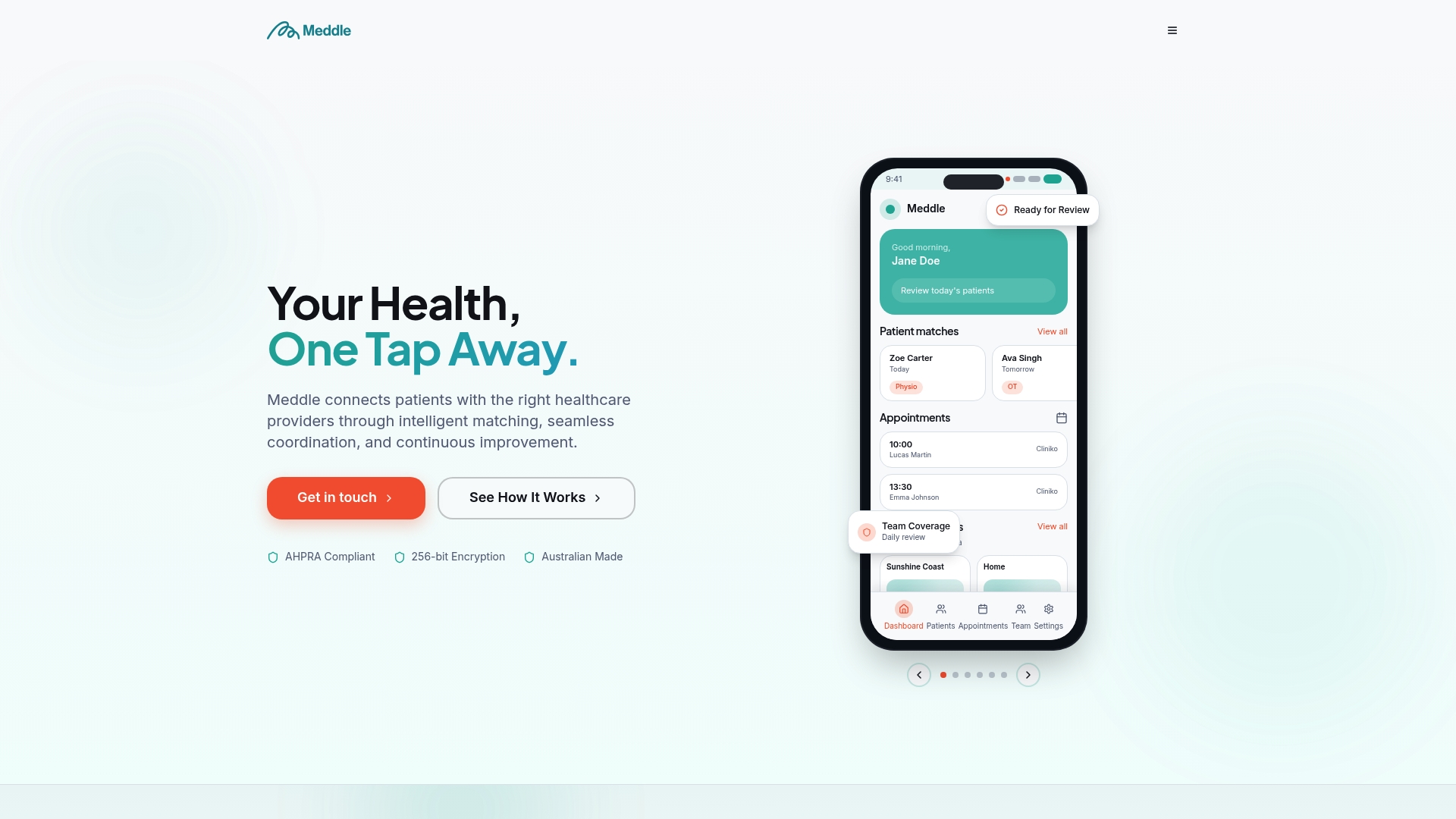
The concrete difference Meddle delivers is speed and accuracy at the handoff point. AI-powered matching connects referred patients to the practitioner best suited to their needs, not just whoever has a gap in the schedule. Because matching uses the capacity each clinician has shared, referrals go to someone who can take them, and the clinic confirms the booking. Automated notifications help close the loop with partners without manual follow-up. Privacy controls are designed around Australian privacy law, and patient data is hosted in Sydney.
For practices evaluating a platform, Meddle’s practitioner benefits page outlines the ROI case in detail. Pricing starts from $40 per practitioner per month (ex GST, $250 monthly minimum), with SMS and email notifications included and a free 30-day pilot. The next step is to explore how Meddle works and assess whether a 90-day pilot fits your current referral volume and partner mix.
Sources
The following resources provide deeper detail on the topics covered in this guide:
-
Guide to Building B2B Referral Partnerships for Professional Services Businesses (Digital Pipeline)
-
Ten referral strategies that actually make the difference (Inside Adviser)
-
How to build a profitable referral partner program (Sprintlaw Australia)
-
Building referral networks through effective allied health marketing (Hype Insight)
FAQ
What is a referral network?
A referral network is a structured group of professionals or clients who consistently direct new clients or patients to your practice because they trust your work and understand who you help. It differs from casual word-of-mouth in that it is intentional, maintained, and measurable.
How do you build a referral system from scratch?
Define your ideal client profile, identify five to ten complementary professionals who serve the same audience, make a structured ask within 7–21 days of a visible result, set up a referral form and CRM tracking fields, and close the loop with every referrer after each outcome.
What are the three types of referrals?
The three common types are client referrals (satisfied clients recommending you), strategic partner referrals (complementary professionals directing their clients to you), and institutional referrals (hospitals, discharge planners, or coordinators routing patients through a formal pathway).
Who pays the most for referrals?
Payment structures vary by industry and professional body rules. In Australian professional services, financial referral fees are typically a percentage of the sale value, paid after the client pays, as outlined by Digital Pipeline’s B2B referral guide. AHPRA-registered practitioners must check professional standards before offering cash incentives, as fee-splitting restrictions apply in some disciplines.
How does Meddle support referral coordination?
Meddle automates the handoff between referrers and allied health practitioners: AI-powered matching by discipline, location and the capacity each clinician has shared, referral routing, and automated notifications, with the clinic confirming the booking. This reduces the manual follow-up that causes most referral relationships to go cold, and gives partners visibility into outcomes without requiring extra admin from the practice.