Improve patient satisfaction: practical steps for providers

The most effective actions to improve patient satisfaction are validated measurement using Patient-Reported Experience Measures (PREMs), structured communication training, tighter care coordination, and a disciplined feedback-to-action cycle. Organisations that embed all four consistently outperform those that treat any one of them as a standalone project.
Five quick wins to act on now:
-
Implement validated PREMs — use the Australian Hospital Patient Experience Questionnaire Set or the Your Experience of Service (YES) questionnaire to collect structured, comparable data at discharge or 30 days post-care.
-
Train staff in structured communication — AIDET (Acknowledge, Introduce, Duration, Explanation, Thank you) and teach-back techniques reduce patient confusion and measurably lift satisfaction scores.
-
Reduce booking and wait-time friction — online scheduling, automated reminders and clear availability information cut no-shows and improve first impressions before a patient walks through the door.
-
Deploy bedside communication tools and open notes — whiteboards, bedside information screens and shared clinical notes give patients visibility and reduce anxiety-driven call volume.
-
Close the feedback loop — share PREM results with frontline teams within two weeks of collection, set one specific micro-improvement per cycle, and tell patients what changed.
These approaches align with the NSQHS Standards, the national PREM guidance from the Australian Commission on Safety and Quality in Health Care, and the Bureau of Health Information’s benchmarking framework. The evidence is consistent: measurement without action is noise; action without measurement is guesswork.
Key takeaways
Improving patient satisfaction requires validated measurement, targeted communication and coordination interventions, and a consistent feedback-to-action cadence — not any single tool or initiative in isolation.
| Point | Details |
|---|---|
| Measure with validated PREMs | Use the Australian Hospital Patient Experience Questionnaire Set or YES questionnaire; aim for ≥30% response rate per service. |
| Target communication and coordination first | AIDET training, bedside whiteboards and structured discharge planning address the domains that drive most low scores. |
| Close the feedback loop within two weeks | Share PREM results with frontline teams promptly and set one specific micro-improvement per cycle. |
| Stratify your data by population | Disaggregate scores by age, language and diagnosis to avoid equity blind spots in aggregate results. |
| Use Meddle to reduce access friction | Meddle’s matching, booking and referral tools cut wait times and administrative burden, supporting higher satisfaction when paired with the interventions above. |
Table of Contents
-
Why improving patient satisfaction matters for outcomes and performance
-
Key drivers of patient satisfaction: applying the 5 P’s and 6 C’s
-
Evidence-based interventions that reliably improve patient experience
-
Step-by-step implementation plan for a patient experience programme
-
Turning feedback into KPIs, dashboards and reporting cadence
-
Legal and ethical considerations in patient feedback collection
-
A perspective on what actually moves the needle in patient experience work
-
Meddle supports your patient satisfaction programme from day one
Why improving patient satisfaction matters for outcomes and performance
Better patient experience is not a courtesy metric. Systematic review evidence links satisfaction directly to quality indicators including communication effectiveness, access, environment and care coordination — all factors that also predict clinical outcomes. Patients who feel heard and informed are more likely to follow treatment plans, attend follow-up appointments, and report symptoms early.
The clinical case is equally clear. A clinical review on inpatient experience found that positive inpatient experience can reduce fear, support recovery and improve long-term engagement with care. Shorter stays, fewer readmissions and lower rates of adverse events correlate with higher experience scores across multiple health systems.
The operational case is just as compelling:
-
Reputation and retention — patients who rate their experience highly are significantly more likely to return and refer others, reducing the cost of patient acquisition.
-
Funding and commissioning — in value-based care models, experience data increasingly influences contract performance and funding allocations.
-
Staff morale — teams that see their work reflected in positive patient feedback report higher job satisfaction and lower turnover intentions.
-
Regulatory alignment — the NSQHS Standards, particularly the Comprehensive Care Standard, require organisations to demonstrate systematic patient engagement and experience measurement as part of accreditation.
Treating patient satisfaction as a strategic priority rather than a compliance task is what separates high-performing services from those that plateau.
How to measure patient satisfaction reliably
Use validated PREMs as the primary instrument for experience measurement, supplemented by Patient-Reported Outcome Measures (PROMs) where clinical outcomes matter, and qualitative methods — stories, focus groups, open-text responses — where you need to understand the why behind a score.
Choosing the right instrument
The Australian Hospital Patient Experience Questionnaire Set is the national standard for acute inpatient settings. It covers communication, respect, involvement in care decisions, and discharge planning — the domains that drive most variance in satisfaction. The YES questionnaire suits community mental health and outpatient settings, capturing relational and recovery-oriented dimensions that generic hospital surveys miss. Short bespoke PREMs work well for specific touchpoints (e.g., post-procedure or telehealth encounters) when you need rapid, targeted data. Net Promoter Score (NPS) is useful as a single-item tracking metric but should never replace a validated instrument as your primary measure.
| Measure type | Best timing | Collection modality | What it reveals |
|---|---|---|---|
| Australian Hospital Patient Experience Questionnaire Set | At discharge or within 48 hours | Paper, SMS, or bedside tablet | Communication, respect, involvement, discharge quality |
| YES questionnaire | 2–4 weeks post-episode | SMS or email | Relational quality, recovery support, carer inclusion |
| Short bespoke PREM (3–5 items) | Point of care or immediately post-appointment | Bedside kiosk or SMS | Specific touchpoint experience (e.g., wait time, booking) |
| PROMs (e.g., PROMIS, EQ-5D) | Baseline and 30/90 days post-care | Email or patient portal | Functional outcomes, symptom burden, quality of life |
| Open-text / qualitative follow-up | Triggered by low PREM score | Phone or email | Root cause, specific incidents, improvement ideas |
Pro Tip: *Mixing a validated PREM with a single open-text question (“What is the one thing we could have done better?”) consistently surfaces the root causes that closed-ended scores miss.
Offer SMS and email as default modalities — response rates for digital collection typically exceed paper in outpatient settings. Always obtain informed consent before collecting experience data, and make clear how responses will be used and de-identified. Privacy obligations under the Privacy Act 1988 and applicable state health records legislation apply to all PREM collection, including third-party survey platforms.
Key drivers of patient satisfaction: applying the 5 P’s and 6 C’s
Five to seven factors explain most of the variance in patient satisfaction scores across settings: communication, the people delivering care, the processes patients move through, the physical environment, and the sense of shared purpose between patient and provider. Two complementary frameworks help map these to specific interventions.
The 5 P’s (Patient, People, Processes, Place, Purpose/Pathways) from service design practice give teams a structural lens:
-
Patient — who is being served, what their needs and preferences are, and how well the service is tailored to them.
-
People — the clinical and administrative staff whose behaviours, attitudes and skills shape every interaction.
-
Processes — booking, triage, handover, discharge and follow-up workflows that either reduce or add friction.
-
Place — the physical and digital environment: cleanliness, wayfinding, noise, privacy, and the quality of digital touchpoints.
-
Purpose/Pathways — the clarity of the care plan, the patient’s understanding of next steps, and how well the team coordinates across the pathway.
The 6 C’s framework adds a relational layer — Communication, Competence, Compassion, Coordination, Comfort, and Continuity — that maps directly to what patients most frequently cite in open-text feedback. In practice, communication and coordination account for the largest share of low-score explanations in Australian PREM data.
Applying these frameworks in clinical settings:
-
Admissions — greet patients by name, explain the process and expected duration (People + Communication).
-
Bedside — use whiteboards to display the care team, today’s goals and discharge criteria (Place + Coordination).
-
Discharge — conduct a structured teach-back conversation confirming the patient can explain their medications and follow-up plan (Competence + Continuity).
-
Outpatient — send an automated pre-appointment summary and post-appointment care plan (Processes + Communication).
Use these drivers as an assessment checklist before selecting interventions. A service with strong communication scores but poor coordination scores needs a different fix than one where the physical environment is the primary complaint.
Evidence-based interventions that reliably improve patient experience
Prioritise communication training, care coordination improvements, measurement-to-action cycles and environment or process fixes. These four categories account for the majority of satisfaction gains documented in the literature.
Staff communication training (AIDET and teach-back) AIDET gives every staff member a repeatable structure for patient interactions: Acknowledge the patient, Introduce yourself and your role, state the Duration of the interaction, Explain what will happen, and Thank the patient. Teach-back closes the loop by asking patients to explain back what they have understood. Both techniques reduce anxiety, improve adherence and lift satisfaction scores — particularly in the “communication with nurses” and “information about care” domains. Who leads it: nurse unit managers and allied health team leaders. Pilot timeframe: 30 days for training, 90 days for measurable score movement.

Bedside whiteboards and open notesNSW Health guidance identifies bedside communication boards and open clinical notes as practical tools that increase trust and reduce patient anxiety. Whiteboards display the care team, daily goals and expected discharge date — information patients consistently say they want but rarely receive unprompted. Open notes (sharing clinical documentation with patients via a portal) reduce confusion about diagnoses and medications. Implementation cost is low; the primary investment is staff training on how to write notes patients can understand.

Care partner and carer programmes Including family members and carers as active participants in care planning — not just visitors — improves both patient experience and post-discharge outcomes. Structured carer inclusion programmes, where carers attend discharge planning meetings and receive written summaries, reduce unplanned readmissions and improve patient-reported continuity scores. For patients with dementia or complex needs, tailored allied health coordination that actively involves carers is particularly effective.
Structured discharge planning Unplanned readmissions often trace back to a discharge conversation that was too brief, too clinical, or too close to the patient’s departure time. A structured discharge checklist — covering medications, red-flag symptoms, follow-up appointments and who to call — takes under ten minutes and demonstrably reduces post-discharge confusion. Pair it with a 48-hour follow-up call or SMS to catch problems early.
Real-time feedback loops High-performing services collect experience data continuously and feed it into weekly team huddles, not quarterly reports. A short three-item digital survey sent within 24 hours of an appointment gives teams actionable signal while the experience is still fresh. The critical step is closing the loop: tell patients what changed as a result of their feedback, and tell staff what the data showed.
Volunteer programmes Trained volunteers who provide wayfinding, companionship and administrative support in waiting areas consistently improve patient-reported experience in the “felt welcomed” and “not left alone” domains. The investment is coordination time; the return is measurable in both satisfaction scores and staff workload reduction.
Appointment flow redesign Wait time is the single most common complaint in outpatient PREM data. Redesigning appointment scheduling to reduce bottlenecks — staggered arrival times, pre-registration via SMS, and real-time queue updates — can cut perceived wait time significantly without adding clinical staff. A patient growth guide that maps scheduling improvements to first-impression experience is a practical starting point for allied health clinics.
How digital tools support patient satisfaction
Digital tools deliver the most satisfaction gains when they reduce friction for patients and administrative burden for clinicians — not when they add complexity to either. The clearest wins come from tools that improve communication, access and coordination.
Online booking and automated reminders Patients who can book, reschedule and receive reminders digitally report higher satisfaction with access and convenience. Automated SMS reminders reduce no-shows, which in turn reduce wait-time pressure for other patients. Seeing available appointment times online, rather than calling to enquire, is now an expectation in most demographics under 60.
Telehealth for follow-ups Telehealth is particularly effective for post-surgery rehabilitation check-ins, medication reviews and chronic disease monitoring, where travel burden is high and clinical complexity is low. Patients consistently rate telehealth follow-ups favourably when the technology is simple and the clinician is prepared. The telehealth vs in-person decision is worth formalising in your care pathways so clinicians apply it consistently rather than ad hoc.
Secure messaging and open notes Secure patient-clinician messaging reduces unnecessary phone calls and gives patients a documented record of advice. Open notes — shared via a patient portal — improve transparency and reduce the anxiety that comes from not knowing what the clinical team is thinking. Both tools require staff training on appropriate communication style and response time expectations.
Real-time PREM collection platforms Bedside tablets, SMS-triggered surveys and kiosk-based feedback tools allow experience data to be collected at the moment of care rather than weeks later, when recall fades. Integrating these platforms with your electronic health record (EHR) or integrated electronic medical record (ieMR) so that PREM data flows directly into dashboards is the difference between data that sits in a spreadsheet and data that drives decisions.
Pro Tip: Before adding any new digital tool, audit the administrative steps it creates for clinicians. A tool that saves patients five minutes but costs a nurse ten minutes per patient is a net loss for the system. Prioritise tools that automate the administrative task entirely rather than shifting it.
Integration priorities: ensure any digital tool you adopt can connect with your existing EHR or ieMR, supports de-identified data export for PREM reporting, and complies with Australian privacy legislation. Interoperability is not optional — siloed tools create the fragmentation that patients already experience as a core dissatisfier.
Step-by-step implementation plan for a patient experience programme
Follow a pilot-measure-iterate-scale loop with clear governance and genuine staff involvement. Programmes that skip the pilot phase or treat governance as a formality rarely sustain gains beyond the first six months.
Phase 1: Pilot (months 0–3)
-
Map your stakeholders — identify executive sponsors, clinical champions, frontline staff representatives and patient/carer advisors. Assign a named programme lead.
-
Baseline your data — run your chosen PREM instrument at one or two pilot sites to establish current scores before any intervention.
-
Select two or three interventions — choose from the evidence-based list above based on your lowest-scoring PREM domains. Start with communication training and one process fix.
-
Train pilot staff — deliver AIDET or equivalent communication training, brief staff on the PREM instrument and explain how their feedback will be used.
-
Set quick-win targets — define what a meaningful improvement looks like (e.g., a five-point lift in the “communication with staff” domain within 90 days).
Phase 2: Refine (months 3–9)
-
Review PREM data monthly with the pilot team. Use a reflective learning format: what did patients say, what do we think caused it, what will we change?
-
Adjust interventions based on data. If communication scores improved but discharge planning scores did not, add the structured discharge checklist.
-
Expand to two or three additional sites once the pilot model is stable.
-
Integrate PREM results into existing governance meetings rather than creating a separate reporting stream.
Phase 3: Scale (months 9–18)
-
Roll out the full programme across all relevant sites with standardised training and data collection.
-
Embed patient experience as a standing agenda item in executive, service and ward-level meetings.
-
Publish results internally and, where appropriate, share improvements with patients and the community.
-
Set an annual PREM audit cycle to track progress and reset improvement targets.
Checklist for launch:
-
Named programme lead and executive sponsor confirmed
-
Baseline PREM data collected at pilot sites
-
Instrument selected (Australian Hospital Patient Experience Questionnaire Set or YES questionnaire)
-
Staff training plan drafted and scheduled
-
Data privacy and consent process documented
-
Quick-win targets agreed and communicated to frontline teams
-
Reporting cadence set (weekly huddle, monthly review, quarterly strategy)
Staff engagement is the most common failure point. Run reflective learning sessions — not performance reviews — where staff read patient comments together and identify one specific change they can make that week. This approach builds ownership rather than defensiveness.
Turning feedback into KPIs, dashboards and reporting cadence
Combine PREM scores with operational KPIs — wait times, referral completion rates, readmission rates — and staff engagement metrics. No single metric tells the full story; the pattern across all three categories is what guides decisions.
Dashboard design: executives need trend lines and benchmark comparisons; service managers need domain-level PREM breakdowns by ward or clinician group; frontline teams need the verbatim comments and the specific items where they scored below target. One dashboard does not serve all three audiences — design for each level separately.
Reporting cadence:
-
Daily huddles — flag real-time feedback from the previous 24 hours; assign immediate follow-up for any complaint or critical comment.
-
Monthly KPI reviews — review the full KPI set, identify outliers, and set one improvement action per service.
-
Quarterly strategy reviews — assess progress against programme targets, review PREM trends, and adjust the intervention mix for the next quarter.
The Referral Pathway Advisor is a practical tool for tracking referral completion rates and identifying where patients drop out of the care pathway before their first appointment.
Addressing equity, cultural and health-literacy barriers
The most common barriers to improving patient satisfaction are data blind spots (surveys that miss certain populations), staff workload constraints, poorly integrated systems, and a mismatch between what clinicians prioritise and what patients actually experience as important. Each is solvable with the right approach.
Stratified measurement is the starting point. Aggregate PREM scores hide variation by age, language, cultural background, diagnosis and socioeconomic status. Disaggregate your data by these dimensions before drawing conclusions — a service with a satisfactory overall score may be performing poorly for patients from non-English-speaking backgrounds or for older patients with complex needs.
Practical mitigations:
-
Provide PREM instruments in the languages most common in your patient population. The Australian Commission on Safety and Quality in Health Care offers translated versions of several validated instruments.
-
Use professional interpreter services for qualitative follow-up conversations — telephone interpreters are acceptable when in-person is not available, but never use family members as interpreters for clinical or feedback conversations.
-
Adapt communication materials for low health literacy: plain language, large font, visual aids and the teach-back technique apply equally to written materials and verbal conversations.
-
For patients with cognitive impairment or disability, involve carers or advocates in the feedback process with the patient’s consent.
-
Ensure digital collection tools are accessible: screen-reader compatible, available in multiple languages, and not dependent on a smartphone.
Pro Tip: Embed at least one representative from a priority population — culturally and linguistically diverse communities, Aboriginal and Torres Strait Islander patients, or patients with disability — in your patient experience governance group. Their presence changes which questions get asked before interventions are designed, not just after.
For services supporting patients with complex or chronic conditions, allied health coordination tools that account for carer involvement and tailored communication needs are particularly relevant to equity outcomes.
Australian and international evidence summary
The evidence base for patient experience improvement is substantial and consistent. Australian data and international systematic reviews point to the same conclusion: structured, validated measurement combined with targeted interventions in communication and coordination produces measurable gains in satisfaction and, in many cases, clinical outcomes.
The most significant recent Australian finding comes from a survey of acute care professionals following the introduction of the Comprehensive Care Standard: 55% of respondents reported improved patient satisfaction, with additional gains in shared decision-making (61%), care continuity (59%) and symptom control (51%). The CCS requires care planning, patient involvement and coordinated discharge — exactly the domains where targeted interventions deliver the clearest returns.
Internationally, a systematic literature review confirms that patient satisfaction is a widely used quality indicator and is most strongly influenced by communication, access, environment and coordination. These are modifiable factors — which means the evidence directly supports the interventions described in this guide.
The Australian Commission on Safety and Quality in Health Care provides the national framework for PREM implementation, including guidance on instrument selection, sampling, reporting and using results to drive improvement. The Bureau of Health Information publishes benchmarked patient experience data for NSW health services, giving organisations a reference point for their own scores.
Key sources for further evidence:
-
The UQ repository on continuous improvement and patient feedback provides practical guidance on integrating PREMs with team learning cycles.
-
The NSW Health Elevating the Human Experience guide offers the most comprehensive Australian practical toolkit currently available.
-
The BMC Health Services Research publication on CCS implementation provides detailed implementation findings for organisations adopting structured care frameworks.
How to handle negative feedback and complaints effectively
Negative feedback is the most valuable data a patient experience programme generates. A complaint that reaches a formal channel represents a fraction of the patients who had the same experience and said nothing. Treating complaints as signals rather than problems to close is what separates high-performing services from defensive ones.
Acknowledge quickly. Patients who receive an acknowledgement within 24 hours of lodging a complaint report significantly higher satisfaction with the complaints process itself, regardless of the outcome. A brief, genuine acknowledgement — not a form letter — is the first step.
Investigate at the right level. Not every complaint requires a formal root cause analysis. Triage complaints by severity: a comment about wait times goes to the operations lead for a process review; a concern about clinical communication goes to the nurse unit manager for a reflective learning session; a serious safety concern triggers the formal incident management pathway. Mixing these levels wastes resources and frustrates patients who want a human response, not a bureaucratic one.
Close the loop with the patient. Where possible, contact the patient directly to explain what was found and what has changed. This step is frequently skipped, and its absence is itself a common complaint. Patients do not expect perfection; they expect honesty and evidence that their feedback mattered.
Feed complaints into the PREM cycle. Complaints and PREM data should be reviewed together in monthly KPI meetings. A spike in complaints about a specific domain — discharge information, for example — that is not yet visible in aggregate PREM scores is an early warning signal worth acting on before scores drop.
Staff who receive complaints need support, not blame. A reflective debrief after a significant complaint, focused on system factors rather than individual fault, builds the psychological safety that makes staff more likely to surface problems early rather than conceal them.
Legal and ethical considerations in patient feedback collection
Collecting patient experience data carries legal and ethical obligations that are non-negotiable. Getting this right protects patients, staff and the organisation.
Privacy legislation. Patient feedback data is personal information under the Privacy Act 1988 (Cth) and, in most states, under applicable health records legislation. This means you must: collect only the data you need, store it securely, de-identify it before using it for reporting or publication, and not share it with third parties without consent. If you use a third-party survey platform, confirm it stores data on Australian servers and meets the Australian Privacy Principles.
Informed consent. Patients must understand what they are being asked, why, how their responses will be used, and that participation is voluntary with no impact on their care. Consent should be obtained before the survey is administered — not buried in the survey itself. For patients with cognitive impairment, consent from a legally authorised representative is required.
Anonymity and de-identification. Promising anonymity and then failing to deliver it — for example, by including a patient identifier in a survey link — is both an ethical breach and a privacy violation. Design your collection process so that individual responses cannot be linked back to a patient without explicit consent.
Mandatory reporting obligations. Serious complaints that disclose potential harm, abuse or a notifiable safety event must be managed through the organisation’s incident management and mandatory reporting frameworks, not treated solely as patient experience data. Clinicians and administrators have separate obligations under the Health Practitioner Regulation National Law and relevant state legislation.
Equity in participation. Excluding certain patient groups from feedback collection — whether by design or by default (e.g., English-only surveys in a multilingual population) — creates a biased evidence base and may constitute indirect discrimination. Accessible, inclusive collection is both an ethical requirement and a data quality requirement.
This article provides general information about patient experience improvement strategies. It is not legal or clinical advice. Confirm your obligations under current privacy and health records legislation with a qualified legal professional or your organisation’s privacy officer.
A perspective on what actually moves the needle in patient experience work
The most persistent mistake in patient experience programmes is treating measurement as the intervention. Organisations spend months selecting the right PREM instrument, debating response rate targets and building dashboards — and then the data sits in a folder while the same problems recur. The measurement is not the work. The work is what happens in the 48 hours after the data lands.
The services that genuinely improve are the ones where a nurse unit manager reads the verbatim comments with their team on a Tuesday morning, picks one specific thing to change by Friday, and then tells patients the following week what changed. That cycle — read, decide, act, communicate — takes less than an hour a week. It does not require a consultant, a new platform or an executive mandate. It requires a team that believes the feedback is real and that their response to it matters.
The second underestimated factor is staff experience. Clinicians who feel unsupported, under-resourced or unheard by their own organisation cannot consistently deliver the kind of care that produces high satisfaction scores. The correlation between staff engagement and patient satisfaction is well-documented and consistently underweighted in improvement plans. Before adding another patient-facing intervention, ask whether your staff have what they need to deliver the ones you already have.
The frameworks in this guide — the 5 P’s, the 6 C’s, AIDET, structured discharge planning — are all sound. But they work only when the team using them understands why they matter, not just how to execute them. That understanding comes from leaders who share the data, explain the reasoning, and make it safe to say “this isn’t working.”
Meddle supports your patient satisfaction programme from day one
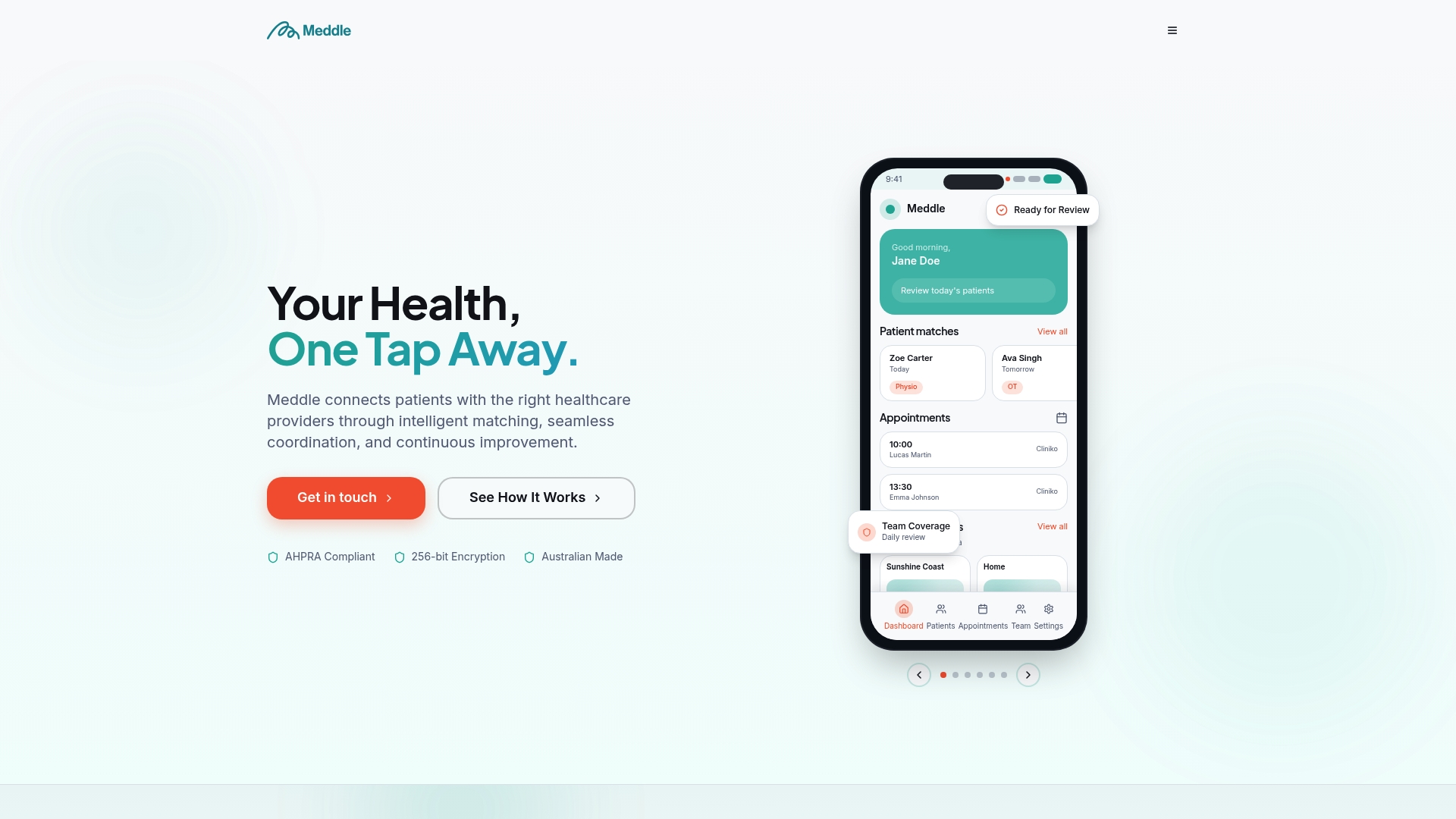
Reducing administrative friction is one of the fastest ways to free up the clinical time that patient experience improvements actually require. Meddle’s AI-powered matching and coordination platform is built for exactly this: connecting patients with the right allied health practitioner faster, automating referral workflows, and giving clinicians a clear view of incoming referrals without the manual overhead.
Specific ways Meddle supports the programme described in this guide:
-
Faster patient access — matching by discipline, location and the capacity each clinician has shared, then routing the referral for the clinic to confirm, means patients reach the right practitioner sooner, reducing the wait-time complaints that consistently top PREM low-score lists.
-
Referral accuracy — the Referral Quality Scorecard helps GPs and coordinators send complete, clinically appropriate referrals, reducing the back-and-forth that delays care and frustrates patients.
-
Coordination tools — referral templates and automated SMS and email notifications reduce the handover gaps that patients experience as fragmented care.
-
Practitioner analytics — per-practitioner reporting in the practice dashboard, alongside one view of referrals and bookings, so administrators can track operational KPIs alongside PREM data.
Meddle starts from $40 per practitioner per month (ex GST, $250 monthly minimum, SMS included) with guided onboarding and a free 30-day pilot — no long implementation project required. Explore how Meddle works or visit Meddle’s practitioner benefits page to see the operational impact in detail.
Sources
This article is general information, not a substitute for advice from a qualified doctor. Consult a qualified healthcare professional about your own circumstances before acting on anything here.
FAQ
What are seven ways to improve patient satisfaction?
The seven most evidence-backed approaches are: implementing validated PREMs, delivering structured communication training (AIDET and teach-back), deploying bedside whiteboards and open notes, introducing structured discharge planning, running real-time feedback loops, including carers as active care partners, and redesigning appointment flows to reduce wait times.
What are the five P’s of patient experience?
The 5 P’s are Patient, People, Processes, Place and Purpose/Pathways. They provide a service design framework for mapping where experience gaps occur — from who is being served and how staff behave, through to the physical environment and clarity of the care pathway.
What are the benefits of improving patient satisfaction?
Higher satisfaction scores correlate with better treatment adherence, lower readmission rates, stronger staff morale and improved organisational reputation. A clinical review found that positive inpatient experience can reduce fear and support recovery, making it both a clinical and operational priority.
What are the 6 C’s of healthcare?
Definitions of the 6 C’s vary across frameworks, but a widely used version in patient experience work covers Communication, Competence, Compassion, Coordination, Comfort and Continuity. These map directly to the domains measured by validated PREMs and to the interventions most likely to lift scores in each area.
How do you measure patient satisfaction reliably?
Use a validated PREM instrument — such as the Australian Hospital Patient Experience Questionnaire Set for acute inpatient settings or the YES questionnaire for community and mental health settings — collected at discharge or within 48 hours. Supplement with open-text questions and qualitative follow-ups on low-scoring responses to identify root causes.