How to reduce clinic wait times: strategies that actually work

The clinics that cut wait times fastest combine five moves: protected same-day appointment slots, virtual triage or telehealth to divert low-acuity demand, an electronic medical record with automated booking and reminders, delegated tasks to extended-role practitioners, and a structured process-improvement cycle to keep gains from sliding backward. None of these work in isolation. Together, they attack wait time from both ends, cutting how many people need a slot and how long each slot takes.
The evidence behind each is measurable, not aspirational. A 2026 systematic review of waiting-list reduction strategies found protected appointment models produced a median reduction in time from referral to first appointment by about one-third. The STAT trial, which combined triage with initial management in community outpatient services, cut median waiting time from 42 days to 24 days, a 33.8% drop. These aren’t small pilot anomalies. They’re outcomes from trials designed specifically to test whether structural change beats simply asking staff to “work faster.”
Here’s where to start, roughly ranked by effect size and speed of payoff:
-
Protected/same-day appointment scheduling: median reductions around 30 to 45% in referral-to-appointment time, evidenced across multiple trials.
-
Virtual triage and telehealth: shifts a substantial share of low-acuity demand away from in-person slots, freeing capacity without adding staff.
-
EMR and booking automation: measured reductions in overall outpatient waiting time of up to 45% when combined with block scheduling.
-
Team-based task delegation: expands effective capacity by moving appropriate tasks to nurses, allied clinicians, and extended-role practitioners.
-
Lean-style process improvement: sustains gains from the above by catching new bottlenecks before they become entrenched.
Statistic callout: A multi-year outpatient intervention combining block appointments and electronic medical records reduced median waiting time by 45%, from around six hours to three and a half hours, in the reported department. That’s the scale of change achievable when scheduling redesign and digital tooling are implemented together, not as separate initiatives.
Key Takeaways
Reducing clinic wait times requires combining protected scheduling, virtual triage, digital automation, and task delegation rather than relying on any single fix.
| Point | Details |
|---|---|
| Protected appointments cut lead time | Trials show a median 34% reduction in referral-to-appointment time with reserved slots. |
| Virtual triage shifts demand | Australian VTCR data shows a substantial rise in appropriate lower-acuity care selection. |
| Combined interventions outperform single fixes | Block scheduling plus EMR adoption cut median outpatient waiting time by 45% in one intervention study. |
| Measure before you change anything | Track wait time, cycle time, lead time, no-shows, utilisation, and backlog weekly to prove impact. |
| Meddle supports the digital layer | Its matching, referral routing and practice dashboard address the technology gaps behind slow patient flow. |
This article is general information, not a substitute for advice from a qualified doctor. Consult a qualified healthcare professional about your own circumstances before acting on anything here.
Table of Contents
-
How long does it take to reduce wait times, and what does it cost?
-
What does the research actually prove about wait-time reduction?
Quick wins to reduce patient wait times this week
You don’t need a twelve-month transformation project to see movement. Several interventions produce measurable change within days, and they cost little beyond staff time to set up.
Start with automated appointment reminders. Manual reminder calls are slow, inconsistent, and usually the first task dropped when reception gets busy. Automated SMS or email reminders sent 48 and 24 hours before an appointment close that gap without adding headcount. Pair this with a no-show cost calculator to show your team, in dollar terms, what unfilled slots are actually costing the practice, which tends to accelerate buy-in for the rest of the changes below.

Second, tighten your arrival instructions. Vague appointment confirmations (“see you Tuesday”) create ambiguity about parking, paperwork, and what to bring, which produces late arrivals that cascade through the whole day’s schedule. A confirmation message with a map link, expected visit duration, and a one-line checklist of what to bring removes friction before the patient even leaves home.
Third, offer online booking for at least your most predictable appointment types. Patients who can see the times you’ve opened online and book directly tend to choose slots that suit their actual schedule, which correlates with fewer late cancellations.
Fourth, retime your reminder cadence around patient risk profiles rather than sending the same message to everyone. Practices that segment reminders (for example, an extra same-day text to patients with a history of no-shows) see sharper reductions in missed appointments than blanket reminder systems.
-
Automated reminders: assign to reception lead; monitor no-show rate weekly; expect measurable change within 1 to 2 weeks.
-
Clear arrival instructions: assign to admin/marketing; monitor late-arrival rate; expect change within days.
-
Online booking rollout: assign to practice manager; monitor booking completion rate and slot fill time; expect partial impact within a week, full impact within a month.
-
Risk-based reminder timing: assign to reception/clinical lead jointly; monitor no-show rate by patient segment; expect measurable change within 2 to 4 weeks.
Pro Tip: Track your baseline no-show rate for two weeks before changing anything. Without a “before” number, you won’t be able to prove any of these quick wins actually worked when you report back to the practice owners.
Which scheduling model actually cuts wait times?
Scheduling structure decides how much of your day is wasted before a single patient walks in. Four models dominate the evidence base, and each suits a different clinic profile.
Advanced access (open access) reserves the majority of each day’s slots for same-day requests rather than pre-booking weeks out. It’s the model with the deepest evidence trail: a 2017 systematic review of interventions to reduce primary care wait times identified open access scheduling as one of the most consistently effective interventions, reducing both pre-booked wait times and no-show rates. The logic is straightforward: demand met close to the point of need is easier to predict than demand booked a month in advance, when circumstances (and priorities) change.
Block appointments group similar visit types into batches, run at set times of day. This suits clinics with high volumes of routine, short visits (vaccinations, reviews, simple follow-ups) because it reduces the setup and teardown time between dissimilar consultations.
Wave scheduling books multiple patients into the same time block, expecting some variability in arrival and consultation length to even out. It’s a defensive model, useful where no-show rates are historically high and unfilled slots are the bigger risk than overcrowding.
Fixed-slot standardisation assigns a consistent, evidence-based duration to each appointment type instead of letting practitioners set arbitrary lengths. This sounds mundane, but inconsistent slot lengths are one of the most common hidden causes of daily schedule drift.
Statistic callout: The STAT model, which combines triage with initial management to protect assessment capacity, reduced waiting time to first appointment by 33.8% in a stepped-wedge trial across community outpatient services, with the median wait falling from 42 to 24 days (95% CI on the incidence rate ratio: 0.516 to 0.852).
If you’re testing a new scheduling model, run it as a genuine pilot rather than a permanent switch on day one:
-
Clear the existing backlog first, using temporary extra sessions or locum capacity if the budget allows. Piloting a new model on top of an unresolved backlog buries the signal.
-
Choose one clinic day or one practitioner’s list to trial the model for four to six weeks minimum.
-
Track daily slot utilisation, same-day request volume, and average wait-to-be-seen throughout the pilot.
-
Assign a single staff member to own the pilot’s day-to-day adjustments; scheduling models fail more often from inconsistent execution than from a flawed design.
-
Compare pilot metrics against your pre-pilot baseline at the four-week mark before deciding to expand it clinic-wide.
Can virtual triage reduce unnecessary in-person visits?
Yes, and the effect is larger than most administrators expect. A cross-sectional study of Australia’s national virtual triage and care referral service found that AI-based virtual triage increased patient selection of appropriate lower-acuity, non-urgent care by 31.6 percentage points, with low-acuity selection rising from 21.3% to 52.9%. That’s not a marginal nudge. It’s a demand-shaping effect large enough to change how a whole clinic’s booking demand looks week to week.
Telehealth produces a related but distinct benefit. A 2023 survey of Australian telehealth users found a majority of respondents reported shorter wait times for telehealth consultations than for face-to-face visits. Together, virtual triage and telehealth do two different jobs: triage decides whether a visit needs to happen at all, and telehealth removes the physical scheduling constraint when it does.
Practices that treat virtual triage purely as a “nice-to-have” convenience feature miss its real function: it’s a demand-management tool that redirects patients before they ever occupy a slot that a higher-acuity patient might need.
Getting the safety governance right matters as much as the technology itself:
-
Set clear clinical escalation rules so any triage flag of uncertainty routes to a human clinician, never a default “wait and see” outcome.
-
Document every triage decision in the patient record, including the rationale, so downstream practitioners aren’t guessing why a pathway was chosen.
-
Build in mandatory follow-up contact for patients diverted to lower-acuity pathways, particularly where symptoms could still escalate.
-
Review triage outcomes monthly against actual clinical presentations to catch any systematic under-triage before it becomes a pattern.
A clinic running a telehealth pilot alongside virtual triage typically sees the two reinforce each other: triage identifies who’s suitable for a virtual consult, and telehealth capacity absorbs that redirected demand without adding a physical appointment slot. Tools like a telehealth suitability advisor can help staff make that call consistently rather than relying on individual judgement each time.
What technology features actually shorten clinic flow?
Not every EMR feature moves the needle on wait times. Some are administrative nice-to-haves; others directly attack the delay points patients experience. Prioritise the second group.
Online booking against your current calendar removes the phone-tag cycle that eats reception time and delays patients from securing a slot in the first place. Waitlist auto-fill matches cancellations to waiting patients automatically instead of leaving that slot empty until someone happens to call. Intelligent reminders that adjust timing and channel based on patient behaviour reduce no-shows more effectively than a single fixed reminder rule. Automatic rebooking prompts at the end of a consultation cut down on patients who intend to return but never get around to calling.
National reporting on digital health adoption trends points to expanding EMR, e-referral, and telehealth capability as core enablers of more efficient care delivery, which reflects what’s happening inside individual clinics: the practices seeing the largest wait-time gains are the ones combining several digital levers, not relying on a single feature.
When you’re comparing systems, weight your evaluation toward:
-
Integration depth with your existing referral and billing workflows, since a system that requires duplicate data entry adds friction rather than removing it.
-
Configuration simplicity for non-technical staff, because a system only your IT-savvy office manager can adjust will stagnate once they’re on leave.
-
No-show and waitlist-specific features, rather than generic calendar functions that any diary app already provides.
Pro Tip: Before signing with any platform, ask for a specific answer on waitlist auto-fill: does it match patients automatically, or does staff still have to manually call down a list? That single feature difference often determines whether cancelled slots actually get filled.
Statistic callout: The Tanzanian outpatient department study that combined block appointments with EMR implementation and extended clinic hours reduced median waiting time by 45%, from approximately six hours to three and a half hours, illustrating the scale achievable when scheduling and digital tools are deployed as a combined intervention rather than sequentially.
Which KPIs prove your wait-time strategy is working?
Vague statements like “things feel faster” don’t survive scrutiny in a board meeting. You need defined metrics, consistent measurement windows, and a data source for each one.
Six KPIs cover the core of wait-time performance:
-
Wait time to be seen — the interval between a patient’s scheduled or arrival time and when a clinician actually begins the consultation.
-
Cycle time — total time a patient spends within the clinic, from check-in to discharge, capturing bottlenecks beyond just the waiting room.
-
Lead time from referral — the gap between a referral being received and the first appointment offered, which is what patients and referrers actually feel most acutely.
-
No-show rate — the percentage of booked appointments where the patient doesn’t attend and doesn’t cancel in advance.
-
Practitioner utilisation — the proportion of available clinical capacity actually filled with booked, attended appointments.
-
Backlog size — the total number of patients waiting for an initial appointment at any given point, tracked as a trend rather than a single snapshot.
| KPI | Measurement definition | Data source | Collection frequency |
|---|---|---|---|
| Wait time to be seen | Scheduled/arrival time to consultation start time | EMR appointment logs | Daily |
| Cycle time | Check-in time to discharge time | Practice management system | Daily |
| Lead time from referral | Referral received date to first offered appointment date | Referral management/EMR | Weekly |
| No-show rate | Missed appointments ÷ total booked appointments | Booking system reports | Weekly |
| Practitioner utilisation | Booked and attended slots ÷ total available slots | Scheduling system | Weekly |
| Backlog size | Count of patients awaiting first appointment | Waitlist register | Weekly |
Build your measurement routine around a simple discipline: collect daily where the metric changes daily (wait time, cycle time), and review weekly where the metric moves more slowly (backlog, utilisation). A dashboard doesn’t need to be elaborate. A single screen showing this week’s average wait time against a rolling four-week average, alongside current backlog size and no-show rate, gives most practice managers everything needed to spot a regression before it becomes a crisis.

How does task delegation increase clinic capacity?
Changing who performs which task, without adding headcount, is one of the fastest ways to expand effective capacity. The evidence on team-based care and task delegation shows extended-role practitioners and workforce redesign reduce wait times while maintaining patient satisfaction, provided the scope changes are backed by proper supervision and monitoring.
Practical examples worth adopting:
-
Nurse-led triage for incoming patient queries, filtering routine questions and simple presentations away from practitioner time.
-
Extended-role practitioners (nurse practitioners, senior allied health clinicians) handling initial assessments for conditions within their scope, freeing specialist time for complex cases.
-
Administrative automation for tasks like appointment confirmation, insurance verification, and basic intake forms, removing them from clinical staff entirely.
Before reallocating any clinical task, run it through a short delegation checklist:
-
Confirm the task sits within the delegate’s professional scope of practice and registration requirements.
-
Define clear escalation criteria for when a case needs to move back to a more senior practitioner.
-
Set a supervision cadence appropriate to the risk level of the delegated task, not a blanket monthly check-in regardless of complexity.
-
Document outcomes for delegated cases separately for the first three months to confirm quality hasn’t slipped.
Pro Tip: Introduce role changes one at a time, not all at once. A clinic that delegates triage, initial assessment, and admin automation simultaneously loses the ability to tell which change actually drove any improvement, or which one caused a new problem.
How Lean and PDSA cycles cut clinic bottlenecks
Structural changes like new scheduling models and delegation only hold if you keep testing and adjusting them. This is where a Lean-inspired Plan-Do-Study-Act (PDSA) cycle earns its keep, and it’s far less complicated than the terminology suggests.
-
Plan: pick one specific bottleneck (say, patients waiting more than 20 minutes past their scheduled time on Mondays) and design a small, testable change.
-
Do: run the change for a short, defined period, typically one to two weeks, with a single staff member responsible for consistent execution.
-
Study: compare the metric before and after against your baseline, being honest about whether the change caused the shift or something else did.
-
Act: if it worked, expand it to other days or practitioners; if it didn’t, adjust the change and run another short cycle rather than abandoning the goal entirely.
A basic value-stream map helps surface where time actually disappears, and it’s often not where staff assume. Common hidden waste points include: phone lines that create queuing before a patient even reaches reception, document handoffs between referral intake and clinical records that sit unprocessed for days, and single diagnostic machines that become bottlenecks whenever one practitioner’s list runs long.
Pro Tip: Protect capacity before you try to smooth demand. Operations teams that succeed with Lean cycles in clinics usually fix scheduling leaks (double-booking, unfilled cancellations, inconsistent slot lengths) before touching anything related to patient volume or demand management. Fixing demand while supply is still leaking wastes the effort.
How long does it take to reduce wait times, and what does it cost?
Timelines vary by intervention, but a realistic phased rollout looks like this:
-
Weeks 1 to 2: quick wins (reminders, arrival instructions, booking cleanup). Low cost, mostly staff time.
-
Weeks 3 to 8: triage and telehealth setup, including staff training on escalation protocols. Moderate cost, depending on platform choice.
-
Weeks 6 to 14: scheduling model pilot, run in parallel with digital tooling once staff are comfortable with new booking workflows.
-
Weeks 10 to 20: EMR configuration and automation build-out, including waitlist auto-fill and intelligent reminder rules.
-
Ongoing from week 12: backlog clearance using temporary capacity injections (extra sessions, locum support) if the pilot reveals a stubborn queue.
| Phase | Primary role responsible | Time commitment | Rough cost tier |
|---|---|---|---|
| Quick wins | Reception lead / practice manager | 5 to 10 hours setup | Low |
| Triage and telehealth | Clinical lead + IT/vendor support | 2 to 4 weeks part-time | Low to medium |
| Scheduling pilot | Practice manager + one practitioner | 4 to 6 weeks part-time oversight | Low |
| EMR/automation build | IT/vendor + admin lead | 4 to 8 weeks part-time | Medium to high |
| Backlog clearance | Clinical team + temporary staff | 2 to 6 weeks intensive | Medium to high |
A low-cost approach leans on existing staff time and free or low-tier software features. A medium-cost approach adds a paid automation platform and possibly casual locum hours for backlog clearance. A high-cost approach adds a full EMR migration or platform switch alongside temporary staffing to clear a substantial backlog quickly. Tools like an admin hours saved estimator can help you build a rough internal business case before committing budget to any tier.
What does the research actually prove about wait-time reduction?
The strongest evidence for wait-time interventions comes from a handful of well-designed studies, and it’s worth being specific about what each one actually measured rather than treating them as interchangeable proof points.
The 2026 systematic review of protected appointment strategies pooled multiple trials and found a median 34% reduction in referral-to-first-appointment time, with a 95% confidence interval suggesting the effect is real and moderate to large across settings. The STAT trial, a stepped-wedge cluster design, delivered a 33.8% reduction with a statistically significant incidence rate ratio (0.663, P = 0.001), which is about as clean a result as clinical operations research gets. The Tanzanian outpatient study offers a real-world before/after case rather than a controlled trial, showing a 45% reduction after combining block appointments, EMR adoption, and extended hours.
The consistent thread across these studies isn’t any single technique. It’s that protecting capacity, whether through reserved slots or combined triage-and-treatment models, beats simply asking staff to move faster through an unchanged system.
Statistic callout: The Australian VTCR study recorded a substantial increase in appropriate lower-acuity care selection by about 30 percentage points, one of the largest measured demand-shaping effects in this evidence base, and a strong signal for why virtual triage deserves serious budget consideration rather than token investment.
None of this evidence is unlimited in scope. Worth flagging honestly:
-
Most trials were conducted in specific health systems (UK, Australian, and low-resource settings), so external validity to every clinic type isn’t guaranteed.
-
Implementation intensity varied significantly between studies; a lightly-resourced pilot won’t necessarily replicate a well-funded trial’s results.
-
Measurement definitions differ across studies (some measure referral-to-appointment, others measure arrival-to-consultation), so comparing headline percentages across studies requires care.
Platforms built around intelligent matching and coordination are still a relatively recent addition to this evidence base, and outcomes will keep accumulating as more clinics adopt AI-assisted booking and triage tools alongside the structural changes described above.
What clinic teams tell us actually works
Talk to enough practice managers who’ve been through a wait-time overhaul, and a pattern emerges: the interventions that stick are rarely the flashiest ones. Reminder automation and clear arrival instructions get treated as too basic to matter, yet they’re consistently the changes staff report noticing first, because they remove daily friction rather than requiring anyone to learn a new system.
The interventions that stall are usually the ones rolled out without a dedicated owner. A new scheduling model introduced clinic-wide on day one, with no pilot phase and no single person accountable for adjusting it, tends to quietly revert to old habits within a month. Staff default back to familiar patterns under pressure unless someone is actively watching the metrics and correcting drift.
A few practical patterns worth carrying into your own rollout:
-
Run every major change as a pilot first, even when you’re confident it’ll work clinic-wide, because pilots surface implementation problems a full rollout would hide until it’s too late to correct cheaply.
-
Give staff the “why” behind a change, not just the instruction. A team that understands protected same-day slots reduce urgent-care spillover will defend those slots against pressure to double-book; a team that’s just been told “don’t book Tuesdays full” won’t.
-
Revisit KPIs monthly for the first six months of any change, then quarterly once results stabilise. Improvements that aren’t monitored tend to erode gradually and invisibly.
One common failure worth naming directly: a clinic introduces virtual triage but doesn’t retrain reception staff on how to explain it to patients calling in confused about why they’re being redirected to an online form. Patients abandon the process, revert to calling for a standard appointment, and the clinic concludes triage “didn’t work.” The fix isn’t abandoning triage. It’s a short script for reception staff explaining what to expect and why it gets them seen faster, which usually resolves the drop-off within a couple of weeks.
A practical next step for clinics ready to move
Everything above works better with a system that actually connects the pieces: matching patients to the right practitioner, routing each referral to a clinician with capacity, and automating reminders so gains don’t rely on staff remembering to chase every gap manually. Meddle was built around exactly that gap: it matches by discipline, location and the capacity each clinician has shared, then routes the referral, and the clinic confirms the booking.
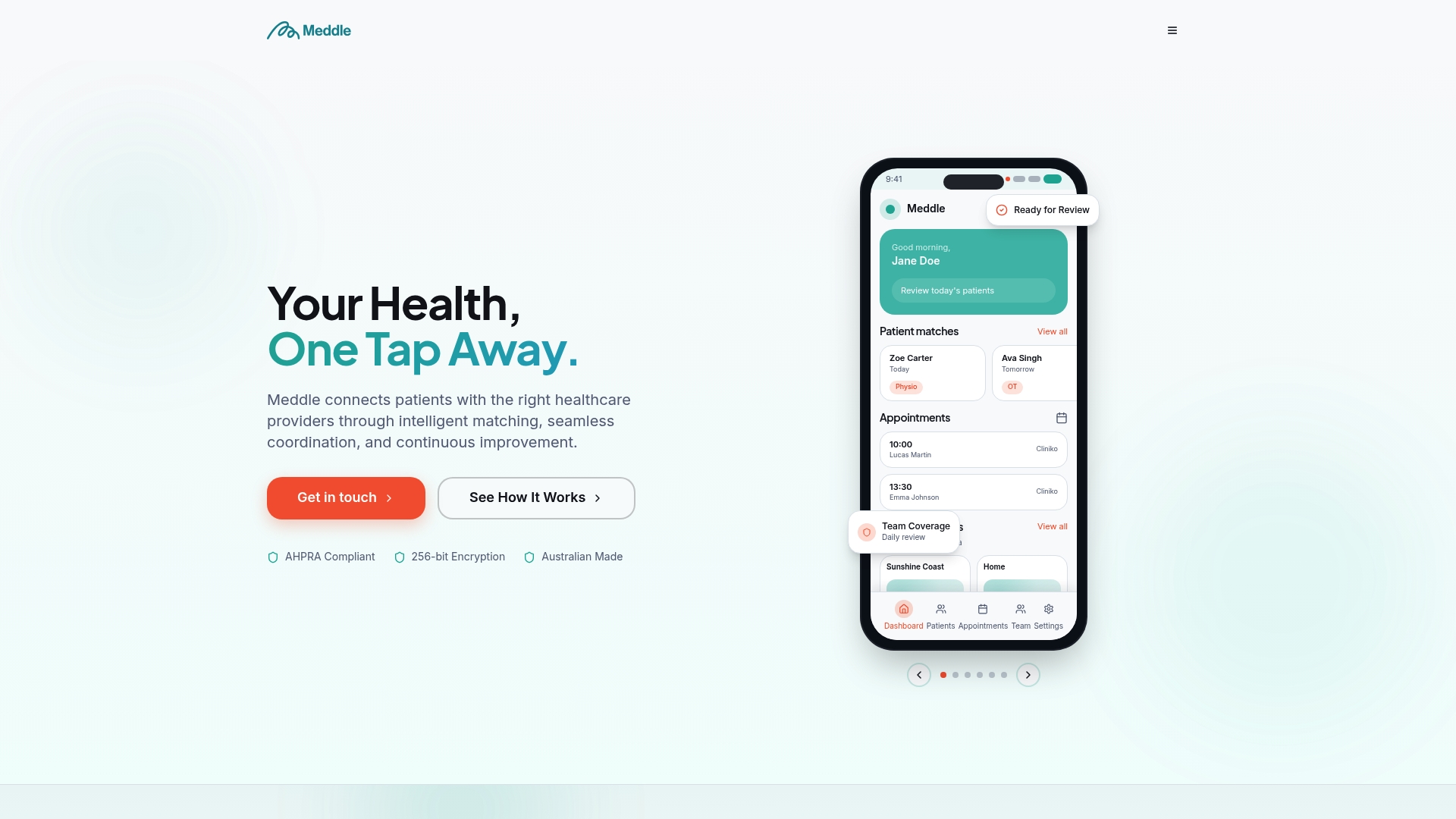
For a clinic manager weighing where to start, a pilot is the lowest-friction entry point. Meddle offers a free 30-day pilot on the Meddle platform, focused on routing referrals through intelligent matching, automating SMS and email reminders, and giving you one practice dashboard view of referrals and bookings, with practitioner analytics. Practitioners get back admin hours currently lost to phone tag and manual scheduling, which you can estimate in advance using the admin hours saved tool. If pathology turnaround is part of your bottleneck, independent partners like EIV Diagnostics can also shorten the diagnostic leg of a patient’s journey.
If you manage an allied health clinic and want to see what a pilot would look like for your specific patient volume and appointment mix, the simple rollout page outlines pricing from $40 per practitioner per month (ex GST, $250 monthly minimum, SMS included) and what onboarding involves in the first month.
Sources
FAQ
What is the 4 hour rule for emergency departments?
The 4 hour rule (also called the National Emergency Access Target in some health systems) aims to have emergency department patients admitted, discharged, or transferred within four hours of arrival. It’s an emergency care benchmark and applies differently to outpatient and allied health settings, where wait-time targets are set by individual clinics or referral pathways rather than a single national rule.
How long is too long to wait to see a doctor?
There’s no single universal threshold, since acceptable wait time depends on clinical urgency and appointment type. As a practical benchmark, clinics using protected scheduling and triage models discussed above have shown they can bring referral-to-appointment waits down by around a third compared to standard booking systems.
How can a clinic shorten patient waiting time quickly?
Automated reminders, clear arrival instructions, and simple online booking typically produce measurable reductions in no-shows and late arrivals within one to two weeks, with no major system change required. Larger reductions come from combining these quick wins with scheduling redesign and virtual triage over a longer rollout.
How can I check how busy a clinic or hospital is before visiting?
Real-time availability tools, where a clinic publishes current booking slots and estimated wait times online, are the most direct way to check. Platforms like Meddle match you to a suitable practitioner based on the capacity clinicians have shared, and the clinic confirms a time with you, so you’re not guessing based on past visits.
Does virtual triage actually reduce unnecessary in-person visits?
Yes. Australian data on a national virtual triage service found it increased selection of appropriate lower-acuity, non-urgent care options by 31.6 percentage points, meaningfully reducing pressure on in-person appointment slots.