7 Steps Australian Clinics Use to Keep Shared Care Plans Current

A shared care plan is a single, agreed record that lets a GP, specialists, allied health providers and the patient manage a complex condition together, with clear roles for who does what. It cuts duplication, keeps everyone working from the same information and, according to the RACGP, reduces preventable hospital admissions. In Australia, that structure is often backed by GPMPs, TCAs and My Health Record, with downloadable templates available so you don’t have to start from scratch.
TL;DR:
- Shared care plans are most effective when they clearly define each provider’s responsibilities, support integration with clinical systems, and include structured review and escalation pathways.
- Medicare billing for GP management plans and team care arrangements encourages ongoing updates and reviews, especially when supported by digital tools that automate reminders and record-keeping.
- Using standardized templates, ensuring patient involvement early, and maintaining printed copies improve plan usability and safety, particularly outside the primary care setting.
- Automated platforms like Meddle help reduce administrative burden, support real-time updates, and keep shared plans current, which is crucial for managing complex, multi-provider cases.
Table of Contents
- What is a shared care plan?
- Who is involved and what each person does
- What should a shared care plan include?
- How shared care plans fit into GPMPs, TCAs and My Health Record
- Digital tools and integration: what clinical systems should do
- Steps to create, share and review a shared care plan
- Common barriers to shared care and how to fix them
- Where to find shared care plan templates and examples
- Clinician perspective: what integrated shared care actually changes day to day
- How a coordination platform supports your shared care plans
- Sources
- FAQ
What is a shared care plan?
A shared care plan is a structured, agreed document that a multidisciplinary team, including the patient, uses to manage a complex or chronic condition together. The RACGP defines the model as joint responsibility between GP and non-GP specialists, built to improve continuity and reduce duplicated tests or conflicting instructions. It differs from an informal handwritten note or a single specialist’s file because everyone involved can see it, update it and act on it.
You’ll see a few working models in practice:
- GP-led shared care, where the GP coordinates and specialists contribute defined input, common in diabetes and cardiovascular disease.
- Specialist-shared care, used heavily in oncology, where a hospital team manages acute treatment while the GP handles ongoing monitoring.
- Coordinator-led models, common in antenatal care and complex paediatric cases, where a dedicated care coordinator manages appointments and information flow.
Each model suits a different clinical picture, but all of them replace scattered notes with one living plan.
Who is involved and what each person does

Shared care only works when every person’s job is written down, not assumed. The RACGP is explicit that general practice should stay central, because the GP sees the whole patient across co-morbidities while specialists focus on one problem at a time.
Typical roles look like this:
- GP: coordinates the overall plan, manages medications across conditions, and is usually the first point of contact for the patient.
- Specialist: manages the specific condition requiring their expertise and reports changes back into the shared plan.
- Allied health providers (physiotherapists, dietitians, psychologists): deliver agreed interventions and flag any changes in function or risk.
- Care coordinator: needed when three or more providers are involved, to chase updates and keep review dates on track.
- Patient or carer: gives consent, contributes goals, and carries a copy of the plan to appointments.
Documenting consent early matters. Patients engaged in building their own plan report higher satisfaction and better adherence, according to CareSearch, so treat that first conversation as part of the clinical work, not paperwork to tick off afterwards.
What should a shared care plan include?
A plan that looks thorough but sits unused helps nobody. The most effective ones are built around the fields the whole team actually checks during a consult.
- Problem list covering every active diagnosis, not just the one triggering the referral.
- Agreed goals, written in language the patient understands and revisits.
- Monitoring schedule, specifying which provider checks what, and how often.
- Escalation pathway, naming who to contact if a result or symptom crosses a threshold.
- Current medication list, updated at every change, with the prescriber noted.
- Contact details for every team member, including after-hours arrangements.
- Review date, set at creation, not left open-ended.
Pro Tip: Keep a patient-held paper or PDF copy alongside the electronic clinical record. If a patient turns up at an emergency department outside your network, the printed copy is often the only version anyone can see.
Format matters as much as content. A plan buried in a specialist letter gets missed; a plan structured as a standalone document with clear headings gets used at the next appointment.
How shared care plans fit into GPMPs, TCAs and My Health Record
Australia formalises multidisciplinary care through two Medicare items: General Practice Management Plans (GPMPs) and Team Care Arrangements (TCAs). A GP prepares a GPMP for a patient with a chronic or terminal condition, then adds a TCA when at least two other providers are needed to deliver care. Eligibility sits with the GP’s clinical judgement, not a fixed diagnosis list, though chronic diseases such as diabetes, COPD and heart failure are the most common triggers.
The evidence for using them is solid. MJA research found multidisciplinary team care arrangements are associated with improved intermediate health outcomes, and a follow-up study linked structured reviews and web-based care management tools to better follow-up rates in diabetes care specifically.
My Health Record adds another layer, giving every provider access to shared documents, medication history and discharge summaries. It’s useful for background visibility, but it isn’t a substitute for direct clinician-to-clinician messaging or a live shared plan; treat it as a record repository, not a coordination tool.
Worth knowing before you set one up:
- GPMPs and TCAs attract Medicare rebates, which makes ongoing coordination time billable rather than unpaid admin.
- Smaller practices, per MJA’s analysis, often implement TCAs more flexibly than larger practices, which need more structured administrative support to make the same process work.
- Reviews are billable too, so build them into the plan from day one rather than treating them as optional.
Digital tools and integration: what clinical systems should do
A shared care plan is only as current as the system holding it. Clinical software needs to integrate with your existing clinical information system (CIS), support secure messaging between providers, and generate automated reminders when a review date is approaching, as solutions like Home Gradient demonstrate. Without those three features, plans quietly go stale.
Before choosing a platform, check for:
- Direct integration with your CIS, so updates don’t require duplicate manual entry.
- Secure, auditable messaging, not general email, for provider-to-provider updates.
- Automated review reminders tied to the plan’s own review date.
- An audit trail showing who changed what and when.
Privacy and Medicare compliance both need checking before rollout. WNSW PHN’s guidance recommends requesting demonstrations and comparing vendors against your specific clinical requirements and budget, rather than picking based on marketing alone.
Pro Tip: Ask any vendor to show you a GPMP or TCA compliant output before you sign up. A system that can’t produce Medicare-compliant documentation leaves your collaborative time unbilled, no matter how good the interface looks.
Tools like Meddle’s referral pathway advisor reduce the admin load of tracking who needs to be looped in next, which matters most when a plan involves four or five separate providers.
Steps to create, share and review a shared care plan
Building a shared care plan follows a fairly predictable sequence, whether the condition is diabetes, cancer follow-up or a complex antenatal case.
- Gather the basics. Pull together the current problem list, medications, recent results and existing goals before you convene anyone.
- Convene the team. Bring the GP, relevant specialists and allied health providers together, even briefly, to agree who owns which task.
- Document escalation and review cadence. Write down thresholds for concern and set a firm review date, not a vague “as needed”.
- Confirm patient consent and goals. Sit down with the patient to check the plan reflects what matters to them, not just clinical targets.
- Distribute copies. Send the plan to every provider and give the patient a version they can carry.
- Schedule the review. Set a calendar reminder or use automated software reminders so the review actually happens on the date agreed.
- Audit follow-up. Check after the review date that updates were actually made, not just discussed.
Skipping step six is the single most common reason plans fail to stay current.
Common barriers to shared care and how to fix them
Most shared care plans that fail don’t fail because of clinical disagreement. They fail because of process gaps.
- Communication breakdowns: fixed by using a structured template every provider follows, plus secure messaging rather than ad hoc phone calls or faxes.
- Funding and admin friction: GPMPs and TCAs exist specifically to make coordination time billable, so use them rather than absorbing that time unpaid.
- Unclear role ownership: the RACGP recommends formalised protocols precisely because informal arrangements tend to collapse under pressure.
- Plan bloat: keeping a plan targeted to the active problem list, rather than trying to capture every possible detail, reduces patient burden and keeps the document usable.
Fixing these usually costs a template and a review calendar, not a bigger IT budget.
Where to find shared care plan templates and examples
You don’t need to design a shared care plan from a blank page. Cancer Australia publishes a downloadable shared care plan template built specifically for patients to bring to follow-up appointments, so both the GP and specialist can record updates in the same place. The RACGP position statement includes worked examples of role delineation you can adapt for non-cancer conditions.
A minimal layout you can copy straight into a clinical record includes:
- Problem list and current goals
- Provider contact list with roles
- Medication list with last-updated date
- Review date and escalation contact
Give the patient a printed copy regardless of how good your digital system is. It’s the cheapest safety net in the whole plan.
Clinician perspective: what integrated shared care actually changes day to day
The gap between a shared care plan on paper and one that’s genuinely current is where most of the benefit lives. Teams using integrated tools like Meddle report faster referral matching and fewer chased-up messages between providers. The fastest path forward is small: pick one complex patient, build one plan properly, and use it as the template for the next ten.
— Taylor
How a coordination platform supports your shared care plans
Meddle gives allied health clinics and GPs a faster way to keep a shared care plan current instead of chasing updates across phone calls and fax machines. 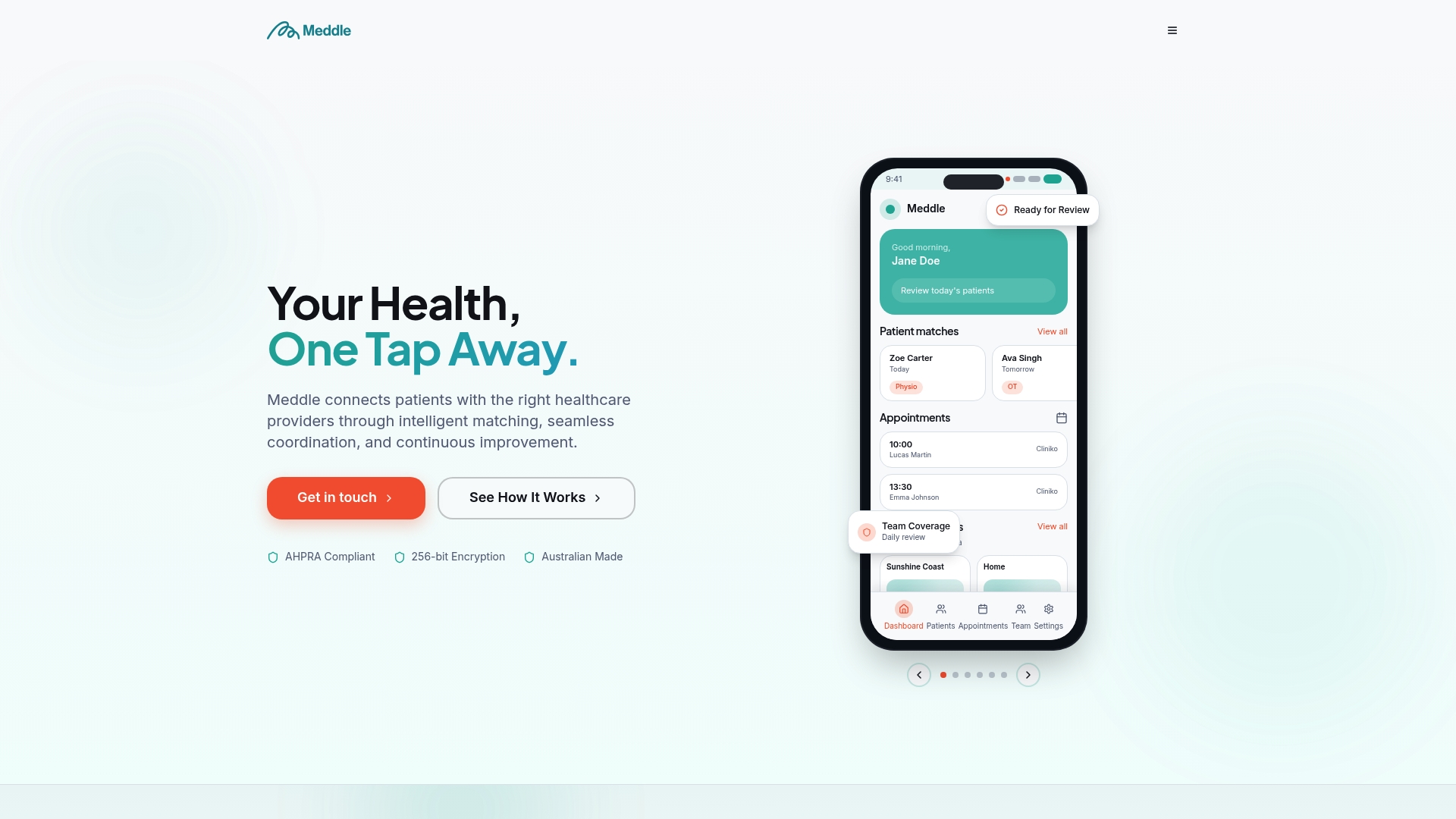
The platform’s AI-powered matching connects patients to the right practitioner quickly, its referral pathway tools keep every provider aligned on next steps, and secure messaging plus automated reminders stop review dates from slipping through the cracks. None of that replaces clinical judgement. It just removes the admin that gets in the way of it, which is exactly where most shared care plans break down in practice. For practices managing multiple providers across a single patient’s care, that admin reduction is often the difference between a plan that stays current and one that quietly goes stale after the first review.
If you’re building or improving a shared care plan for a patient with complex needs, see how Meddle works and check out the practitioner benefits page to find out what a smoother referral and coordination workflow could look like for your team.

This article is general information, not a substitute for advice from a qualified doctor. Consult a qualified healthcare professional about your own circumstances before acting on anything here.
Sources
- Shared Care Model between GP and non-GP specialists for complex chronic conditions (RACGP)
- Multidisciplinary team care arrangements in the management of patients with chronic disease in Australian general practice (MJA)
- Shared care - Shared Care Plan (Cancer Australia)
- Digital health adoption guidance (WNSW PHN)
FAQ
What are the main components of a shared care plan?
A shared care plan typically includes a problem list, agreed goals, a monitoring schedule, an escalation pathway, a current medication list and a set review date.
Who qualifies for a shared care plan?
Any patient with a complex or chronic condition managed by more than one provider can benefit, and a GP determines eligibility for Medicare-funded GPMPs and TCAs based on clinical need rather than a fixed diagnosis list.
Is a shared care plan covered by Medicare?
GPMPs and Team Care Arrangements attract Medicare rebates when a GP prepares them for eligible patients, which makes ongoing coordination time billable rather than unpaid administrative work.
What does an example shared care plan look like?
Cancer Australia’s downloadable template is a practical starting point, featuring a follow-up schedule, provider contacts and space for both GP and specialist to record updates at each appointment.
How do digital platforms support shared care plans?
Platforms that integrate with clinical systems, support secure messaging and automate review reminders help keep plans current; tools like Meddle also speed up matching patients to the right allied health provider in the first place.