What is the third next available appointment and why it matters

The third next available appointment (TNA) is the number of calendar days between a patient’s request for a routine slot and the third opening a provider actually has free. Administrators use “third” instead of “first” because the first opening is volatile. Someone cancels, a slot opens up, and your metric looks great for one day and terrible the next. The RACGP notes that the third available appointment is the most internationally recognised measure of appointment delay, precisely because it smooths out that noise.
Should you adopt it as a primary access metric? Yes, with one condition: measure it the same way every time.
-
Definition: calendar days to the third open routine slot, not business days
-
Why third, not first: filters out one-off cancellations that distort the picture
-
Rough benchmark: An aspirational target for TNA is often considered to be very short delays, generally aiming to minimize waiting times
-
Use case: a weekly trend line rather than relying on a one-off snapshot
Key Takeaways
Reliable third next available appointment tracking depends on consistent weekly sampling, calendar-day counting, and excluding carve-outs from the count.
| Point | Details |
|---|---|
| Use third, not first | The first available slot is too volatile; third filters out one-off cancellations. |
| Target minimal delay | This range is often regarded as an ideal standard by quality-improvement toolkits. |
| Exclude carve-outs | Same-day and urgent-only slots inflate apparent availability if counted. |
| Track trends weekly | A single measurement means little; a multi-week line graph reveals real change. |
| Meddle reduces the admin load | One dashboard view of referrals and clinician-shared capacity, with practitioner analytics, makes the weekly TNA sample quicker to pull. |
Table of Contents
-
Practical ways to reduce your third next available appointment
-
Why administrators overrate the single number and underrate the habit
How to measure your third next available appointment
Getting a usable TNA number takes minutes, but only if you follow the same rules every single week. Skip a step and you’re comparing apples to oranges three months later.
Start with what counts. Routine, non-urgent appointment types are in scope. Same-day or urgent carve-outs are not, because they exist precisely to bypass the normal queue and including them will flatter your numbers artificially.
-
Pick one appointment type (e.g. standard GP consult, standard physio review) and stick with it across all measurement cycles.
-
Choose a fixed sample point — Tuesday at 10am works well because it avoids Monday backlog and Friday drop-off.
-
Count calendar days, including weekends and public holidays, from the sample date to the third open routine slot.
-
Record it consistently: provider name, date sampled, TNA value, and who did the sampling.
-
Repeat weekly and log the numbers in a simple spreadsheet or your practice management system.
A few practical notes make this durable:
-
Assign one person as the designated measurer to avoid inconsistent interpretation between staff.
-
Adjust for part-time FTE by noting rostered days so a 0.6 FTE clinician isn’t compared unfairly against a full-timer.
-
When a provider is on leave, either exclude them for that cycle or note locum cover explicitly, since locum-backed capacity behaves differently to an empty column.
According to operational scheduling guidance from the National Academy of Medicine, experienced practices report this whole process takes roughly two minutes per provider per week once it’s routine. That’s a low price for data you can actually trust.
What the evidence says about TNA and patient access
The strongest evidence linking TNA to real patient experience comes from a cross-sectional study in JAMA Network Open, which found that each additional week of TNA reduced the share of patients rating their wait times as “good” or “excellent” by roughly 7.35%. That’s not a rounding error. A clinic sitting at three weeks’ wait versus one week is looking at a meaningfully worse patient-reported experience, not just a longer column on a spreadsheet.

Supporting this, a systematic review on NCBI Bookshelf backs consistent sampling, calendar-day counting, and excluding carve-outs as the conditions that make TNA data reliable enough to compare over time. The RACGP’s guidance reinforces the same message from a clinical operations angle.
A few things TNA does not do:
-
It doesn’t capture whether a patient specifically wanted their usual GP or a particular time slot.
-
It doesn’t reflect patient satisfaction with the visit itself, only the wait to get one.
-
It’s a system-level availability measure, best read alongside patient-reported access surveys rather than in isolation.
Turning your TNA number into a decision
Raw numbers only help if you know what to do with them. A useful interpretation scale looks like this: 0–1 day is excellent, 2–7 days is moderate and worth watching, and anything beyond 7 days signals a genuine access problem worth investigating.

Before reacting to a bad number, check whether it’s one provider or the whole clinic. Look at the distribution across your team, not just an average. A single overbooked clinician can drag a clinic-wide mean upward while everyone else is running fine. The median TNA across providers is often more honest than the mean, since one extreme outlier skews an average badly.
Run through a short checklist before you assume a systemic problem:
-
Was the same day/time sampled as usual?
-
Were any carve-out slots miscounted as available routine slots?
-
Has a staff member gone on leave or reduced hours recently?
-
Has demand shifted (new referral source, seasonal illness spike)?
Pro Tip: Plot TNA on a simple line graph updated weekly. A single bad week rarely means anything, but three consecutive weeks trending upward is your signal to investigate before patients start noticing.
Common measurement mistakes that quietly wreck your data
Most bad TNA data doesn’t come from a complicated failure. It comes from small inconsistencies that compound over weeks.
-
Counting carve-outs as routine availability. Same-day and urgent-only slots are reserved for a reason. Including them in your TNA count deflates the number and hides real access problems.
-
Measuring providers on extended leave without noting locum cover. A blank column looks like unavailability, but if a locum is covering, the real access position is different.
-
Sampling at inconsistent times. A Monday morning check will almost always look worse than a Thursday afternoon check, purely due to weekend backlog. Pick one time and don’t drift.
-
Skipping audit checks. Run duplicate sampling occasionally and cross-check against your appointment system’s own reports to catch human error before it builds into a trend.
Practical ways to reduce your third next available appointment
Once you’ve got reliable TNA data, the real value is in testing changes and watching the number move. This is where a Plan-Do-Study-Act (PDSA) cycle earns its keep.
Start with a single, deliberate change rather than overhauling everything at once. Some of the highest-leverage levers include:
-
Open-access scheduling, where more of the day’s slots are held for near-term booking rather than weeks-out appointments.
-
Redistributing demand across clinicians so one popular practitioner doesn’t carry a disproportionate backlog while others run underbooked.
-
Reviewing carve-outs deliberately. As the RACGP points out, carve-outs work best as a planned operational lever, not a leftover habit nobody revisits.
-
Increasing patient portal uptake, so booking friction itself isn’t adding artificial delay to the queue.
-
Reminder systems to cut down on did-not-attends (DNAs), which quietly eat into available capacity every week.
To structure a test properly: record your baseline TNA for two to three weeks, introduce one change, keep measuring weekly at the same day and time, and run the trial for four to eight weeks before judging results. Weekly sampling and a simple trend line, as recommended by the WellSouth continuous improvement toolkit, is genuinely the simplest way to see whether a change is working or just noise.
Pro Tip: Never change two variables at once. If you adjust carve-outs and roll out portal booking in the same week, you won’t know which change actually moved your TNA.
Where Meddle fits into your TNA measurement routine
Manual TNA tracking works, but it eats admin time every single week. Meddle’s matching, practice dashboard and practitioner analytics can reduce that friction: it matches referrals by discipline, location and the capacity each clinician has shared, then routes them, so you can see demand against shared capacity in one place, with per-practitioner reporting in the practice dashboard. The TNA count itself still comes from your own booking system.
What this looks like in practice:
-
Automated visibility into open routine slots, removing manual counting errors.
-
Provider-level dashboards that make outlier detection faster than eyeballing a shared spreadsheet.
-
Referral templates and workflow tools that reduce the administrative drag contributing to longer TNA in the first place.
-
A consistent data trail that makes PDSA cycles easier to document and defend to your practice manager or board.
| Point | Details |
|---|---|
| Definition matters | TNA counts calendar days to the third open routine slot, not the first. |
| Consistency beats precision | Sample the same day, time, and appointment type every week. |
| Watch the trend, not one week | A single bad reading is noise; three weeks trending up is a signal. |
| Meddle supports the workflow | Matching and referral routing against clinician-shared capacity cut the admin load around weekly TNA sampling. |
Why administrators overrate the single number and underrate the habit
The conventional advice on TNA treats it like a scorecard. Hit 0 to 2 days, get a gold star, move on. That framing misses what the evidence actually supports: the value isn’t in one clean reading, it’s in the discipline of measuring the same way, every week, without fail. The JAMA Network Open findings only mean something because researchers controlled for consistent methodology. A clinic that samples sporadically or swaps measurement days is generating numbers that look precise but tell you almost nothing reliable.
Where most practices go wrong isn’t the maths. It’s treating a bad week as a crisis and a good week as a win, when neither means much without a trend line behind it. The pre-action checklist matters more than the target number itself. Verify your sampling before you panic about your result.
If there’s one thing worth prioritising above benchmarks and PDSA cycles, it’s building the habit first. Get consistent measurement running for six weeks before you touch a single scheduling variable. Everything else, open access, carve-out redesign, portal uptake, only tells you something useful once your baseline is trustworthy.
— Taylor
Get TNA measurement working without the manual grind
Running consistent weekly TNA sampling by hand is doable, but it competes with every other admin task on a practice manager’s plate, and consistency is exactly what slips first when things get busy. Meddle is built for allied health clinics that want that consistency without hiring another admin hour.
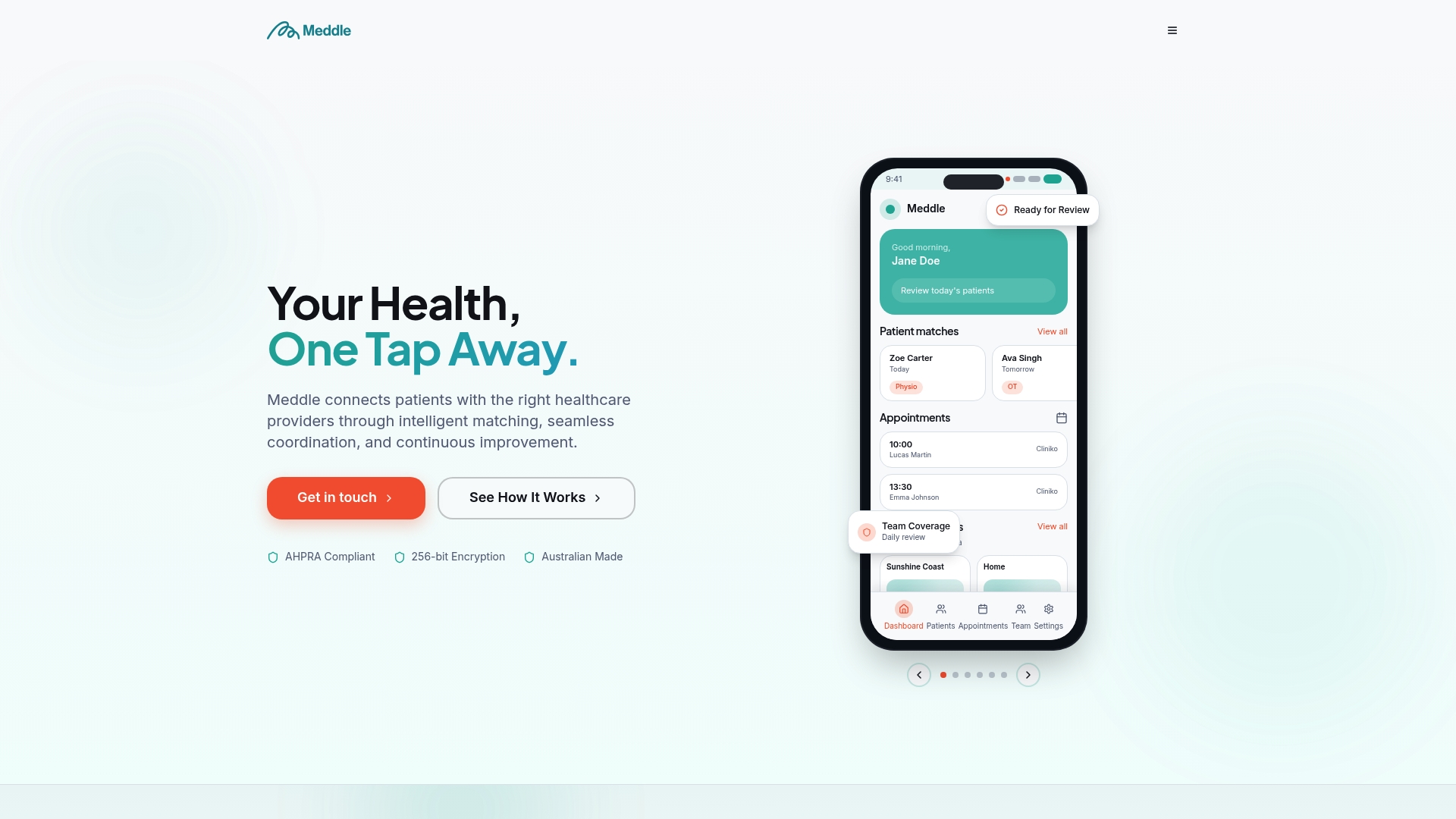
Meddle matches patients by discipline, location and the capacity each clinician has shared, then routes the referral; the clinic confirms the booking. When clinicians keep their shared capacity up to date, the practice dashboard gives you a current picture of demand against capacity, with per-practitioner reporting, rather than one reconstructed from memory on a Tuesday morning. Referral routing cuts the friction that quietly extends TNA in clinics still relying on fax-and-phone referral loops. Rollout starts simply, with plans from $40 per practitioner per month (ex GST, $250 monthly minimum, SMS and email notifications included), and Meddle works alongside your practice software, so you don’t have to overhaul your existing systems.
If your clinic is ready to see what your real third next available appointment number looks like, check Meddle’s practitioner benefits and get your team measuring properly from week one.
Sources
If you want to check the numbers or brief your team, these are the primary references behind this article:
-
RACGP — Appointments 101 – how to shape a more effective appointment system
-
Third Next Available — WellSouth continuous improvement toolkit
FAQ
How many patients does a GP typically see in a day?
Caseloads vary widely by clinic and consultation length. This has less bearing on TNA directly than scheduling structure and carve-out policy do.
What scheduling model has multiple patients arriving at the same time, such as three per hour?
This describes wave scheduling, sometimes called block scheduling, where several patients are booked for the same start time and seen in the order they arrive or as capacity allows. It differs from open-access scheduling, which is one of the improvement tactics that tends to lower TNA over time.
Is seeing 20 patients a day too much for a GP?
There’s no universal answer since it depends on consultation length, case complexity, and support staff. What matters more for access is whether your third next available appointment stays within the moderate range rather than climbing past a week.
Why measure the third available appointment instead of the first?
The first available slot is highly volatile because a single cancellation can make it look artificially short. The third slot, as RACGP guidance confirms, gives a more stable and internationally recognised picture of real access.
Can a platform like Meddle help track TNA automatically?
It can help. Meddle matches and routes referrals against the capacity each clinician has shared, and its practice dashboard, with practitioner analytics, puts that in one view, which reduces the manual work around weekly TNA sampling. The TNA count itself still comes from your booking system.