How to verify patient identity online: a compliance-first guide
The most effective approach to online patient identity verification in Australia combines the Healthcare Identifiers Service (IHI/HPI), the Document Verification Service (DVS), and multi-factor authentication (MFA) into a layered workflow. That combination prevents duplicate records, blocks medical identity fraud, and satisfies your obligations under the Healthcare Identifiers Act 2010 and My Health Record regulations.
Start here. Before configuring any software, complete these four steps:
- Register your organisation’s Responsible Officer (RO) and Organisation Maintenance Officer (OMO) in PRODA/HPOS.
- Obtain your Healthcare Provider Identifier for Organisations (HPI-O) and apply for NASH PKI certificates or confirm your Clinical Service Provider (CSP) details.
- Enable IHI lookups in your clinical software and test against the HI Service staging environment.
- Integrate DVS for document checks and add MFA to all patient portal and My Health Record access points.
Pro Tip: For telehealth or rapid onboarding where a patient cannot present documents, request their Medicare number and date of birth to perform an IHI lookup, then issue an Identity Verification Code for My Health Record linking. This keeps friction low while meeting the “reasonable steps” standard.
Key takeaways
A layered approach combining IHI lookups, DVS document checks, and MFA covers the majority of compliance obligations and fraud risk for Australian healthcare providers deploying online patient identity verification.
| Point | Details |
|---|---|
| Start with governance, not software | Appoint your RO and OMO in HPOS before any technical integration; these roles are legally required and gate your HPI-O and NASH certificate access. |
| IHI lookup is the authoritative check | Validate an IHI before creating any clinical record or exchanging clinical data; it prevents duplicate records and is a conformance requirement. |
| DVS beats manual document inspection | The Document Verification Service returns a yes/no against issuer records without storing document images, reducing privacy risk and improving reliability. |
| MFA is non-optional for portals | Apply TOTP-based MFA to all patient portal and My Health Record access points; use step-up MFA for e-prescribing and controlled-substance workflows. |
| Meddle reduces post-verification admin | After identity is confirmed, Meddle’s AI matching and booking platform connects patients to the right practitioner and cuts front-desk coordination time. |
Table of Contents
- How to verify patient identity online: the core methods
- Where each method fits in your clinical workflows
- Australian legal and national systems you must comply with
- Technical checklist for deploying online patient identity verification
- How to choose a verification vendor or decide to build in-house
- Common failure modes and how to prevent them
- How to verify patient identity over the phone
- Why this guide prioritises the HI Service, My Health Record, and RO responsibilities
- The trade-offs that actually matter in implementation
- Meddle supports your patient onboarding after verification is done
- Sources
- FAQ
How to verify patient identity online: the core methods
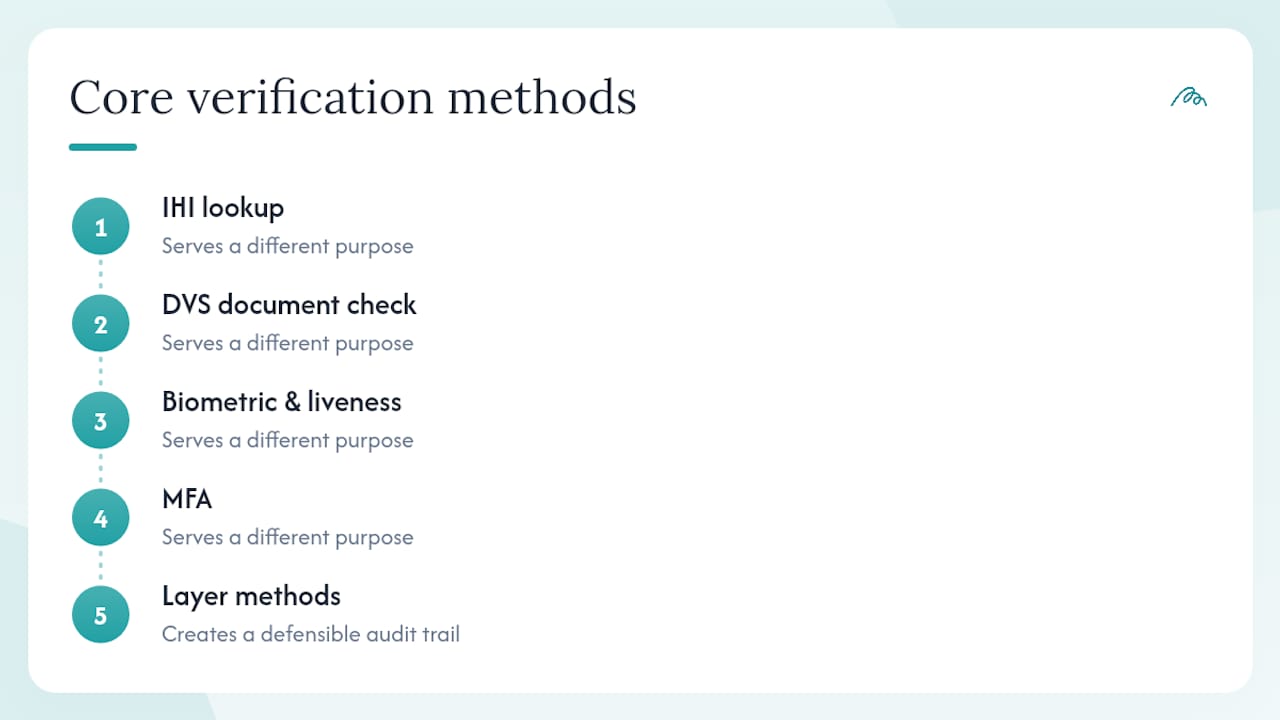
Knowing which verification technique to apply, and when, is where most clinics get it wrong. The four main methods each serve a different purpose, and layering them is what creates a defensible audit trail.
Document verification via DVS
The Document Verification Service checks a patient’s biographical details (name, date of birth, document number) against the original issuer’s records and returns a simple yes or no. It does not store document images, which means you avoid the privacy risk of holding copies of passports or driver licences. DVS supports a wide range of Australian documents including Medicare cards, passports, and state-issued licences. Use it at new-patient registration and whenever a patient’s identity cannot be confirmed through Medicare matching alone.
Healthcare Identifier (IHI/HPI) lookups
Healthcare identifiers are persistent, purpose-built identifiers assigned under the Healthcare Identifiers Act. The Individual Healthcare Identifier (IHI) is the authoritative way to match a patient record to a real individual in Australian clinical workflows. IHIs are assigned automatically for Medicare and Department of Veterans’ Affairs recipients and can be requested for others. Validate an IHI before any clinical data exchange. This single step prevents duplicate records and is a conformance requirement for clinical software connecting to My Health Record.
Biometric and liveness checks
Biometric proofing, typically a selfie matched against a document photo combined with a liveness challenge, is appropriate for high-assurance onboarding: telehealth platforms handling controlled substances, mental health portals with sensitive records, or any service where a patient cannot attend in person. Liveness checks counter replay attacks by requiring real-time interaction rather than a static image. That said, biometrics are not required for every patient interaction. Routine GP portal access or appointment booking does not warrant the added friction.
Knowledge-based authentication (KBA) and why to avoid it alone
KBA asks patients to answer questions drawn from credit or public records. It is fast to deploy but weak in practice. Synthetic identities and data breaches mean an attacker can often answer KBA questions correctly. Never rely on KBA as the sole verification method for healthcare enrolment or record access. Use it only as a supplementary signal alongside a stronger check.
Multi-factor authentication (MFA) and step-up flows
MFA is non-optional for patient portals and My Health Record access. Authenticator apps (TOTP-based, such as Google Authenticator or Microsoft Authenticator) are preferable to SMS one-time passwords, which are vulnerable to SIM-swap attacks. For sensitive actions such as e-prescribing or accessing controlled-substance records, implement step-up authentication: require a second factor at the point of that specific action, not just at login.
Pro Tip: Combine methods at the right stage. New-patient registration warrants DVS plus IHI lookup plus MFA setup. Returning portal access needs MFA only. E-prescribing warrants step-up MFA. Matching the method to the risk level keeps patient friction manageable and your audit trail clean.
Where each method fits in your clinical workflows
Different clinical actions carry different identity risk. Applying the same verification level everywhere creates unnecessary friction; applying too little creates liability.
Patient intake and new-patient registration
- Collect full legal name, date of birth, Medicare number, and address.
- Run a DVS check on at least one government-issued document.
- Perform an IHI lookup to confirm the identifier before creating a clinical record.
- Set up MFA for the patient’s portal account before they leave (or send a setup link for telehealth onboarding).
Patient portal access and My Health Record linking
My Health Record linking uses two pathways. The primary route is Medicare matching via myGov: the patient signs into myGov, selects My Health Record under linked services, and the system matches their Medicare details. Where Medicare matching is unavailable, the patient can request an Identity Verification Code by phone from Services Australia and use that code to complete linking. Your portal should prompt patients to complete linking at registration and confirm their IHI is active before granting record access.
Telehealth identity proofing
Telehealth presents the highest impersonation risk because no in-person check occurs. A practical minimum: confirm Medicare number and date of birth, run an IHI lookup, and require MFA on the telehealth platform. For higher-risk consultations (mental health, controlled substances), add a liveness check via a biometric provider before the session begins.
E-prescribing and controlled medicines
Step-up MFA is required at the point of prescribing. The prescribing practitioner must have a validated HPI-I and NASH certificate or CSP linkage active. Retain the verification event in your audit log with timestamp, method used, and outcome.
Insurance and claims fraud prevention
Flag any mismatch between the IHI returned by the HI Service and the details on the claim. Retain DVS response records and IHI lookup logs as evidence. Set automated alerts for duplicate IHI matches across claims within a defined period.
Australian legal and national systems you must comply with
Healthcare Identifiers Service (IHI, HPI-I, HPI-O)
The HI Service, administered by Services Australia, assigns and maintains IHIs for patients and Healthcare Provider Identifiers for individual practitioners (HPI-I) and organisations (HPI-O). These identifiers are the backbone of safe clinical data exchange in Australia. The Healthcare Identifiers Act 2010 governs what identifying information may be collected, how it must be recorded, and what verification evidence must be retained. Organisations must record whether identity has been verified and by which method, for example a DVS response or the specific document used.
My Health Record linking
My Health Record is Australia’s consumer-controlled national electronic health record. Identity verification underpins both record linking and controlled access. Patients link via myGov using Medicare matching or an Identity Verification Code. Organisations access records through HPOS/PRODA with NASH certificates or CSP credentials. Unauthorised access is a legislative breach, not merely a policy failure.
PRODA, HPOS, and organisational roles
Individual practitioners need a PRODA account to access HPOS, which is the gateway to HI Service registration, HPI-I and HPI-O management, and My Health Record organisation access. Every organisation must appoint a Responsible Officer (RO), who is legally accountable for the organisation’s use of the HI Service, and an Organisation Maintenance Officer (OMO), who manages day-to-day access lists and certificate requests. These roles are not optional administrative titles; they are gating requirements for registration and carry legal accountability.
NASH PKI certificates and CSP approach
NASH (National Authentication Service for Health) PKI certificates authenticate clinical software to national systems. Organisations can obtain NASH certificates directly through HPOS or connect via a certified Clinical Service Provider (CSP), which manages certificate infrastructure on the organisation’s behalf. Smaller practices typically find the CSP route lower overhead; larger health services with dedicated IT teams often manage NASH certificates directly.
OAIC “reasonable steps” standard
The Office of the Australian Information Commissioner (OAIC) requires organisations to take “reasonable steps” to protect healthcare identifiers and personal health information. In practice, that means preferring authoritative checks (IHI lookups, DVS) over manual document inspection, embedding verification into clinical software rather than relying on staff memory, and maintaining audit logs that demonstrate what was checked and when.
Pro Tip: Store your DVS response records and IHI lookup logs in a system that timestamps and locks entries against editing. The Healthcare Identifiers regulations require you to record the verification method and outcome; a tamper-evident log satisfies that requirement and protects you in any audit or dispute.
| Obligation | Governing instrument | Practical action |
|---|---|---|
| Record verification method and outcome | Healthcare Identifiers Act 2010 and regulations | Log DVS response, IHI lookup result, and document type used for each patient |
| Appoint RO and OMO | My Health Record Act 2012 and HPOS registration requirements | Register roles in HPOS before applying for HPI-O or NASH certificates |
| Protect healthcare identifiers | Healthcare Identifiers Act 2010, OAIC guidance | Use IHI lookups and DVS; avoid manual document copies where possible |
| Manage authorised staff access | My Health Record organisation registration requirements | Maintain and audit the authorised staff list; de-provision immediately on exit |
| Retain evidence of verification | Healthcare Identifiers regulations | Keep timestamped, tamper-evident logs for the duration required by your state’s health records legislation |
Technical checklist for deploying online patient identity verification
Pre-deployment
- Assign your RO and OMO and register both in HPOS.
- Register your HPI-O through HPOS; confirm your organisation’s legal name and ABN match exactly.
- Apply for NASH certificates via HPOS or engage a CSP and confirm certificate installation in your clinical software.
- Set up PRODA accounts for all practitioners who need HI Service or My Health Record access.
- Confirm your clinical software vendor’s conformance status with the Australian Digital Health Agency.
Integration options
- API/SDK integration: Connect your patient portal or intake system directly to the HI Service API for IHI lookups and to the DVS API for document checks. Requires AU-hosted infrastructure or a certified cloud environment with data residency controls.
- Middleware/integration engine: Use an HL7 FHIR-compatible middleware layer to route IHI lookups and DVS calls from your EMR without modifying core clinical software.
- Direct EMR integration: Many major clinical software packages (Best Practice, Medical Director, Genie) have built-in HI Service connectors. Confirm the connector version is current and conformance-tested.
Per Australian Digital Health Agency implementer guidance, validate a patient’s IHI before any clinical data exchange and configure your system to handle IHI status codes (active, retired, unverified) correctly.
Testing and conformance
- Run IHI lookups against the HI Service staging environment before go-live.
- Test DVS flows with sample document data in the DVS test environment.
- Conduct liveness check testing in a controlled environment with varied lighting and device types.
- Verify that your audit log captures the verification method, timestamp, operator ID, and outcome for every transaction.
Operational controls and go-live checklist
- Write helpdesk scripts for common failure scenarios: IHI not found, DVS mismatch, MFA lockout.
- Define a fallback flow for patients who cannot complete online verification (phone-based Identity Verification Code, in-person document check).
- Set up automated alerts for duplicate IHI matches and failed verification thresholds.
- Schedule a 30-day post-go-live audit of verification logs to catch configuration gaps.
How to choose a verification vendor or decide to build in-house
Procurement decisions for identity verification tooling carry compliance consequences, not just technical ones. Use these criteria before signing any contract.
- Accuracy metrics (FAR/FRR): Require independent assessment of the vendor’s False Accept Rate and False Reject Rate for biometric and liveness components. Vendor-supplied figures alone are insufficient; ask for third-party test results or iBeta certification where available.
- AU data residency: Confirm that identity documents, biometric data, and verification logs are processed and stored in Australia. This is a requirement under the Privacy Act 1988 for sensitive health information and a practical necessity for OAIC compliance.
- DVS integration: Confirm the vendor connects to the Australian Government’s DVS (via IDMatch) rather than a proprietary document database. Only DVS provides a yes/no check against original issuer records.
- EMR and My Health Record connectors: Native connectors to your existing clinical software reduce integration time and conformance risk. API-only vendors require more internal development effort.
- Audit trail and evidence retention: The vendor’s platform must produce tamper-evident, exportable logs that record the verification method, timestamp, operator, and outcome. Confirm log retention periods match your state’s health records legislation.
- NASH/PRODA workflow support: Confirm the vendor understands NASH certificate management and PRODA-based access controls, particularly if they are managing certificate infrastructure on your behalf as a CSP.
- Operational impact: Assess patient friction by running a pilot with real patients before full deployment. Track helpdesk call volume during the pilot; a spike in “I can’t log in” calls signals a UX problem that will erode adoption.
Pricing shapes to budget for: Per-verification fees (typical for DVS and biometric checks), monthly subscription tiers (common for portal MFA and identity orchestration platforms), and one-off integration or professional services fees. Request a full cost model including staging, testing, and ongoing support before comparing vendors.
Pro Tip: Require a proof-of-concept using your actual patient workflows, not a vendor demo environment. A two-week pilot with 50 real patient onboarding events will surface integration gaps, edge cases in IHI status handling, and patient friction points that no demo will show you.
Common failure modes and how to prevent them
Synthetic and stolen identities
Synthetic identities combine real and fabricated details, often using a legitimate Medicare number with a different name or date of birth. Detection heuristics: flag any IHI lookup that returns an “unverified” status, any DVS check where the name does not match the Medicare record, or any new registration where the document number has been used before. Escalate these cases to manual review before creating a clinical record.
Deepfake and replay attacks on biometric systems
Static photo matching without liveness detection is vulnerable to printed photos and video replay. Require active liveness challenges (head turn, blink, spoken phrase) rather than passive selfie matching. For high-risk workflows, use challenge-response liveness that changes with each session so a recorded video cannot be replayed.
Over-reliance on SMS one-time passwords
SMS OTP is better than no MFA, but SIM-swap fraud is a documented attack vector in Australian financial and health services. Where your patient population can support it, move to TOTP authenticator apps. For patients who cannot use an authenticator app, combine SMS OTP with a device fingerprint check as a compensating control.
Operational pitfalls: role mismanagement and delayed de-provisioning
The most common compliance failure in Australian health services is not a technical breach; it is a former staff member retaining access because the OMO was not notified promptly. Implement an immediate de-provisioning workflow triggered by HR offboarding. Audit the authorised staff list in HPOS quarterly. The organisation registration checklist identifies RO/OMO role maintenance as a gating compliance item, and it is one of the most commonly overlooked.
Insufficient logging
An audit trail that records only “verification passed” is not sufficient under the Healthcare Identifiers regulations. Logs must capture the method used, the document type or identifier checked, the operator ID, and the timestamp. Without that granularity, you cannot demonstrate compliance in a dispute or OAIC inquiry.
How to verify patient identity over the phone
Phone verification remains necessary for patients who cannot complete online flows. A structured approach keeps it both secure and auditable.
Minimum evidence to capture on every call:
- Full legal name and date of birth.
- Medicare number (or DVA number where applicable).
- Address on file (suburb and postcode at minimum).
- A callback number that matches the record.
When Medicare matching is unavailable, direct the patient to contact Services Australia to request an Identity Verification Code for My Health Record linking. Record in the audit log that the code pathway was used and the date of the call.
Sample script for frontline staff:
- “Can I confirm your full legal name and date of birth?”
- “Can I confirm your Medicare number and the name on your Medicare card?”
- “Can I confirm your current address, including suburb and postcode?”
- “I’m going to check those details against our records now. Please hold for a moment.”
- (Run IHI lookup or cross-check against existing record.)
- “Thank you, I’ve confirmed your identity. I’ll note this verification in your record.”
When to escalate: If any detail does not match, do not proceed. Ask the patient to attend in person with a government-issued photo ID, or direct them to complete a DVS-backed online verification flow. Record the failed attempt, the discrepancy type (without logging the incorrect detail itself), and the escalation action taken.
Log every phone verification event: date, time, staff ID, verification method used, outcome, and any escalation action. This log entry is your evidence of “reasonable steps” if the verification is later questioned.
Why this guide prioritises the HI Service, My Health Record, and RO responsibilities
The recommendations in this guide are grounded in Australian government policy and legislation, not vendor marketing. Here is the evidence base:
- The Healthcare Identifiers Act 2010 and its regulations are the primary legal instrument governing what identifying information may be collected, how verification must be recorded, and what evidence must be retained. Every compliance claim in this guide traces back to that legislation.
- The Healthcare Identifiers Service, administered by Services Australia, is the authoritative source for IHI, HPI-I, and HPI-O assignment and maintenance. IHI validation is a conformance requirement for clinical software connecting to national systems.
- My Health Record guidance from the Australian Government Department of Health and Aged Care treats identity verification as foundational to safe clinical data exchange and the prevention of duplicate records and unauthorised access.
- The DVS (IDMatch) is the Australian Government’s own privacy-preserving document check service. Recommending it over proprietary alternatives reflects both its legislative backing and its privacy design.
- RO and OMO roles are legally required under the My Health Record Act 2012 and are gating items for organisation registration. Governance failures at this level are the most common operational compliance gap in Australian health services.
The Australian Digital Health Agency’s position is clear: patient identity verification is a legislative cornerstone of the national digital health ecosystem, and technical choices must align with national systems rather than operate independently of them.
The trade-offs that actually matter in implementation
Most clinics approach identity verification as a technical project. The harder part is governance. Getting the RO and OMO appointed, NASH certificates installed, and HPOS access configured correctly takes longer than any software integration, and it is where projects stall.
The sequencing that works in practice: start with IHI lookups and DVS integration, add MFA to portals, and get your audit logging right. Those three steps cover the majority of your compliance obligations and the majority of your fraud risk. Biometrics and advanced liveness detection are worth adding later, particularly for telehealth and controlled-substance workflows, but they should not delay your initial go-live.
Where clinics should invest first: the RO/OMO appointment and PRODA/HPOS setup. Without those, nothing else can proceed. Where to defer: biometric proofing for low-risk workflows, advanced analytics on verification events, and custom identity orchestration platforms. A well-configured DVS plus IHI lookup plus TOTP MFA will handle the vast majority of patient identity risk at a fraction of the cost and complexity of a full biometric stack.
The gap between what vendors promise and what clinics actually need is wide. Most allied health practices do not need enterprise-grade identity orchestration. They need IHI lookups working in their existing clinical software, DVS integrated at intake, and MFA on their patient portal. Start there.
Meddle supports your patient onboarding after verification is done
Once identity is confirmed, the next challenge is getting patients to the right practitioner quickly and without administrative overhead. That is where Meddle fits.
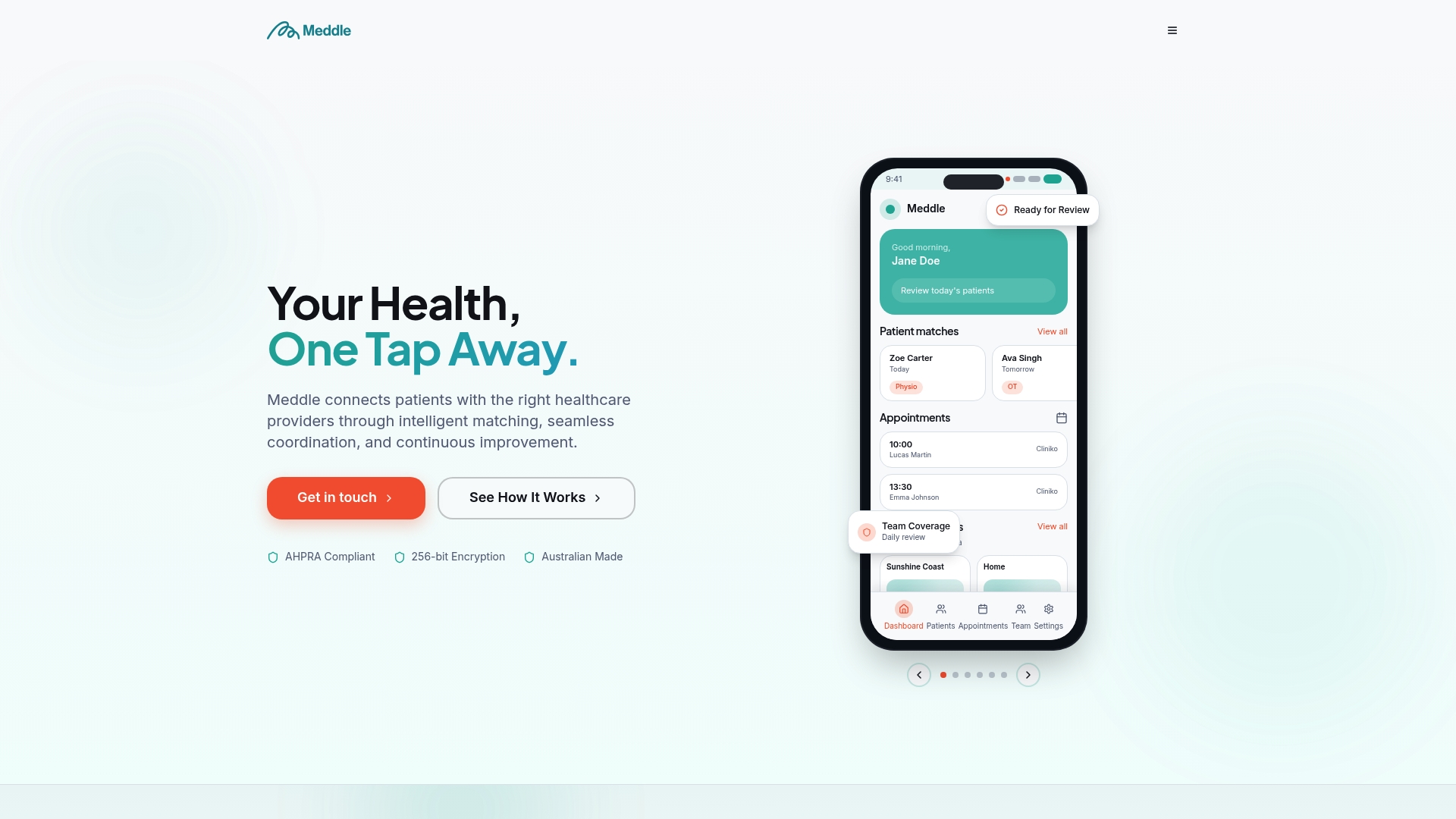
Meddle is an AI-powered healthcare coordination platform built for allied health clinics across Australia. After your verification workflow confirms a patient’s identity, Meddle takes over the coordination layer: algorithmic matching connects patients to the right practitioner based on their needs and your availability, instant booking removes the back-and-forth, and referral automation reduces the admin load on your front desk. Clinics using Meddle report meaningful reductions in admin hours per week, and the platform’s practitioner benefits include a practice management dashboard that keeps onboarding, scheduling, and care coordination in one place.
Pricing starts from A$40 per practitioner, with no long-term lock-in, making it straightforward to add alongside your verification tooling without a separate procurement process. See how the platform works and book a demo at Meddle.
Sources
These are the primary Australian government and authoritative resources for configuration, registration, and legal obligations:
- Healthcare Identifiers and the Healthcare Identifiers Service | Australian Government Department of Health, Disability and Ageing
- Legislation
- Link my Health Record — myGov help
- IDMatch — Identity Verification Services (Document Verification Service)
- Healthcare Identifiers (HI) Service for individual health care providers — Services Australia
This article is general information, not a substitute for advice from a qualified lawyer. Consult a qualified legal professional about your own circumstances before acting on anything here.
FAQ
How do you verify patient identity online in Australia?
Use a layered approach: run an IHI lookup via the Healthcare Identifiers Service, perform a DVS document check through IDMatch, and require MFA on all portal and My Health Record access points. Record the method and outcome in a tamper-evident audit log.
How do you verify patient identity over the phone?
Confirm full legal name, date of birth, Medicare number, and address, then cross-check against your clinical record or run an IHI lookup. If My Health Record linking is needed and Medicare matching is unavailable, direct the patient to request an Identity Verification Code from Services Australia.
What are the three main ways to confirm patient identity?
The three primary methods are document verification (DVS check against issuer records), healthcare identifier lookup (IHI validation via the HI Service), and multi-factor authentication for portal and record access. Combining all three provides the strongest assurance and the most defensible audit trail.
What is an Identity Verification Code for My Health Record?
It is a code issued by Services Australia that allows a patient to link their My Health Record via myGov when Medicare matching is not available. Patients request it by phone, and it is used as an alternative linking pathway during portal registration or phone-based onboarding.
Do allied health clinics need NASH certificates to access My Health Record?
Yes. Organisations must obtain NASH PKI certificates through HPOS or connect via a certified Clinical Service Provider (CSP) to authenticate their clinical software to My Health Record and the HI Service. This requires a registered HPI-O and appointed RO and OMO.