3 Essentials to Prevent Double Bookings in Australian Healthcare APIs

A healthcare booking API must guarantee three things: real-time slot accuracy, atomic transactional booking, and reliable reconciliation with downstream systems. The right approach is a standards-first, FHIR-aware integration with idempotency, temporary holds, and active monitoring rather than a fragile point-to-point connection. In Australia, that means accounting for eReferral and My Health Record obligations from day one. Some platforms are built around this model.
TL;DR:
Most healthcare booking APIs risk failures due to identity, status, timing, or stale data mismatches, causing silent booking errors and manual work.
Implementing real-time availability, idempotency keys, and reconciliation jobs significantly reduces duplicate bookings and booking failures.
For compliance with systems like Australia’s My Health Record, APIs must support consent, use OAuth2, and enable capability discovery before go-live.
Integration complexity outweighs API design, with reconciliation, monitoring, and error handling being critical for a reliable booking system.
Platforms like Meddle offer matching and referral routing that work alongside your practice software, with the clinic confirming each booking, so there is less custom booking code to support.
Table of Contents
Which integration model fits your healthcare booking API?
Three integration models dominate healthcare appointment API projects, and all trades speed against control.
Widget embeds drop a booking calendar into an existing site or app with minimal engineering effort. You get a live appointment slot picker in days, not months, but you inherit the vendor’s data model, branding limits, and EHR coverage. Most widgets talk to one practice-management system well and everything else poorly.
API-connected platforms sit between raw EHR integration and a widget. You call a documented REST or FHIR API, control your own UI, and the vendor handles the messy translation layer to individual practice-management systems. The trade-off is coverage and service-level commitments: check exactly which EHRs the vendor supports natively versus through workarounds.
Custom EHR integration gives full control over data flow, consent handling, and error recovery, built directly against a practice-management system’s native interface. It costs the most in engineering time and ongoing maintenance, since EHR vendors change schemas without much notice.
-
Time-constrained teams: widget embed
-
Teams needing UI control with reasonable timelines: API-connected platform
-
Teams with compliance obligations spanning multiple EHR vendors: custom integration, budgeted for ongoing maintenance
What standards should a healthcare scheduling API follow?
FHIR defines three resources that matter for scheduling: Schedule (a practitioner or resource’s bookable calendar), Slot (a discrete bookable time window with a status of free, busy, or busy-tentative), and Appointment (the confirmed booking linking patient, practitioner, and slot). A well-designed patient scheduling API exposes a CapabilityStatement so consuming systems can discover which resources and search parameters it actually supports before writing a single line of integration code.
The NHS Booking and Referral FHIR API is a useful reference implementation: it exposes endpoints for retrieving slots, processing booking and referral messages, and demonstrates the redirect based workflow pattern many national systems now favour.
In Australia, referral and scheduling systems need to go further. Referral systems should support authoring and consuming clinical documents in FHIR formats, and be able to upload referral content to My Health Record while respecting patient consent at every step. For HL7 V2 referral messaging specifically, Australia maintains a dedicated HL7 V2 e-referral implementation profile built around AS 4700.6, and it doubles as a testing profile for conformance.
-
Design consent flags as first-class fields, not metadata bolted on later
-
Use OAuth2 with scoped tokens for any national service integration
-
Where mutual TLS or client certificates are mandated, provision them early since approval cycles run long
-
Treat capability discovery as mandatory, not optional, before go-live
Healthdirect’s Provider Appointments API requires formal onboarding and contextualised, real-time booking URLs to keep the consumer’s journey consistent end to end. Budget weeks, not days, for that approval process.
How do EHR integrations fail, and how do you prevent it?
Four connection options exist for healthcare API integration with practice-management systems: native EHR APIs (rare and inconsistent), aggregator or FHIR intermediary layers, PMS connectors modelled on Healthengine’s approach, and browser automation for systems with no API at all. That last option sounds crude, but it’s a legitimate fallback: browser automation can expose API-like access to scheduling interfaces that vendors never built an integration for.
Four failure modes cause most real-world outages:
-
Identity mismatch: a patient or practitioner record exists under different identifiers across systems, causing bookings to attach to the wrong record.
-
Semantic mismatches: one system’s “confirmed” status means something different in another, silently corrupting downstream logic.
-
Timing and race conditions: two booking requests hit the same slot within milliseconds of each other.
-
Stale availability: cached slot data goes out of sync with the source EHR, so patients book times that no longer exist.
The operational cost is real. Duplicate bookings burn reception time, claim rejections cascade from mismatched patient identifiers, and every unresolved case lands in a manual work queue someone has to clear by hand. Broken healthcare API integrations create exactly these silent failures, where an endpoint returns a 200 response while the actual booking workflow fails downstream.
Pro Tip: Build a canonical identifier mapping layer between every connected system before you write booking logic. Retrofitting identity resolution after launch is far more painful than designing for it up front.
Mitigate with canonical identifiers resolved at the integration boundary, explicit mapping layers between status vocabularies, idempotency keys on every write operation, and a final confirmation step that re-checks slot availability immediately before committing.
Implementation checklist for reliable booking integrations
Ship a healthcare reservation API in this order:
-
Design the resource model around FHIR Schedule, Slot, and Appointment, with explicit versioning from the first release.
-
Define your error model with specific status codes for slot-taken, validation failure, and downstream-system-unavailable conditions, not a generic 500 for everything.
-
Build idempotency into every write path using a client-supplied idempotency key so retried requests never create duplicate bookings.
-
Choose your event model. Webhooks suit real-time booking confirmations; polling suits lower-frequency availability syncs. Healthengine’s PMS API model uses dedicated request endpoints for bookings and flags an integration unhealthy if critical requests like availability or bookings aren’t acknowledged promptly, supporting both webhooks and polling depending on the request type.
-
Secure webhooks with signature verification and implement exponential backoff retries for failed deliveries.
-
Test end-to-end, not just unit level: simulate double-bookings, expired holds, and out-of-order webhook delivery.
-
Monitor business outcomes, not just uptime.
| Metric | What it reveals | Target behaviour |
|---|---|---|
| Booking completion rate | Share of started bookings that reach confirmation | Investigate any sustained drop |
| Reconciliation rate | Bookings matching correctly across systems | Should approach full alignment |
| Duplicate-booking rate | Race conditions or retry failures | Should trend near zero |
| Time-to-acknowledge | Speed of critical request handling | Minutes, not hours |
Monitoring endpoint uptime alone misses this entirely. As the CapMinds analysis notes, business-level monitoring that tracks booking completion and reconciliation is what catches failures a green health check dashboard hides. For deeper workflow context on how booking confirmations should behave for patients, see this clinical workflow guide to instant appointment booking.
How do you prevent double-bookings in a healthcare API?
Transactional integrity is the hardest part of any appointment scheduling API, and it’s where most integrations quietly fail.
Start with slot holds: when a patient begins checkout, place a time-limited reservation (60 to 120 seconds is typical) on that slot so a second user can’t claim it mid-transaction. Release the hold automatically on timeout or explicit cancellation.
Every booking write needs an idempotency key, generated deterministically from the request context so retried calls (from network timeouts, client retries, or webhook redelivery) resolve to the same outcome instead of creating a second appointment. Pair that with a correlation ID that threads through every system the booking touches, from initial request to EHR write to confirmation receipt.
-
Log every state transition with a timestamp and actor for audit purposes
-
Build a reconciliation job that replays uncertain transactions on a schedule, not just on failure alerts
-
Issue a confirmation receipt to the patient only after the source-of-truth system acknowledges the write
-
Surface reconciliation status to admin users, not just developers, so front-desk staff can see what’s pending
Pro Tip: Never confirm a booking to the patient before the practice-management system has acknowledged it. An optimistic confirmation followed by a silent failure is worse for trust than a slightly slower booking flow.
Reconciliation isn’t a one-time build. Uncertain transactions, ones where the request timed out and you don’t know if it landed, need a replay strategy that checks the source of truth before deciding whether to retry, cancel, or escalate to a human.

How Meddle approaches healthcare booking integration
Meddle connects patients to allied health practitioners through algorithmic matching: it matches by discipline, location and the capacity each clinician has shared, then routes the referral, and the clinic confirms the booking. The match is only useful if the clinic’s booking layer underneath is genuinely transactional, which is why the clinic’s own system stays the source of truth.
Practically, that means:
-
Matching against the capacity each clinician has shared, tied to the patient’s stated needs
-
A clinic confirmation step, so a routed referral never creates the double-booking and stale-slot problems covered above
-
Privacy and consent handling, designed to align with applicable requirements.
-
A practice dashboard giving clinics visibility into referrals and bookings.
Developers evaluating Meddle can review the platform overview for how matching, referral routing and booking fit together. Meddle works alongside your practice software, so ask what integration options are available for your stack today.
Why “just connect the API” is the wrong starting question
The conventional pitch on healthcare booking integration treats it like any other e-commerce checkout: expose an endpoint, take a booking, done. That framing fails the moment a real practice-management system enters the picture, because the hard problem was never the API contract. It’s reconciling two systems that disagree about what “confirmed” means.

Most teams underestimate how much engineering effort goes into the boring middle: identity mapping, status vocabulary translation, and reconciliation jobs that nobody demos in a sales call. The FHIR resources and HL7 profiles matter, but they’re table stakes, not the differentiator. What separates a booking integration that works from one that generates a support queue is whether someone designed for the failure case before launch, not after the first duplicate booking complaint.
If you’re prioritising anything first, prioritise reconciliation and monitoring over feature breadth. A booking API with three endpoints and airtight idempotency beats one with twenty endpoints and no visibility into whether bookings actually landed.
— Taylor
Get started integrating with Meddle
Meddle gives allied health clinics a matching and referral-routing layer that works alongside their practice software: it matches patients by discipline, location and the capacity each clinician has shared, and the clinic confirms each booking. That can mean less stitching together of a directory and a separate intake process.
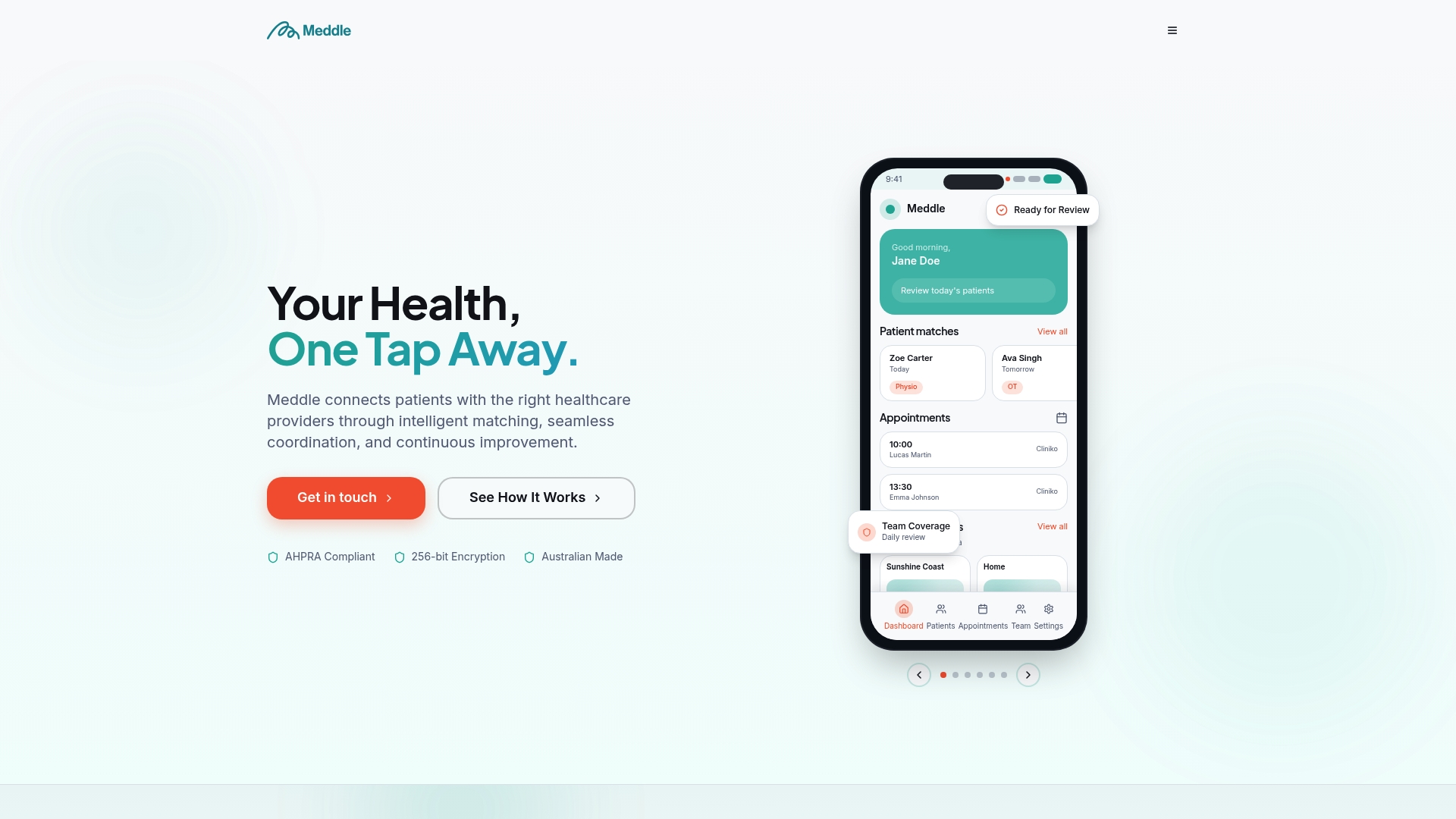
Getting started is straightforward: review the platform overview to understand how matching and booking connect, then reach out through Meddle’s main site to discuss integration options for your stack. Practices weighing telehealth against in-person workflows can also check the telehealth vs in-person advisor to plan which visit types suit each before committing engineering time.
This article is general information, not a substitute for advice from a qualified doctor. Consult a qualified healthcare professional about your own circumstances before acting on anything here.
Sources
-
HL7 V2 e-referral implementation profile – Digital Health Implementer Hub
-
Why healthcare API integrations fail and how to fix them – CapMinds
FAQ
What is a booking API?
A booking API is a programmatic interface that lets one system check availability and create, update, or cancel appointments in another system, typically returning structured responses like confirmed, slot-taken, or pending.
What is an API in healthcare?
In healthcare, an API is the technical interface that lets separate systems, such as a scheduling platform, an EHR, and a national referral service, exchange patient, appointment, or clinical data in a structured, standards-based format like FHIR or HL7.
Is there a free API for healthcare data?
Some government and national health services offer free-to-integrate APIs for specific purposes, such as Healthdirect’s Provider Appointments API for provider listings, but most require formal onboarding, approval, and adherence to specific technical and privacy standards rather than open public access.
What is API in scheduling?
An API in scheduling exposes availability data (via resources like FHIR Slot and Schedule) and booking actions programmatically, so external applications can display real-time openings and create appointments without manual staff intervention.
Does Meddle offer a healthcare booking API for clinics?
Meddle matches patients by discipline, location and the capacity each clinician has shared, then routes the referral; the clinic confirms the booking. It works alongside your practice software, and integration options depend on your stack, so confirm what is available today before planning engineering work.