Patient self scheduling: a practical guide for Australian clinics

TL;DR:
- Australian health services should adopt patient self scheduling selectively through small-scale pilots focusing on low-complexity visit types. Evidence shows that well-designed self-scheduling improves access, reduces administrative workload, and does not increase no-show rates when integrated with clinical systems.
Australian health services should adopt patient self scheduling selectively and start immediately with a narrow pilot. Open online booking for patients in well-defined, low-complexity visit categories first: follow-ups, routine tests, immunisations, and standard allied health appointments. The evidence is clear that this approach cuts admin hours, extends booking access beyond staff hours, and does not increase no-shows. The main operational risk is continuity of care when a patient books with a different clinician than their usual provider. Your first step: define a pilot scope of two to four visit types, nominate a project owner, and measure single-step booking rate and no-show rate over six to twelve weeks.
Table of Contents
- What the research shows: measured outcomes from real deployments
- Concrete benefits for administrators, clinicians, and patients
- Barriers, clinician concerns, and risks to manage during rollout
- Step-by-step implementation checklist for Australian health services
- Technical design: what your integration needs to get right
- Staffing, workflows, and training during rollout
- What to measure: KPIs, sample targets, and a simple ROI example
- How to choose a self-scheduling solution: procurement criteria and demo questions
- Typical timeline and budget considerations for Australian clinics
- Meddle: supporting safe self-scheduling in Australian allied health
- Key takeaways
- Why the evidence-first approach is the only responsible one
- Meddle makes the case for a smarter pilot
- Useful sources and further reading
- FAQ
What the research shows: measured outcomes from real deployments
The evidence base for patient self scheduling has grown substantially, and the headline findings are more nuanced than the marketing claims suggest. Three peer-reviewed studies provide the most useful benchmarks for Australian health administrators.
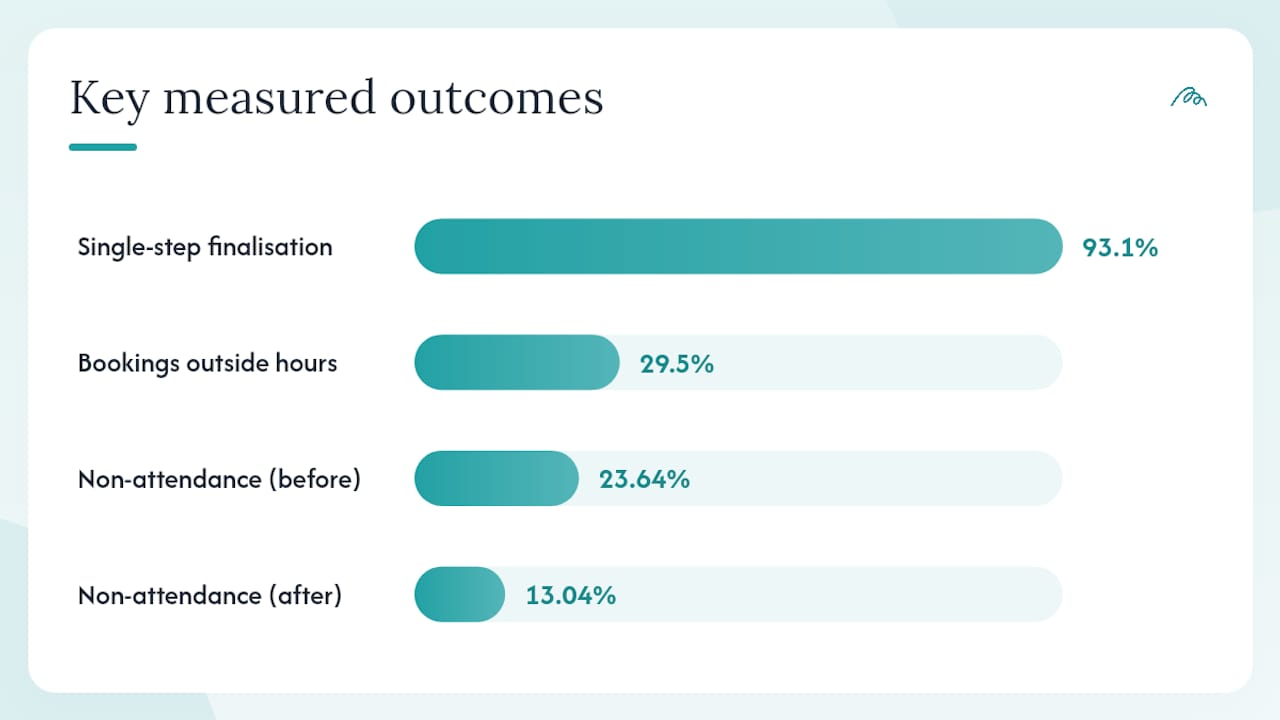
A large well-child appointment study published in JMIR Medical Informatics found that self-scheduling produced a 93.1% single-step finalisation rate, meaning nearly all patients who started a booking completed it without staff assistance. Critically, 29.5% of self-scheduling actions occurred outside usual staff hours, demonstrating that extending booking access genuinely captures demand that would otherwise go unmet or require a callback. No-show rates were not statistically different between self-scheduled and staff-scheduled appointments in that study.
93.1% of self-scheduled appointments were finalised in a single step, and 29.5% of bookings occurred outside standard staff hours, according to a peer-reviewed well-child appointment study.
In remote Australia, patient-led scheduling in a mental health practice delivered efficient session use, with missed and cancelled appointments averaging between 0 and 1.1 per patient. That result is particularly relevant for services in regional and remote settings where appointment waste carries a higher operational cost.
A UK outpatient physiotherapy study found that a patient-focussed bookings approach reduced non-attendance from 23.64% to 13.04%, while clinic utilisation rose and waiting times fell. The same study noted that clinicians perceived an initial administrative workload increase of 0.5–2 hours per week during the transition period.
| Metric | Well-child study | Remote mental health (Australia) | Outpatient physiotherapy |
|---|---|---|---|
| Single-step booking rate | 93.1% | Not reported | Not reported |
| Bookings outside staff hours | 29.5% | Not reported | Not reported |
| No-show / non-attendance change | No significant difference | 0–1.1 missed/cancelled per patient | Reduced from 23.64% to 13.04% |
| Admin workload during transition | Not reported | Not reported | +0.5–2 hrs/week (perceived) |
The pattern across studies is consistent: well-scoped self-scheduling programmes improve access and attendance without worsening no-shows, but the transition period carries a real, if temporary, admin cost.
Concrete benefits for administrators, clinicians, and patients
The benefits of patient self scheduling map to three distinct stakeholder groups, and your pilot success metrics should reflect all three.
Operational benefits for administrators:
- Reduced inbound call volume for routine bookings, freeing staff for complex scheduling and patient queries.
- Extended booking hours: nearly a third of bookings in the JMIR study occurred outside staff hours, capturing demand that would otherwise require callbacks.
- Higher fill rates through automated recall invites and real-time slot visibility.
- Reduced non-attendance: the physiotherapy study recorded a reduction in non-attendance from 23.64% to 13.04% after patient-focussed booking was introduced.
- KPI to track: admin hours saved per week, single-step booking rate, and fill rate.
Clinical benefits:
- Shorter waiting times when patients can self-select available slots rather than waiting for a callback.
- Better appointment preparation when confirmation messages include pre-visit instructions.
- Reduced clinician interruptions from scheduling queries during consult time.
- KPI to track: average days from booking request to appointment, patient satisfaction score.
Patient-experience benefits:
- 24/7 booking access without hold times.
- Ability to compare available times and choose what fits their schedule.
- Automated reminders reduce forgotten appointments.
- Patient-facing tools that match patients to the right practitioner before booking reduce the risk of a mismatched appointment.
- KPI to track: patient satisfaction (e.g., net promoter score or post-visit survey), repeat booking rate.
Pro Tip: Pair self-scheduling templates with provider-continuity rules from day one. Set a rule that established patients are offered their usual clinician’s slots first, and only surface other providers’ availability if no slot is available within a defined window (e.g., 14 days). This protects therapeutic relationships without blocking access.
Barriers, clinician concerns, and risks to manage during rollout
Self-scheduling is not universally suitable, and the risks are specific enough to plan for before you configure a single template.
Complexity and visit-type suitability
Large multispecialty practices face a fundamental complexity problem: the sheer number of unique visit types, each with different duration, equipment, room, and clinician requirements, makes most visits unsuitable for pure self-scheduling. In one multispecialty study, self-scheduled visit types accounted for only 4.0% of completed visits. Guideline-based visits, screening appointments, immunisations, and standard tests are the best early candidates because their booking rules are finite and automatable.
Only 4.0% of completed visits in a multispecialty, multisite practice were self-scheduled, reflecting how many visit types remain too complex for automated booking without staff intervention.
Multi-step bookings (e.g., a consultation followed by an in-house test requiring a specific room and equipment) are particularly prone to errors when the booking system cannot model all dependencies simultaneously.
Continuity of care
When a patient self-schedules with a different clinician because their usual provider has no available slot, continuity of care is at risk. This is not a hypothetical concern. In allied health and mental health settings, therapeutic continuity directly affects outcomes. Mitigation requires provider-continuity rules in the booking template and clear patient communication about when they are booking with a different practitioner.
Equity and digital access
Not all patients can use online booking for appointments. Older patients, those with limited English, patients in remote areas with poor connectivity, and those without smartphones or internet access are systematically disadvantaged by a self-scheduling-only model. Australian outpatient clinic research confirms that adoption drivers differ between organisations and patients, and that a design approach addressing both groups’ enablers and barriers is needed for equitable uptake.
Practical mitigations include:
- Keeping a phone booking channel open at all times as a fallback.
- Offering proxy booking for carers and family members.
- Providing multilingual booking interfaces or multilingual staff support for the phone channel.
- For telehealth contexts, ensuring patients understand consent to telehealth requirements before booking remotely.
Privacy and regulatory considerations in Australia
Patient booking data is personal health information under the Privacy Act 1988 (Cth) and the Australian Privacy Principles (APPs). Key obligations include:
| Obligation | Practical implication |
|---|---|
| APP 1 (open and transparent management) | Publish a clear privacy policy covering how booking data is collected, stored, and used. |
| APP 6 (use and disclosure) | Booking data must not be used for secondary purposes (e.g., marketing) without consent. |
| APP 11 (security) | Booking platforms must use encryption in transit and at rest; access must be role-controlled. |
| My Health Record interactions | If the booking system reads or writes to My Health Record, additional consent and governance obligations apply under the My Health Records Act 2012. |
Escalate to your privacy officer or legal counsel if your platform integrates with My Health Record, uses offshore data storage, or collects sensitive health information (e.g., mental health or reproductive health appointment types) during the booking flow.
Step-by-step implementation checklist for Australian health services
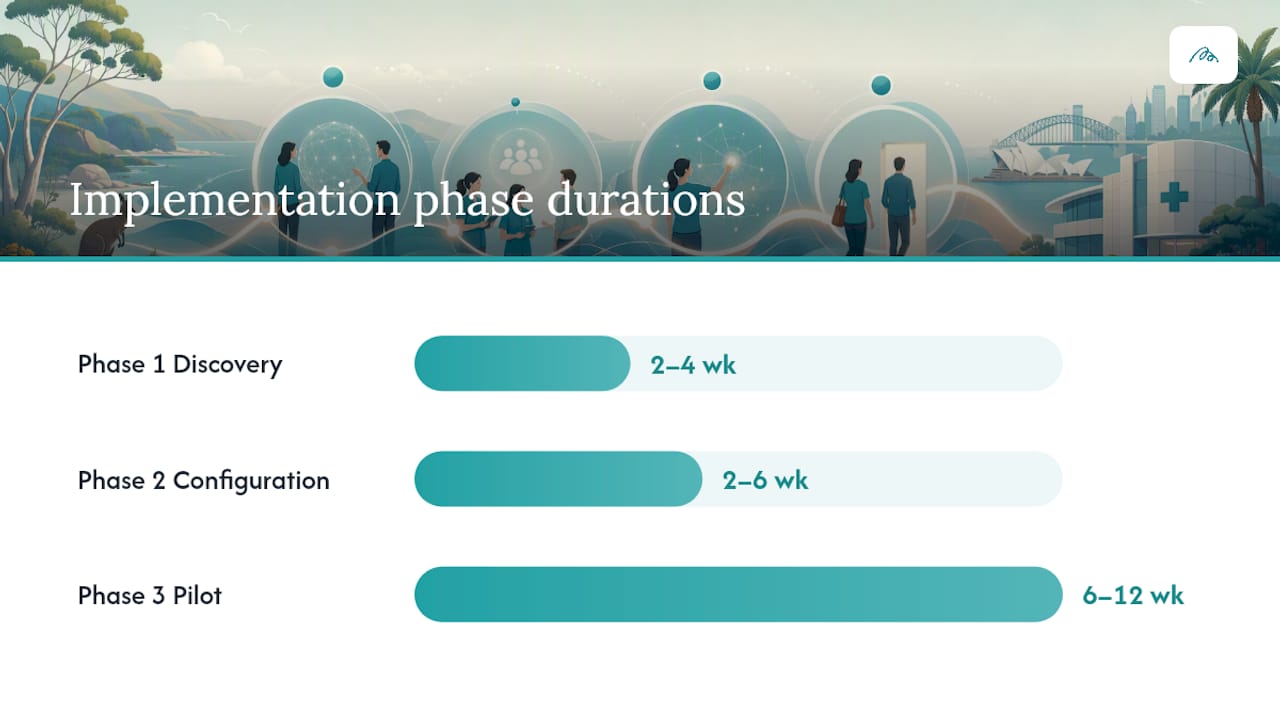
A phased approach reduces risk and builds internal confidence before you scale. The following checklist is structured around four phases.
Phase 1: Discovery (2–4 weeks)
- Map all current visit types and categorise each as: suitable for full self-scheduling, suitable for request-to-book, or staff-only.
- Identify the two to four visit types with the highest volume, simplest booking rules, and lowest clinical risk for the pilot.
- Audit your current clinical management system (CMS) or practice management system (PMS) for self-scheduling capability and API availability.
- Assign a project owner, a clinical lead, and a practice manager as the core implementation team.
- Document your current no-show rate, fill rate, and admin hours spent on scheduling per week as baseline metrics.
Phase 2: Configuration (2–6 weeks)
- Configure appointment templates for pilot visit types: set duration, lead time (minimum and maximum days in advance), provider-continuity rules, and eligibility criteria (e.g., established patients only).
- Set up SMS and email reminders at 48 hours and 24 hours before the appointment.
- Configure a fallback workflow: define who receives exception alerts, how quickly they must act (e.g., within 4 business hours), and how patients are notified of booking issues.
- Test the booking flow end-to-end, including edge cases: simultaneous double-book attempts, proxy bookings, and slots that require a specific room or piece of equipment.
- Complete a privacy impact assessment for the booking platform and confirm data residency is within Australia.
Phase 3: Pilot (6–12 weeks)
- Launch self-scheduling for the two to four selected visit types with established patients only.
- Communicate the new booking option to patients via SMS, email, and in-clinic signage.
- Brief all admin and clinical staff on the new workflow, exception process, and escalation path before go-live.
- Monitor weekly: single-step booking rate, no-show rate, bookings outside staff hours, and exception queue volume.
- Hold a 30-day checkpoint with the project team to review metrics and address any template or workflow issues.
Phase 4: Evaluation and scale (ongoing)
- At 12 weeks, compare pilot metrics against baseline. If single-step booking rate exceeds 80% and no-show rate has not increased, proceed to expand visit types.
- Gather patient and staff feedback through a short survey before scaling.
- Add visit types incrementally, applying the same configuration and testing discipline used in the pilot.
Technical design: what your integration needs to get right
The technology underneath patient self scheduling is where most implementation failures originate. A booking widget sitting in front of a static calendar is not self-scheduling. Real self-scheduling requires bidirectional, real-time integration with your clinical management system.
Integration essentials
Your platform must read live availability from the PMS or EHR in real time, not from a cached or manually updated calendar. It must write confirmed bookings back to the clinical schedule immediately, with an audit log of every booking action (who booked, when, what was changed). Practices that treat self-scheduling as an ecosystem (portal plus CMS integration plus a rule engine) report fewer reconciliation issues than those using standalone booking widgets, and the difference in downstream admin work is substantial.
Australian multi-practitioner clinics typically require custom integration work to apply real clinic rules at booking time. This is the most effort-intensive part of the project and should not be underestimated.
Reliability and fallback
Define what happens when the booking system is unavailable: patients must be routed to a phone channel, not left with a broken booking experience. Set up monitoring alerts for booking failures and reconciliation mismatches. Assign a staff member to review the exception queue at least twice daily during the pilot.
Pro Tip: Before go-live, run a structured edge-case test session covering: a multi-provider booking where one provider becomes unavailable mid-flow; a simultaneous double-book attempt on the same slot; and an allied health booking that requires a specific piece of equipment. Document the outcome of each and fix any failure before opening to patients.
Staffing, workflows, and training during rollout
The biggest predictor of a smooth rollout is not the technology. It is whether your staff understand the new workflow before the first patient uses it.
Defining roles and responsibilities
- Project owner: accountable for the overall rollout timeline, vendor relationship, and escalation decisions. Usually a practice manager or operations lead.
- Clinical lead: responsible for approving which visit types are suitable for self-scheduling and for managing clinician concerns. A senior clinician or department head.
- Practice manager: manages day-to-day configuration, staff training, and the exception queue during the pilot.
- Helpdesk / reception lead: first point of contact for patient booking queries and for triaging booking errors.
- Escalation path: define a clear chain for issues that cannot be resolved at reception level (e.g., a booking that has created a clinical risk).
Training checklist
- Run a 60-minute training session for all admin staff covering: how to find self-scheduled bookings in the schedule, how to process exceptions, and how to assist patients who cannot use the online system.
- Run a 30-minute briefing for clinicians covering: what visit types are now self-schedulable, how provider-continuity rules work, and what to do if they see a booking they are concerned about.
- Provide a one-page cheat sheet at each reception desk covering the exception workflow and escalation contacts.
- Schedule a shadowing session for new admin staff in the first two weeks of the pilot.
Exception management workflow
When a booking error or continuity concern is flagged, the practice manager reviews it within four business hours, contacts the patient if rescheduling is needed, and logs the exception type for the 30-day review. Clinicians should not be the first point of contact for booking errors.
Monitoring schedule
- Days 1–30: weekly team check-in, daily exception queue review, and a 30-day metric report against baseline.
- Days 31–90: fortnightly check-in, exception queue reviewed three times per week, and a 90-day metric report with a go/no-go recommendation for scaling.
What to measure: KPIs, sample targets, and a simple ROI example
Choosing the right KPIs before go-live prevents the common mistake of measuring what is easy rather than what matters.
Recommended KPI set:
- Single-step booking rate: — target above 80%, based on the 93.1% benchmark from the JMIR well-child study.
- Admin hours saved per week: — calculated from the reduction in inbound scheduling calls and manual booking tasks.
Simple ROI example
Assume a five-practitioner allied health clinic with two admin staff spending an average of 8 hours per week each on scheduling calls and manual bookings (16 hours total). At an average admin hourly cost of AUD 35, that is AUD 560 per week in scheduling labour. If self-scheduling handles 50% of bookings, the estimated saving is AUD 280 per week, or approximately AUD 14,560 per year. Set that against your platform subscription and integration costs to calculate payback period.
Use Meddle’s admin hours saved estimator to model this calculation for your specific clinic size and hourly rates.
The no-show cost calculator is equally useful: if your current non-attendance rate is above 15%, even a reduction in non-attendance from 23.64% to 13.04% (as seen in the physiotherapy study) can generate significant revenue recovery.
How to choose a self-scheduling solution: procurement criteria and demo questions
The procurement process for a self-scheduling platform is where many clinics make avoidable mistakes, usually by prioritising the booking interface over the integration depth.
Procurement checklist:
- EHR/PMS integration method: does the vendor use a real-time, bidirectional API, or a scheduled sync? A scheduled sync (even hourly) creates double-booking risk.
- Rule engine capability: can the system enforce provider-continuity rules, lead-time constraints, and resource dependencies? Ask for a live demonstration with your actual visit types.
- Proxy access: does the platform support parent, carer, and legal guardian booking with appropriate identity verification?
- Audit logging: does every booking action (create, modify, cancel) generate a timestamped audit log accessible to your practice manager?
- Data residency: is all patient data stored within Australia? This is a requirement for compliance with the Australian Privacy Principles.
- Privacy compliance documentation: can the vendor provide a data processing agreement and confirm compliance with the Privacy Act 1988 (Cth)?
- Fallback and offline mode: what happens to patients attempting to book when the system is unavailable?
- SMS/reminder costs: are these included in the subscription or charged per message?
Demo questions to ask every vendor:
- “Show me how provider-continuity rules work when a patient’s usual clinician has no availability for 21 days.”
- “How does the system handle a booking for a visit type that requires both a specific room and a second clinician?”
- “What does the audit log look like, and who in my team can access it?”
- “Where is patient data stored, and can you provide written confirmation of Australian data residency?”
- “What is your API documentation, and can we speak with your integration engineer before signing?”
Operational red flags:
- No real-time API (only scheduled syncs or manual exports).
- No audit log or a log that is not accessible to the clinic.
- Vague answers about data residency or an inability to provide a data processing agreement.
- No documented fallback workflow for system outages.
- A rule engine that cannot model your actual visit-type dependencies.
Typical timeline and budget considerations for Australian clinics
Setting realistic expectations with your leadership team before the project starts prevents the budget and timeline overruns that derail most implementations.
Indicative timeline:
- Discovery: 2–4 weeks
- Configuration and integration build: 2–6 weeks (longer for multi-practitioner clinics with complex rule requirements)
- Pilot: 6–12 weeks
- Evaluation and scale: ongoing, with quarterly tuning cycles
Budget factors:
Integration is consistently where Australian clinics encounter the most cost and effort. For multi-practitioner clinics, first-stage integration projects typically range from AUD 18,000–45,000 (ex GST) for a V1 build, with timelines of 8–16 weeks. Ongoing integration maintenance commonly runs AUD 500–1,500 per month.
AUD 18,000–45,000 (ex GST) is the typical range for a first-stage integration build in Australian multi-practitioner clinics, with ongoing maintenance at AUD 500–1,500/month, according to Australian digital health integration specialists.
Additional cost factors include:
- Per-practitioner platform subscription fees (these vary by vendor; Meddle’s pricing starts from A$40 per practitioner).
- SMS reminder costs (typically charged per message or as a monthly bundle).
- Custom rule configuration work if your visit types require non-standard logic.
- Staff training time (budget for two to four hours per admin staff member and one hour per clinician).
Where to invest: spend more on integration depth and rule engine configuration than on the patient-facing interface. A polished booking widget that sits on top of a shallow integration will generate reconciliation errors and clinician frustration within weeks. The interface can be improved incrementally; a poor integration requires a rebuild.
Meddle: supporting safe self-scheduling in Australian allied health
Meddle’s platform is designed for the specific operational context of Australian allied health clinics, where the combination of complex visit types, multi-practitioner schedules, and strict privacy obligations makes generic booking widgets inadequate.
A representative pilot scenario: a five-practitioner allied health group in New South Wales opened self-scheduling for three visit types (standard physiotherapy follow-up, occupational therapy review, and speech pathology session) using Meddle’s rule engine to enforce provider-continuity and lead-time constraints. The practice manager configured templates in the first week of the configuration phase, and the integration team connected Meddle’s API to the clinic’s practice management system. The pilot ran for eight weeks with established patients only.
Meddle’s platform addresses the implementation checklist in the following ways:
- Real-time availability: Meddle’s matching and booking engine reads live practitioner availability and writes confirmed bookings back to the clinical schedule without manual reconciliation.
- Practitioner-facing tools: the practice management dashboard gives clinicians and administrators visibility over self-scheduled bookings, exception queues, and fill rates in one view.
- ROI tools: — the admin hours saved estimator and no-show cost calculator give practice managers a quantified business case before and after the pilot.
Key takeaways
Patient self scheduling delivers measurable access and efficiency gains when scoped to the right visit types, integrated deeply with the clinical management system, and supported by clear provider-continuity rules from day one.
| Point | Details |
|---|---|
| Start narrow, then scale | Pilot with two to four low-complexity visit types (follow-ups, routine tests, immunisations, and standard allied health appointments) before expanding. |
| Integration depth matters most | Real-time, bidirectional API integration prevents double-bookings and reconciliation errors that undermine clinician trust. |
| Expect a temporary admin burden | Clinicians reported an initial workload increase of 0.5–2 hours per week during transition; plan for this in your staffing model. |
| Measure the right KPIs | Track single-step booking rate (benchmark: 93.1%), outside-hours bookings (benchmark: 29.5%), and no-show rate (benchmark: reduced from 23.64% to 13.04% in physiotherapy) against your pre-pilot baseline. |
| Meddle for Australian clinics | Meddle’s rule engine, real-time availability, and Australian privacy compliance map directly to the implementation checklist for allied health practices. |
Why the evidence-first approach is the only responsible one
The pressure to adopt patient self scheduling quickly is real. Waiting lists are long, admin teams are stretched, and patients expect digital booking as a baseline. But the services that have struggled with self-scheduling rollouts share a common pattern: they moved too fast, opened too many visit types at once, and underestimated the integration work.
The evidence points in a clear direction. Self-scheduling works well for defined, high-volume visit types. It does not work well when the booking rules are too complex to automate, when continuity of care is not protected by the template design, or when the integration sits on a scheduled sync rather than a live API. The remote Australian mental health study and the physiotherapy non-attendance data both show that when the scope is right, the outcomes are genuinely meaningful, not marginal.
What the research does not show is a shortcut. The 93.1% single-step booking rate and the 10-percentage-point drop in non-attendance both came from services that invested in proper configuration and change management. The 0.5–2 hours of temporary admin burden per clinician per week is a real cost, and it is worth paying if the pilot is designed to capture the benefit.
The recommendation here is not to wait for a perfect system. It is to start with a pilot scope narrow enough that you can measure it clearly, learn from it honestly, and scale what works.
Meddle makes the case for a smarter pilot
Allied health clinics across Australia are under pressure to reduce admin costs and improve patient access without adding headcount. Meddle gives you a concrete path: AI-powered patient-to-practitioner matching, real-time availability, and a rule engine that enforces provider-continuity and visit-type eligibility from the first booking.
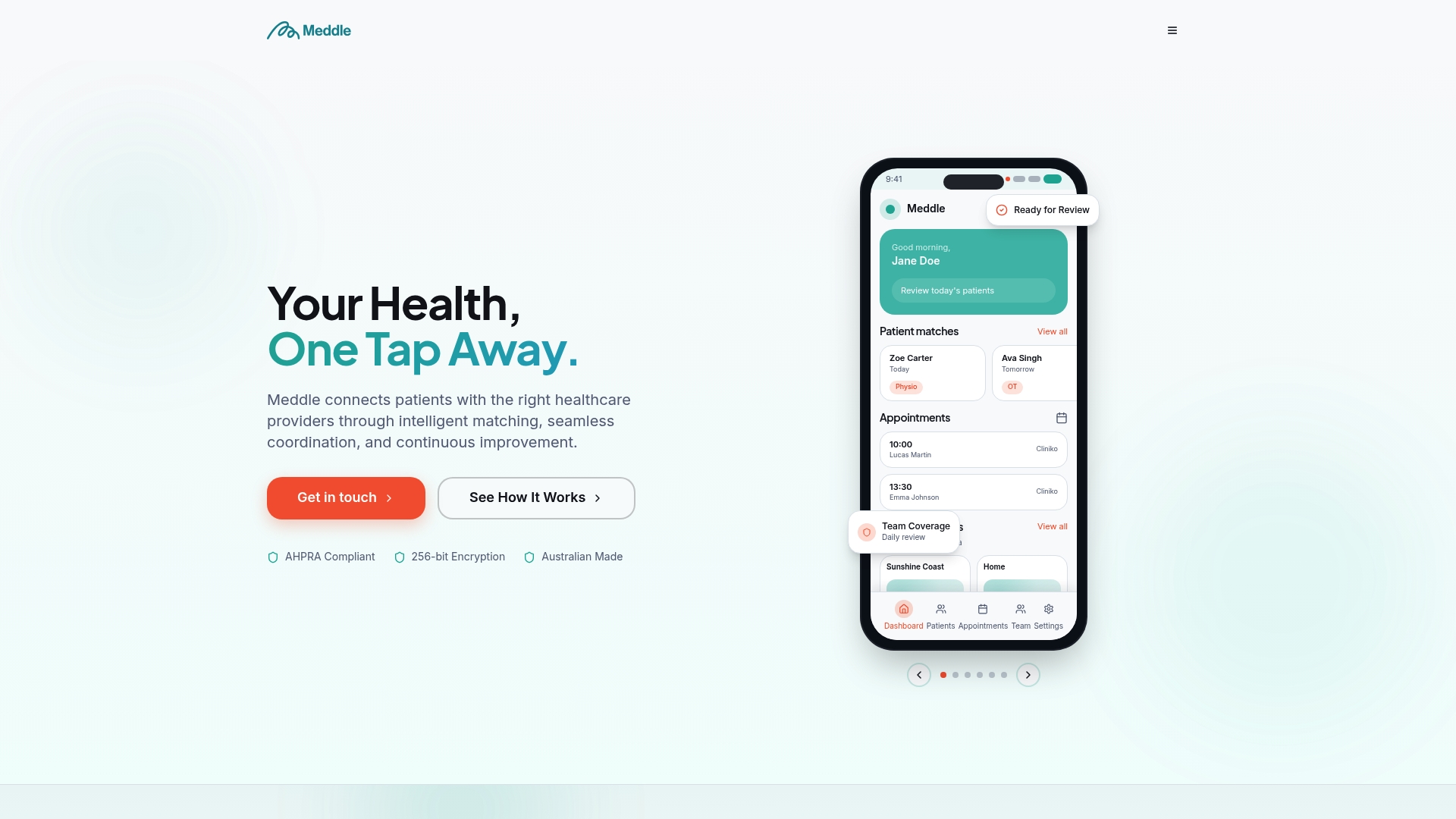
The platform is built for Australian allied health, with data residency within Australia, documented compliance with the Australian Privacy Principles, and a subscription model that starts from A$40 per practitioner. There are no large upfront implementation fees for standard configurations, and the admin hours saved estimator gives you a quantified business case before you commit.
The practical next step: use Meddle’s no-show cost calculator to quantify your current attendance cost, then explore the platform to see how a structured pilot maps to your clinic’s visit types and schedule. If you want to talk through your specific configuration before committing, Meddle’s team can walk you through a demo scoped to your practice size and visit-type mix.
Useful sources and further reading
The following peer-reviewed articles and Australian policy references underpin the evidence and guidance in this guide.
- medinform.jmir.org
- Self-scheduling Medical Visits in a Multispecialty, Multisite Medical Practice: Complexity, Challenges, and Successes - PMC
- Effective and efficient: Using patient-led appointment scheduling in routine mental health practice in remote Australia
- Can a patient‑focussed bookings approach reduce patient non‑attendance in postnatal and continence physiotherapy?
- Barriers to and Facilitators of Automated Patient Self-scheduling for Health Care Organizations - PMC
- An investigation of the opportunities and challenges facing the acceptance and adoption of patient focused booking systems in Australian outpatient clinics for improved organisational and patients outcomes
- Nookal integrations for multi-practitioner Australian clinics | Advantage Digital
- How Meddle Works: AI-Powered Healthcare Matching & Coordination
This guide provides general information for health administrators and clinicians. It is not legal or clinical advice. Confirm current privacy obligations with the Office of the Australian Information Commissioner or a qualified privacy lawyer before deploying a self-scheduling system that handles sensitive health information.
FAQ
What is patient self scheduling in healthcare?
Patient self scheduling is the process by which patients book, reschedule, or cancel their own appointments in real time through a web portal, mobile app, or patient management system, without requiring staff to handle the booking manually.
How do you automate appointment booking for patients?
Automated appointment booking requires a platform with a real-time API connected to your practice management system, a rule engine that enforces visit-type eligibility and provider-continuity logic, and automated SMS or email reminders. The booking must write directly to the clinical schedule without a manual step.
What is another name for patient self scheduling?
Patient self scheduling is also called patient-initiated booking, patient-led scheduling, or online booking for patients. In clinical literature, “automated patient self-scheduling” is the most common formal term.
Does Meddle support patient self scheduling for Australian allied health clinics?
Yes. Meddle’s platform includes real-time availability lookup, AI-powered patient-to-practitioner matching, and a rule engine for provider-continuity and visit-type eligibility, with data residency within Australia and compliance with the Australian Privacy Principles.
Does patient self scheduling increase no-shows?
The peer-reviewed evidence does not support that concern. A large well-child appointment study found no statistically significant difference in no-show rates between self-scheduled and staff-scheduled appointments, and a physiotherapy study recorded a reduction in non-attendance from 23.64% to 13.04% after patient-focussed booking was introduced.