Booking conversion rate: how allied‑health clinics track and lift it

Booking conversion rate is the percentage of patient sessions, profile views or contact requests that turn into confirmed appointments. The core formula is simple: confirmed bookings ÷ total sessions (or inquiries) × 100. If 400 people view your practice profile and 12 book, you’re converting at 3%.
Three fixes move this number faster than anything else. Simplify the booking flow to essentials only. Respond to inquiries within minutes, not hours. Show trust signals and starting price ranges before you ask anyone to commit.
-
Simplify the flow — cut form fields to name, contact detail and preferred time.
-
Speed up response — first contact within five minutes changes outcomes dramatically.
-
Show pricing and trust signals — verified reviews and starting rates reduce hesitation before checkout.
Medical website conversion rates typically sit between 1.5% and 6.8% depending on practice type, with anything above 5% counting as strong performance. That range is your first reference point. Everything after this section is about getting your clinic toward the top of it.
Key Takeaways
Booking conversion rate rises fastest when clinics cut form friction, respond to inquiries within minutes, and publish clear pricing and trust signals before asking patients to commit.
| Point | Details |
|---|---|
| Track the right events | Record sessions, profile views, contact requests, confirmed bookings and no-shows separately. |
| Benchmark against your flow type | Self-scheduling flows convert at 80–92%, while callback forms typically sit at 1.5–3.2%. |
| Fix the biggest leaks first | Address unclear pricing, heavy forms and slow response times before smaller tweaks. |
| Run one test at a time | Validate each change with an A/B or cohort test over at least two weeks. |
| Consider automated matching | Meddle matches by discipline, location and the capacity clinicians have shared, then routes the referral, to shorten the inquiry-to-booking gap. |
Table of Contents
How do you measure booking conversion rate?
You need five events tracked consistently: session (someone lands on your profile or site), profile view (they open a practitioner listing), contact request (they message, call or fill a form), confirmed booking (an appointment is locked in), and no-show (a booked patient doesn’t turn up). Miss any one of these and your conversion math will lie to you.
There are three formulas worth running side by side, because each tells a different part of the story:
-
Visitor to booking: confirmed bookings ÷ total sessions × 100. This is your headline number.
-
Inquiry to booking: confirmed bookings ÷ contact requests × 100. This isolates how well your team closes people who’ve already raised a hand.
-
Prospect to patient: confirmed bookings ÷ qualified leads × 100, useful if you filter out obvious mismatches (wrong location, wrong service) before counting.
Worked example: a physiotherapy clinic gets 900 profile views in a month, 90 contact requests, and 24 confirmed bookings. Visitor to booking sits at 2.7%. Inquiry to booking sits at 26.7%. That gap tells you the leak isn’t interest, it’s the step between “I’m curious” and “I’ve made contact.”
A few practical notes before you trust the numbers. Set a clear attribution window (7 to 14 days between first contact and booking is standard for allied health). Deduplicate phone and web leads, because the same patient often calls after browsing online, and counting both inflates your denominator. Decide upfront whether “confirmed” means paid deposit taken or simply a slot reserved, and apply that definition consistently across every channel.

What is a good booking conversion rate for a clinic?
“Good” depends heavily on how the booking happens. A basic contact form with a callback flow performs very differently to a live self-scheduling calendar, so benchmark yourself against the right comparison, not the average.
Lead-to-patient conversion averages around 3.2%, while top performers reach roughly 21.1%, and response speed is the single biggest separator between the two groups.
Here’s the ROI that matters: if your clinic gets 1,000 monthly profile views and you lift conversion from 1% to 3%, you go from 10 bookings to 30. At an average of $110 per initial consult, that’s an extra $2,200 a month from traffic you’re already paying to attract.
Why do patients abandon the booking process?
Most leakage happens at a handful of predictable points, and each one has a specific, fixable cause.
-
Trust deficit. Thin bios, no reviews and stock photography make patients hesitate before committing to a stranger. Fix: publish verified reviews and real practitioner photos and credentials.
-
Unclear pricing. Patients won’t call to ask what a session costs; they’ll leave instead. Fix: publish starting price ranges and note accepted insurance upfront.
-
Heavy forms. Every extra field is a chance to bail. Fix: collect only what’s needed to confirm the appointment. Insurance details and full medical history can wait until after the booking.
-
Forced account creation. Asking someone to build a login before they’ve even booked kills momentum. Fix: make account creation optional, offered after confirmation, not before.
-
Slow staff response. A lead that waits hours for a callback has usually already booked elsewhere.
-
Availability fragmentation. If your online calendar shows different slots to what reception actually has, patients notice and drop off even when your underlying booking tech works fine.
-
Poor mobile experience. Slow-loading, hard-to-tap booking pages lose people before they even reach the form.
Optimised clinic landing pages that fix these issues push conversion from a typical 3–4% up to 7–10%, largely by addressing page speed and mobile usability. Bookings completed within a shorter window also convert far better. Completing a booking in under two minutes makes it roughly 2.8 times more likely to finish than a slower flow.
What’s a 90-day plan to lift booking conversion?
Treat this as a sequence, not a wish list. Each phase builds on the measurement you set up in the last one.
Immediate (days 0–14):
-
Audit your current booking flow on mobile and cut every non-essential form field.
-
Publish starting price ranges and verified reviews on your practitioner profiles.
-
Set a response SLA of under 15 minutes for new inquiries during business hours and assign an owner.
Short term (weeks 3–6): 4. Run an A/B test comparing your current contact form against a shortened version. Track inquiry-to-booking rate as the KPI. 5. Enable self-service scheduling for at least one high-volume service line and compare its flow-start-to-booked rate against your callback flow. 6. Add SMS or email booking confirmations and reminders to reduce no-shows.
Tactical (weeks 7–12): 7. Segment conversion data by referral source (search, referral partner, direct) to find which channels convert best and worst. 8. Test a cohort of returning patients against new patients to see whether onboarding friction differs. 9. Review and retire any step that didn’t move the KPI it was assigned.
Pro Tip: Run one change at a time per service line for at least two weeks before judging results. Allied-health booking volumes are often too low for overlapping tests to give you a clean read.
Each tactic needs a measurement plan before you launch it: tag campaigns with UTMs, name your analytics events consistently, and define your cohort window (typically 14 to 30 days) before you start comparing before-and-after numbers.

What technical setup do you need to track bookings accurately?
Reliable data starts with consistent event naming. Create these five events in your analytics platform: booking_initiated, booking_completed, inquiry_submitted, phone_call_started, and no_show_recorded. Without this baseline, every benchmark comparison above is guesswork.
-
Connect your booking system to analytics and your CRM so bookings, inquiries and no-shows land in one place.
-
Use phone tracking numbers or call-tracking software to capture inquiries that start by phone, not just web forms.
-
Set up server-side event tracking where possible so ad blockers and browser privacy settings don’t undercount real bookings.
-
Verify webhooks between your booking platform and CRM are firing correctly, not just configured.
Before trusting any dashboard, run a QA pass:
-
Submit a test booking end to end and confirm it appears correctly tagged in analytics and the CRM.
-
Check for cross-device duplication, the same patient booking from mobile after browsing on desktop.
-
Sample ten real bookings weekly for the first month and manually verify they’re recorded once, correctly, in every system.
What privacy rules apply to tracking patient bookings?
Collect only what’s needed to confirm an appointment, name, contact detail and preferred time, and move anything sensitive to a secure post-booking intake step.
-
Store consent records tied to the timestamp of each booking event, not as a vague blanket agreement.
-
Use encrypted, secure webhooks between your booking system and analytics or CRM tools.
-
Keep detailed health information out of marketing or analytics platforms entirely; it belongs in clinical systems only.
-
Check your obligations under local privacy and health-record laws before finalising your tracking setup, since requirements vary by jurisdiction.
Why CRO needs to be a habit, not a project
Clinics that treat conversion optimisation as a one-off redesign lose the gains within months, because booking behaviour, staffing and seasonality keep shifting. Continuous measurement and small, deliberate tests beat one big overhaul every time.
The compounding effect is easy to underrate. A steady lift from 1% to 3% conversion doesn’t just add a few bookings, it can triple output from the exact same traffic and ad spend, with zero extra acquisition cost. Someone specific needs to own this: a practice manager, admin lead or dedicated growth owner, checking the numbers monthly and running the next small test.
A faster path to higher booking conversion
Meddle gives clinics smarter matching and a shorter path from inquiry to a booking the clinic confirms, without you having to rebuild your booking flow from scratch.
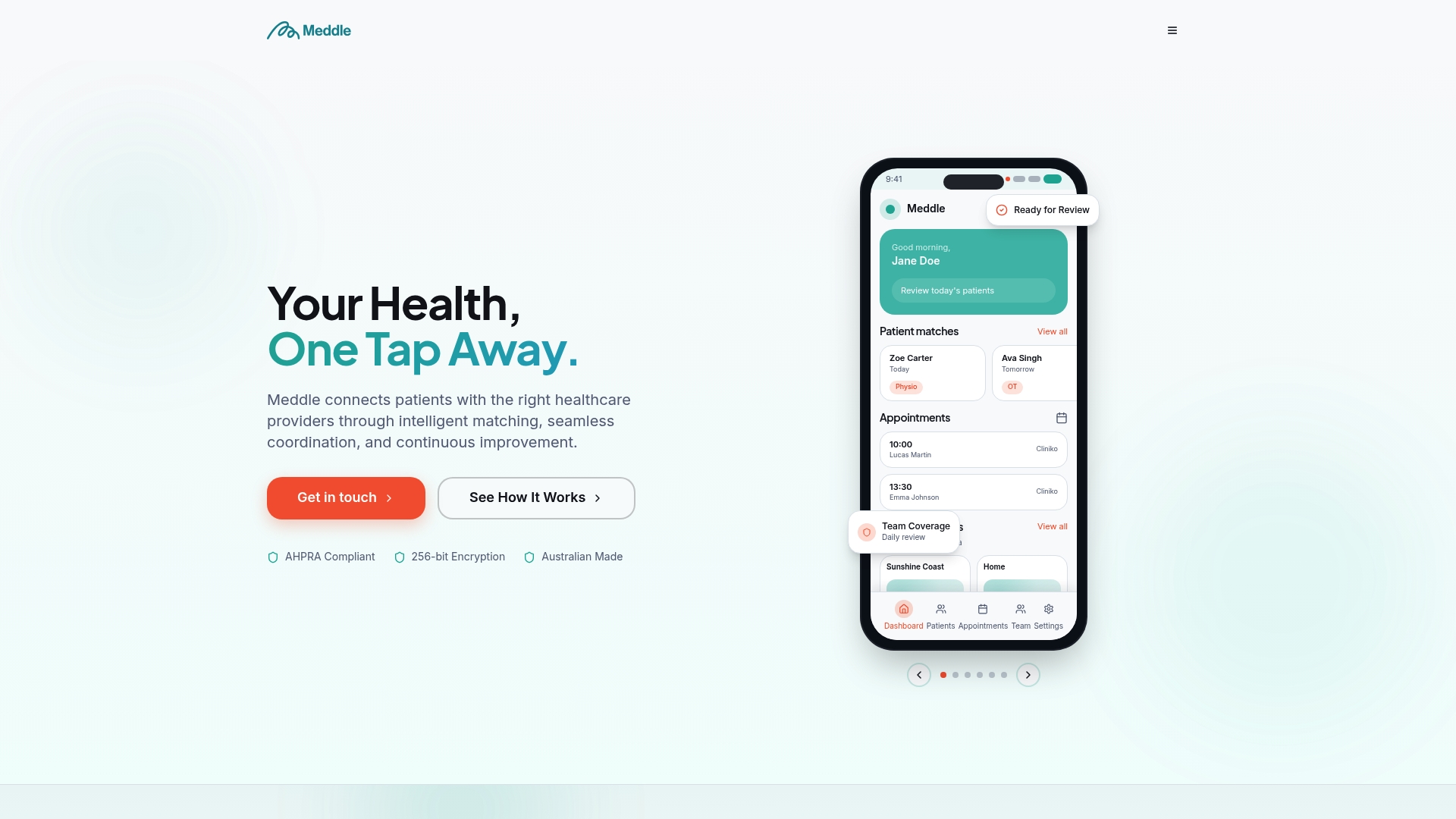
The friction points covered above, slow responses, unclear availability, thin trust signals, are exactly what Meddle’s algorithmic matching and referral routing are built to reduce. Meddle matches by discipline, location and the capacity each clinician has shared, then routes the referral, and the clinic confirms the booking. For practitioners, that means less time chasing admin, more inquiries reaching the right clinician, and privacy controls that keep patient data secure by design. You can see how it works for your practice on the practitioner benefits page, and getting the match right first cuts down the back-and-forth that usually stalls a booking.
If you want to see the financial upside before committing, run your numbers through the no-show cost calculator first. Then check the simple rollout page, pricing starts from $40 per practitioner per month (ex GST, $250 monthly minimum, SMS included), to see how quickly a pilot could get running in your clinic.
Sources
FAQ
What Is a Good Booking Conversion Rate for Allied Health?
Anything above 5% for session-to-booking is considered strong, though intelligent self-scheduling flows can reach 80–92% flow-start to booked.
How Do You Calculate Booking Conversion Rate?
Divide confirmed bookings by total sessions or inquiries, then multiply by 100. Run both visitor-to-booking and inquiry-to-booking versions to see where leakage happens.
What Causes the Biggest Drop in Bookings?
Slow response times and unclear pricing cause the most abandonment, followed by heavy intake forms and forced account creation before booking.
Can Automated Matching Improve Booking Conversion?
Yes.
How Often Should Clinics Test Booking Changes?
Test one change per service line at a time, running each for at least two weeks before judging results, since low booking volumes make overlapping tests unreliable.