5 steps to align Australian healthcare consent with OAIC rules

Consent management in healthcare is the system of legal checks, documentation and technical controls that governs when a patient’s health information can be collected, used or shared. Its purpose is twofold: give patients real control over their own data, and keep your organisation aligned with the Australian Privacy Principles and My Health Record rules. Get it wrong and you’re carrying legal and reputational risk. Get it right, and platforms exist that show what a privacy-first patient experience can look like.
TL;DR:
- Proper consent management requires separate, documented permissions for treatment, data sharing, and secondary use, with each case needing its own consent trail.
- Valid consent in Australia must be informed, voluntary, given by capacity, and current, with exceptions only for legal requirements or urgent safety threats.
- Implementing effective systems involves building a privacy governance plan, mapping data flows, and ensuring consent capture and withdrawal are enforced across all connected platforms.
- Consent features should include structured metadata, role-based access, audit trails, patient controls, and interoperability with systems like My Health Record, to prevent fragmentation and misuse.
- Practice failures often stem from sequencing errors, such as neglecting high-risk workflows or poor staff training, rather than legal violations alone, emphasizing the need for ongoing review and targeted controls.
Table of Contents
- What does consent management cover in healthcare?
- What are the legal requirements for consent in healthcare in Australia?
- Express, implied and substitute consent: what applies when
- How do you actually implement a consent management system?
- What features should a consent-management system actually have?
- What are your My Health Record obligations for consent?
- What goes wrong when practices manage consent poorly?
- How does a privacy-aware platform handle consent in practice?
- What actually moves the needle on consent management
- See how Meddle keeps patient matching privacy-first
- Sources
- FAQ
What does consent management cover in healthcare?
Consent management sits across three distinct activities: clinical care, administrative sharing, and secondary use of data for research or quality improvement. Each carries a different consent standard, and treating them as one blanket permission is where most practices trip up.

The first distinction that matters is between consent to treatment and consent to handle health data. A patient agreeing to a knee injection is not the same as a patient agreeing to have their imaging results shared with a third-party physiotherapist, forwarded to an insurer, or used in a de-identified research dataset. These are legally separate decisions, and OAIC guidance treats them as such. Clinicians frequently conflate the two, assuming that once a patient consents to care, everything downstream is covered. Recording them separately in the patient file reduces medico-legal exposure and makes audits far less painful.
Scope-wise, consent management touches referrals between practitioners, secondary use for clinical audits or academic studies, data shared with allied health providers, and disclosures to health funds or workers’ compensation insurers. Each of these use cases needs its own consent trail, even when the underlying clinical relationship is the same.
Where this gets operationally messy is at the integration point between your practice management system and your electronic health record. If a patient restricts sharing with a specific provider, that restriction needs to propagate through every system touching the record, not just sit in a paper file in reception. A patient recall system that sends reminder texts without checking consent status, for instance, can breach a patient’s explicit preference even when the clinical intent is entirely benign. Consent management, done properly, is less a policy document and more a live data governance layer that every connected system has to respect.
What are the legal requirements for consent in healthcare in Australia?
Valid consent under Australian privacy law rests on four elements, and all four have to be present for consent to hold up under scrutiny. According to OAIC guidance, the patient must be:
- Adequately informed about what they’re consenting to, including who will access the information and why.
- Acting voluntarily, free from coercion or pressure from staff, family, or the treatment context itself.
- Assessed as having capacity to understand and communicate a decision.
- Giving current and specific consent tied to a particular purpose, not a blanket approval given years earlier for an unrelated matter.
Statistic callout: These four criteria apply identically whether consent is express or implied, and they form the backbone of every health privacy assessment the OAIC conducts on Australian providers.
These elements aren’t a bureaucratic checklist to tick and forget. A signed form doesn’t automatically satisfy the test if the patient wasn’t genuinely informed, or if their capacity was compromised by sedation, distress, or a language barrier at the time they signed. The NSW Health consent manual makes this explicit: written consent is useful contemporaneous evidence, but it is not, on its own, proof that consent was valid. The manual frames consent as an ongoing process rather than a single signature, which is a mindset shift worth embedding in staff training rather than just policy documents.
There are lawful exceptions where consent isn’t required at all. Providers can collect, use or disclose health information without consent when the law requires or authorises it, or when there’s a reasonable basis for believing disclosure is necessary to lessen or prevent a serious threat to someone’s life, health or safety. The OAIC’s guidance on handling health information sets the bar at what a reasonably informed person would believe in the circumstances, which means the exception is meant to be used sparingly and documented thoroughly when it is.
State-level variation adds another layer. Some jurisdictions apply different rules to uploading records into My Health Record, particularly around pathology and diagnostic imaging results, where states have staggered consent and notification requirements. If your practice operates across state lines, or you’re building a system meant to scale nationally, checking your state health department’s own consent policy alongside the federal framework isn’t optional. NSW, Queensland and the ACT each publish their own operational guidance, and they don’t always align perfectly on timing or notification wording.
Express, implied and substitute consent: what applies when
Not every clinical interaction needs a signature. Australian privacy law recognises both express and implied consent, and knowing which applies where saves your front desk a genuine headache.
- Express consent is explicit and usually written or verbally confirmed and documented. It applies to significant procedures, sharing data with a new specialist, research participation, or any disclosure outside routine care. A physiotherapist referring a patient’s scan results to an orthopaedic surgeon for the first time needs express consent, clearly recorded.
- Implied consent is inferred from context and behaviour. A patient booking a follow-up appointment and describing symptoms to a nurse is implicitly consenting to that information being used for their immediate care. OAIC guidance is clear that implied consent is only appropriate in routine, well-explained contexts, where the patient has a reasonable understanding of what’s happening with their information.
- Substitute consent applies when the patient lacks capacity, whether due to age, cognitive impairment, or a medical emergency. A parent or legal guardian consents for a minor; a next of kin or appointed decision-maker consents for an adult who temporarily or permanently can’t. Capacity isn’t binary either, a patient can have capacity to consent to a blood test but not to a complex surgical procedure, so assess it per decision, not per person.
Documentation should reflect which type of consent applies and why. A one-line note like “verbal consent obtained for referral to Dr Smith, patient understood purpose and recipient” does more legal work than a generic tick-box.
Pro Tip: Train front-of-house and clinical staff to say the purpose out loud when relying on implied consent. “I’ll pop these results in your file so Dr Lee can review them before your next visit” turns a silent assumption into a documented, informed moment.
How do you actually implement a consent management system?
Rolling out consent management well is less about buying software and more about sequencing the work correctly. Skip the governance step and jump straight to a tool, and you’ll end up automating a process nobody agreed on.
- Build a privacy management plan first. OAIC’s Good Practice guidance recommends embedding privacy governance through a documented plan covering roles, processes, evaluation and ongoing improvement. This becomes your reference point when a new system or workflow gets proposed.
- Map your data flows. Chart every point where health information enters, moves, or leaves your organisation, referrals, lab results, billing, third-party integrations, and mark exactly where consent needs to be captured or checked.
- Choose or configure your consent capture point. Decide whether consent is captured at intake, at each disclosure event, or both, and make sure the system enforces it rather than relying on staff memory.
- Enable audit trails and withdrawal handling. Every consent decision needs a timestamp, a scope, and a mechanism for the patient to withdraw it, with that withdrawal actually propagating through connected systems.
- Train staff and review regularly. Consent policy that lives in a manual nobody reads isn’t policy, it’s decoration.
Practical checkpoints worth building into that rollout:
- Confirm collection is limited to what’s necessary for the specific healthcare activity, per OAIC collection principles.
- Notify patients of collection matters at or before the point of collection, not retrospectively.
- Set a review cadence, quarterly is reasonable for most allied health practices, to check whether captured consent still matches current data flows.
- Assign a named privacy lead who owns the plan, rather than leaving it as a shared responsibility that nobody actually drives.
Pro Tip: If your practice runs multiple software systems (booking, EHR, billing), test what happens when a patient withdraws consent in one system. If it doesn’t automatically flag or restrict the other two, you have a gap that no policy document will fix.
What features should a consent-management system actually have?
Specifying the right feature set to a vendor, or building it internally, is where a lot of good governance intentions get lost in implementation. The following controls are the ones worth insisting on rather than treating as nice-to-haves:
- Structured consent metadata. Every consent record should capture scope (what’s covered), purpose (why it’s needed), and duration (when it expires or needs renewal), not a single “consent given: yes/no” flag.
- Time-stamped, exportable audit trails. You need to produce, on request, a full history of who consented to what, when, and who accessed the record as a result.
- Role-based access control. Reception staff, clinicians, and billing teams should see only what their role requires, reducing the blast radius of any single account being compromised.
- Integration APIs, ideally SMART on FHIR, so consent status travels with the patient record across systems rather than living in a silo.
- Encryption in transit and at rest, as a baseline expectation for any system touching health information. A security questionnaire for healthcare software is a useful reference when assessing a vendor’s actual claims against what they can demonstrate.
- Patient-facing controls that let people see, adjust, or withdraw their own consent preferences without needing to call the practice.
- Interoperability with My Health Record access settings, so a patient’s restrictions there aren’t contradicted by looser settings in your own system.
Academic research into purpose-based and patient-controlled consent models, including some exploring blockchain-backed approaches, points toward where this technology is heading: more granular, more patient-driven, and less reliant on a single static form.
What are your My Health Record obligations for consent?
My Health Record operates on an opt-out default access model, which means most participating providers can view a patient’s record unless the patient has actively restricted it. That default doesn’t give you licence to ignore patient-set controls.
- Patients can restrict access to their entire record or to specific documents, and your organisation is legally obligated to respect those restrictions the moment they’re set, per Digital Health guidance for healthcare providers.
- Emergency access, sometimes called “break glass” access, exists for genuine emergencies but is narrowly authorised.
Statistic callout: Emergency access must be justifiable under section 64 of the My Health Records Act, is logged in every instance, and is expected by the Digital Health Agency to be rare and only used in genuine emergencies.
For IT teams, this is one of the highest-risk controls in the whole system. Configure restrictive role mappings so emergency access isn’t a blanket permission handed to every staff account, enforce strong logging, and require documented justification for each use rather than a generic “clinical necessity” note. State-specific upload consent rules also apply in some cases, particularly for pathology and diagnostic imaging, so check your state health department’s own guidance before assuming the federal default covers you. Our guide to My Health Record compliance walks through the alignment steps in more detail.
What goes wrong when practices manage consent poorly?
Three failure modes show up repeatedly across Australian healthcare settings, and none of them are exotic.
Fragmentation is the most common. Consent gets captured on a paper form at intake, then never makes it into the digital record, or makes it in but doesn’t sync across the booking system, the EHR, and the billing platform. The fix is data-flow mapping done properly, not a one-off spreadsheet exercise, but an ongoing process reviewed whenever a new system gets added.
Human factors matter more than most technical controls. Patients with low health literacy, English as a second language, or high anxiety at the point of consent are more likely to sign without genuinely understanding what they’re agreeing to. Staff training that emphasises plain-language explanation, not just form completion, closes this gap better than any software feature can.
Weak audit trails and emergency access misuse are the technical risks that surface hardest during a breach investigation or OAIC assessment. If you can’t produce a clean record of who accessed what and why, you’re exposed regardless of how good your intake process was.
How does a privacy-aware platform handle consent in practice?
Some platforms are built around the idea that matching patients to the right practitioner shouldn’t come at the cost of data control. Algorithmic matching processes may use structured consent metadata to limit what information is shared during the matching stage, so a patient’s symptoms and preferences inform the match without exposing more than necessary to any given practitioner before a booking is confirmed.
That approach aligns naturally with the same principles running through My Health Record’s access model: default settings that work for most people, with real controls for patients who want to restrict what’s visible and to whom. Booking integration and referral automation tools are ideally built to respect those preferences rather than treat them as an afterthought bolted on post-launch.
If you’re assessing your own practice’s consent workflows against the checklist earlier in this guide, structured metadata, audit trails, patient-facing controls, it’s worth checking how some platforms handle the same requirements. The gap between what a vendor claims and what they can actually demonstrate is often where the real risk sits, and it’s a gap worth closing before you’re the one explaining it to a regulator.

What actually moves the needle on consent management
Most consent management failures aren’t legal failures, they’re sequencing failures. Practices try to fix everything at once, buy a platform, rewrite policy, retrain staff, in the same quarter, and the whole effort collapses under its own weight.
Start with your highest-risk workflows: anything involving third-party disclosure, minors, or emergency access. Build the minimum viable technical control there first, structured consent capture and a working audit trail, before worrying about polish elsewhere.
Documentation, training and automation each cover a different failure mode, and none of them substitutes for the others. If you want to know whether it’s working, track three numbers: audit completion rates, time taken to honour a withdrawal request, and the volume of patient complaints tied to data handling. Those three tell you more than any compliance checklist ever will.
— Taylor
See how Meddle keeps patient matching privacy-first
Some platforms give allied health clinics a way to match patients to the right practitioner without the administrative guesswork that usually comes with juggling referrals, intake forms and consent tracking across separate systems. Algorithmic matching can be built around structured, purpose-specific data handling that mirrors principles running through My Health Record’s access model, so patient information moves only as far as it needs to at each stage of the booking process.
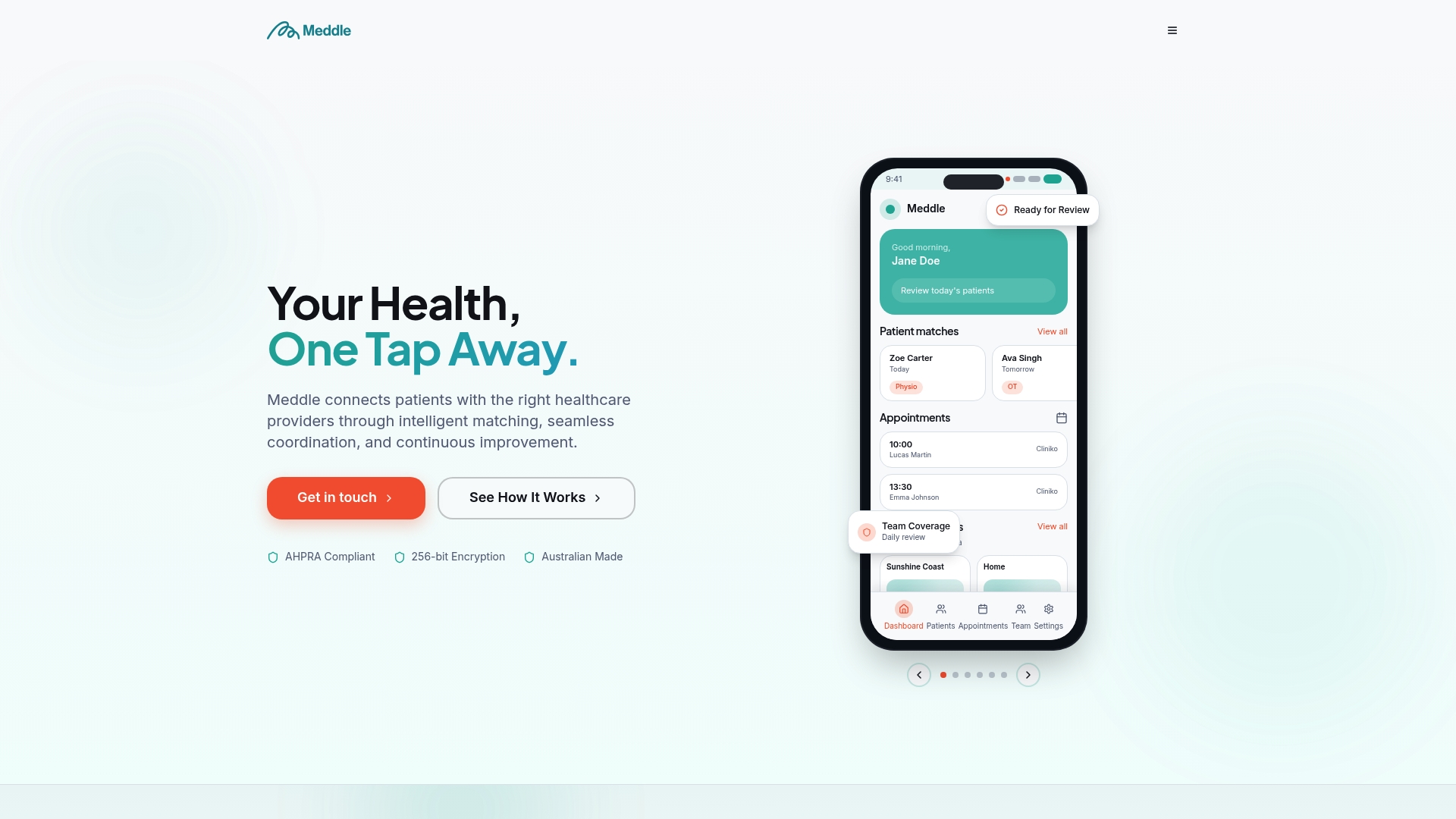
If your practice is reviewing how consent-aware workflows fit into your existing systems, Meddle’s platform is worth a look alongside the checklist in this guide. See how the matching and booking process actually works, or explore the allied health discipline matcher to get a sense of how consent metadata shapes a real patient match. Request a demo to see the privacy controls in action before deciding whether it fits your practice.
This article is general information, not a substitute for advice from a qualified doctor. Consult a qualified healthcare professional about your own circumstances before acting on anything here.
Sources
- Guide to health privacy (OAIC)
- My Health Record for healthcare providers (Digital Health)
- Consent to Medical and Healthcare Treatment Manual (NSW Health)
- Patient consent management by a purpose-based consent model for EHR (PMC)
FAQ
What is consent management in healthcare?
Consent management in healthcare is the process of capturing, documenting, tracking and honouring a patient’s decisions about how their health information is collected, used, shared or withdrawn, aligned with OAIC privacy guidance and My Health Record rules.
What are the five steps of the consent process?
A practical consent process generally covers: informing the patient of the purpose, confirming voluntary agreement, assessing capacity, documenting the specific scope, and enabling a clear pathway to withdraw consent later.
What are the three C’s of consent?
Definitions vary across settings, but a widely used version refers to consent being capacity based, current, and clear (specific and adequately informed), echoing the four-element test the OAIC applies to Australian health information.
What are the legal requirements for consent in healthcare in Australia?
Valid consent must be informed, voluntary, given by someone with capacity, and current and specific to the purpose, per OAIC guidance, with exceptions where the law authorises disclosure or a serious threat to safety exists.
How does My Health Record affect patient consent?
My Health Record defaults to allowing participating providers access to a patient’s record, but patients can restrict access to specific documents or providers, and those restrictions must be respected except in narrowly authorised, logged emergency access situations under the My Health Records Act.