Healthcare software procurement checklist (Australia)

A healthcare software procurement checklist must cover six areas: procurement phases, security and privacy evidence, interoperability and conformance, supplier due diligence, contract and SLA obligations, and testing and acceptance. Anchors worth building your checklist around include the Business-to-government conformance register, OAIC guidance on APP 11 and ASD/ISM procurement guidance.
TL;DR:
- Vendors must provide concrete security evidence, including dated penetration tests, incident response records, and encryption details, to meet Australian privacy standards.
- Interoperability requirements should be embedded in the tender, with vendors demonstrating API support, standards compliance, and product conformance assessments upfront.
- Evaluation should prioritize security and conformance artifacts over vendor claims, and scoring must reflect actual evidence of compliance and technical readiness.
- Procurement teams need to assess supplier stability, support practices, and supply chain risks, requesting multiple quotes and maintaining an approved vendor list.
- Cost planning must include implementation, integration, ongoing support, and post-launch fixes, with total ownership costs over the contract period being a key comparison metric.
Table of Contents
- How the checklist maps across procurement phases
- Procurement phases: requirements and technical evaluation checklist
- Security and privacy checklist: evidence to request and how to validate it
- Interoperability and conformance: standards, registers and API readiness
- Supplier due diligence and cyber supply-chain risk checklist
- Contract and SLA items to require
- Testing, deployment and acceptance criteria
- Ongoing governance and vendor management checklist
- Budgeting and cost planning for healthcare software procurement
- Stakeholder engagement and requirement gathering methodologies
- Change management and training planning for software adoption
- Post-deployment support and maintenance agreements
- Regulatory compliance specific to healthcare software procurement
- Evaluation criteria weighting and scoring methods for selecting vendors
- Author perspective: common procurement pitfalls and prioritisation advice
- An alternative worth evaluating against your checklist
- FAQ
- Sources
How the checklist maps across procurement phases
A checklist only works when each item has an owner and a phase. Requirements gathering belongs to the clinical lead and procurement officer together. Technical evaluation belongs to IT and security. Contract terms belong to legal, informed by what IT and security have already found.
We recommend risk-ranking every item by two factors: how sensitive the data is, and how directly a failure would affect patient safety. A scheduling tool that never touches clinical notes carries different risk weight than a referral platform handling diagnostic results.
- Requirements phase: clinical lead and procurement define must-haves and data flows.
- Invitation to respond: procurement issues the checklist as tender criteria.
- Technical evaluation: IT and security score architecture, hosting and conformance evidence.
- Best and final offer: legal and procurement negotiate contract and SLA terms.
- Transition: IT and clinical operations run acceptance tests before go-live.
Procurement phases: requirements and technical evaluation checklist
Before you evaluate a single vendor, write down what the software actually needs to do and what data it will touch. Vague requirements produce vague vendor answers, and vague answers are impossible to score fairly.
- Capture business and clinical requirements, including integration points, API needs and the exact types of data involved (identifiable health information, billing data, images).
- Evaluate the proposed architecture: cloud or on-premise hosting, authentication method, encryption at rest and in transit, and identity and access management.
- Request architecture diagrams, assurance reports (such as SOC 2), conformance evidence and access to a developer or test environment before committing.
The Digital Health Procurement Guidelines recommend embedding interoperability requirements directly into tender documents rather than treating them as a later integration problem, which prevents long-term vendor lock-in and reduces migration cost later.
Pro Tip: Ask for a working test environment before the final offer stage, not after signing. A vendor that cannot provide one at evaluation usually cannot provide one at go-live either.
Security and privacy checklist: evidence to request and how to validate it
Start by mapping exactly what personal or health information the software will process, store or transmit. You cannot ask meaningful security questions until you know whether you are protecting appointment bookings, clinical notes or both.
Once that’s mapped, request:
- Dated penetration-test reports with remediation timelines, not a summary paragraph.
- Incident-response test records, whether table-top exercises or live drills.
- Encryption specifications for data at rest and in transit.
- Multi-factor authentication details and logging or forensic-access capability.
- A privacy impact assessment or privacy management plan specific to the product.
Our security questionnaire guide for healthcare software sets out sample questions that map directly to these evidence types.
Every one of these ties back to the Australian Privacy Principles. OAIC guidance on APP 11 sets out the security-of-personal-information obligation, and it rewards evidence over assurance.
Recent enforcement shows the cost of getting this wrong. OAIC penalties against Australian Clinical Labs followed a pathology data breach, underlining that civil penalties for failing to protect health information or respond promptly can be substantial.
Reject one-word answers like “yes, we’re compliant.” Require dated artefacts, the scope they cover and the actual test results, not a marketing claim about compliance. For the controls that sit behind these answers, our 12 steps to secure patient records guide breaks down what APP 11 looks like in practice.
Interoperability and conformance: standards, registers and API readiness
Interoperability failures surface months after signing, usually when a clinic tries to connect the new system to an existing record or referral pathway. Build the check in early instead.
- Require alignment with FHIR or HL7 where the software exchanges clinical data, and ask for implementation guides or test evidence rather than a verbal assurance of “standards support.”
- Check the Business-to-government conformance register when government gateway access is required, and ask vendors for their own conformance assessment artefacts rather than taking “we’re conformant” at face value.
- Ask for API documentation, a developer or test environment, and evidence of integration tests already completed with systems similar to yours.
Our comparison of HL7 versus FHIR is useful background if your technical team is deciding which standard to specify in the tender, and our FHIR integration guidance covers what a credible implementation looks like in practice.
Supplier due diligence and cyber supply-chain risk checklist
A product can look secure on paper while the vendor behind it carries risk you have not assessed. Supplier due diligence closes that gap.
- Review the vendor’s governance structure, financial stability and the maturity of its security programme, not just the product’s feature list.
- Request a subprocessor list, the locations where support staff operate, and the policy governing privileged access to your data.
- Assess patching cadence, any history of past incidents, and how the vendor manages its own third-party risk.
Industry reporting on the MediSecure breach pointed to vendor and third-party weaknesses as contributing factors, a reminder that one weak link in the supply chain can compromise systems well beyond the original vendor.
Pro Tip: Keep an approved-supplier list and request quotes from more than one vendor for critical services. It strengthens your negotiating position and limits single-point-of-failure risk, a practice Cyber recommends directly.
Contract and SLA items to require
Technical findings only protect you once they are written into the contract. Translate every security and interoperability requirement into an enforceable clause.
- Define breach notification timelines in hours or days, plus forensic log access and clear legal responsibility for notifying affected patients.
- Include a conformance re-assessment clause that triggers whenever the vendor changes core functionality or data handling, consistent with how the conformance register treats significant product changes.
- Specify data portability requirements, including export formats, and set out exit support obligations if you terminate the contract.
- Set measurable service-level targets with stated penalties or remediation obligations when the vendor misses them.
Our piece on meeting the Australian Privacy Principles walks through how clinics translate these obligations into day-to-day practice.
Testing, deployment and acceptance criteria
Go-live is not the finish line for testing, it is the point where your acceptance criteria get enforced. Agree on them before the contract is signed.
- Define integration, interoperability, performance and security acceptance tests, with named sign-off roles for each.
- Require vendor-supplied test artefacts: penetration-test evidence, integration test logs and load-test results.
- Confirm data migration validation, backup and restore verification, and documented rollback criteria before any live patient data moves.
The healthdirect Integration Hub getting-started guidance recommends signed acceptance tests and documented rollback procedures as standard practice, not an optional extra.
Ongoing governance and vendor management checklist
Procurement does not end at go-live. Build ongoing governance into the contract from day one.
- Schedule periodic security reviews, a vulnerability reporting cadence and agreed patch windows.
- Set periodic conformance checks and require the vendor to notify you of material changes in writing.
- Maintain an approved-supplier list and run regular supplier performance reviews against the original SLA targets.
Our data governance guide for healthcare organisations sets out the five pillars worth building into this ongoing cycle.
Budgeting and cost planning for healthcare software procurement
Budgeting for healthcare software is rarely just the licence fee. Build your cost model around four layers: licensing or subscription cost, implementation and integration cost, ongoing support and maintenance, and the internal staff time needed for training and change management.
Integration cost is the one teams most often underestimate. Connecting a new system to existing records, referral pathways or a government gateway can take longer and cost more than the software itself, particularly if conformance assessment is required partway through.
Build in contingency for post-launch fixes. Even a well-tested system surfaces edge cases once real patient data and real clinical workflows hit it, and a contract without a defined support tier for this period leaves you negotiating from a weak position.
Compare vendors on total cost of ownership over the contract term, not sticker price. A cheaper subscription with a high integration cost, a thin support tier or no conformance maintenance built in can cost more over three years than a pricier option that includes it. Ask every vendor for a cost breakdown by layer so you are comparing like for like, and get the ongoing cost of patch management, conformance re-assessment and support in writing before you compare final offers. Procurement teams that only compare headline licence fees consistently underestimate what a healthcare system costs to run well over its full contract life.

Stakeholder engagement and requirement gathering methodologies
The requirements that matter most rarely come from procurement alone. Clinical staff know which workflows break under pressure, IT knows what the existing architecture can support, and patients or carers know where the current process frustrates them.
Run structured requirement-gathering sessions with each group separately before drafting the tender. Clinicians describe pain points in clinical terms, not technical ones, and a joint session tends to let the loudest voice dominate rather than surfacing the full picture.
Use a simple method: workshops for broad input, structured interviews for specific role groups, and a short survey for staff who cannot attend either. Document every requirement with the stakeholder group it came from, so you can trace a tender criterion back to a real need when vendors push back on scope.
Separate “must have” from “nice to have” early, and get clinical sign-off on the must-have list before it goes into the tender. A requirement added late in the process, after vendors have already submitted proposals, usually means a second evaluation round or a compromise nobody is happy with.
Keep a single requirements register that procurement, IT and clinical leads all update from, rather than separate documents that drift out of sync. This becomes the reference point for both technical evaluation scoring and the final contract schedule.
Change management and training planning for software adoption
The best-evaluated software still fails if staff cannot or will not use it. Build change management into the procurement timeline, not as an afterthought once the contract is signed.
Start with a clear picture of current workflows and where the new system changes them. Staff adopt new software faster when they understand why a step changed, not just that it did.
Plan training in tiers: a short overview session for all staff, a deeper technical session for power users and administrators, and refresher sessions scheduled a few weeks after go-live, once staff have hit real workflow gaps. Training delivered only once, before anyone has used the system in anger, is often forgotten by the time it matters.
Nominate internal champions in each team who get extra training and act as the first point of contact for questions. This reduces pressure on IT helpdesk tickets and builds confidence faster than a help manual alone.
Set a realistic adoption timeline with milestones, and expect a temporary dip in efficiency immediately after go-live as staff adjust. Communicate that dip to leadership in advance so it is not mistaken for the software failing.
Post-deployment support and maintenance agreements
Support quality after go-live matters as much as the evaluation that got you there. Define support tiers, response times and escalation paths in the contract, not as a verbal promise during the sales process.
Specify response time targets by severity: a system outage affecting patient bookings demands a faster response than a cosmetic display issue. Ask what hours support is available and whether after-hours cover exists for clinics running extended hours.
Confirm how maintenance and patching work. Ask whether updates roll out automatically or require scheduling, and whether you get advance notice before a change affects your workflows. A vendor that pushes updates without notice creates risk for clinics running tightly scheduled days.
Clarify what is included in the base subscription versus billed separately. Our Simple Rollout plan and add-ons like SMS Notifications at $50 AUD per month per practice illustrate how support and feature tiers can be structured, and the same clarity should apply to any vendor you evaluate.
Finally, agree on a review cadence, quarterly or half-yearly, to assess whether the support relationship is meeting the SLA and whether the product roadmap still matches your clinical needs.
Regulatory compliance specific to healthcare software procurement
Regulatory obligations for healthcare software vary by market, and the checklist you build should reflect where your organisation actually operates and who your patients are. In Australia, the Privacy Act and the Australian Privacy Principles, particularly APP 11 on security of personal information, set the baseline for how any software handling health data must be governed.
Software connecting to government health infrastructure carries an additional layer: conformance assessment through the Business-to-government conformance register. This is not a one-off tick box. Assessments are ongoing, and a significant change to a product’s functionality or data handling can trigger reassessment partway through a contract.
Other jurisdictions apply different frameworks entirely, such as HIPAA in the United States or FDA regulation of certain software as a medical device. These frameworks do not apply to Australian healthcare operations, and a vendor citing HIPAA compliance alone is not demonstrating anything relevant to obligations under the Privacy Act. If your organisation operates across borders, treat each jurisdiction’s requirements as separate items on the checklist rather than assuming compliance in one covers the other.
Build a regulatory column into your evaluation matrix that names the specific law or register each requirement maps to, so vendor responses are checked against the right standard rather than a general compliance claim.

Evaluation criteria weighting and scoring methods for selecting vendors
A checklist only produces a fair outcome when every item carries a weight that reflects its real risk. Treat security evidence and conformance status as heavily weighted, pass-or-fail gates rather than scored alongside cosmetic features like interface design.
A practical structure: group criteria into categories (security and privacy, interoperability, usability, cost, support), assign each category a percentage of total score, and score individual criteria within each category on a simple scale, such as 1 to 5.
Score against evidence, not vendor presentations. A vendor that provides a dated penetration-test report and a vendor that simply states “we take security seriously” should not score the same on a security criterion, even if both answered the question asked.
Have more than one evaluator score independently before discussing scores as a group, which reduces the risk of one voice dominating the outcome. Document the reasoning behind each score, particularly for security and conformance items, so the decision can be defended if a vendor or an auditor later questions it. A medical supply vendor comparison checklist built for a different procurement category shows the same weighted-scoring logic applied well outside software, which is worth reviewing if your team is building a scoring matrix from scratch.
Author perspective: common procurement pitfalls and prioritisation advice
The most common mistake we see is accepting vendor claims without artefacts: a “yes, we’re secure” with no dated report behind it. The second is treating interoperability as an integration problem to solve later rather than a tender requirement. The third is underestimating supply-chain risk, assuming the vendor’s own security covers every subprocessor behind it.
If you prioritise only two things, make them patient-safety impact and breach-notification clauses. Everything else can be negotiated after the contract starts.
— Taylor
An alternative worth evaluating against your checklist
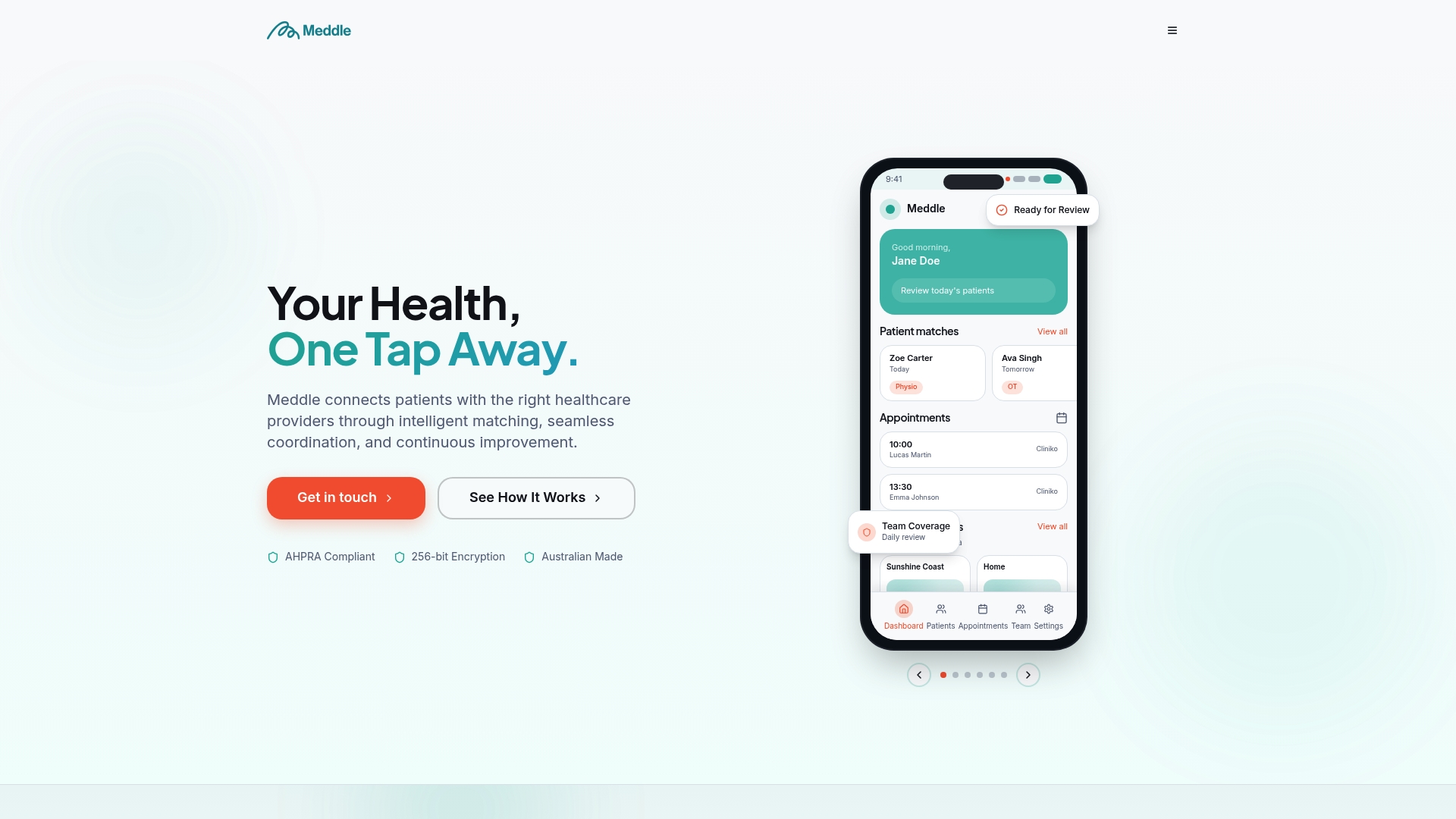
We built our platform around the same evidence standards this checklist describes: AI-powered patient-practitioner matching, secure scheduling, and API integrations designed for allied health clinics.
-
Patient matching and booking run through a platform we designed specifically for allied health workflows.
-
Secure messaging and referral automation sit alongside scheduling, reducing the number of separate systems a clinic needs to use.
-
We still expect you to verify our conformance status and contract terms against this same checklist, the same way you would for any vendor.
If your team wants to see how matching, scheduling and integrations work in practice, our how Meddle works page walks through the platform, and our pricing page sets out the plans available to clinics, including Simple Rollout and add-ons for SMS Notifications and CRM Integration.
FAQ
What is the first step in a healthcare software procurement checklist?
Start by mapping what data the software will process and who within your organisation owns each checklist category, before writing a single evaluation criterion. This prevents vague requirements from producing vague vendor answers later in the process.
What security evidence should a vendor provide, not just claim?
Request dated penetration-test reports with remediation timelines, incident-response test records, encryption specifications and a privacy impact assessment specific to the product. OAIC guidance on APP 11 treats evidence-based controls as the standard, not a verbal assurance of compliance.
How does conformance assessment affect software procurement?
Software connecting to government health gateways must complete conformance assessment and may be listed on the Business-to-government conformance register. Reassessment can be triggered by significant changes to a product’s functionality or data handling, so this is not a one-off check.
Does HIPAA apply to healthcare software bought in Australia?
No. HIPAA is a United States framework and does not apply to Australian healthcare operations; the relevant baseline here is the Privacy Act and the Australian Privacy Principles. A vendor citing HIPAA compliance alone does not demonstrate anything relevant to Australian privacy obligations.
How should procurement teams weight evaluation criteria?
Score against dated artefacts and test results rather than vendor presentations or verbal assurances.
Sources
- Business-to-government conformance register (Australian Digital Health Agency)
- Digital health procurement guidelines
- Australian Privacy Principle 11: security of personal information (OAIC)
- Cyber