Clinics: Governance first to improve care coordination in 12 months

Adopt fit-for-purpose governance, standardised shared care plans, and rapid multidisciplinary handovers to improve care coordination now. Layer these onto an established model, such as MBS-funded Chronic Condition Management plans or a transdisciplinary team structure, then measure results with patient-reported experience and follow-up rates. Tools like an AI-powered healthcare platform can operationalise the referral and matching side once the governance is right.
TL;DR:
Building shared care plans with clear triggers and ensuring all providers can view and update them is crucial for effective care coordination.
Multidisciplinary team meetings should follow a fixed agenda, use pre-circulated patient lists, and document outcomes within 24 hours to drive decision-making.
Conducting a short triage checklist before referrals and formalising referral partnerships reduce delays and incomplete submissions.
Embedding governance, defining roles through simple RACI matrices, and piloting on narrow referral pathways enhance the likelihood of sustaining coordination improvements.
The most impactful KPIs are timely follow-up rates and referral closure percentages, which should be monitored monthly via existing electronic records.
Table of Contents
What does it actually take to improve care coordination?
Care coordination means organising a patient’s care across multiple providers so nothing falls through the cracks between appointments, referrals, and handovers. It sounds simple. In practice it means someone owns the plan, everyone on the team knows their role, and information travels with the patient instead of getting stuck in one provider’s notes.
Most services already run some version of this informally. The gap is rarely goodwill. It’s structure: no shared documentation, no defined escalation path, and no agreed way to close the loop when a referral goes quiet for three weeks. Fixing that structure is what actually moves outcomes, more than any single new piece of software or a well-meaning memo about “better communication.”

Structured handovers that don’t waste anyone’s time
The ISBAR framework, which stands for Identify, Situation, Background, Assessment, Recommendation, gives teams a shared shorthand for handovers between shifts, services, or providers. It works because it forces the sender to lead with the point, not the history.

Use it whenever a patient moves between care settings, when risk status changes, or during any handover where the receiving clinician has less than five minutes to get up to speed. A GP referring a complex patient to three allied health providers at once benefits from the same discipline: state the concern, the relevant history, current status, and what you need from the receiving team.
1. Build shared care plans with clear triggers
A shared care plan only earns its name if every provider can see it and update it. Set clear triggers for when a case moves from routine care to a formal Chronic Condition Management plan or case conference, typically two or more chronic conditions, frequent presentations, or multiple providers who aren’t talking to each other.
2. Run multidisciplinary team meetings with a fixed agenda
MDTs fail when they become status updates instead of decision points. A workable structure:
-
Fixed fortnightly or monthly cadence, never “as needed”
-
Pre-circulated patient list with one flagged issue per patient
-
Named owner assigned for each action before the meeting ends
-
Outcomes documented in the shared plan within 24 hours
3. Check referral readiness before it leaves the building
Incomplete referrals are the single biggest cause of delayed care. A short triage checklist, reason for referral, urgency, relevant results attached, preferred setting, catches most gaps before they cost a patient two weeks. Practices that formalise this through structured referral partnerships tend to see fewer bounced or incomplete referrals reaching specialists.
4. Activate patients as coordination partners
Person-centred coordination, backed by ACI NSW’s consumer enablement guidance, works best when patients hold a copy of their own care plan and know who to call first. Low-burden supports, a single point of contact, a printed summary, a follow-up text, do more for adherence than another appointment.
Pro Tip: Give every patient with a shared care plan one card listing their care coordinator’s name and number. It costs nothing and cuts “who do I even call” confusion dramatically.
Which coordination model actually fits your setting?
Not every service needs the same scaffolding. Choosing the wrong model wastes effort; the right one matches your caseload and workforce.
The general care coordination model suits services managing moderate complexity, where a case manager or care coordinator tracks a defined patient list, runs regular check-ins, and liaises across providers. It’s the default starting point for most primary care and community health teams.
The transdisciplinary model, often described locally as quART, works through role-sharing, collaborative goal-setting, and joint documentation across disciplines. It suits rural and sub-acute settings where workforce shortages make discipline-siloed care impractical, provided it’s paired with role-release training and clear clinical oversight.
Chronic Condition Management (CCM) plans and case conferencing, funded through relevant MBS items, formalise coordination for patients with complex or multiple chronic conditions. Registering patients in MyMedicare strengthens continuity by anchoring them to a regular practice and provider.
| Model | Best suited to | Core mechanism |
|---|---|---|
| Care coordination model | Moderate complexity, defined caseload | Named coordinator, regular check-ins |
| Transdisciplinary (quART) | Rural, sub-acute, workforce-constrained | Role-sharing, shared goals, joint notes |
| CCM and case conferencing | Multiple chronic conditions | MBS-funded structured plans |
A rural allied health team managing a caseload of stroke rehabilitation patients, for example, typically gets more mileage from transdisciplinary role-sharing than from a rigid coordinator model, simply because there aren’t enough specialists on the ground to keep everyone in their lane.
How do you actually roll this out?
Governance gaps, not missing technology, are the most cited reason coordination efforts stall. Nous Group’s analysis of integrated care in Australia found that a lack of fit-for-purpose governance, unclear roles, unclear accountability, undermines even well-funded initiatives. Fix that first.
-
Define aims and cohort. Decide which patient group you’re targeting (complex chronic disease, post-discharge transitions, a specific referral pathway) before touching workflows.
-
Establish governance and escalation rules. Name a clinical lead accountable for the coordination effort and a clear path for escalating when a handover stalls.
-
Assign roles with a simple RACI. Who’s Responsible for the referral, who’s Accountable for the outcome, who needs to be Consulted, who’s just Informed. Write it down.
-
Map the workflow. Referral in, appointment booked, follow-up completed, documented at each step in a shared format everyone actually uses.
-
Pilot before scaling. Run a short pilot with a small cohort and pre-agreed evaluation metrics, patient experience, referral time-to-book, and follow-up completion give visible early wins that build clinician buy-in.
-
Loop in a GP liaison early; clinician engagement research flags administrative burden as the top reason clinicians resist new coordination processes.
-
Train staff on the RACI and workflow map before go-live, not after.
-
Set a review date at 90 days to adjust before scaling further.
Pro Tip: Run your pilot on one referral pathway, not your whole service. A narrow, well-measured pilot builds more trust than a broad rollout with fuzzy results.
What KPIs actually show coordination is working?
Measurement only works if it’s tied to what patients and referrers actually notice. The AIHW frames coordination as a measurable dimension of care quality, not a soft outcome, and that’s worth taking seriously when you design a dashboard.
Core KPIs worth tracking:
-
Patient-reported coordination experience, via a short survey modelled on CCQM-PC style questions
-
Timely follow-up rate, the share of patients contacted within the agreed window after a referral or discharge
-
Referral closure rate, referrals that result in a completed appointment, not just a booking
-
Avoidable ED presentations or readmissions tied to the coordinated cohort
Pull data from EHR extracts, appointment and referral logs, and short patient surveys rather than building a new system from scratch. A monthly dashboard with four or five figures beats a quarterly report nobody reads.
One number worth anchoring your dashboard around: timely follow-up rate. It’s the single KPI that most directly reflects whether your handover and referral processes are actually closing loops, and it’s usually the easiest to pull straight from existing booking logs.
Why do coordination projects stall, and how do you stop it?
Three failure points show up again and again, and none of them are really about technology.
-
Clinician engagement and role confusion. Bring in a GP liaison early, co-design workflows with the clinicians who’ll use them, and lead with relational trust before adding process.
-
Interoperability and documentation gaps. Short-term, use shared templates and a single accessible care plan document; long-term, prioritise EHR systems that actually talk to each other.
-
Funding and incentives misaligned. Align CCM and MBS item use with local funding streams, and look for pragmatic commissioning arrangements rather than waiting for a perfect funding model.
-
Coordination fades once the pilot ends. Sustainability means embedding governance, training, and measurement into routine practice, not treating them as one-off project deliverables.
Pro Tip: If clinicians say a new process adds paperwork, believe them and fix the paperwork before asking again. Rural services using teleradiology models, for instance, reduce local burden by outsourcing a discrete task rather than adding a coordination layer on top of an already stretched team.
What should you look for in a coordination tool?
Before comparing platforms, specify what the tool actually needs to do. A checklist beats a feature list:
-
Referral readiness support, flags incomplete referrals before they’re sent
-
Matching logic, connects patients to the right practitioner based on need, not just availability
-
Shared care plans, accessible and editable across the care team, not locked in one provider’s system
-
Secure messaging, for handovers and quick clinical questions without phone tag
-
Analytics and reporting, exportable data for the KPIs above
-
APIs or integration options, so it talks to existing practice management software
Check privacy and compliance credentials, onboarding effort, and whether staff can be trained in under a day. Simple workflow tools suit a single referral pathway; full platforms make more sense once you’re coordinating across multiple services or a large caseload, where patient self-scheduling alone can meaningfully cut admin load.
Where does an AI matching platform fit into this?
Once governance and roles are settled, referral readiness and matching become the operational bottleneck, and that’s where a platform like Meddle earns its place. An AI matching platform matches each patient to relevant practitioners by discipline, location and the capacity each clinician has shared, then routes the referral for the clinic to confirm, which directly addresses the referral triage problem covered earlier.
-
Referral readiness checks that flag gaps before a referral reaches a specialist
-
Algorithmic matching based on patient needs and preferences, not just next-available slot
-
Faster access for complex cases that would otherwise wait longer for the right practitioner
-
Reduced handover delays through streamlined practitioner workflows
| Guide recommendation | How Meddle supports it |
|---|---|
| Referral readiness checks | Automated triage before booking |
| Fast access for complex cases | Algorithmic practitioner matching |
| Reduced handover delays | Shared booking and communication workflow |
Is a year enough to see real change?
Twelve months is realistic for meaningful change, but the timeline isn’t linear. By three months, expect governance and roles settled and a pilot running, not results yet. By six months, early KPI movement, usually timely follow-up rate improving first. By twelve months, referral closure and patient experience scores should show a measurable shift if the pilot scaled properly.
The biggest surprise is usually how much resistance evaporates once clinicians see their own workload drop, not before. Lead with a GP liaison, keep the pilot narrow, and let the early data do the persuading instead of a slide deck.
— Taylor
Ready to put referral readiness into practice?
Meddle handles the part of this guide that eats the most admin time: matching patients to the right practitioner and getting referrals booking-ready without a fortnight of phone tag. It’s one option among several, and the right fit depends on your caseload, workforce, and existing referral partnerships, so weigh it against what your service already has running.
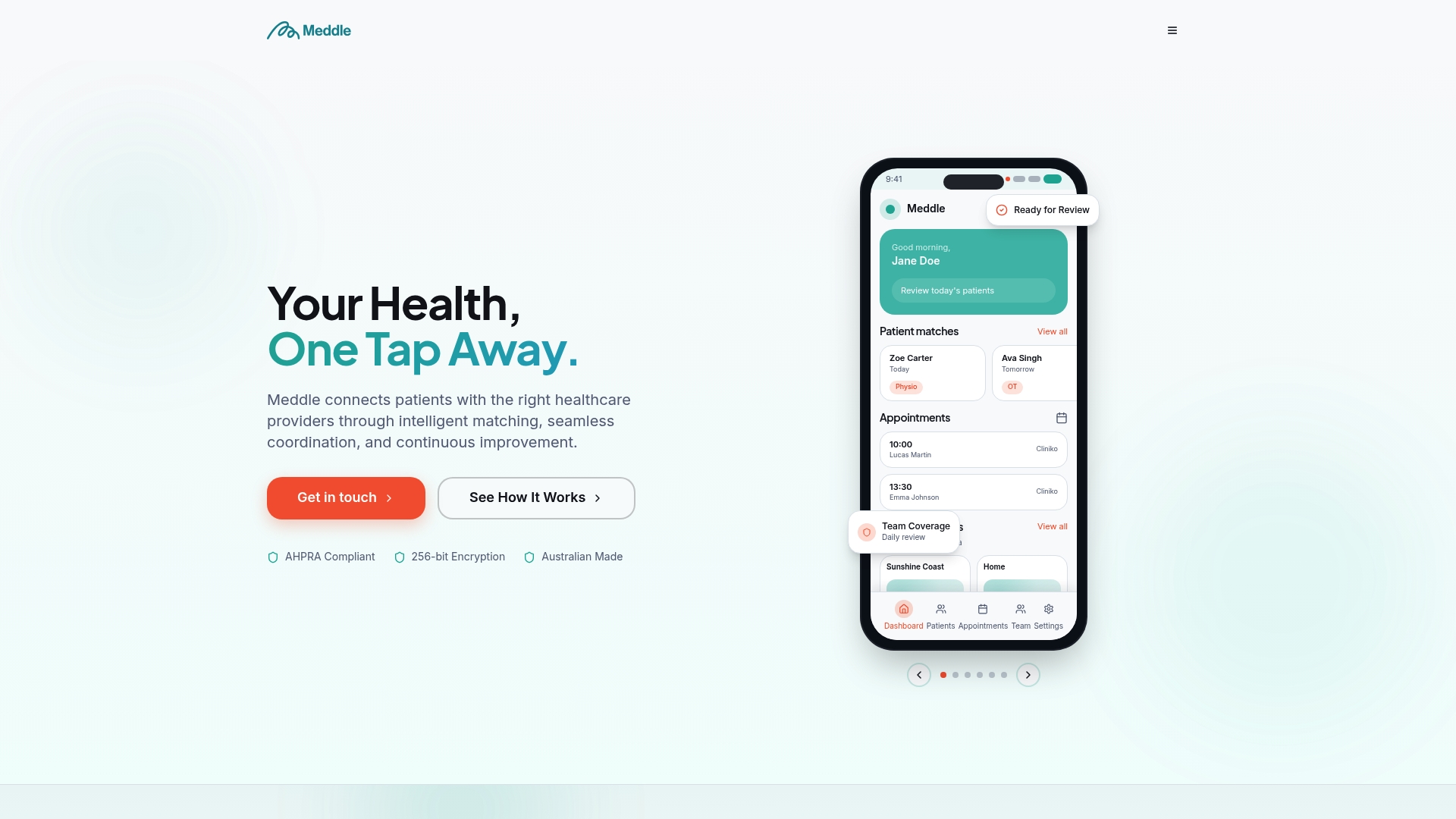
If governance and shared care plans are sorted and referral triage is still the bottleneck, see how Meddle’s matching works and check whether it fits your referral pathway. Clinics can explore rollout options for allied health practices and get a practical sense of onboarding effort before committing to anything.
Where this guide’s recommendations come from
-
AIHW’s coordination of health care reporting frames coordination as a measurable quality dimension.
-
Nous Group’s integrated care analysis identifies governance gaps as the leading barrier.
-
NSW Health’s quART guidance details transdisciplinary role-sharing standards.
-
The Australian Commission on Safety and Quality in Health Care’s ISBAR poster sets the standard handover framework.
This article is general information, not a substitute for advice from a qualified doctor. Consult a qualified healthcare professional about your own circumstances before acting on anything here.
Sources
FAQ
Can you give me an example of care coordination?
A patient with diabetes and heart failure gets a GP-led Chronic Condition Management plan, a case conference involving their cardiologist and dietitian, and a shared care plan all three can view and update as results change.
What are the “5 Cs” of care coordination?
Definitions vary across sources, but most versions centre on communication, continuity, collaboration, consistency, and a clearly defined care coordinator role.
What does “care coordination” mean?
It means organising a patient’s care across multiple providers and settings so information, referrals, and follow-up all happen without gaps or duplication.
What are practical ways to improve patient satisfaction through coordination?
Faster referral turnaround, a single named point of contact, clear shared care plans, timely follow-up calls, structured handovers using ISBAR, patient-held care summaries, and tools like Meddle that cut booking delays all measurably lift satisfaction.