SMS appointment reminders for Australian practices
TL;DR:
- Automated SMS appointment reminders are the most cost-effective way for Australian practices to reduce no-shows. Using verified sender IDs, consent logging, and behaviorally-informed wording significantly improves attendance rates. Meddle offers an integrated platform with AI-based booking and compliance features tailored for allied health clinics.
Automated SMS appointment reminders are the fastest, most cost-effective way for an Australian practice to cut no-shows. The core recommendation: deploy an automated reminder system configured for documented consent, a registered sender ID, and behaviourally-informed message wording. For allied health clinics, Meddle is the recommended platform because it combines verified messaging, AI-powered booking, and Australian compliance support in one place.
Quick shortlist for Australian allied health clinics:
- Meddle — integrated booking, verified sender ID, two-way messaging, analytics, and Australian compliance features built in; see how it works
- Appointment Reminder (appointmentreminder.com AU) — standalone SMS reminder service with calendar sync and customisable templates
- Square Appointments (Square AU) — built-in reminders within the Square booking ecosystem, suited to smaller practices
- SMS Client Reminders — lightweight per-SMS tool for low-volume or occasional reminder needs
Three questions to ask any vendor first:
- Can you register a branded sender ID in Australia, and will you support the new ACMA Sender ID Register from July 2026?
- Does the system support two-way replies (confirmations, cancellations, rescheduling)?
- Which calendar and practice management systems do you integrate with natively?
Table of Contents
- How do SMS appointment reminders work, and how do you send your first one?
- What should you ask vendors, and what are the red flags?
- What does SMS reminder pricing actually cost an Australian practice?
- What wording and timing actually improve attendance?
- Are your SMS reminders compliant with Australian law?
- How do you measure success and follow up on missed appointments?
- Key takeaways
- Why integrated reminders outperform standalone SMS tools
- Meddle gives your clinic reminders that are already connected
- Useful sources
- FAQ
How do SMS appointment reminders work, and how do you send your first one?
The mechanics are straightforward. Your booking system or calendar syncs with the SMS platform, which applies your scheduling rules (send 7 days out, then again 24 hours before) and fires personalised messages from your registered sender ID. Replies route back to a shared inbox or trigger automated confirmation workflows.
Quick-start checklist to reach your first reminder sent:
- Connect your calendar (Google Calendar, Outlook, or practice management software) via the platform’s native integration or API.
- Import or sync existing appointments; confirm the data mapping is correct (patient name, date, time, practitioner name).
- Set your reminder cadence: a 7-day reminder and a 24-hour reminder cover most attendance lift scenarios supported by Australian trial data.
- Configure your message templates (see Section 6 for tested wording).
- Register your sender ID with your telco or through the platform’s sender ID registration process. From July 2026, unregistered branded sender IDs risk being labelled “Unverified” and grouped with potential scam messages.
- Enable two-way replies and map reply keywords (CONFIRM, CANCEL, STOP) to automated actions.
- Test on five internal numbers: verify message content, sender ID display, reply handling, and delivery receipts.
- Enable consent logging so every outgoing message is timestamped in the patient record, as recommended by Avant.
- Go live and monitor the dashboard for the first 48 hours.
Pro Tip: Run your pilot with a single practitioner’s calendar for one week before rolling out clinic-wide. This limits exposure if a template or integration setting needs adjustment, and gives you a clean baseline for measuring no-show lift.
What should you ask vendors, and what are the red flags?
Choosing the wrong SMS reminder service costs more than the subscription fee. A poor integration creates double-handling; an unregistered sender ID damages patient trust; hidden per-SMS fees erode your ROI.
Selection criteria to evaluate:
- Native integration with your existing calendar or practice management software
- Two-way messaging with automated confirmation and rescheduling workflows
- Sender ID registration support and readiness for the ACMA Sender ID Register
- Documented consent capture and opt-out handling (Reply STOP)
- Data residency: patient data stored in Australia or with explicit cross-border disclosure
- Granular reporting: delivery rate, reply rate, attendance lift by practitioner
- SLA and local Australian support availability
Vendor questions to ask (exact and testable):
- “Can you register a branded sender ID in Australia, and are you ready for the July 2026 ACMA Sender ID Register?”
- “How do you handle unsubscribe requests, and how quickly is the opt-out applied?”
- “Which practice management systems do you integrate with natively, and can I test the integration before signing?”
- “Where is patient data stored, and do you have a Data Processing Agreement available?”
- “What is your delivery SLA, and do you provide delivery receipts at the individual message level?”
- “Are there per-SMS charges above the subscription, and what triggers them?”
Red flags to walk away from:
- No sender ID registration process or vague answers about the July 2026 ACMA changes
- Consent flow is a checkbox buried in the terms, not a configurable patient-facing step
- No Australian phone number support or routing through international gateways without disclosure
- Hidden per-SMS fees that activate above a “fair use” threshold not stated upfront
- Reporting limited to total messages sent, with no delivery or attendance data
What does SMS reminder pricing actually cost an Australian practice?
Pricing structures vary considerably, and the cheapest per-SMS rate is rarely the lowest total cost once you account for surcharges and minimums.
| Pricing model | Typical monthly cost (AU) | Per-SMS rate | Best suited to | Watch for |
|---|---|---|---|---|
| Pay-as-you-go | No minimum | $0.08–$0.25 per SMS | — | International routing surcharges |
| Entry subscription | — | Included up to cap | — | Fair-use caps and overage fees |
| Mid-tier subscription | — | Included up to cap | — | MMS costs billed separately |
| Per-practitioner (platform) | from A$40/practitioner | Included or add-on | Multi-practitioner clinics | Add-on SMS packs at extra cost |
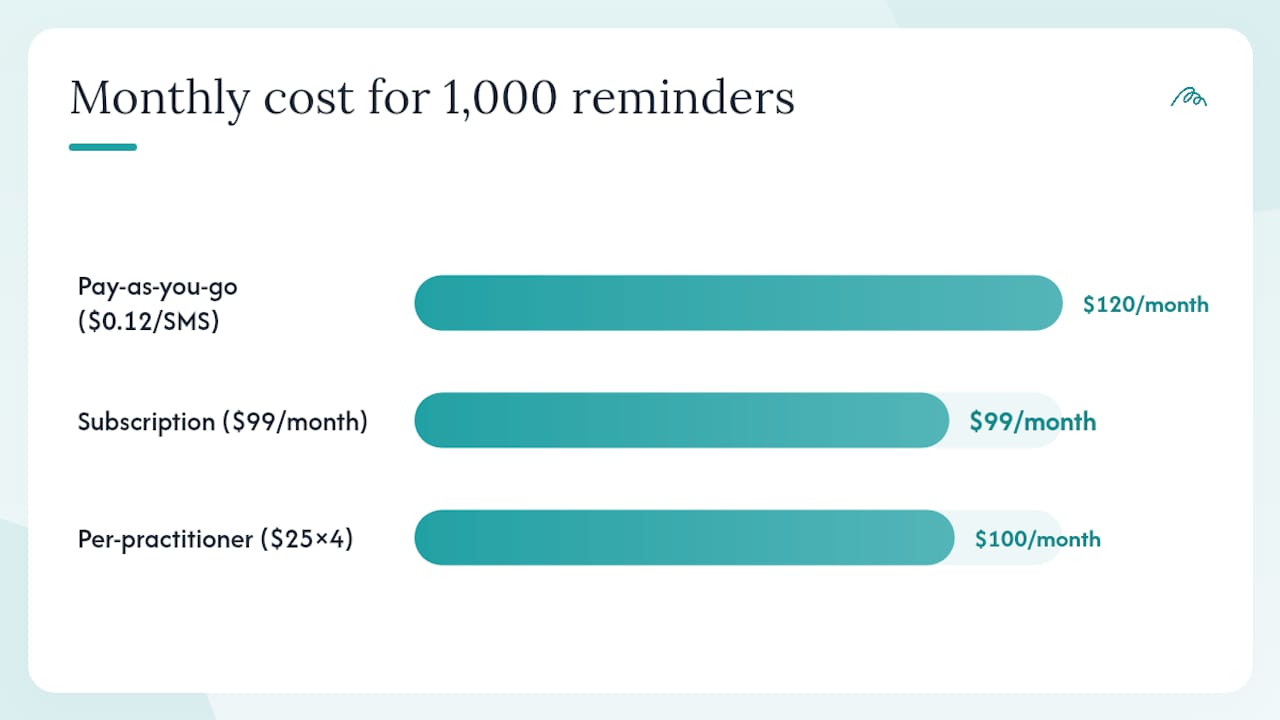
Worked example for a clinic sending 1,000 reminders per month:
- At $0.12 per SMS (pay-as-you-go): $120/month before surcharges.
- At a $99/month subscription covering 1,500 SMS: $99/month, saving roughly $21 and removing per-message variability.
- At a per-practitioner platform (A$40 × 4 practitioners = $100/month) with SMS included: $100/month with booking, matching, and analytics bundled.
Common billing traps:
- International routing surcharges applied when messages transit overseas gateways, even for Australian recipients
- MMS billed at 3–5× the SMS rate; avoid sending images unless the use case demands it
- Delivery retries counted as separate billable messages on some platforms
- Hidden monthly minimums that apply even when your volume drops (e.g., during holiday periods)
Use Meddle’s no-show cost calculator to estimate how much a reduction in your failure-to-attend rate is worth before comparing subscription costs.
What wording and timing actually improve attendance?
Message framing matters as much as timing. Australian and UK trial data consistently show that personalised, behaviourally-informed messages outperform generic reminders.
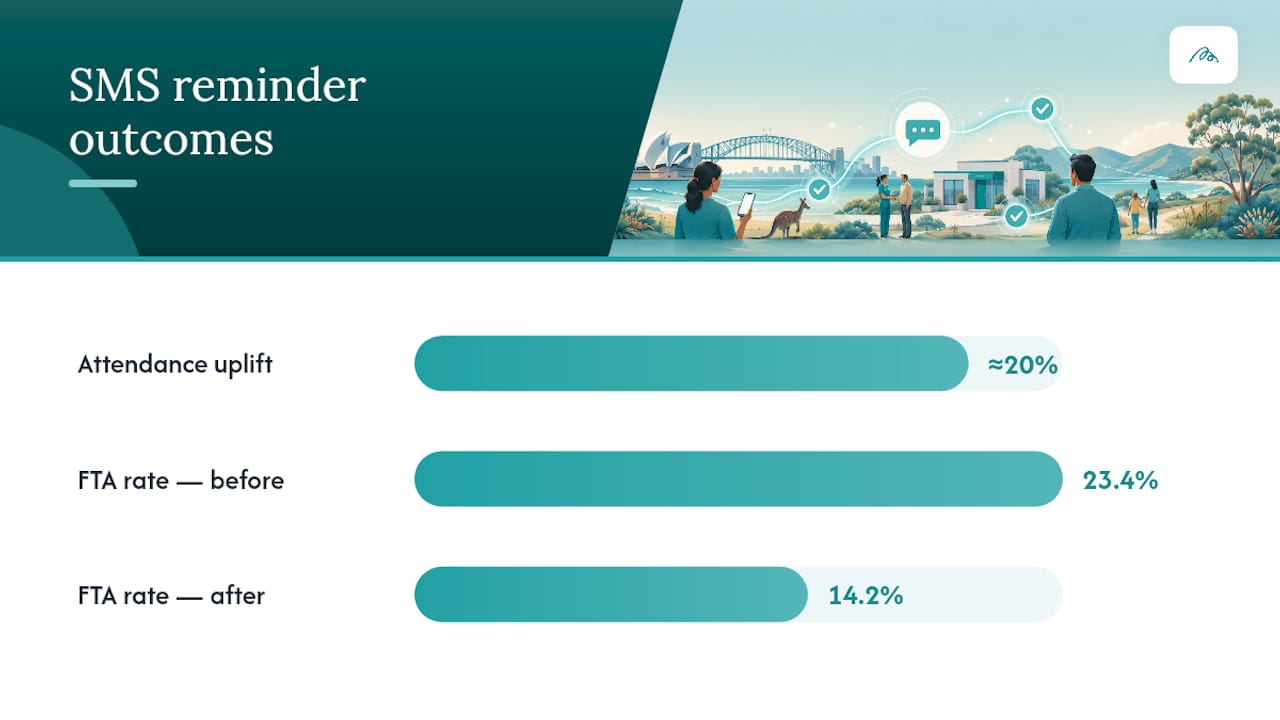
A Royal Children’s Hospital Melbourne study found that SMS reminders reduced failure-to-attend rates from 23.4% to 14.2% in trial groups. A Behavioural Insights Unit RCT at St Vincent’s Hospital Sydney found that recipients of an “avoided loss to hospital” message were almost 20% more likely to attend than the control group, with estimated savings of approximately $67,000–$97,000 per year for the hospital in the trial context.
Key finding: Personalised messages that name the treating practitioner and use a reciprocity or avoided-loss framing consistently outperform generic “don’t forget your appointment” reminders in Australian and Victorian trials. Victorian behavioural insights trials found that personalised messages doubled reply engagement and reduced no-shows compared with standard reminders.
Tested templates you can copy:
- Confirmation (sent immediately after booking): “Hi [First Name], your appointment with [Practitioner] at [Clinic] is confirmed for [Date] at [Time]. Reply CONFIRM to lock it in or CANCEL if plans change. Reply STOP to opt out.”
- 7-day reminder (avoided-loss framing): “Hi [First Name], your appointment with [Practitioner] on [Date] at [Time] is reserved for you. Cancelling with 48 hours’ notice lets another patient take your spot. Reply CANCEL to free it up or CONFIRM to keep it. Reply STOP to opt out.”
- 24-hour reminder (reciprocity framing): “Hi [First Name], [Practitioner] is looking forward to seeing you tomorrow at [Time] at [Clinic]. Reply CONFIRM or call [Phone] if you need to reschedule. Reply STOP to opt out.”
Recommended timing cadence:
- Send a confirmation immediately after booking
- Send a 7-day reminder for appointments booked more than 7 days out
- Send a 24-hour reminder for all appointments
Pro Tip: Track cancellations alongside no-shows when you run a new template. Behavioural insights research shows that effective reminders often increase cancellations while reducing failure-to-attend rates. A rise in cancellations is a good outcome: it frees slots for other patients and is far preferable to a silent no-show.
Note that SMS alone may be insufficient for some patient groups. Research at public dental clinics found younger patients and those facing socio-economic barriers often need a phone call or letter in addition to an SMS reminder.
Are your SMS reminders compliant with Australian law?
Appointment reminders occupy a specific position under Australian law. The ACMA classifies appointment and payment reminders as messages that are generally not spam, but the moment a reminder includes a promotional element (a special offer, a product recommendation), it becomes a commercial electronic message subject to the full requirements of the Spam Act 2003: consent, sender identification, and a functional unsubscribe mechanism.
Practical compliance checklist for your clinic:
- Obtain and document consent at patient registration (express or clearly inferred consent for administrative communications)
- Keep reminder messages administrative only: appointment date, time, practitioner name, and reply options
- Never include clinical details (diagnosis, test results, medication) in an SMS
- Include a clear opt-out in every message: “Reply STOP to opt out”
- Register your sender ID with your telco or through your SMS platform; from July 2026, unregistered sender IDs risk being labelled “Unverified” by carriers
- Store a timestamped log of every outgoing message in the patient’s health record, as Avant recommends
- Separate recall messages (clinical follow-up) from promotional content; mixing the two creates AHPRA advertising compliance risk
Vendor compliance checklist:
- Sender ID registration process in place and July 2026 ACMA register-ready
- Automated opt-out handling with immediate suppression on “STOP” reply
- Australian data residency or documented cross-border disclosure
- Secure, auditable logging of all outgoing messages
How do you measure success and follow up on missed appointments?
Measuring the right metrics tells you whether your reminder system is working or just adding cost.
Core KPIs to track from day one:
- Attendance rate (appointments attended / appointments scheduled)
- No-show rate (failure-to-attend / total scheduled)
- Cancellation rate and time-to-cancellation (early cancellations free slots; last-minute ones do not)
- SMS reply rate (CONFIRM vs CANCEL vs no reply)
- Time-to-fill cancelled slots
- Admin hours saved per week
Running an A/B test on your templates:
- Split your appointment cohort randomly: half receive Template A (standard reminder), half receive Template B (avoided-loss or reciprocity framing).
- Run the test for a minimum of four weeks to account for weekly booking patterns.
- Measure attendance rate and cancellation rate separately for each group.
- Declare a winner only when the difference is consistent across at least two consecutive weeks.
- Roll the winning template out clinic-wide and set a calendar reminder to retest in six months.
Follow-up workflow for non-responsive patients:
- If no reply to the 24-hour SMS: make one phone call on the morning of the appointment.
- If the appointment is missed: send a same-day SMS offering to rebook, then a phone call within 48 hours.
- For clinically significant recalls, the BSPHN recall and reminder toolkit recommends up to three contact attempts using a mix of methods (SMS, phone, letter) and full documentation of each attempt in the health record.
- Escalate to personal contact (practitioner or care coordinator) when clinical urgency warrants it.
Key takeaways
Automated SMS reminders with registered sender IDs, documented consent, and behaviourally-informed wording are the most evidence-backed method for reducing no-shows in Australian allied health practices.
| Point | Details |
|---|---|
| Sender ID registration is urgent | From July 2026, unregistered sender IDs risk being labelled “Unverified” by Australian carriers. |
| Wording drives attendance lift | Avoided-loss and personalised messages produced almost 20% higher attendance in the St Vincent’s RCT. |
| SMS reminders cut FTA rates | Royal Children’s Hospital data shows FTA fell from 23.4% to 14.2% with a single timed reminder. |
| Compliance is non-negotiable | Consent, opt-out, and message logging are required under the Spam Act 2003 and Avant guidance. |
| Meddle for allied health clinics | Meddle combines verified messaging, booking automation, and analytics from A$40/practitioner. |
Why integrated reminders outperform standalone SMS tools
The practices that get the most from automated reminders are not the ones with the cheapest per-SMS rate. They are the ones where the reminder system and the booking system share a single source of truth.
When reminders fire from a disconnected SMS tool, you get a familiar set of problems: a patient cancels via SMS reply, but the slot stays blocked in the calendar because the two systems do not talk. The practitioner sits idle; the admin team scrambles. An integrated platform eliminates that gap. The cancellation triggers an immediate slot release, which can then be offered to a waitlisted patient automatically.
There is also the compliance dimension. Standalone tools often leave consent logging and message archiving as manual steps. In an integrated platform, every outgoing message is timestamped against the appointment record without any extra effort from your team. That audit trail matters when a patient disputes a communication or when a regulator asks for evidence of opt-out compliance.
The analytics picture changes too. When your reminder data and your attendance data live in the same system, you can measure the actual lift from a template change in real time, not by exporting two spreadsheets and reconciling them manually.
Meddle gives your clinic reminders that are already connected
Less no-shows, less admin, and no separate SMS tool to manage: that is the practical difference Meddle delivers for allied health clinics. Rather than bolting a reminder service onto an existing booking system, Meddle builds verified messaging, AI-powered patient matching, and attendance analytics into a single platform from A$40 per practitioner per month.
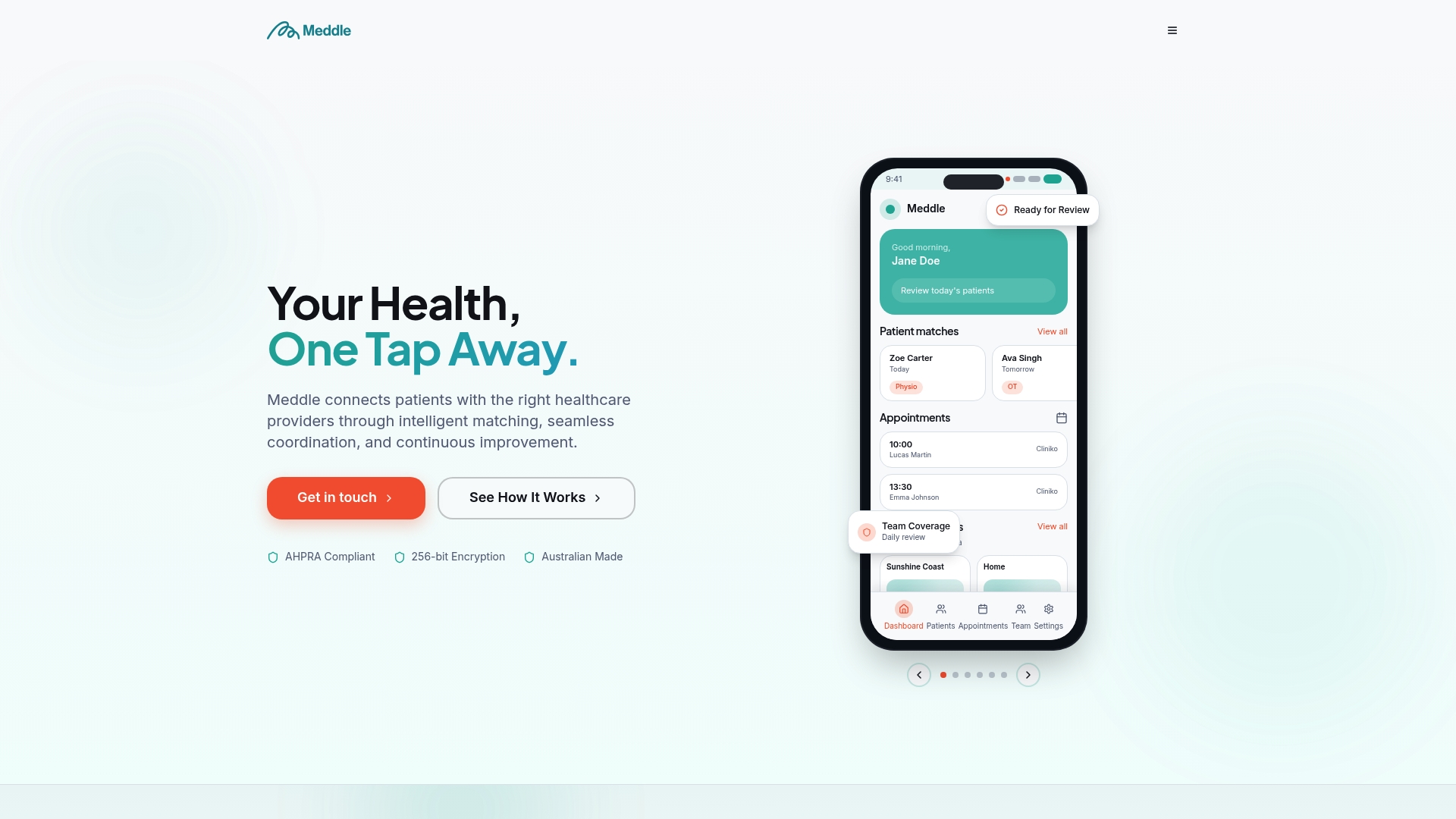
Your sender ID is registered as part of the onboarding process, consent capture is built into patient intake, and every outgoing message is logged automatically against the appointment record. Two-way replies (CONFIRM, CANCEL, RESCHEDULE) update the calendar in real time, so your team sees an accurate schedule without manual reconciliation. The simple rollout path takes most clinics from sign-up to first reminder sent in under 30 minutes.
See Meddle’s pricing or request a demo to test the full workflow with your own calendar before committing.
Useful sources
The following authoritative sources underpin the compliance, evidence, and clinical practice guidance in this article:
- Recommendations for patient communication via telephone and text message (Avant)
- Dealing with spam (ACMA guidance)
- Spam Act 2003 (consolidated legislation)
- Behavioural insights case study: specialist clinic attendance (Victoria State Government)
- Recommendations for recall and reminder systems (BSPHN toolkit)
- Spam in the spotlight: ACMA raises the stakes for business messaging (Sparke Helmore)
FAQ
What are SMS appointment reminders?
SMS appointment reminders are automated text messages sent to patients before a scheduled appointment to reduce no-shows. They typically include the appointment date, time, practitioner name, and a reply option to confirm or cancel.
How do you set up text message reminders for appointments?
Connect your calendar or practice management software to an SMS platform, configure your reminder timing (commonly 7 days and 24 hours before), set up your message templates, register your sender ID, and test on internal numbers before going live. Most platforms reach “first reminder sent” in under 30 minutes.
How do you write an effective reminder text for an appointment?
Include the patient’s first name, the practitioner’s name, the date and time, and a clear reply option (CONFIRM or CANCEL). Australian trial evidence shows that avoided-loss framing (“cancelling with 48 hours’ notice lets another patient take your spot”) and reciprocity framing (“[Practitioner] is looking forward to seeing you”) both improve attendance compared with generic reminders.
Are SMS appointment reminders covered by the Spam Act?
Pure administrative appointment reminders are generally not classified as spam under ACMA guidance, but they must still include sender identification and a functional opt-out. Adding any promotional content converts the message into a commercial electronic message subject to the full Spam Act 2003 consent and unsubscribe requirements.
Can Meddle send automated appointment reminders for allied health clinics?
Yes. Meddle’s platform includes two-way SMS reminders with registered sender ID support, consent logging, and calendar integration, starting from A$40 per practitioner per month. The for-clinics page outlines the rollout process and available integrations.