5 Day TNAA Playbook: Advanced Access Scheduling for Clinics

Advanced access scheduling balances clinic supply against patient demand so most patients get seen within a day or two of calling, rather than weeks later. Systematic reviews confirm it reduces the time to third-next-available appointment in most well-run implementations, with knock-on drops in no-show rates. The single non-negotiable requirement: commit to active supply-demand balancing and track the third-next-available appointment metric weekly, not the calendar of same-day slots you happen to open.
TL;DR:
Achieving lasting access improvements requires reducing backlog first before implementing same-day scheduling, typically taking four to six weeks of focused effort.
The key metric to monitor is the third-next-available appointment, which should stay under five days for two consecutive weeks to ensure capacity is sufficient.
Reconfiguring appointment types into two or three categories and matching patients by discipline and the capacity clinicians have shared speeds up backlog clearance and demand management.
Sustaining gains depends on ongoing PDSA cycles, weekly TNAA reviews, clear communication with patients, and contingency planning for demand surges or staff absences.
Improvements are most significant in clinics with high baseline no-show rates, but benefits diminish in already efficient practices with low wait times.
Table of Contents
What is advanced access scheduling, really?
Most administrators who hear “advanced access” picture same-day appointments and stop there. That’s a misreading of the model, and it’s the fastest way to sabotage an implementation.
The framework comes from Mark Murray and Donald Berwick, who described advanced access as a quality-improvement method grounded in queuing theory rather than a booking gimmick. Their foundational paper argues that clinics create their own backlogs by mismatching supply and demand, then compound the problem by adding appointment types, triage rules and referral hoops that push demand further into the future. You’ll also see the model called open access or same-day scheduling, but those names undersell it. Same-day booking is a symptom of good advanced access, not the definition of it.
Murray and Berwick identified six operational elements that have to move together for the model to hold:
-
Balance supply and demand — measure how many appointment slots a clinician can realistically offer against how many a panel actually needs, then adjust one or both.
-
Reduce the backlog — work down the existing queue of booked-ahead appointments before flipping the switch on open scheduling, or the backlog just resurfaces as a new bottleneck.
-
Reduce appointment types — collapse the dozen visit categories most clinics run (new patient, follow-up, procedure, review, and so on) into two or three, so reception isn’t guessing which slot fits which need.
-
Develop contingency plans — pre-plan for staff leave, seasonal surges and clinician absence, because a model built on daily balance breaks quickly without a buffer.
-
Work to adjust demand — shift some demand to nurses, allied health colleagues or telehealth rather than assuming every request needs the same clinician on the same day.
-
Increase the availability of bottleneck resources — find where the queue actually stalls (often a specific clinician, a specific room, or a specific test slot) and add capacity there specifically.
The queuing-theory logic behind this is straightforward once you see it: appointment backlogs behave like any queue with variable arrival and service times. Add slack anywhere in the system, and the queue shortens everywhere downstream. Try to manage the backlog with rules and triage instead of capacity changes, and the queue simply moves rather than shrinks. That’s the trap same-day pilots fall into. They open ten slots at 8am without touching the other five elements, and the backlog reappears within a fortnight.
What does the evidence actually show?
The results are consistent on access, less consistent everywhere else. A systematic review by Rose et al. found that five of eight reviewed studies achieved a mean time to third-next-available appointment under five days after implementation. That’s the headline number worth anchoring your project to.
Key data point: Across systematic reviews, no-show rate changes ranged from a 24 percent reduction to no change at all, with the largest gains concentrated in practices that had high baseline no-show rates — typically above 15 percent.
That pattern matters for how you set expectations internally. A clinic already running lean, with low no-shows and a tight backlog, shouldn’t promise the board a dramatic attendance turnaround. The gains show up where the problem was worst to begin with.
Where the evidence gets murkier is everything downstream of access. A narrative synthesis of the advanced access literature found inconsistent effects on patient satisfaction, continuity of care, and clinical outcomes, alongside real methodological weaknesses in the underlying studies:
-
Definitions of “advanced access” vary between studies, making pooled comparisons unreliable.
-
Many studies carry a meaningful risk of bias, often from self-reported outcome measures or non-randomised before-after designs.
-
Continuity of care, loss-to-follow-up and clinical outcome data are thin compared with the volume of access-metric data.
The practical takeaway: treat wait-time and no-show improvements as well-supported and reasonably predictable. Treat satisfaction and continuity claims as directional at best, and measure them yourself rather than importing someone else’s published result as a promise to your own patients. Local measurement isn’t a nice extra here. It’s the only way to know if your version of advanced access is actually working.
Which metrics do you need to track?
The third-next-available appointment metric, or TNAA, is the industry-standard capacity signal, and for good reason. Counting the very next open slot gets distorted by last-minute cancellations and worked-in double-bookings. Counting the third one filters that noise out, giving a more honest read on real capacity. To calculate it: on any given day, for any given clinician, count forward from today to the third appointment slot that’s genuinely open for booking, and log the number of calendar days.
TNAA on its own tells you about access, not the whole operation. Pair it with complementary indicators so a clean access number doesn’t mask a quieter problem building elsewhere.
| Metric | What it tells you | Typical review cadence |
|---|---|---|
| Third-next-available appointment (days) | Real capacity signal, filtered for booking noise | Weekly |
| No-show rate (%) | Whether open access is translating into kept appointments | Weekly |
| Completed follow-up rate (%) | Whether patients needing review are actually returning | Monthly |
| Visit volume per clinician | Whether panel load matches capacity assumptions | Monthly |
| Continuity index (% seeing own GP) | Whether access gains are eroding relationship-based care | Monthly |
| Demand forecast variance | Gap between predicted and actual daily demand | Weekly |
Set a red-flag threshold before you go live, not after something goes wrong. A common working rule: if TNAA climbs past five days for two consecutive weeks, or no-shows jump more than five percentage points month over month, that triggers an immediate review rather than waiting for the next scheduled dashboard meeting.
How do you actually implement advanced access?
Rolling out advanced access in stages beats flipping a switch, mostly because the backlog has to be worked down before open scheduling can hold. Skip a stage and you’ll spend the next six months firefighting instead of monitoring.
-
Stage 0: Assessment. Measure your baseline TNAA for every clinician, quantify the existing backlog (how many appointments are booked more than two weeks out), map panel size against demand, and identify where bottlenecks sit. This stage alone often takes two to four weeks and should not be rushed, because every later decision depends on this baseline.
-
Stage 1: Fix the templates. Collapse appointment types down to two or three categories and rebuild the daily template around them. This is also where max packing earns its keep — resolving multiple patient issues in a single visit instead of booking three follow-ups for three separate concerns frees genuine capacity without adding a single new slot. Adjust prescription-cycle timing here too, since misaligned repeat scripts quietly generate a large share of avoidable bookings.
-
Stage 2: Work down the backlog. Run dedicated backlog sessions, sometimes with temporary extra capacity (locum cover, extended hours for a defined period) purely to clear the queue of appointments booked weeks ahead. Don’t open full advanced access until this backlog is materially reduced, or the new system inherits the old problem on day one.
-
Stage 3: Live demand matching. Move rostering and booking rules to match real daily demand patterns rather than a fixed historical template. Same-day booking rules go live here, once the backlog is cleared and templates are stable enough to absorb genuine daily variation.
-
Stage 4: Contingency and surge planning. Build cross-coverage protocols, pre-authorise a pool of clinicians who can flex into surge windows, and document what happens when a clinician is unexpectedly away. This is the stage most clinics skip, and it’s the reason otherwise successful rollouts collapse the first time flu season or a staff illness hits.
Pro Tip: Run Stage 2 (backlog clearance) for at least four to six weeks before touching your booking rules in Stage 3. Clinics that rush this step almost always see TNAA creep straight back up within two months, because the old backlog was never actually cleared, just temporarily hidden by the new template.
Who does what: reshaping team roles and workflows
Advanced access changes daily behaviour for almost everyone in the clinic, not just the person managing the diary.
Reception and scheduling staff need new booking scripts built around the collapsed appointment types from Stage 1, not the old triage questions that sorted patients into a dozen categories. The shift is subtle but real: instead of asking “is this urgent or routine,” the question becomes “what does this patient need today, and does it fit in a standard slot.”
Clinicians carry the bulk of the behavioural change. Practising max packing means genuinely addressing multiple concerns in one consultation rather than deferring the second issue to “book again next week.” Telehealth slots, used deliberately rather than as an afterthought, absorb a meaningful share of demand that doesn’t need a physical room. Time-boxing visits, holding to the scheduled length rather than letting appointments run long, protects the whole day’s template from cascading delays.
Team scheduling needs its own redesign:
-
Cross-coverage rosters so one clinician’s leave doesn’t collapse the whole day’s availability.
-
Rotation approaches for training clinics and residency placements that preserve continuity even as personnel change.
-
Clear escalation paths for when demand genuinely exceeds available capacity on a given day.
On the systems side, your booking platform needs configuration that reflects the new appointment types, telehealth slot rules, and same-day booking logic. A system still configured around the old dozen appointment categories will quietly undermine every other change you make.
What goes wrong, and how do you fix it?
The single biggest failure mode is treating advanced access as a same-day appointment policy instead of a system redesign. Murray and Berwick’s own work is explicit on this: opening a handful of same-day slots without touching templates, backlog or appointment types doesn’t produce lasting change — it produces a temporary illusion of access that collapses under the first surge.
Three other risks show up repeatedly in clinics running advanced access:
-
Continuity loss. Patients who used to see their regular GP start getting whoever has the next open slot. Carve out dedicated continuity slots for patients with chronic or complex conditions, and build proactive recall for anyone who falls through the gaps rather than assuming they’ll rebook themselves.
-
Staff burnout during demand surges. A model built on daily balance has no slack by design, which means an unplanned surge lands directly on staff. Contingency rosters (Stage 4) exist precisely to absorb this, and removing low-value bottleneck tasks from clinician workload matters just as much as adding bodies.
-
Metric misinterpretation. A falling TNAA looks like success on its own. Reviewed alongside a growing backlog or falling visit volume, it can mean patients are simply being turned away or diverted elsewhere. Review TNAA, backlog and volume together, every time, never TNAA in isolation.
Pro Tip: If your TNAA improves but your completed follow-up rate quietly drops in the same period, don’t celebrate yet. It’s often a sign patients are getting same-day access for acute issues while chronic-condition follow-ups are being crowded out of the same shrinking template.
How does a matching platform support advanced access goals?
Platforms that match patients to practitioners by discipline, location and the capacity each clinician has shared solve a specific piece of the advanced access puzzle: getting the right patient to the right practitioner faster, without reception manually cross-checking clinician calendars.
Meddle approaches this with an algorithmic matching engine that matches patients by discipline, location and the capacity each clinician has shared, then routes the referral; the clinic confirms the booking. For a clinic mid-way through Stage 2 or Stage 3 of an advanced access rollout, that does two useful things: it helps clear the backlog by routing referrals across a whole panel rather than one clinician’s diary, and it supports daily demand matching once same-day rules go live. Referral routing and a shared practice dashboard also mean fewer manual handoffs between reception, clinicians and allied health colleagues during the transition, which is exactly where advanced access rollouts tend to lose momentum.
Keeping the gains: PDSA cycles and governance
Advanced access degrades without deliberate upkeep. Clinics that sustain their gains treat it as an ongoing improvement cycle, not a one-off project with a launch date and a ribbon.
Set a clear PDSA rhythm: a small test of change (a template tweak, a new booking script), a defined success criterion tied directly to TNAA movement, and a named owner accountable for the result. Weekly huddles should review the leading indicators (TNAA, demand variance); monthly operational reviews should cover the lagging ones (continuity, follow-up completion, burnout signals from staff). Escalation needs a single named owner, usually the practice manager, so a red-flag threshold triggers action rather than a debate about whose job it is.

Programs that reviewed data on this cadence sustained their access gains more reliably than those that checked in only when problems became visible.
A 90-day checklist you can copy into a project plan
-
Weeks 1 to 2: Baseline TNAA, backlog size and panel demand for every clinician; identify bottleneck resources.
-
Weeks 3 to 6: Fix appointment-type categories and rebuild daily templates; test max-packing rules with one or two clinicians first.
-
Weeks 7 to 10: Run dedicated backlog-clearance sessions; assign a named owner for daily monitoring.
-
Weeks 11 to 12: Set up the dashboard (TNAA, no-shows, continuity), define red-flag thresholds, and schedule the first monthly review before go-live on live demand matching.
How do you communicate the change to patients?
Patients notice when booking rules change, and unexplained change breeds complaints even when the new system is objectively better. The clinics that transition smoothly treat communication as its own workstream, not an afterthought tacked onto the go-live date.
Start before the backlog-clearance stage, not after. Tell patients plainly what’s changing and why: shorter waits for new issues, possibly a different clinician than usual for same-day needs, and a specific plan for anyone with a chronic condition who needs continuity. That last point matters enormously, because continuity is exactly what patients worry about losing under an open-access model.
Reception scripts need to explain the new appointment categories without sounding like a policy lecture. A simple framing works: “We’re changing how we book so you can get in sooner. For today’s issue, here’s your options.” Patients with complex or ongoing needs should hear directly that they still have a protected path to their regular clinician, because continuity carve-outs only work if patients actually know they exist and ask for them.
Signage, SMS reminders and website updates should all say the same thing in the same words. Mixed messaging between what reception says on the phone and what the website promises is one of the fastest ways to generate confused, frustrated calls in the first month of transition.
What role does scheduling technology play?
Templates and workflow redesign do most of the heavy lifting in advanced access, but the software underneath either supports that redesign or actively fights it.
The core requirement is simple to state and harder to find: a system that reflects your collapsed appointment types, shows current capacity across the whole panel (not just one clinician’s calendar), and supports telehealth slots as first-class bookable appointments rather than a bolt-on. Booking workflows that notify clinicians and reception at the same time cut the manual back-and-forth that otherwise eats into the capacity gains you’ve just fought to create.
Patient self-scheduling tools deserve particular attention during an advanced access rollout. Letting patients book directly into times the clinic has opened for online booking removes a layer of reception workload and, done well, reduces the friction that drives no-shows in the first place. The risk is a self-scheduling tool that doesn’t understand your new appointment-type categories, in which case patients simply recreate the old triage confusion themselves, just without a receptionist to correct it.
Dashboard and reporting capability matters just as much as booking. If your system can’t produce a weekly TNAA figure without a manual spreadsheet exercise, the monitoring discipline this model depends on will quietly stop happening within a few months, regardless of good intentions at launch.
What does advanced access cost to implement?
The direct costs are lower than most administrators expect, and the resource allocation question is really about staff time, not capital spend.
Backlog-clearance sessions (Stage 2) are the main line item, since temporary extra capacity, whether locum cover or extended hours, costs real money for a defined period. Budget for four to six weeks of this, scaled to how large your existing backlog actually is. Template redesign and staff training absorb administrative time rather than direct spend, but that time has to be protected on someone’s calendar or it never happens amid the daily grind of running a clinic.
Technology costs vary depending on whether your existing scheduling software can be reconfigured or needs replacing. A platform evaluation early in Stage 0 avoids the expensive mistake of redesigning templates around software that can’t actually support the new appointment-type structure. The resource question that matters most, though, isn’t dollars. It’s whether you have a named owner with protected time to run the weekly TNAA review, because a model that depends on continuous measurement fails quietly the moment nobody’s watching the numbers.
Does advanced access work the same in every clinic?
No, and treating a rural solo practice the same as a large urban multidisciplinary clinic is a reliable way to misjudge timelines.
Small and rural practices often have a natural advantage: fewer clinicians and simpler panels make supply-demand balancing more visible and faster to adjust. The trade-off is thinner contingency margin. One clinician’s leave in a two-GP rural practice has a proportionally bigger impact than the same absence in a twelve-clinician urban clinic, so Stage 4 contingency planning deserves more weight, not less, in smaller settings.
Large clinics and networks face the opposite problem: more moving parts, more appointment-type variation to collapse, and more competing clinical opinions about how the templates should work. Academic and training clinics carry an extra layer again, since resident rotation and continuity require pairing arrangements and designated responsible clinicians to stop continuity collapsing every time a training placement changes over. Networks with multiple sites benefit from running one site as a pilot before network-wide rollout, since the template and backlog work rarely transfers cleanly from one clinic’s demand pattern to another’s.
What do real implementations actually look like?
Academic family-medicine networks offer the most documented before-and-after picture, largely because they combine the full complexity advanced access has to handle: rotating residents, faculty continuity requirements and formal measurement obligations.
One academic network implementation built its rollout around staged measurement of TNAA alongside explicit continuity solutions, pairing residents with designated backup clinicians so patient relationships survived rotation changes. Leadership commitment and structured change-management support were identified as necessary conditions for success, not optional extras. Clinics that skipped formal governance and simply asked staff to “try open access” saw far less durable improvement than those that built in panel-size calculations and staged backlog work from the outset.
The pattern across implementation literature is consistent even outside academic settings: the clinics that see lasting TNAA reductions are the ones that worked through backlog clearance methodically before flipping on same-day rules, and kept measuring afterward. The ones that saw gains evaporate within months skipped straight to same-day booking without touching templates, backlog or contingency planning, which is precisely the failure mode Murray and Berwick warned about decades ago.
What leaders get wrong before they start
Every implementation lead eventually has the same uncomfortable conversation: someone on the team, usually a well-meaning clinician, wants to declare victory the day same-day slots open, weeks before the backlog is actually cleared. That’s the moment that decides whether the whole project holds or quietly reverts within a quarter.
Three things I’d tell any administrator starting this work. First, resist the urge to skip Stage 2. The backlog doesn’t disappear because you’ve announced a new policy; it disappears because someone worked through it, session by session. Second, protect the weekly TNAA review as a non-negotiable meeting, not a nice-to-have that gets bumped when the roster’s short-staffed. Third, tell your continuity story to patients before they have to ask about it. The clinics that struggle most aren’t the ones with weak templates. They’re the ones that never explained the change to the people it affects most.
— Taylor
How Meddle fits into your advanced access rollout
The implementation steps above rely on one thing above all: knowing who has capacity and matching that to who actually needs care right now. That’s the specific gap Meddle’s matching engine is built to close: it matches patients by discipline, location and the capacity each clinician has shared, then routes the referral, so reception isn’t hunting across multiple calendars. The clinic still confirms the booking.
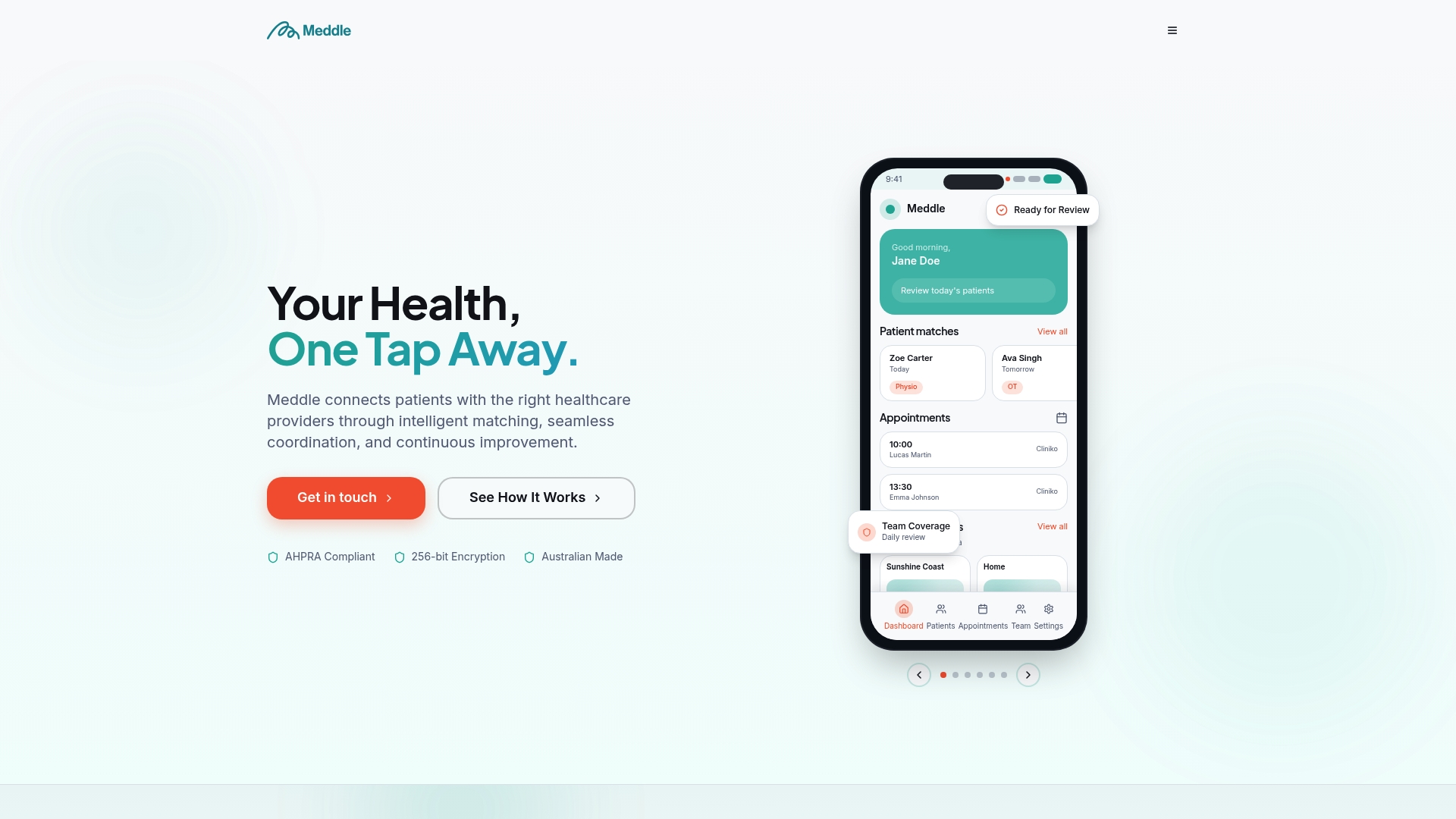
If you’re evaluating a platform to support your Stage 3 demand-matching work, ask any vendor four questions before you sign anything: how patient data is protected, how the tool integrates with your existing systems, what reporting comes standard for TNAA and backlog tracking, and how much control clinicians retain over their own availability rules. Meddle’s practitioner benefits page walks through how the platform handles each of those, including dashboard reporting built for exactly the metrics this article recommends tracking weekly. If telehealth is part of your capacity plan, the telehealth versus in-person advisor tool is worth a look before you finalise your template design. Book a walkthrough to see how the matching engine slots into your existing backlog-clearance timeline.
Sources
Murray and Berwick’s original framework remains the essential starting point for the six-element model. The Rose et al. systematic review supplies the strongest evidence on TNAA outcomes, while the NCBI Bookshelf synthesis covers no-show rate effects in detail. For implementation specifics in complex, multi-clinician settings, the academic family medicine network study documents panel-sizing, continuity planning and governance in practice.
-
Advanced access scheduling outcomes: A systematic review (Rose et al.)
-
Advanced access: reducing waiting and delays in primary care (Murray & Berwick)
FAQ
What are the three types of scheduling used in primary care?
Most primary care clinics use fixed-interval scheduling (equal time blocks), wave scheduling (several patients booked at once), or advanced access scheduling, which balances daily supply against demand instead of relying on a fixed template.
What are the five key steps to schedule a patient’s appointment under advanced access?
Assess the patient’s actual need, match it against the collapsed appointment-type categories, check current availability across the panel, book into the earliest genuinely open slot, and confirm with a script that reinforces continuity options for ongoing conditions.
What is the most popular scheduling method in healthcare?
Advanced access, also called open access scheduling, is the model most widely recommended in primary care improvement literature because it directly targets the time to third-next-available appointment rather than managing symptoms of a backlog with triage rules.
How long does it take to see results from advanced access scheduling?
Backlog clearance typically takes four to six weeks, with measurable TNAA improvement following once templates and appointment types are stabilised. Full stabilisation across all six elements usually takes several months.
Does advanced access scheduling reduce no-show rates?
Yes, particularly in clinics with high baseline no-show rates. Reviewed studies found no-show reductions as large as 24 percent in practices starting above a 15 percent no-show rate, with smaller gains where attendance was already strong.