Fix Templates First: Load Balancing Appointments That Actually Work

Appointment load balancing is the practice of distributing patient bookings across providers based on capacity, complexity, and availability, rather than filling each clinician’s diary in the order requests arrive. The single most effective first step is to segment your visit types and apply one simple rule, usually least-busy or weighted-by-complexity, before touching anything more advanced. Get that right and you’ll see smoother throughput, fairer provider load, and fewer of the cascading delays that turn a Tuesday into chaos by 11am.
TL;DR:
Least-busy allocation works well for small clinics with similar providers, spreading new bookings within a few appointments of each other.
Round robin cycling suits low-variance visit types but can underperform with complex cases or mixed provider skill levels.
Tracking utilization, wait times, and no-show rates regularly helps identify whether imbalance issues stem from templates or staffing, influencing rule choice.
Proper appointment templates, with differentiated visit complexity tiers and staggered starts, are crucial for load balancing to work effectively.
Real-time data and AI-driven patient-provider matching improve load balancing accuracy and reduce rebookings, enhancing overall clinic efficiency.
Table of Contents
-
What are the main load balancing strategies for appointments?
-
Designing appointment templates that make balancing rules work
-
Does load balancing actually improve the patient experience?
-
What legal and compliance issues affect appointment distribution?
-
How do you monitor and adjust a balancing rule in real time?
What are the main load balancing strategies for appointments?
Most clinics choose between four core scheduling algorithms. Each one solves a different problem, and picking the wrong one for your clinic size or case mix is the most common reason a balancing rule gets abandoned within a month.
Least-busy allocation sends the next new booking to whichever provider currently has the lightest load, measured by open slots or booked minutes over a rolling window. It suits practices with several providers offering similar services, where fairness in raw volume matters more than matching for complexity. A five-physio clinic running this rule for new patient intakes typically sees new bookings spread within a few appointments of each other across the team.
Round robin simply cycles bookings through providers in sequence, regardless of current load. It’s the easiest rule to explain to reception staff and the easiest to audit, but it ignores the fact that a provider who just took three complex cases in a row is in no position to take a fourth. Round robin works best for low-variance visit types, think standard 15-minute check-ins, where complexity swings are small.
This is the rule of choice for mixed-seniority teams or clinics blending complex and routine care, and it’s the approach genetic algorithm scheduling research shows can meaningfully outperform first-come-first-served allocation once inter-procedural constraints (linked appointments, equipment, room type) get complicated.
Preference-based scoring lets patients or referrers indicate a provider preference and factors that into the balancing decision, rather than overriding it outright. Outpatient scheduling research using fuzzy-logic preference models found this approach can reduce waiting time while still respecting patient choice, which matters in allied health where continuity of care drives outcomes.
A few things to settle before you pick a rule:
-
Decide upfront which appointment types count toward the balancing calculation, usually public and initial consults only.
-
Exclude internal meetings, admin blocks, and routine follow-ups unless you have a specific reason not to.
-
Match rule complexity to team size: round robin for two to three providers, weighted rules once you pass six or seven.
-
Review the rule quarterly, because provider mix and referral volume shift.
How do you measure balance and pick the right rule?
You can’t tune what you don’t track. Before configuring anything, pull 90 days of data from your practice management or EHR system covering visit durations by type, per-provider panel size, and booking lead times. This baseline tells you whether your imbalance problem is really a staffing issue or, as is far more common, a template and segmentation problem.
Most clinic load imbalance traces back to poor appointment templates and missing visit-type segmentation rather than an actual shortage of clinician hours. That’s worth sitting with, because it means the fix is often cheaper and faster than hiring.
Pro Tip: Pull your no-show data by day of week before you touch a balancing rule. Clinics often discover their “capacity problem” is really a Monday-morning no-show problem in disguise.
Track these KPIs weekly once a rule goes live:
-
Utilisation rate per provider, booked minutes against available minutes.
-
Average wait time from booking request to appointment, and from check-in to being seen.
-
No-show and late-cancellation rate, segmented by visit type and provider.
-
Complexity mix per provider, to check weighted rules are actually working as intended.
Data-driven load balancing that redirects volume from over-capacity to underutilised providers has been shown to cut booking delays and lower no-show rates in practice, largely because patients get seen sooner and stay engaged. As a rule of thumb: clinics under five providers usually do fine with least-busy allocation reviewed monthly; clinics above ten providers or with multiple sites tend to need weighted rules and more frequent, even weekly, review.
Designing appointment templates that make balancing rules work
A balancing rule is only as good as the template sitting underneath it. If every provider’s day is one long column of identical 20-minute slots, no algorithm can compensate for the fact that a complex case and a script renewal are being treated as equivalent.

Start by categorising visit complexity into three tiers, low, moderate, and high, based on actual historical visit durations rather than guesswork. Pull the real numbers: if your “standard” consult is templated at 15 minutes but actually runs 22 on average, that gap is where your day quietly falls apart by 2pm.
From there, a few template patterns solve most of the everyday problems:
-
Staggered starts, offsetting provider start times by five to ten minutes to prevent simultaneous check-in bottlenecks at reception.
-
Modified wave scheduling, booking two shorter visits at the top of an hour and one longer visit after, so a delay in one lane doesn’t stall the whole clinic.
-
Reserved same-day lanes, holding two or three slots per provider per day for urgent or add-on bookings, released if unused by a set cut-off time.
-
Buffer slots, five to ten minutes built in after high-complexity visit types, monitored monthly to see whether they’re actually being used or just quietly disappearing into overrun.
Alternating complex and simple visits through the day, rather than block-booking all your complex cases into one provider’s morning, spreads cognitive load and prevents the kind of afternoon backlog that turns into unpaid overtime. This is a deliberate template decision, not something a balancing rule alone can fix. If your buffer slots are running at zero utilisation for a month straight, that’s a signal your templated visit lengths are wrong, not that the buffer is unnecessary.
Good template design also interacts directly with your booking page and how patients self-select visit type, since a mislabelled booking at intake undoes any segmentation work you’ve done on the back end.
Rolling out a balancing rule without breaking your calendar
Implementation fails most often because clinics try to configure everything at once. The safer path is policy first, configuration second, pilot third.
Policy decisions to lock in before you touch settings:
-
Which appointment types count toward the balancing calculation (public and initial consults, typically; exclude internal admin and most follow-ups).
-
The booking window the rule applies to, same-day, next-day, or the full open calendar.
-
Priority weights per provider, if using a weighted rule, and who has authority to adjust them.
-
Override rules for reception staff, and under what circumstances a manual override is logged and reviewed.
Document each of these in a one-page policy sheet reception can reference, because verbal agreements about “who gets the tricky cases” evaporate within a fortnight.
Concrete scheduler parameters worth setting as defaults:
-
Rolling load-comparison window of 7 to 14 days, not a single day, to smooth out short-term noise.
-
A load-difference threshold (commonly 15 to 20%) before the system actively redirects a new booking.
-
A maximum consecutive high-complexity booking cap per provider per day, often two to three.
-
An automatic weekly export of utilisation and wait-time KPIs to whoever owns the pilot.
Pilot on one clinic pod or provider group first, over a four-week observation window, before rolling the rule clinic-wide. That timeframe is long enough to smooth out weekly noise but short enough to get a decision made before enthusiasm fades. Set rollback criteria in advance, such as a defined rise in wait times or a spike in manual overrides, so ending a pilot doesn’t feel like a defeat if the first version doesn’t stick.
Protecting clinician time so the change actually sticks
The technical side of load balancing is the easy part. The harder part is making sure clinicians don’t experience “balanced” as a euphemism for “busier.”
Burnout is closely tied to a lack of control over one’s own schedule, which means protected administrative time isn’t a nice extra bolted onto a balancing scheme, it’s part of what makes the scheme survivable. Build in a fixed block of protected admin time per provider per week, with a “schedule-over” option that lets a clinician trade it for clinical bookings on weeks they choose to, rather than having it mandated either way.
-
Give clinicians visibility into the utilisation dashboard, not just management.
-
Set up a monthly review where providers can flag a rule that’s routing unfairly.
-
Use float or shared rooms sparingly, and audit for idle room time monthly, since a fixed room per provider often hides capacity a balancing rule could otherwise use.
Pro Tip: Let providers see their own utilisation numbers next to the clinic average, not just a total. Comparative transparency does more for buy-in than any policy memo.
How AI matching strengthens your balancing data
Load balancing rules are only as accurate as the demand data feeding them, and that’s where matching quality upstream starts to matter more than most clinics realise.
That accuracy matters for balancing because AI matching that improves patient-provider fit tends to reduce rebookings, and every avoided rebooking is one less phantom “load” event distorting your utilisation figures.
Combined with a clean booking workflow and capacity that clinicians keep up to date, that gives clinics cleaner utilisation signals to tune a balancing rule against, rather than relying on stale end-of-month exports. A few ways to use this alongside a balancing pilot:
-
Comparing the capacity clinicians share in Meddle with a weighted rule, to check the rule reflects actual, not templated, capacity.
-
Using per-practitioner reporting in the practice dashboard to spot a provider trending toward overload mid-week, before it shows up in Friday’s report.
-
Feeding referral routing data into the visit-complexity tiers used for template design.
What happens to a balancing rule when a patient cancels?
Cancellations are the moment a balancing rule proves whether it actually works or just looks good on paper. A slot that opens up needs to re-enter the balancing pool immediately, not sit empty because reception forgot to release it or, worse, get filled first-come-first-served and quietly undo the fairness the rule was built to create.

The practical fix is a standing rule: any cancellation with more than 24 hours’ notice returns to the same-day lane or standard pool under the existing balancing logic, not to whichever provider reception happens to be looking at. Late cancellations, inside that window, should route first to your reserved same-day lanes described earlier, since that’s exactly the capacity they exist to cover.
Rescheduling needs the same discipline. A patient moved from Tuesday to Thursday should be re-evaluated against Thursday’s current load, not simply slotted into the same provider by default because it’s administratively easier. That’s a small friction point for reception, but it’s the difference between a balancing rule that holds up over months and one that drifts back to its old patterns within a few weeks, quietly, one rebooked appointment at a time.
Track cancellation-to-rebooking time as its own metric. If it’s blowing out past 48 hours, your rule isn’t broken, but your release-and-reallocation process around it probably needs a tighter policy.
Does load balancing actually improve the patient experience?
Patients rarely notice a balancing rule directly, but they notice its effects constantly, shorter wait times, less rushed consults, and fewer “we’ll have to reschedule you” calls.
The connection runs through wait time and no-show rate more than any other lever. Redirecting volume from over-capacity providers to underutilised ones measurably reduces booking delays and no-show rates, and shorter delays between booking and being seen are one of the more reliable predictors of a patient actually turning up. A patient who books today and is seen in four days is far less likely to no-show than one booked three weeks out, regardless of how good the clinic’s reminder system is.
There’s a second, quieter effect: when complexity is genuinely balanced, appointments run closer to their scheduled time, which means patients spend less time in the waiting room watching the clock. That single factor shapes a disproportionate share of patient satisfaction feedback in allied health, more than almost anything reception says at check-in.
AI-driven appointment systems that cut booking time and reduce manual intervention have shown measurable gains in patient satisfaction in pilot deployments, largely because the friction between “I need care” and “I’m seeing someone” shrinks. That’s the real target metric behind any balancing initiative, not utilisation for its own sake, but the lived experience of getting seen without a fight.
What legal and compliance issues affect appointment distribution?
Balancing rules touch several compliance areas that are easy to overlook when you’re focused on utilisation numbers.
Privacy is the most immediate concern. Any system pulling visit history, complexity scores, or provider panel data to run a balancing algorithm is handling sensitive health information, and your obligations under the Privacy Act and the Australian Privacy Principles apply to that data just as they would to clinical notes. If a third-party scheduling tool is involved, confirm where that data is stored and who can access it before you go live.
Anti-discrimination considerations matter too, particularly with weighted or preference-based rules. A weighting scheme that inadvertently deprioritises certain patient groups, whether by geography, referral source, or payer type, can create both an equity problem and a compliance exposure. Document the rationale behind every weight you assign, not just the number itself.
Practitioners registered under AHPRA also carry obligations around continuity of care and informed consent that a rigid balancing rule shouldn’t override. If a preference-based system routes a patient away from a provider they’ve specifically requested for clinical continuity reasons, that decision needs a documented exception path. Clinics working through broader compliance obligations around patient communication and marketing can find a useful starting point in the AHPRA compliance checklist.
Keep an audit trail of manual overrides. If a complaint ever surfaces about unfair scheduling, being able to show why a decision was made, and by whom, matters far more than the balancing algorithm’s internal logic.
How do you monitor and adjust a balancing rule in real time?
A balancing rule set once and left alone degrades within a season, sometimes faster, as provider mix, referral volume, and seasonal demand shift underneath it.
Real-time monitoring doesn’t require anything exotic. A weekly dashboard review covering utilisation by provider, wait times, and override frequency catches most drift before it becomes a real problem. The key is having someone with actual authority to adjust weights own that review, rather than letting it sit on a report nobody reads.
Set clear trigger points for adjustment in advance:
-
A sustained utilisation gap above your chosen threshold (commonly 15 to 20%) for more than two weeks running.
-
An override rate from reception climbing above a set percentage of total bookings, a sign the rule isn’t matching real-world conditions.
-
A seasonal spike, flu season, school holidays, that predictably shifts visit-type mix and needs a temporary weight adjustment rather than a permanent one.
Access leaders increasingly treat load balancing as core to system reliability rather than an emergency lever pulled only when things go wrong. That framing matters, because it means routine, complex, and urgent care are meant to run in parallel continuously, adjusted in small increments, rather than balanced only after a backlog has already built up. Small, frequent adjustments beat large, infrequent overhauls, both for data stability and for staff trust in the system.
Author perspective: what actually matters in real clinics
Clinics that succeed at this start small: fix the templates, segment visit types, apply one simple rule, and measure for a month before adding complexity. The ones that struggle usually jump straight to weighted algorithms without first fixing a template that was wrong to begin with.
Bring clinicians into the pilot as partners, not subjects; providers can use listings to help families connect through AFHCircle. A rule imposed without input gets quietly worked around within weeks.
And be strict about scope: count only public and initial consultations in your fairness metrics. Folding in follow-ups or internal meetings muddies every number you’re trying to act on.
— Taylor
How Meddle supports balanced scheduling
Meddle is built for exactly the gap most balancing rules expose: mismatched demand data. Because Meddle’s algorithm matches patients to the right practitioner from the first booking, based on symptoms and preferences rather than whoever has the next free slot, clinics get cleaner utilisation signals to run a balancing rule against, and fewer mismatch-driven rebookings clogging the numbers.
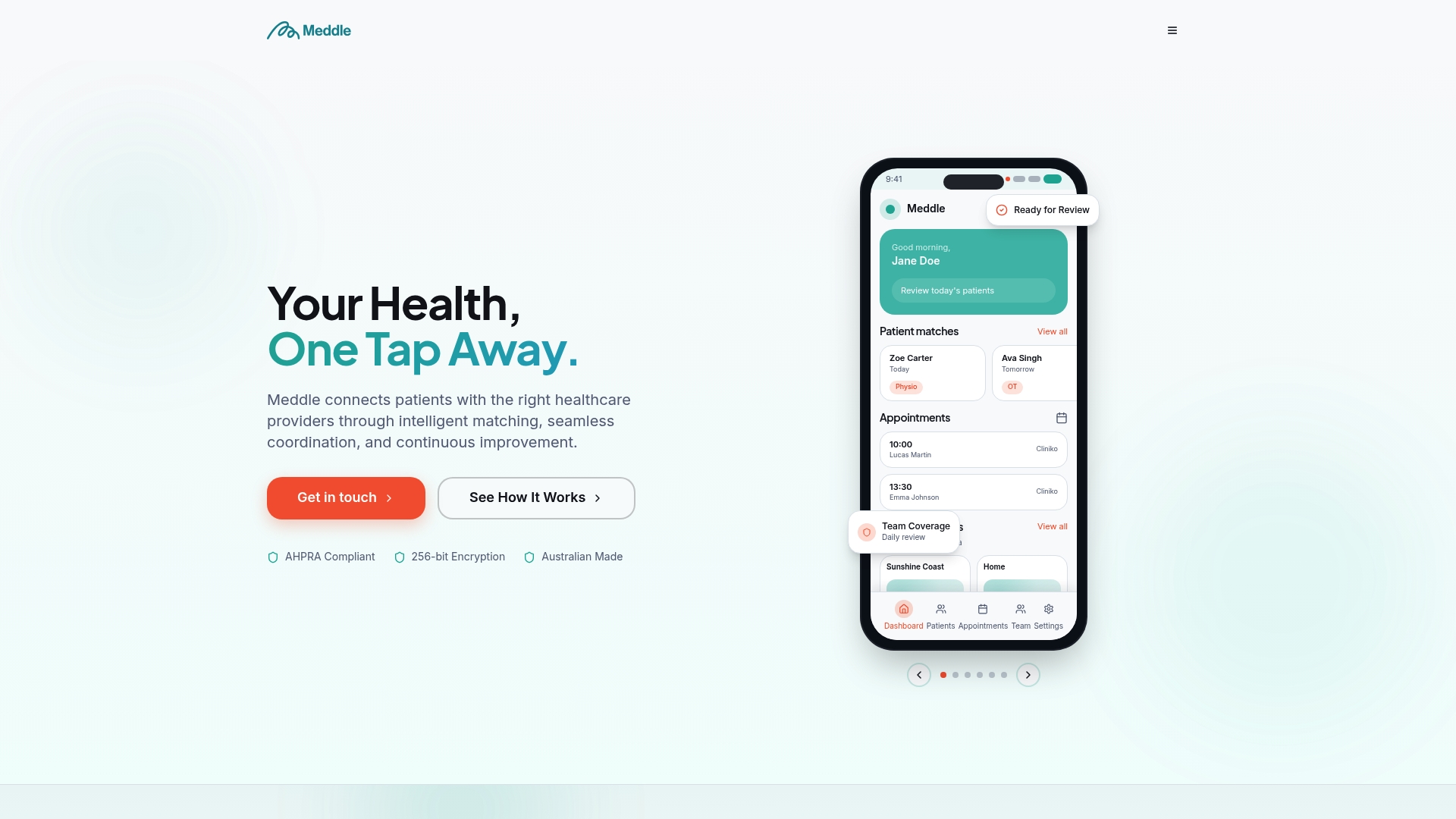
During a balancing pilot, that translates into a few practical wins: matching by discipline, location and the capacity each clinician has shared, so referrals reflect genuine rather than templated capacity; a practice dashboard with practitioner analytics for keeping an eye on referrals and bookings; and referral routing that keeps complex cases going to the right level of practitioner without manual triage. The clinic still confirms each booking. Practitioner-side benefits, covered on Meddle’s practitioner benefits page, also help secure the staff buy-in a rollout depends on.
If you’re planning a pilot along the lines described above, one clinic pod, four weeks, clear rollback criteria, visit Meddle’s page for allied health clinics to see rollout support and ROI tools built specifically for that kind of trial.
Sources
-
New patient load balancing (CHTI / University of Pennsylvania)
-
Addressing burnout in health professionals (Black Dog Institute)
-
Genetic algorithm optimisation for medical appointment scheduling (arXiv, 2026)
-
How to balance patient load and cut wait times in your clinic (MedLaunch)
FAQ
What does load balancing mean in appointment scheduling?
It means distributing patient bookings across providers based on current capacity, complexity, and availability, rather than filling diaries strictly in order of request.
Can you give an example of load balancing in a clinic?
A five-provider physio clinic using least-busy allocation routes each new patient enquiry to whichever provider has the fewest booked minutes that week, keeping new intake volume within a few appointments across the team.
What are the main types of load balancing rules for appointments?
The four common types are least-busy allocation, round robin, weighted or priority-based rules, and preference-based scoring, each suited to different team sizes and case-mix complexity.
Should my clinic enable load balancing?
If your wait times or no-show rates vary significantly between providers, yes, starting with a simple least-busy rule on new patient intakes typically delivers measurable improvement within a month, and platforms like Meddle can supply the clean utilisation data needed to tune it further.