4 Reasons Clinics Must Require Match Rationales from Explainable AI
Yes. When designed specifically for patient matching, explainable AI can give clinicians a short evidence snippet, a confidence score, and an exportable audit trail for every recommendation. That combination lets a practitioner check, in seconds, why a system suggested a particular referral. It won’t tell you why a diagnosis was made. It will tell you why a match happened.
TL;DR:
Explainable AI for patient matching provides clear, checkable reasons for matches, including input data, top factors, confidence scores, and evidence snippets.
Clinicians need timestamped logs, plain-language explanations, and exportable records to ensure transparency, aid compliance, and support trust.
Using explanations effectively requires visual aids like color-coded confidence indicators and compact factor lists, with a focus on simple high-level summaries.
A structured, staged procurement and pilot process improves trust and safety, with ongoing training, audit logs, and feedback loops for continuous improvement.
Trust in a matching system builds over time through proper validation, detailed logging, and clinician oversight, not from initial reliance on explanations alone.
Table of Contents
-
Design patterns that make explanations usable in clinic workflows
-
Procuring, piloting and governing an explainable matching tool
What explainable AI means for patient matching
Explainable AI in healthcare gets used loosely, so scope matters. In this context, it means something specific: showing the inputs, weightings, and evidence behind a match recommendation. It is not about explaining a diagnostic model or a clinical prediction. Those are different problems with different stakes.
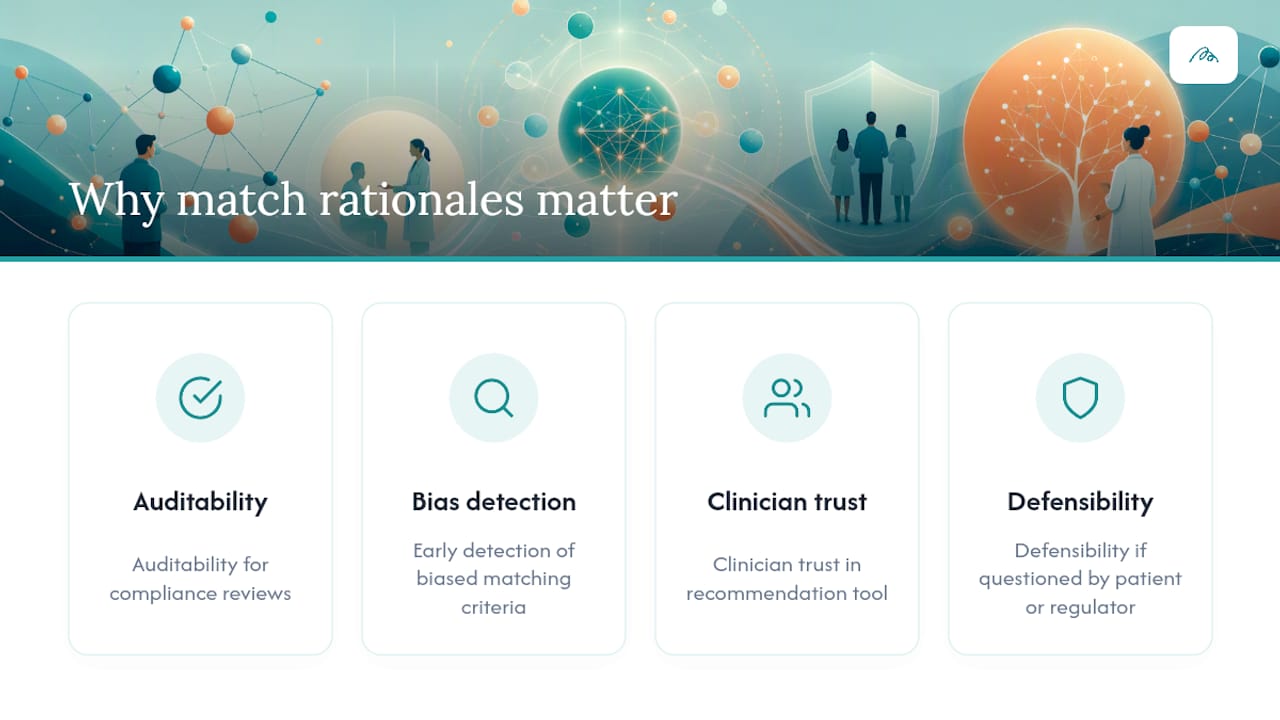
Clinics need this rationale for four practical reasons: auditability for compliance reviews, early detection of biased matching criteria, clinician trust in a tool making recommendations on their behalf, and defensibility if a match is ever questioned by a patient or regulator.
There are limits worth naming upfront. Most explainability techniques generate post-hoc approximations of what a model weighed, not causal proof. There’s also a trade-off: the more complex the matching model, the harder genuine transparency becomes. Task-targeted explainability that focuses on matching inputs and provenance, rather than internal model mechanics, tends to hold up better in real clinic use than attempts to expose every layer of the algorithm.
What clinicians need to see in a match explanation
An explanation that can’t be audited isn’t an explanation. It’s a claim. For a match recommendation to hold up under scrutiny, clinicians need it broken into concrete, checkable parts.
-
A timestamped audit entry recording exactly when the match was generated and by which model version.
-
The input list used to generate the recommendation, in plain terms (symptoms, location, availability, stated preferences).
-
The top contributing factors, ranked and described in language a clinician can read without training in machine learning.
-
A confidence or uncertainty score, so a borderline match looks different from a strong one.
-
An evidence snippet showing the specific data points that pushed the recommendation.
Beyond the explanation itself, clinics need a decision protocol: accept, query, or override, with the clinician’s rationale recorded against the case, as recommended by Panora for Clinics. This is what turns explainability from a nice feature into a governance tool.
Evaluation matters just as much as the explanation format. A systematic review of XAI effectiveness in healthcare settings points to four measures worth tracking: user satisfaction, trust calibration, task performance, and correctability, meaning how easily a clinician can fix a mismatch once flagged. Mismatch logs feed directly back into that correctability figure.
Design patterns that make explanations usable in clinic workflows
Good explanations fail when they’re hard to read fast. Clinicians reviewing dozens of matches a day don’t have time to parse a dense statistical output between patients.
Research on clinician preferences consistently points to a few formats that work: colour-coded confidence indicators (green for high confidence, amber for borderline, red for weak matches), compact weighting bars showing which factors mattered most, and SHAP-style feature lists rewritten in plain clinical language rather than raw model terms. A study on clinician preferences for XAI visualisation found these visual aids measurably improve how well clinicians calibrate their trust in a system’s output.
-
Default to a high-level summary view, with an expand option for full provenance and raw evidence.
-
Keep SHAP-style detail available but optional. A scoping review of hospital decision-support tools found many clinicians find raw SHAP plots difficult to interpret without dedicated training.
-
Make the explanation record exportable and printable so it can attach to a patient file.
Pro Tip: Ask any vendor to show you a match explanation on a genuinely borderline case, not a clean example. That’s where you find out whether the confidence score actually means anything.
Procuring, piloting and governing an explainable matching tool
Rolling out a matching platform without a structured process is how clinics end up with a tool nobody trusts. A staged approach protects both patients and practitioners.
-
Pre-procurement. List the explanation artefacts you require (audit entries, evidence snippets, confidence scores), the data fields the system will use, consent requirements, and the success metrics you’ll measure against.
-
Pilot. Run a small sample of matches with mandatory clinician verification. Track task performance and correctability, and log every mismatch with a reason.
-
Operations. Maintain audit logs, apply role-based access to sensitive match data, schedule periodic revalidation of the model, and set data minimisation and retention policies.
-
Training. Onboard clinicians on how to read explanations, write standard operating procedures for overrides, and build a feedback loop back to the product team so recurring issues get fixed, not just flagged.
Australian policy guidance backs this staged, risk-based approach to clinical AI procurement, recommending transparency and demonstrable safety testing before wider rollout. Skipping the pilot stage to save time tends to cost more later, in re-training, patient complaints, or a scramble to explain a bad match after the fact.
Using explanations day to day: human in the loop
Explainability only earns its keep if it changes how staff actually work. The routine matters more than the technology.
A workable triage flow looks simple: read the evidence snippet and confidence score, then either accept the match or flag it for closer clinician review. Most matches with high confidence and clean evidence clear this step in seconds.
-
Escalate whenever confidence is low, the evidence conflicts with what you know about the patient, or a feature pattern looks like it might reflect bias rather than genuine clinical fit.
-
Document every override with a short reason, not just a rejection click.
-
Feed that structured feedback back into the platform so it informs retraining or rule adjustments over time.
Explainability also functions as a bias check. Expert commentary on XAI and algorithmic bias warns that clinicians can still be misled by biased outputs even when explanations are present, which is exactly why the override and feedback steps matter as much as the explanation itself.
Compliance and professional obligations clinics should know
Explainability isn’t just a usability feature in Australia. It sits close to professional obligation. AHPRA guidance on AI in healthcare is clear that clinicians and organisations remain accountable for AI-influenced outcomes, regardless of how the recommendation was generated. That accountability doesn’t transfer to the software vendor.
Auditable logs, demonstrable testing history, documented bias checks, and clear patient consent records are what let a clinic show, if asked, that it exercised proper oversight. National policy direction under the AAAiH roadmap points the same way: a documented procurement decision, scheduled revalidation of the tool, and a written incident response plan for when a match goes wrong. None of this is bureaucratic padding. It’s what turns “the algorithm did it” into a defensible clinical decision.
A clinic lead’s perspective on trusting the match
Early on, you check every explanation. That’s healthy caution, not distrust. Over time, as the system proves itself, reliance on detailed explanations tends to fall, what researchers call learned usefulness. Don’t mistake that comfort for a reason to stop auditing. Pilot it properly, keep watching the mismatch logs, and let trust build on evidence, not habit.
— Taylor
How Meddle builds explainability into patient matching
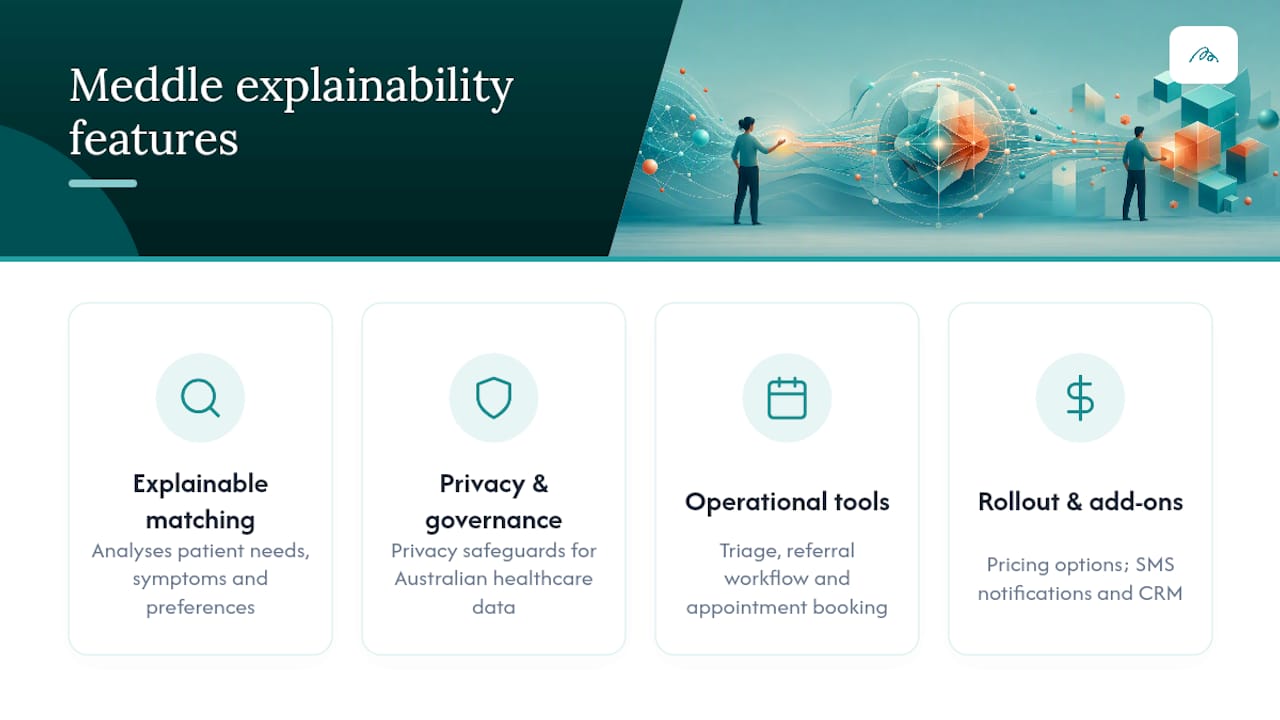
Meddle was built around the idea that a match recommendation should never feel like a black box. Its AI-powered matching analyses individual patient needs, symptoms and preferences, matches them by discipline, location and the capacity each clinician has shared, then routes the referral for the clinic to confirm, backed by privacy safeguards designed for Australian healthcare data.
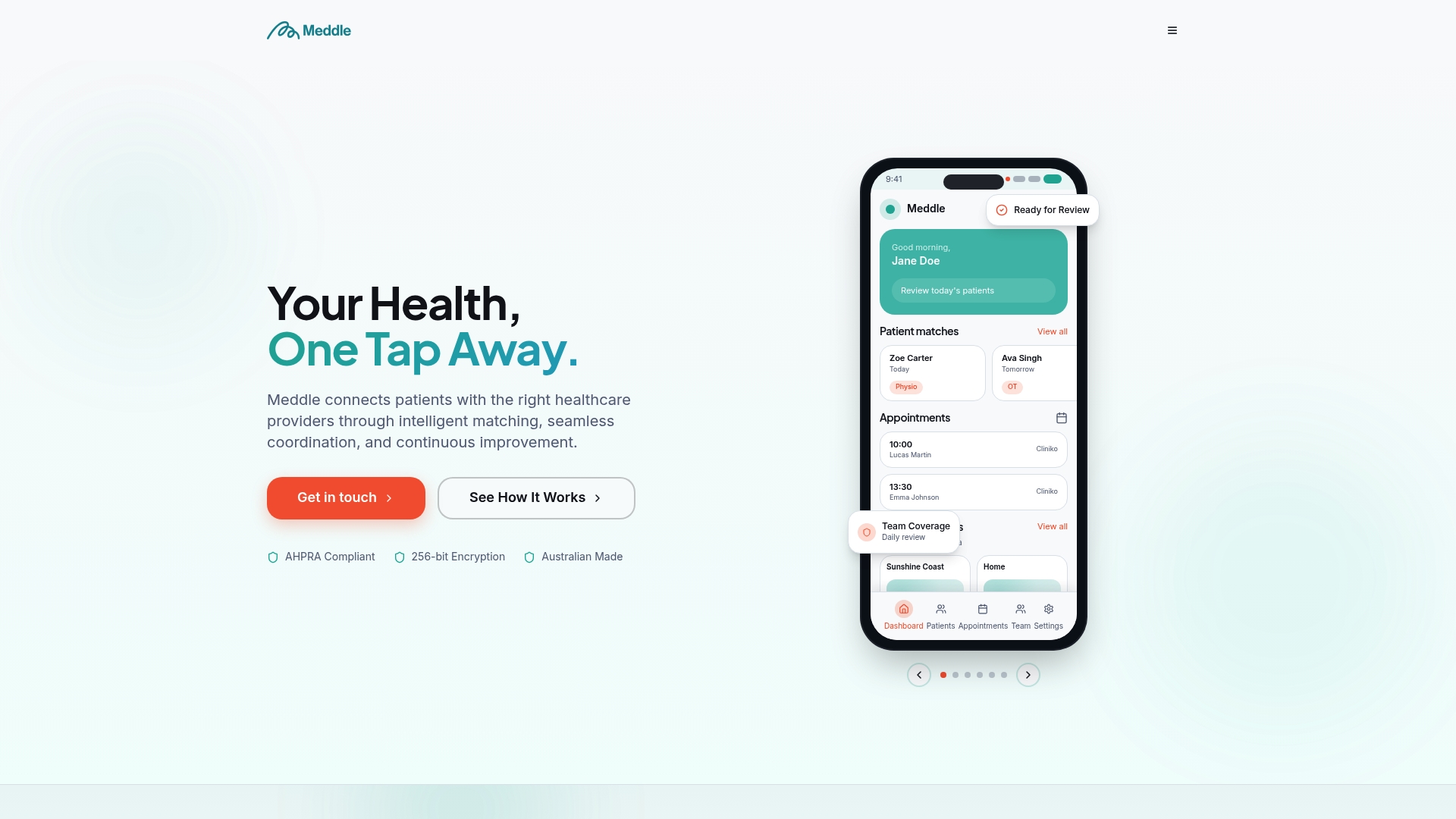
For clinics evaluating a platform, that means you’re not choosing between speed and oversight. You get both: fast algorithmic triage plus the referral workflow and appointment booking tools your admin team actually needs day to day. If your clinic is weighing up procurement, you can review pricing across Meddle’s rollout options, where SMS notifications are included in Simple Rollout and CRM integration is a price-on-application add-on, or see how the matching and coordination workflow fits into daily practice. Clinics wanting a closer look at data handling can also check Meddle’s approach to healthcare data governance before committing to a pilot.
Ready to see it on your own caseload? Head to Find Care and request a demo to see what an explained match actually looks like for your patients.
Sources
For deeper reading, the AAAiH National Policy Roadmap covers Australian AI procurement standards. AHPRA’s AI guidance sets out clinician obligations, and the PLOS ONE prototype study shows explainable matching in action for trial recruitment.
This article is general information, not a substitute for advice from a qualified doctor. Consult a qualified healthcare professional about your own circumstances before acting on anything here.
-
Essential properties and explanation effectiveness of XAI in healthcare (systematic review)
-
AHPRA: Meeting your professional obligations when using Artificial Intelligence
FAQ
Is explainable AI the same as diagnostic AI explanations?
No. In patient matching, explainable AI refers only to why a system recommended a particular practitioner, not to diagnostic reasoning or clinical decision support. Diagnostic explainability is a separate field with different evidence standards and risks.
What should an audit trail for a match recommendation include?
At minimum, a timestamp, the model version used, the input data considered, the top contributing factors, and a confidence score. Systems built around exportable audit records and evidence snippets let clinics attach that history to a patient’s file for later review.
Can a clinician override an AI-recommended match?
Yes, and they should whenever confidence is low or the evidence looks inconsistent with what they know about the patient. Recording the override reason is essential. It feeds back into the system and forms part of the correctability metric researchers use to judge whether an explanation actually works.
Does Meddle provide explainable match recommendations?
Meddle’s platform is built around transparent, AI-powered matching by discipline, location and the capacity each clinician has shared, alongside privacy safeguards for Australian clinics. Clinics can request a demo through Find Care to see sample match explanations directly.
How much does an explainable matching platform cost a clinic?
Pricing varies by rollout option. Simple Rollout is from $40 per practitioner per month (ex GST, $250 monthly minimum), with SMS and email notifications included. CRM Integration, Telehealth, Transcription and White Labelling are add-ons, price on application.