Clinic managers: algorithmic patient triage with 95% matching success
Algorithmic patient triage matches patients to the right practitioner using symptoms, preferences and availability, then books the appointment automatically. Done well, it cuts referral drop-off and fills cancelled slots in minutes rather than days. It is not the same system that hospitals use to prioritise emergency risk. Getting it right depends on clean data, solid integrations and a clinic willing to keep a human in the loop.
TL;DR:
- Automated matching can fill canceled appointments in less than four minutes, significantly faster than manual phone recall processes.
- Proper implementation requires clean, deduplicated patient data and staff involvement in designing matching rules to avoid errors and build trust.
- Clinics must establish clear privacy protocols, monitor for bias across patient groups, and ensure transparency to maintain ethical standards.
- Hybrid systems combining rule-based logic with machine learning handle edge cases better and provide more reliable, governable matches.
- Ongoing staff training, transparent communication, and manual override options are essential to ensure adoption and effective use of the system.
Table of Contents
- What is algorithmic patient triage in allied health?
- What operational gains can clinics expect?
- How does an automated triage system actually work?
- How do you roll out a triage system without disrupting the clinic?
- What are the privacy and bias risks with algorithmic matching?
- Rule-based, machine learning or hybrid: which algorithm type fits?
- How do you get staff on board with a new triage system?
- What ethical questions go beyond privacy compliance?
- How Meddle approaches algorithmic patient triage
- Why the “set and forget” pitch on triage software is wrong
- Ready to pilot smarter patient matching?
- Sources
- FAQ
What is algorithmic patient triage in allied health?
Algorithmic patient triage, in the allied-health sense, is patient-to-practitioner matching. It takes what a patient needs and pairs them with the clinician best placed to see them, then schedules the visit. This is distinct from clinical-risk triage in emergency departments, which ranks patients by urgency and threat to life. Nothing in this article applies to that use case.
The system works from a defined set of inputs and produces a defined set of outputs.
- Inputs: intake form answers, referral letter text, practitioner availability, and a taxonomy of clinician skills and specialties.
- Outputs: a matched practitioner, a booked appointment slot, and an intake summary the clinician can read before the patient walks in.
Most deployments sit as a layer above existing clinic technology rather than replacing it. That means connecting to practice management systems, telehealth platforms, waitlist tools, and, where clinical documents need to move securely, My Health Record via the Healthcare Information Provider Service (HIPS). The matching engine does the thinking; the existing software still runs the clinic day.
What operational gains can clinics expect?
The business case for automated patient assessment rests on four measurable outcomes, and none of them require a leap of faith.
Referral drop-off is the biggest one. A large share of referrals never turn into a completed appointment, and industry commentary points to AI matching paired with digital workflows as one of the more reliable ways to close that gap. When a referral lands and a matching engine immediately checks it against available practitioners, there’s no window for it to sit in an inbox and go cold.
Gap-fill speed is the second gain, and it’s the easiest to put a number on.
In practice: automated waitlist messaging that ranks patients and books the first responder can fill a cancelled appointment slot very quickly. Manual phone-round recall workflows routinely take hours to achieve the same result.
The third gain is administrative load. Automated intake, reminders and booking remove repetitive tasks from front-desk staff, which experts frame as the correct use of automation: handle rules-based admin by machine and keep humans for the complex patient conversations.
- Fewer no-shows through smarter reminder sequencing
- Less time spent manually re-keying referral details
- Faster rebooking after a cancellation, without staff making calls
Patients notice the fourth gain directly: better skill fit and a pre-visit summary the practitioner has already read. The first consultation starts with context rather than a repeat of the intake form.
How does an automated triage system actually work?
An automated triage system moves through a fairly consistent data pipeline, whichever vendor builds it. Intake data comes in, gets matched to a verified patient identity, runs through a matching engine, and lands as a confirmed booking.
The flow typically looks like this:
- Intake — the patient (or referrer) submits symptoms, preferences and referral details through a form or portal.
- Identity resolution — the system checks the patient record against existing identifiers to avoid creating a duplicate. This is where an enterprise master person index (EMPI) matters: EMPI tools detect duplicates and consolidate identities so downstream matching doesn’t inherit bad data.
- Matching engine — the algorithm scores available practitioners against the patient’s needs, using a skill taxonomy rather than guesswork.
- Scheduling API — the match triggers a booking directly into the practice’s calendar.
- Confirmation and intake population — the patient gets a confirmation, and the clinician’s file is pre-populated so the consultation starts with context instead of catch-up.
Most Australian rollouts connect into practice management systems clinics already run, commonly Cliniko, Halaxy, Nookal or Power Diary, via API rather than requiring a migration. Where clinical documents need to move, HIPS handles the middleware connection to My Health Record and the HI Service. SMS gateways and telehealth platforms round out the stack for confirmations and virtual consults.
Behind the scenes, the system automates three specific behaviours: ranked waitlist offers when a slot opens, instant booking confirmation without a staff member touching the calendar, and rebooking sequences that chase a cancelled patient automatically.
How do you roll out a triage system without disrupting the clinic?
A staged rollout beats a big-bang switch every time. Rollouts succeed when they add matching as one incremental layer over the practice management system already in use, rather than changing several workflows at once.
- Clean up patient identity first. Run deduplication and confirm every patient has a unique identifier before any matching rule touches the data. Skipping this step is the single most common cause of a failed pilot.
- Connect the integrations. Link the practice management system API, HIPS or My Health Record where clinical document exchange is needed, and your SMS and telehealth tools.
- Design the matching rules and human checkpoints. Decide what the algorithm can book automatically and what needs a staff member to confirm before the patient is notified.
- Update referral templates and brief frequent referrers. GPs and other referrers need to know what information the new instant appointment booking workflow expects from them.
- Set your baseline metrics. Track matching success rate, referral-to-appointment conversion, and gap-fill time from day one, so you know if the pilot is actually working.
Pro Tip: Run the algorithm in “suggest” mode for the first two to four weeks. Let it recommend matches for staff to approve before switching to fully automated booking. You’ll catch bad skill tags and mismatched availability rules before they touch a real patient.
What are the privacy and bias risks with algorithmic matching?
Data governance is not optional here. Clinics handling health information are already bound by the Australian Privacy Principles, and Australian Privacy Principle 11 requires reasonable steps to protect personal information from misuse and loss. Any matching platform touching patient data should minimise what it collects, log who accesses My Health Record or HIPS-connected records, and audit that access regularly.
Bias is the second risk, and it’s easy to miss because the system looks neutral on the surface.
- Monitor matching outcomes by patient cohort, not just in aggregate, to catch a pattern where one group is consistently matched to less experienced practitioners or longer wait times.
- Keep a manual override available at every matching decision, not just at the end of a complaint process.
- Review whatever historical data trained the matching rules for skew before trusting it at scale.
Operational failure modes are duller but more common: duplicate patient records, mistagged clinician skills, and stale availability data. Each one degrades match quality quietly, which is exactly why the four-minute gap-fill benchmark only holds when the underlying identity and skill data are accurate.
Set clear escalation triggers: a patient describing symptoms outside a practitioner’s listed scope, a referral with ambiguous clinical detail, or three failed match attempts in a row should all route to a human before the algorithm tries again.
Rule-based, machine learning or hybrid: which algorithm type fits?
Not every triage system reasons the same way, and the difference matters when you’re evaluating vendors.
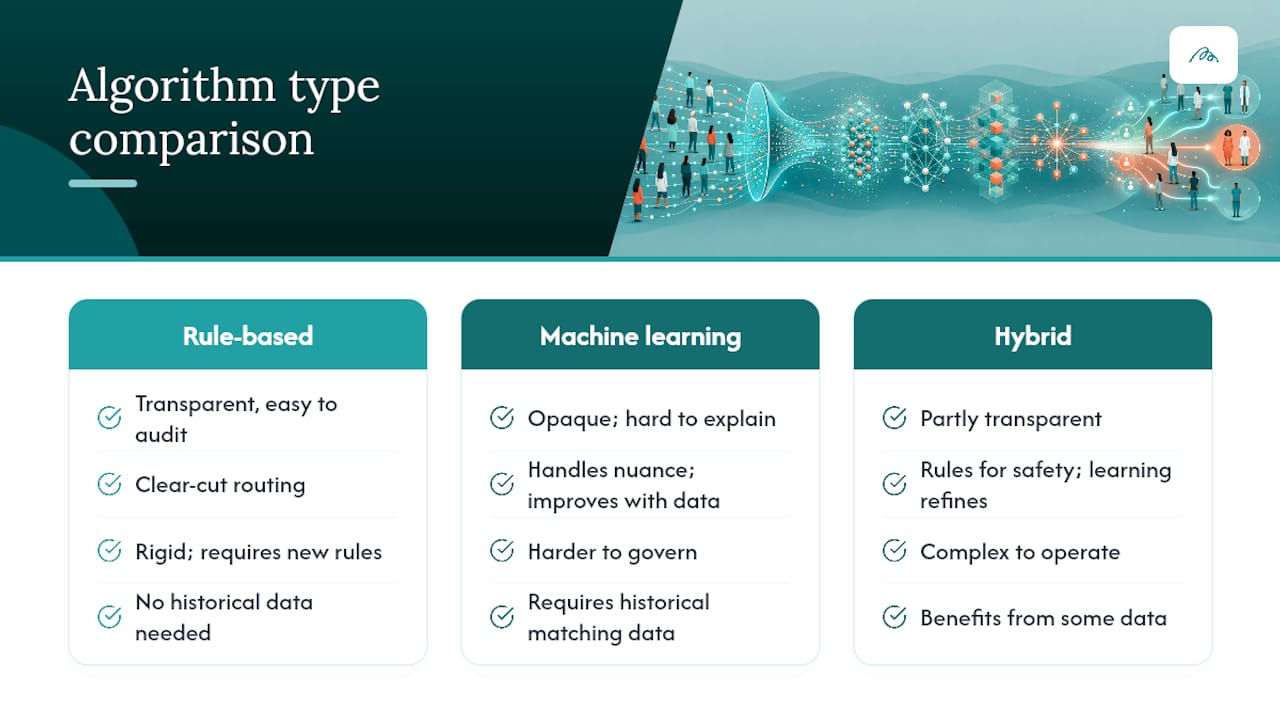
Rule-based systems apply fixed logic: a referral tagged “lower back pain” routes to physiotherapists with that skill flag, in order of availability. They’re transparent and easy to audit, because every match traces back to a written rule a clinic manager can read. Their weakness is rigidity. They struggle with referrals that don’t fit a clean category, and every new scenario needs a new rule written by hand.
Machine learning approaches score matches using patterns learned from historical data, weighing symptoms, practitioner outcomes and patient preferences together rather than following a fixed if-then chain. They handle nuance better and improve as more data flows through, but they’re harder to explain to a patient who asks why they were matched to a particular clinician.
Hybrid systems combine both: rule-based logic handles the clear-cut cases and any safety-critical exclusions, while a learning layer refines ranking within that boundary. Most practical allied-health deployments lean hybrid, because a purely rule-based system misses edge cases and a purely learning-based one is difficult to govern from a compliance standpoint.
The choice affects your implementation checklist directly. Rule-based and hybrid systems need a well-maintained skill taxonomy from day one. Learning-based components need a decent volume of historical matching data before they add real value, which is why most clinics start with rules and layer in learning-based refinement once the data exists to support it.
How do you get staff on board with a new triage system?
Staff resistance sinks more automated appointment triage pilots than bad technology does. Front-desk teams have run manual booking and recall processes for years, and a new system asking them to trust an algorithm’s judgment is a genuine behavioural shift, not just a software update.
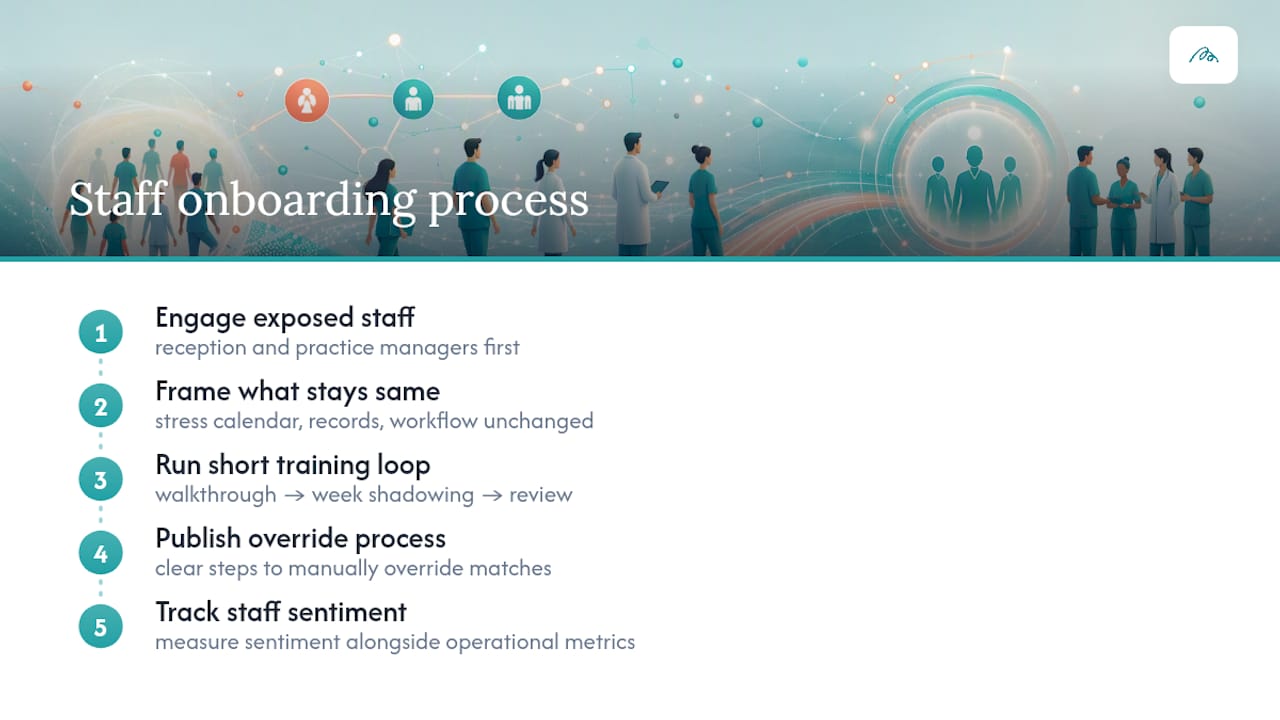
Start with the people who feel the most exposed by the change. Reception staff and practice managers, not clinicians, usually handle the day-to-day matching decisions the system will now influence, so their input on matching rules needs to happen before launch, not after a complaint.
Frame the rollout around what stays the same. If the algorithm is a layer over the practice management system staff already use, say so explicitly and repeatedly. Staff anxiety drops sharply when they understand the calendar, the patient records and the daily workflow are not being replaced, only the manual matching and gap-fill steps.
Run a short training loop rather than a single session: a walkthrough of the matching logic, a week of shadowing where staff approve algorithm suggestions, then a review meeting to surface confusion before full automation switches on. Publish the override process clearly, so every staff member knows exactly how to step in when a match looks wrong, and knows that doing so isn’t a failure of the system but a normal part of running it.
Track staff sentiment alongside your operational metrics. A gap-fill time of under four minutes means nothing if the receptionist quietly reverts to manual recall because they don’t trust the tool.
What ethical questions go beyond privacy compliance?
Privacy compliance is the floor, not the whole conversation. Transparency and consent raise separate questions clinics need to answer before they switch a matching system on.
Patients should know when an algorithm, rather than a person, has chosen their practitioner. This doesn’t require a lengthy disclosure, but it does mean the booking confirmation or intake process should say plainly that matching is automated and that a different practitioner can be requested. Burying that fact erodes trust the moment a patient works it out on their own.
Consent needs to cover more than data storage. A patient consenting to have their referral processed by a clinic is not automatically consenting to have an algorithm rank them against other patients on a waitlist or decide which practitioner they see first. Clinics should make this an explicit part of intake, not an assumption buried in a general terms-of-service link.
Explainability matters most when a match seems wrong to the patient. If someone asks why they were matched to a particular practitioner, “the algorithm decided” is not an answer that holds up, ethically or practically. Clinics need at least a plain-language version of the matching logic on hand, even for a hybrid or learning-based system where the full technical explanation is complex.
Finally, algorithmic matching shouldn’t quietly narrow patient choice. A system that always offers the fastest available slot risks steering patients away from a practitioner they’d actually prefer, purely for scheduling efficiency. Good triage systems surface alternatives, not just the top-ranked match.
How Meddle approaches algorithmic patient triage
Meddle builds its matching engine around the same principles this guide sets out: precise practitioner matching, skill-based routing rather than generic categories, and privacy safeguards that hold up under audit.
The platform supports connectivity patterns clinics need for this checklist: integration with existing practice management workflows, clinical document exchange connectivity, and analytics that track matching success and gap-fill time from a single dashboard rather than several disconnected reports.
Why the “set and forget” pitch on triage software is wrong
Every vendor conversation about algorithmic patient triage eventually drifts toward the promise that you install the software and the admin problem disappears. It doesn’t, and clinics that believe it get burned in the first month.
The uncomfortable truth is that a matching algorithm is only as good as the identity and skill data feeding it. A clinic with duplicate patient records or a stale practitioner skill list will get confidently wrong matches at scale, faster than a human ever could make the same mistakes manually. Speed without accuracy just means bad decisions happen quicker.
The other thing the market undersells is how much staff trust drives adoption, not the sophistication of the matching logic. I’ve seen the framing in vendor pitches lean entirely on algorithm quality, when the deployments that actually stick are the ones where reception staff had input on the matching rules before launch, and where an override sits one click away rather than buried in a settings menu.
Clinics chasing the number without doing the identity resolution and staff training work first will not see it repeat.
— Taylor
Ready to pilot smarter patient matching?
This platform gives allied-health clinics a direct path to the operational gains this guide describes, without the manual recall calls or the referral inbox turning cold. It connects to practice management tools, links to clinical document exchange services where required, and applies privacy discipline recommended for clinics.
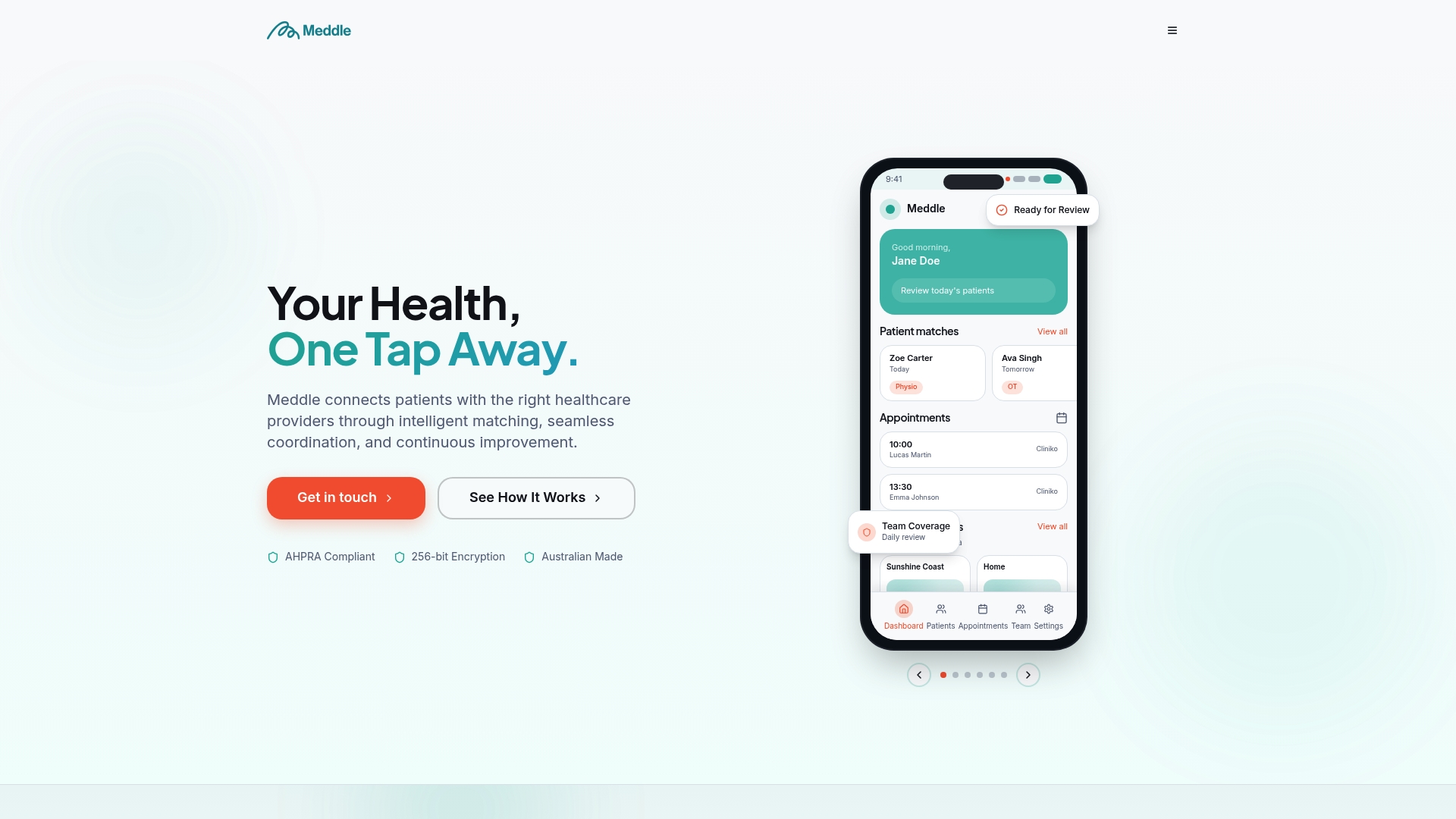
If your clinic is losing referrals to slow manual booking or leaving cancelled slots empty for hours instead of minutes, see how Meddle works end to end and request a pilot to test it against your own referral data.
This article is general information, not a substitute for advice from a qualified doctor. Consult a qualified healthcare professional about your own circumstances before acting on anything here.
Sources
- AI automation for healthcare allied health Australia
- Matching the right practitioner to the right patient with AI - Healthed
- Healthcare Information Provider Service (HIPS)
- Enterprise master person index (EMPI) solutions - Digital Health
- AI for allied health practices | Mamba Strategic
FAQ
Is algorithmic patient triage the same as emergency triage?
No. Algorithmic patient triage in allied health matches patients to the right practitioner for booking and scheduling. Emergency triage prioritises patients by clinical urgency and risk, which is a separate system entirely.
How fast can automated systems fill a cancelled appointment?
Automated waitlist messaging paired with ranked offers can fill a cancelled slot in under four minutes, compared to hours for manual phone recall.
What data does a clinic need before starting a matching pilot?
Clinics need clean, deduplicated patient identifiers, a defined clinician skill taxonomy, and accurate real-time availability data connected through their practice management system.
Does algorithmic matching connect to My Health Record?
Yes, where clinical document exchange is required, integration typically runs through the Healthcare Information Provider Service (HIPS), which provides the middleware connection to My Health Record and the HI Service.
How does Meddle handle patient matching?
Meddle uses an AI-powered matching engine that analyses patient needs and practitioner availability, reporting a 95% matching success rate alongside integration support for existing clinic systems.