Pre Appointment Questionnaires: Templates & Privacy for Australia

A pre-appointment questionnaire collects your essential health and administrative details before a consultation. Fill it in truthfully at least 2 to 7 days before your appointment, whenever the timeline allows. Doing so gives your clinician time to review your answers, flag anything urgent and use the consultation itself for discussion rather than data entry.
TL;DR:
- Keeping questionnaires short and clear, with a privacy notice at the top, improves completion rates and answer accuracy without adding clinical value.
- Sending the form immediately after booking and offering multiple completion options helps ensure timely, accurate responses.
- Patients should prepare a current medicines list, note their main questions, and answer honestly ahead of the appointment to optimize its usefulness.
- Telehealth-specific measures require verifying identity, reviewing medical history beforehand, and ensuring privacy during the session.
- Clinics benefit from integrated digital platforms that streamline intake, reduce administrative load, and support secure, accessible data collection.
Table of Contents
- What pre-appointment questionnaires are and why they matter
- How to complete your questionnaire accurately and on time
- Building a questionnaire that clinics can actually use
- Privacy, consent and telehealth requirements you need to know
- Ready-to-use question templates for common appointments
- What the evidence says about digital intake
- What clinics and patients should each prioritise
- How Meddle supports secure, integrated intake for clinics
- Sources
- FAQ
What pre-appointment questionnaires are and why they matter
A pre-appointment questionnaire is a structured set of questions sent before a consultation to capture the clinical and administrative information a practitioner needs on the day. Clinics use them for new patient intake, telehealth readiness checks and routine screening ahead of a review.
For patients, the benefit is straightforward: your concerns get raised early, and urgent issues can be flagged before you even walk in. For clinics, a completed questionnaire means less time spent on paperwork during the appointment and more time on the actual problem. It also reduces the chance that something important gets missed because it slipped a patient’s mind under pressure.
Completed forms also feed directly into shared decision-making. When a clinician already knows your medicines, allergies and main concern, the consultation can focus on options and next steps rather than basic fact-finding, aligning with the Ask, Share, Know approach to collaborative care.

How to complete your questionnaire accurately and on time
Most clinics send the questionnaire by email or SMS shortly after you book, with a reminder a day or two before the appointment if it is still outstanding. Answering it early, rather than at the last minute, gives you time to check details rather than guess.
- Gather your medicines list first, including prescription drugs, over-the-counter items and supplements, along with doses.
- List your allergies and past reactions, even mild ones, and note any recent test results or referral letters.
- Write down key dates: when symptoms started, when you last saw a specialist, when a prescription was last renewed.
- Describe symptoms with specifics: onset, severity out of 10, what triggers or eases them, and whether anything feels urgent.
- For telehealth appointments, have photo ID ready, check your camera and confirm you are in a private, well-lit space before the call starts.
- Flag anything you don’t understand rather than guessing, and note if a question does not apply to you instead of leaving it blank.
Healthdirect recommends bringing a written medicines list with dosages and a prepared, prioritised list of questions, since consultation time is limited and easy to lose to backtracking.
Pro Tip: Keep a running medicines and allergy list on your phone so you can copy it into every new questionnaire in seconds rather than starting from memory each time.
If a question is unclear or you genuinely cannot complete part of the form, contact the clinic before the appointment rather than leaving it blank. A short phone call resolves most confusion faster than guessing.
Building a questionnaire that clinics can actually use
Good intake design starts with restraint. The OAIC’s guide to health privacy recommends collecting only what is necessary for the appointment, since longer forms reduce both completion rates and answer accuracy.
A clinically useful questionnaire generally includes:
- Identity and contact details, including preferred name and next of kin.
- Current medicines, allergies and known adverse reactions.
- Current symptoms and red flags that would prompt urgent review.
- Recent investigations or referral letters relevant to the visit.
- Interpreter or communication needs, including preferred language.
- A short consent and collection notice explaining why the data is being collected.
On timing, send the form as soon as the booking is confirmed and follow up with one reminder shortly before the appointment. Offer online, paper and phone options so patients without reliable internet access are not excluded.
Write questions in plain, Easy English wherever possible, and offer translated versions for common languages in your patient base, consistent with guidance from the Health Literacy Hub. Be clear about where responses are stored, who can view them and how long they are retained. Our guide to Australian Privacy Principles in healthcare covers this in more detail, and our piece on finishing intake in 2 to 5 minutes has practical tips for shortening forms without losing clinical value.
Pro Tip: Test your questionnaire on a colleague who has never seen it before. If they hesitate on a question, a patient will too.
Privacy, consent and telehealth requirements you need to know
Before collecting health information, providers must tell patients who is collecting it, why, and what happens if they choose not to answer, as set out in the OAIC’s guide to health privacy. This is separate from consent to treatment: agreeing to share your medical history is not the same as agreeing to a specific procedure, and forms should never blur the two.
For telehealth specifically, AHPRA’s Medical Board guidelines expect clinicians to confirm a patient’s identity, review history and medicines, and keep clear records, including responsibility for any information passed on by a third party. Our guide to verifying patient identity online walks through practical steps for meeting this.
A short, compliant collection notice on a form might read: “We collect this information to prepare for your appointment. You do not have to answer every question, but incomplete information may limit what your practitioner can safely assess.”

Ready-to-use question templates for common appointments
A core intake set covers identity, contact details, current medicines, allergies and a short red-flag checklist such as chest pain, severe breathlessness or sudden vision change.
- Symptom triage: “When did this start? On a scale of 1 to 10, how bad is it? What makes it better or worse?”
- Medicines check: “What medicines, vitamins or supplements are you currently taking, and at what dose?”
- Screening and access: “Do you need an interpreter? Do you have any mobility needs we should know about? Can we contact you by SMS?”
- Telehealth checklist: “Do you have photo ID ready? Are you in a private space? Is your camera and microphone working?”
Keep wording short and specific. “What makes it worse?” gets a clearer answer than “Please describe any aggravating factors.”
What the evidence says about digital intake
Structured pre-appointment intake supports better shared decision-making by letting clinicians focus consultation time on a patient’s actual priorities rather than fact-gathering, in line with the Ask, Share, Know framework from the Australian Commission on Safety and Quality in Health Care.
Before adopting a digital intake tool, a clinic should check for:
- Clear privacy controls and a visible collection notice.
- Identity verification suited to telehealth, not just a name field.
- Integration with existing clinical records rather than a standalone spreadsheet.
- Accessible form design, including Easy English and translated options.
- An audit trail showing who accessed patient responses and when.
Security specialists such as Callspace outline similar data handling controls for regulated industries, a useful reference point when comparing intake platforms. Some healthcare platforms apply these principles across their intake and matching workflows for allied health clinics.
What clinics and patients should each prioritise
Clinics get the most out of intake when they keep forms short, put a plain-language privacy notice at the top and build a reliable follow-up workflow for anyone who does not respond. Skip any question that will not change how the appointment runs.
Patients get the most value from preparing a current medicines list, writing down their top two or three questions and submitting the form early rather than in the waiting room. Shared preparation, from both sides, is what actually makes an appointment safer and more useful.
— Taylor
How Meddle supports secure, integrated intake for clinics
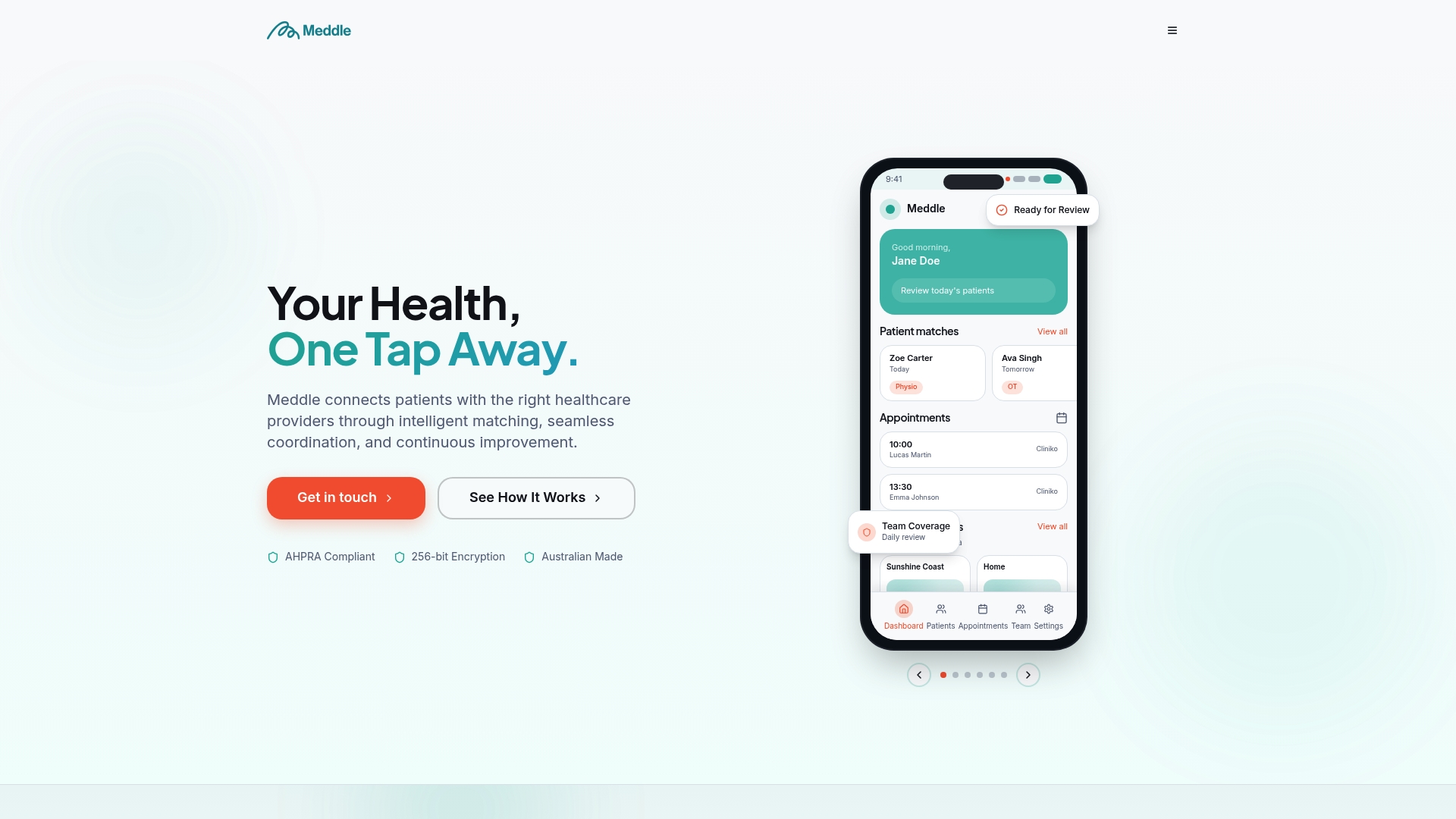
Meddle brings pre-appointment questionnaires, reminders and privacy safeguards into one workflow, so clinics are not stitching together separate forms, spreadsheets and reminder texts. For allied health practices juggling admin load, missed information and identity checks before telehealth calls, that consolidation removes a lot of repeated manual work.
- Reduces admin burden by centralising intake alongside booking and matching.
- Cuts missed information with structured, clinically relevant question sets.
- Supports identity checks as part of the telehealth booking flow.
Clinics can see current plans for SMS Notifications and CRM Integration priced per month per practice on the Meddle pricing page, on the Meddle pricing page. Patients and referrers can find care through the same platform at no cost.
This article is general information, not a substitute for advice from a qualified doctor. Consult a qualified healthcare professional about your own circumstances before acting on anything here.
Sources
- Chapter 2: Collecting health information | OAIC
- Medical Board guidelines for technology-based consultations | AHPRA
- Questions to ask your doctor | Healthdirect
- Ask, Share, Know | Australian Commission on Safety and Quality in Health Care
FAQ
What questions does a pre-appointment questionnaire usually ask?
Most forms cover current medicines, allergies, main symptoms, recent test results and administrative details like contact information and interpreter needs. Healthdirect recommends preparing a written medicines list and a prioritised list of questions before you answer.
What is a pre-testing questionnaire?
A pre-testing questionnaire is a short form completed before a specific test or procedure to check for risk factors, current medicines or conditions that could affect the result or the procedure itself. It is a narrower version of a general pre-appointment questionnaire, focused only on what is relevant to that particular test.
What are the main types of patient questionnaire?
Common types include new patient intake forms, symptom or triage questionnaires, telehealth readiness checks and screening tools for specific conditions. Definitions vary between clinics, but most fall into one of these four practical categories.
What should I bring to a health assessment appointment?
Bring a current medicines list, details of any allergies, recent test results or referral letters, and a short written list of your main concerns. Preparing this ahead of time, ideally alongside your questionnaire, means you are less likely to forget something important during the consultation.
Is my information kept private when I submit a questionnaire online?
Under the Privacy Act, providers must tell you why they are collecting your information and what happens if you choose not to provide it. Reputable clinics and platforms will show this notice on the form itself, before you start answering.