30–90 Day Provider Directory Accuracy Playbook for Australian Clinics

Provider directory accuracy means every listed detail, name, specialty, address, phone number and availability, matches what’s true right now. Errors are common enough to disrupt referrals and bookings daily. The single most useful first step is simple: assign one named, accountable owner and start verifying entries against Ahpra’s register and the Practitioner Information Exchange.
TL;DR:
Verifying provider details against Ahpra’s register and the Practitioner Information Exchange is crucial for maintaining real-time accuracy.
Most errors originate during data entry due to inconsistent formatting, identifier mismatches, and lack of clear ownership or standardized processes.
Legal penalties, such as the ACCC’s fine against HealthEngine, highlight the importance of accurate listings to avoid misleading representations and legal risks.
Automating verification, setting accountability, and implementing routine audits can significantly improve directory reliability within 6 to 12 months.
Matching and referral routing tools like Meddle, which match by discipline, location and the capacity each clinician has shared, reduce manual rework and leave the clinic to confirm the booking.
Table of Contents
-
How widespread is the problem: evidence and measurable error rates
-
Root causes: ingestion, standards and organisational failures that create errors
-
Regulatory and legal context: ACCC, Healthcare Identifiers and disclosure obligations
-
Operational impacts: referrals, claims, member experience and provider relationships
-
Best-practice playbook: step-by-step measures to improve and sustain accuracy
-
Governance and metrics: ownership model, KPIs and monitoring cadence
How widespread is the problem: evidence and measurable error rates
Directory errors aren’t rare edge cases. They’re a structural feature of how most organisations collect and maintain provider data, which is scattered across spreadsheets, legacy systems and manual updates that fall behind the moment a practitioner changes clinics or hours.
Ahpra’s register alone handled a very high number of searches in the 2025 reporting period, reflecting a significant increase year-on-year, which tells you how heavily administrators, employers and patients now lean on authoritative lookups rather than static directory pages. The Ahpra register recorded this growth alongside rising subscriptions to its Practitioner Information Exchange, the paid alert service that flags registration changes automatically.
The most frequent error types repeat across almost every directory audit:
-
Phone numbers: disconnected lines or numbers routed to a closed practice.
-
Addresses: outdated locations after a clinic relocates or merges.
-
Availability: listed hours that no longer reflect actual bookings.
-
Taxonomy: practitioners tagged under the wrong specialty or service type.
Ahpra’s register processed more than 14 million searches in 2025, up 27% on the prior year, a sign that verification against authoritative sources is becoming standard practice rather than an afterthought (Ahpra).
Root causes: ingestion, standards and organisational failures that create errors
Most inaccuracies start at the point of entry, not the point of discovery. Free-text fields invite inconsistent formatting, abbreviations and typos that no downstream check ever catches.
Identifier mismatches compound the problem. Ahpra notes that practitioners often appear “missing” simply because the name they commonly use differs from their registered name, which is why verification by registration number or Healthcare Provider Identifier is far more reliable than matching on name alone (Ahpra). Address fields suffer a similar fate when geocoding tools can’t resolve a unit number or a recently renamed street.
Fragmented ownership is the deeper issue. When no single team is accountable for directory accuracy, updates happen reactively, usually after a patient complaint, and drift back in within weeks.
-
Free-text entry lets staff record the same clinic under five different spellings.
-
Identifier mismatches between registered names and common usage break automated lookups.
-
No service-level agreement means corrections sit in a queue indefinitely.
-
Siloed ownership across credentialing, IT and marketing teams means nobody closes the loop.
Pro Tip: Require a registration number or Healthcare Provider Identifier on every new provider record before it goes live, never a name alone.
Regulatory and legal context: ACCC, Healthcare Identifiers and disclosure obligations
Directory accuracy isn’t just an operational nicety, it carries legal weight. The ACCC’s action against HealthEngine resulted in a $2.9 million penalty for misleading reviews and referral practices that affected roughly 135,000 patients between 2014 and 2018, a clear signal that consumer law applies directly to directory conduct.
On the identifier side, the Department of Health’s Healthcare Identifiers Service issues the HPI-I and HPI-O numbers that underpin the Healthcare Provider Directory and My Health Record. Reforms under the Regulatory Reform Omnibus Act, effective December 2025, strengthened the Healthcare Provider Directory and expanded data-standards powers, with authorisation for future uses scheduled from February 2027.
Administrators redesigning directories should check against:
-
ACCC consumer law, which covers misleading representations about provider availability or qualifications.
-
Healthcare Identifiers legislation, which governs how HPI-I and HPI-O data can be used and shared.
-
Privacy and disclosure rules, which apply when directories reveal commercial relationships or referral incentives.
Operational impacts: referrals, claims, member experience and provider relationships
A single wrong phone number rarely stays a small problem. It cascades through booking systems, referral pathways and claims processing, each failure compounding the last.
Patients hit failure modes directly: a call that goes nowhere, a listed specialty the practitioner no longer offers, hours that don’t match reality. Each failed attempt pushes patients to call again, try another provider, or abandon the search entirely, which quietly erodes the directory’s usefulness.
Referral and claims routing suffer similarly. A referral sent to a closed address or an outdated HPI-O bounces, creating rework for administrative staff and delay for patients already waiting for care.
-
Failed bookings waste patient time and generate repeat calls to practice staff.
-
Misrouted referrals stall care coordination between referring and receiving providers.
-
Claims friction rises when billing identifiers don’t match the provider actually seen.
-
Provider trust erodes when practitioners find their own listings wrong and stop relying on the directory.
Best-practice playbook: step-by-step measures to improve and sustain accuracy
Fixing directory accuracy is less about one big project and more about a sequence of disciplined steps that compound over time.
-
Standardise ingestion fields. Require HPI, business identifiers and a validated address before any record publishes.
-
Automate registration checks against the relevant register and the HPD. Use the Ahpra register for single lookups for registered professions (and the relevant body, such as Speech Pathology Australia, Dietitians Australia or ESSA, for professions Ahpra doesn’t register), and the Practitioner Information Exchange for daily automated alerts where a subscription is in place.
-
Name a single accountable owner. Pair that role with a cross-functional governance group spanning credentialing, IT and clinical operations.
-
Set a service-level agreement for remediation. Define how quickly a flagged error must be corrected, and track breaches.
-
Deduplicate and match records. Apply matching thresholds that catch near-duplicate provider entries before they multiply.
-
Run attestation workflows. Ask providers to confirm their own details on a set cadence rather than waiting for complaints.
-
Sample with secret-shopper checks. Periodically test phone numbers and booking flows the way a patient would.
-
Prioritise by impact. Start with high-traffic providers, referral-critical specialties and services patients search for most.
Pro Tip: Run your first secret-shopper check on the twenty providers who receive the most referrals. That’s where errors cost the most.
Governance and metrics: ownership model, KPIs and monitoring cadence
A directory only stays accurate when someone is answerable for it. A simple RACI works best: one accountable role for directory accuracy, with credentialing, IT and clinical leads responsible for feeding and checking data, and executives informed through quarterly reporting.
Track a small set of KPIs rather than a sprawling dashboard:
-
Directory error rate, measured as a percentage of sampled listings with at least one inaccuracy.
-
Mean time to correction, from flagging an error to publishing the fix.
-
Call-to-book success rate, the share of directory-driven calls that end in a booked appointment.
-
Practitioner Information Exchange alerts actioned, the proportion of automated alerts resolved within the service-level window.
Ahpra’s 2025 annual report recorded Practitioner Information Exchange subscriptions rising from 192 to 274 organisations, alongside over 8 million unique visits to the register, showing growing institutional reliance on automated verification rather than manual lookups (Ahpra).
Pair automated daily checks with weekly exception handling for anything the system flags, and run a full quarterly audit against a sample of listings to catch what automation misses.

Timelines, trade-offs and pilot recommendations
Expect quick wins within 30 to 90 days: standardised fields, a named owner and an initial Ahpra verification pass. Systemic change, deduplication at scale, governance maturity and consistent service-level agreements, takes 6 to 12 months.
There’s a real trade-off between strict verification and keeping the network broad enough to meet patient demand. Resolve it through prioritised rollout, starting with high-impact services, rather than trying to verify everything simultaneously. Pilot one specialty or region first, with clear success criteria, before scaling.
— Taylor
How Meddle helps with directory-driven referrals
Static directories struggle to stay current because they depend on someone remembering to update them. Meddle takes a different approach: instead of publishing a list that ages the moment it’s published, it matches patients to practitioners by discipline, location and the capacity each clinician has shared, rather than a stored hours field, then routes the referral. The clinic confirms the booking.
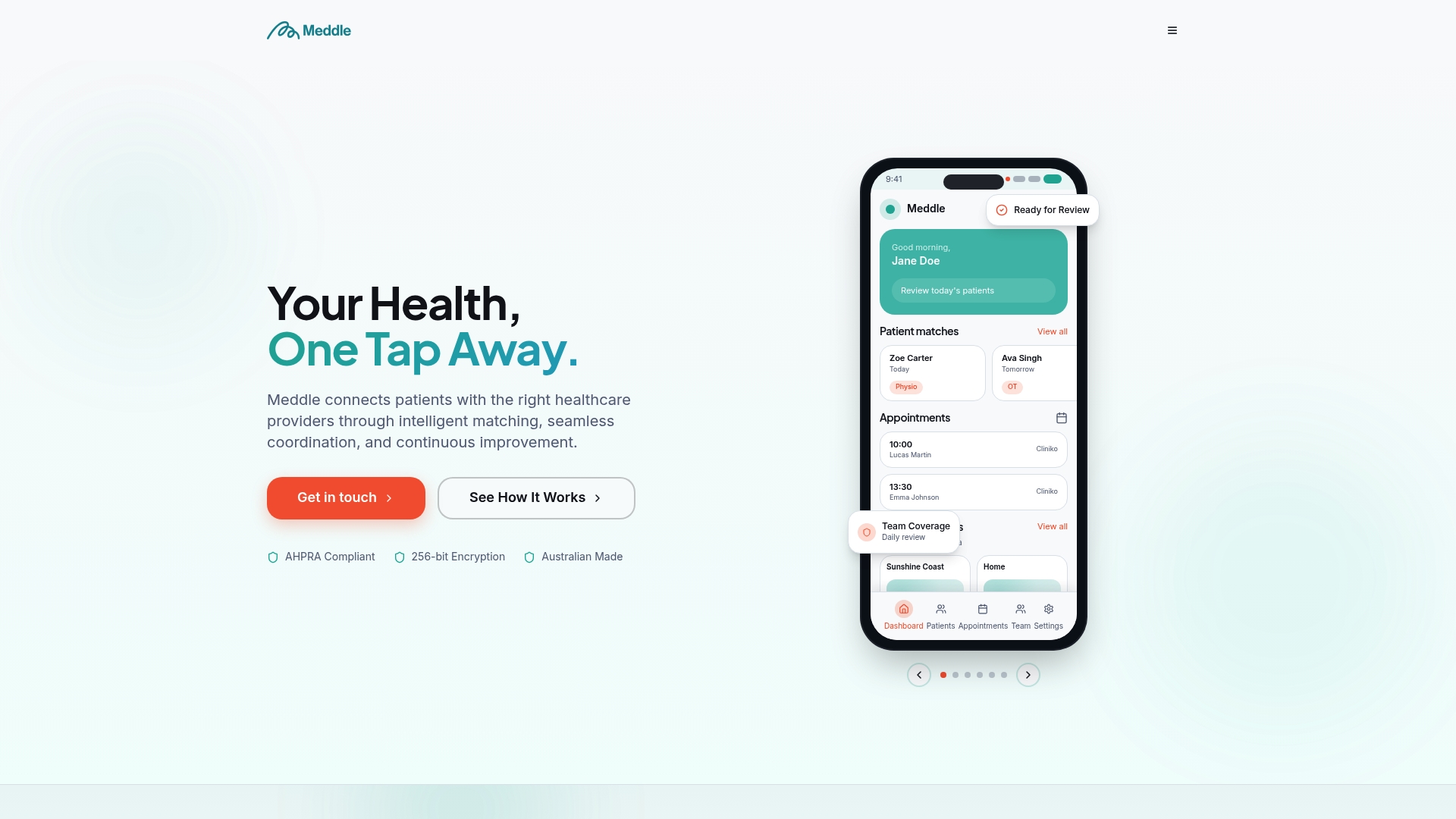
That distinction matters for clinics juggling referral volume and administrative load. Referral routing and practice dashboards can reduce the manual rework that directory drift normally creates, and when clinicians keep their shared capacity up to date, referrals go to someone who has room now, not last month.
-
AI-powered matching connects patients to practitioners based on need, not a static category tag.
-
Referral automation reduces the manual chasing that follows a misrouted or outdated referral.
-
Clinician-shared capacity replaces listed hours that may no longer be accurate.
-
Fits clinic workflows through the practice dashboard and practitioner analytics, alongside your practice software.
| Capability | What it replaces |
|---|---|
| AI-powered matching | Static specialty listings |
| Clinician-shared capacity | Fixed, often outdated hours |
| Referral automation | Manual referral chasing |
Clinics considering a pilot can review plan options on the pricing page, including Simple Rollout (from $40 per practitioner per month, ex GST, $250 monthly minimum, with SMS and email notifications included) and price-on-application add-ons such as CRM Integration. For a closer look at how matching and referral routing work in practice, the how Meddle works page is the next step.
Sources
Choosing the right source for the right job avoids both wasted effort and false confidence. Ahpra’s register handles one-off checks well, while the Practitioner Information Exchange suits organisations that need ongoing, automated alerts every 24 hours.
The Healthcare Provider Directory is a closed system built primarily for provider-to-provider communication, not a public-facing listing. This causes confusion when teams assume it doubles as a patient search tool. The National Health Services Directory serves that public-facing role instead, and public search engines should never substitute for either when clinical or administrative decisions are on the line.
-
ACCC media release – HealthEngine to pay $2.9 million for misleading reviews and patient referrals
-
Department of Health – Healthcare identifiers and the Healthcare Identifiers Service
A workable integration pattern runs a daily sync from the Practitioner Information Exchange, canonicalises names and identifiers, deduplicates against existing records, then routes anything unresolved to a manual exception queue. Address data benefits from geocoding against G-NAF and AusPost datasets, which workforce data custodians already use to clean and validate location fields.
FAQ
What does provider directory accuracy actually measure?
It measures whether listed details, name, specialty, contact information, address and availability, match reality at the time a patient or referrer checks. Error rates are typically assessed through sampled audits and secret-shopper style calls.
Who should be accountable for fixing directory errors?
A single named owner should hold accountability, supported by a cross-functional group covering credentialing, IT and clinical operations. Without one clear owner, corrections tend to stall in a queue with no deadline.
Is the Healthcare Provider Directory the same as a public directory?
No. The Healthcare Provider Directory is a closed system built for provider-to-provider communication, while the National Health Services Directory serves the public-facing role patients typically search.
What legal risk comes from publishing inaccurate directory listings?
The ACCC’s action against HealthEngine resulted in a $2.9 million penalty for misleading reviews and referral conduct affecting around 135,000 patients, showing that consumer law applies directly to directory practices.
How does Meddle address the accuracy problem differently to a static directory?
Meddle matches patients to practitioners by discipline, location and the capacity each clinician has shared, rather than a published, often outdated, hours field. It then routes the referral, and the clinic confirms the booking, which reduces the rework that static listings create. Pricing and plan details are available on the Meddle pricing page.