90 day compliance plan for secure document sharing in Australia
A compliant approach to sharing healthcare documents must deliver strong encryption in transit and at rest, strict access controls with multi-factor authentication, tamper-evident audit trails, and a documented privacy management plan. Australian baselines, the Privacy Act’s Australian Privacy Principles, the My Health Record conformance profile, and the Essential Eight, set the specifics. The right category of tool, secure messaging, a shared portal, or a hybrid on-premises setup, depends on your workflow.
TL;DR:
- Encrypt data using AES-256 both in transit with TLS 1.2 or higher and at rest, ensuring algorithms meet Australian government standards.
- Enforce multi-factor authentication and role-based permissions for all user accounts, supplemented by time-limited access and audit trails.
- Match sharing methods to risk levels, with secure messaging for recurring exchanges, portals for ongoing collaboration, and expiring links for one-off document transfers.
- Conduct regular staff training on security controls, enforce governance routines, and test breach response plans annually to meet Australian Privacy Principles.
- Demand detailed security evidence from vendors, including encryption standards, certifications, and penetration testing summaries, before procurement decisions.
Table of Contents
- What “secure” actually means for healthcare documents
- Which type of secure sharing suits your workflow?
- What are Australia’s regulatory baselines for health data sharing?
- How do you implement secure document sharing operationally?
- How do you choose the right secure sharing solution?
- Where Meddle fits, and what to action this week
- Why audit trails matter more than encryption alone
- How do you assess risk before choosing a sharing method?
- Why interoperability standards matter for secure exchange
- How do you train staff on secure document sharing?
- What should an incident response plan cover in healthcare?
- When should you anonymise or de-identify shared documents?
- RBAC or ABAC: which access model fits your practice?
- Common mistakes and quick wins
- Sources
- FAQ
What “secure” actually means for healthcare documents
“Secure” gets thrown around loosely in vendor brochures. For healthcare data, it has a precise technical meaning, and each element exists because a regulator, an auditor, or a breach investigation will eventually ask for proof of it.
Encryption is the floor, not the ceiling. Documents need protection both in transit (TLS 1.2 or higher) and at rest (typically AES-256), and the underlying algorithms should align with what the Australian Signals Directorate approves for government and health system use. Systems built to connect with My Health Record are explicitly required to use strong cryptography and Gatekeeper-accredited certificates for mutual authentication, which gives smaller practices a useful benchmark even if they never connect directly to the national system.
Authentication and access control come next. Multi-factor authentication should be non-negotiable for anyone touching patient files, and role-based access limits exposure so a receptionist and a treating clinician don’t have identical visibility into a patient’s chart. Time-limited access and single-use links reduce the window a stolen credential or forwarded email can be exploited.
Auditability is where most practices fall short. You need tamper-evident, timestamped logs that show who viewed, downloaded, or forwarded a document, exportable in a format an auditor or the Office of the Australian Information Commissioner can review without a translation exercise.
A workable technical stack usually includes:
- End-to-end or at-rest encryption meeting AES-256 or equivalent standards
- MFA and role-based permissions on every account with document access
- Malware and virus scanning on upload, with secure preview options that avoid unnecessary downloads
- Data loss prevention rules that flag or block unusual export volumes
- Clear data residency terms specifying where documents are stored and under what jurisdiction
Pro Tip: Ask any vendor exactly which encryption algorithm and key length they use for data at rest. “Bank-grade encryption” is marketing language, not a specification.
Which type of secure sharing suits your workflow?
Not every clinical scenario calls for the same tool. Matching the sharing method to the actual risk and frequency of exchange saves both money and administrative headaches.
- Secure clinical messaging works best for structured, recurring exchanges, referrals, discharge summaries, pathology results, where interoperability with existing clinical software matters. The RACGP identifies secure messaging as the safest and most efficient method for transferring patient information between practices, though it notes that inconsistent interoperability between systems still limits universal uptake.
- Secure portals or shared workspaces suit ongoing multidisciplinary collaboration, allied health teams coordinating around a single patient, or a hospital department sharing imaging with external specialists. Version control and persistent audit trails matter more here than in a one-off transfer.
- Encrypted, expiring links solve the occasional single-document handoff, a specialist report, a signed consent form, without the overhead of onboarding someone into a full platform. The trade-off is less centralised oversight once the link is generated.
- On-premises, agent-based, or hybrid architectures fit organisations where data residency rules or zero-cloud-exposure requirements rule out standard SaaS storage. Some clinical AI and document tools now avoid sending identifiable data offsite altogether. MedScrub’s PHI-proxy model, for instance, keeps protected health information out of external cloud environments entirely while still allowing AI-assisted processing.
- Integrated exchange via clinical APIs, particularly HL7 FHIR-based connections, removes manual re-entry and reduces the error rate that comes with faxing or re-typing results between systems.
What are Australia’s regulatory baselines for health data sharing?
Three frameworks do most of the heavy lifting for Australian healthcare providers, and none of them are optional extras.
The Australian Privacy Principles, under the Privacy Act 1988, require health service providers to take “reasonable steps” to protect personal information and to maintain a documented privacy management plan with clear accountability for a breach response. “Reasonable steps” isn’t defined as a fixed checklist. It scales with the sensitivity of the data and the size of the organisation handling it.
Systems that connect to My Health Record face a stricter, explicit bar. The conformance profile mandates a security baseline aligned with the Australian Government Information Security Manual and the Essential Eight, covering strong cryptography, robust authentication, and independent vulnerability testing before a system can connect.
State and territory frameworks add another layer. Victoria’s CareSync Exchange, for example, requires local data storage, penetration testing, monitoring, and break-glass logging before a new system can onboard, a reminder that state-level rules can be stricter than the federal floor.
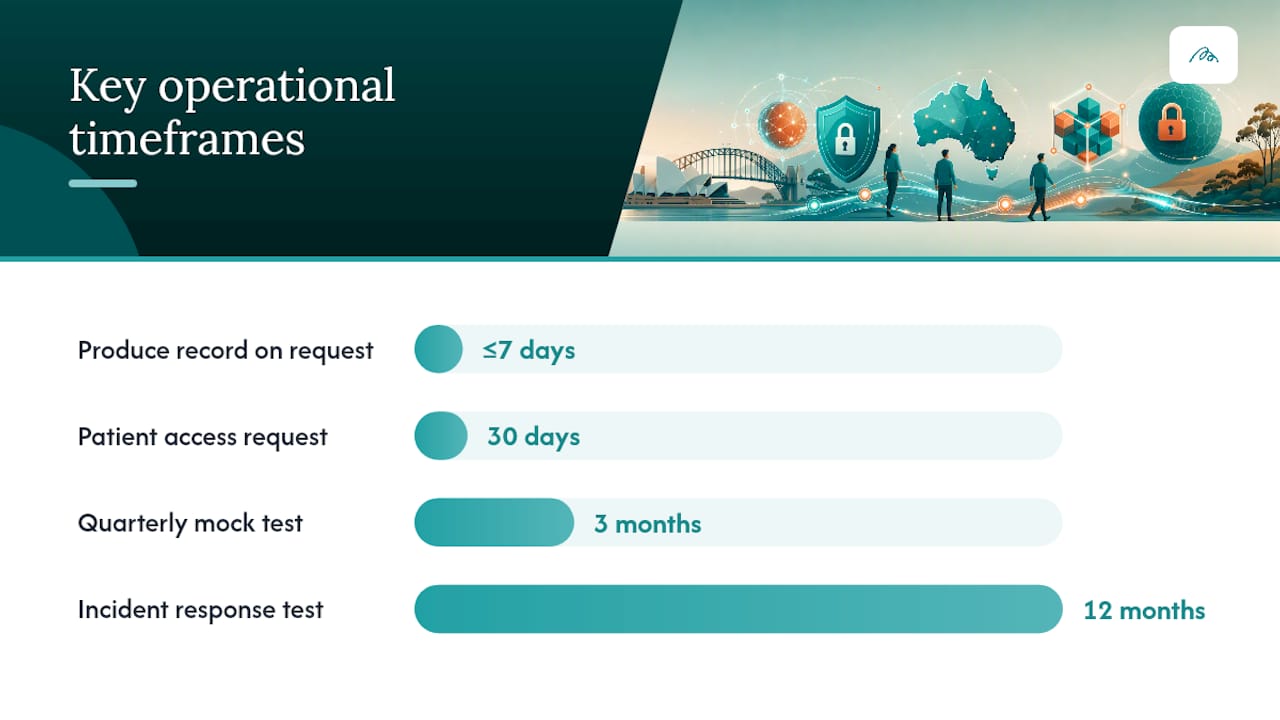
Patient access rights carry their own timeline. The OAIC’s guidance sets an expectation that practices respond to access requests within 30 calendar days in most cases, and breach notification obligations kick in wherever serious harm is a realistic possibility.
Relevant baselines at a glance:
- Australian Privacy Principles: reasonable steps, documented privacy management plan
- My Health Record conformance: ISM and Essential Eight alignment, mandatory pentesting
- State frameworks (e.g. CareSync Exchange): local storage, break-glass logging, auditing
- OAIC access timeline: 30 calendar days for most patient requests
- Breach notification: required where serious harm is likely
How do you implement secure document sharing operationally?
Technology solves half the problem. The other half is process, and it’s usually the half that gets skipped when a practice is short on time.
Start with governance. A privacy management plan needs a named owner, documented procedures, and staff training that actually happens rather than sitting in an induction folder nobody revisits. Meddle’s guide to meeting Australian Privacy Principle obligations walks through the six practical steps most clinics miss first.
Lock down the technical controls next: enforce MFA across every account, apply role-based access consistently, keep endpoints patched, and set data loss prevention rules that catch unusual bulk downloads before they become a breach headline.
On procurement, don’t accept a glossy brochure as evidence. Request the actual security questionnaire responses, ISO/IEC 27001 certification where relevant, and a summary of the vendor’s most recent penetration test. Government transfer policy for confidential health information recommends authorised secure file transfer, MFA, and split transmissions as standard risk-reduction steps, and that’s a reasonable minimum to hold any vendor to.
Build the operational routines too:
- A documented patient access request process that meets the 30-day expectation
- A retention and archiving policy that specifies when documents are deleted, not just when they’re stored
- Break-glass access logging for emergency situations, reviewed regularly rather than left unread
- A written incident response plan tested at least annually
Pro Tip: Run a mock data access request through your own system once a quarter. If your team can’t locate and produce the record within a week, your 30-day compliance margin is thinner than it looks.
How do you choose the right secure sharing solution?
Selection comes down to matching the tool to the workflow, then interrogating the vendor’s actual evidence rather than their marketing claims.
- Map the workflow first. A one-off referral needs an expiring link. Ongoing multidisciplinary care needs a portal with persistent audit trails. Continuous clinical data exchange with a hospital system needs FHIR-based integration, not a shared inbox.
- Demand security evidence, not assurances. Ask for the specific encryption standard, current certifications, a penetration test summary, and a plain statement of where data physically resides. Meddle’s security questionnaire template for healthcare software gives you the exact questions to put in front of a vendor.
- Interrogate the operational lifecycle. How does the vendor handle staff offboarding? What happens to data on contract termination? What’s the actual support SLA when something breaks on a Friday afternoon?
- Weigh managed versus on-premises trade-offs honestly. A managed cloud service cuts administrative burden but concentrates trust in one vendor. On-premises or hybrid setups maximise control but demand internal expertise most small practices don’t have spare.
- Build a short RFP checklist covering encryption specification, MFA enforcement, audit log export capability, data residency statement, and breach notification commitments, and refuse to shortlist any vendor who can’t answer all five clearly.
Where Meddle fits, and what to action this week
A healthcare platform can be built around governance principles such as matching patients to practitioners, coordinating referrals, and handling clinical communication without creating the ad-hoc email and fax trails that cause most avoidable breaches. If you’re assessing your own practice’s exposure, our guide to securing patient records under APP 11 is a practical starting point, and our My Health Record compliance breakdown is worth reading before any procurement conversation with a new vendor.
Three actions matter more than any others right now: document your privacy management plan with a named accountable person, publish a plain-language privacy notice patients can actually find, and test your breach response plan before you need it for real. None of these cost much. All three are frequently missing when a practice gets audited.
If your team is still coordinating referrals and clinical handoffs manually, that’s usually where governance gaps start. Meddle’s practitioner tools are built to reduce exactly that kind of ad-hoc, unaudited sharing across your team.
Why audit trails matter more than encryption alone
Encryption protects data from outsiders. Audit trails protect you from the far more common problem: proving what happened when something goes wrong internally.
A tamper-evident audit log records who accessed a document, when, from what device, and what action they took, view, download, forward, or delete. That record needs to be exportable in a format a compliance officer or the OAIC can actually review, not buried in a raw server log only an engineer can parse.
Auditability also does quiet, unglamorous work in day-to-day operations. It’s how you catch a staff member accessing records outside their role, how you reconstruct a timeline after a suspected breach, and how you demonstrate “reasonable steps” under the Australian Privacy Principles when a regulator asks. Systems without genuine, immutable logging can’t answer the question “who saw this file” with any confidence, and that’s precisely the question that matters most after an incident.
Look for logs that are timestamped to the second, resistant to editing or deletion by the same accounts they monitor, and retained for a period matching your jurisdiction’s record-keeping requirements. Review them on a schedule, monthly at minimum for high-access systems, rather than only when something has already gone wrong.
How do you assess risk before choosing a sharing method?
Every document-sharing decision is really a risk decision dressed up as a technology choice. The starting point is identifying what data you’re moving, how sensitive it is, and who could plausibly intercept or misuse it along the way.
A basic threat model for healthcare document sharing should account for external interception (data in transit), internal misuse (an authorised user accessing data outside their role), device loss (an unencrypted laptop or unlocked phone), and third-party exposure (a vendor’s own security failing). Each of these calls for a different control, encryption addresses the first, RBAC and logging address the second, endpoint encryption addresses the third, and vendor due diligence addresses the fourth.
Sensitivity and volume both change the risk calculus. A single referral letter carries lower stakes than a bulk export of an entire patient database, so your controls should scale with what’s actually being moved, not apply one blanket policy to everything. Practices that skip this step tend to either overspend on unnecessary security for low-risk transfers or, more dangerously, underprotect high-volume exports because “we’ve always emailed reports this way.”
Revisit the threat model whenever your workflow changes, a new integration, a new staff role, a new third-party tool, rather than treating it as a one-time exercise completed during initial setup.
Why interoperability standards matter for secure exchange
Secure sharing means nothing if the receiving system can’t actually use the data without someone re-typing it, and re-typing is where transcription errors creep in.
HL7 FHIR (Fast Healthcare Interoperability Resources) has become the reference standard for structured clinical data exchange in Australia, and Digital Health standards guidance recommends FHIR-compliant APIs alongside security controls mapped to frameworks like ISO/IEC 27017 for systems connecting to national infrastructure. FHIR structures data into discrete, machine-readable resources, a patient record, a medication list, an observation, so systems can exchange exactly the relevant piece without dumping an entire unstructured file.
For imaging specifically, interoperability runs through PACS (Picture Archiving and Communication System) integration. Teleradiology services that connect directly into a practice’s existing PACS, as AstraRad’s workflow demonstrates, avoid the manual export and re-upload cycle that introduces both delay and security exposure.
The practical takeaway for procurement: ask any vendor whether they support FHIR-based exchange or only proprietary export formats. Proprietary formats lock you into that vendor and often force manual re-entry when you need to share with an external system, which defeats much of the point of secure sharing in the first place.
How do you train staff on secure document sharing?
Technical controls fail quietly when the people using them don’t understand why the controls exist. A locked-down system with a poorly trained team still ends up with patient files forwarded to personal email accounts “just this once.”
Effective training goes beyond an annual slideshow. Staff need to understand the specific reasoning behind each control, why MFA matters, why sharing links shouldn’t be forwarded, why a portal exists instead of email, because rules that seem arbitrary get worked around under time pressure. Role-specific training matters too: a receptionist handling appointment bookings faces different exposure than a clinician reviewing full case histories, and training should reflect that difference rather than applying one generic module to everyone.
Build recurring refreshers into the calendar rather than a single onboarding session. Practices that run brief quarterly refreshers alongside simulated phishing tests tend to catch risky behaviour before it becomes a breach, whereas practices relying on a single annual session often find staff have quietly reverted to old habits within months.
Document every training session. When an incident does occur, being able to show that staff were trained on the relevant procedure is part of demonstrating the “reasonable steps” the Australian Privacy Principles require. Training without a record is, for audit purposes, indistinguishable from no training at all.
What should an incident response plan cover in healthcare?
A breach isn’t a hypothetical for healthcare providers. It’s a matter of when, not if, and the difference between a manageable incident and a genuine crisis usually comes down to whether a plan existed before the breach happened.
Your incident response plan needs a clear trigger definition (what counts as a reportable incident), a named response team with defined roles, and a timeline for each stage: containment, assessment, notification, and remediation. The OAIC’s data breach response expectations tie directly into the privacy management plan obligations already required under the Australian Privacy Principles, notification is mandatory where serious harm is a realistic possibility, and delay in assessment can itself become part of the problem.
Practical response plans specify who has authority to isolate an affected system without waiting for a committee decision, how patients are notified and in what language, and how the incident is documented for later review. Break-glass access logs, covered earlier, become critical evidence during this phase, showing exactly which records were accessed and by whom during the incident window.
Test the plan before you need it. A walkthrough exercise, even a short tabletop scenario twice a year, exposes gaps a written document alone never reveals: who’s actually reachable at 7pm on a Saturday, and who has admin rights to lock down a compromised account and won’t clash with someone else acting simultaneously.
When should you anonymise or de-identify shared documents?
Not every use case needs identifiable data, and stripping identifiers before sharing is one of the simplest ways to shrink your risk exposure without touching your core systems.
De-identification removes or obscures direct identifiers, name, date of birth, Medicare number, address, so the remaining data can’t reasonably be traced back to an individual. Anonymisation goes further, removing indirect identifiers too, so re-identification isn’t feasible even by combining datasets. The distinction matters for research, quality audits, and secondary analysis: if a dataset is genuinely de-identified, it typically sits outside the strictest personal information handling obligations under the Privacy Act.
The practical risk is doing it badly. Removing a name while leaving a rare diagnosis, an exact suburb, and an unusual date combination can still allow re-identification in a small population, a genuine concern in regional or specialist services with a limited patient pool. Effective de-identification usually needs a documented methodology, not an ad-hoc redaction pass by whoever’s free that afternoon.
Use de-identified data wherever the task allows it, quality improvement reviews, training material, research collaboration, and reserve fully identifiable sharing for cases where clinical care genuinely requires it. That single habit shift removes a meaningful share of unnecessary exposure without any new technology purchase.
RBAC or ABAC: which access model fits your practice?
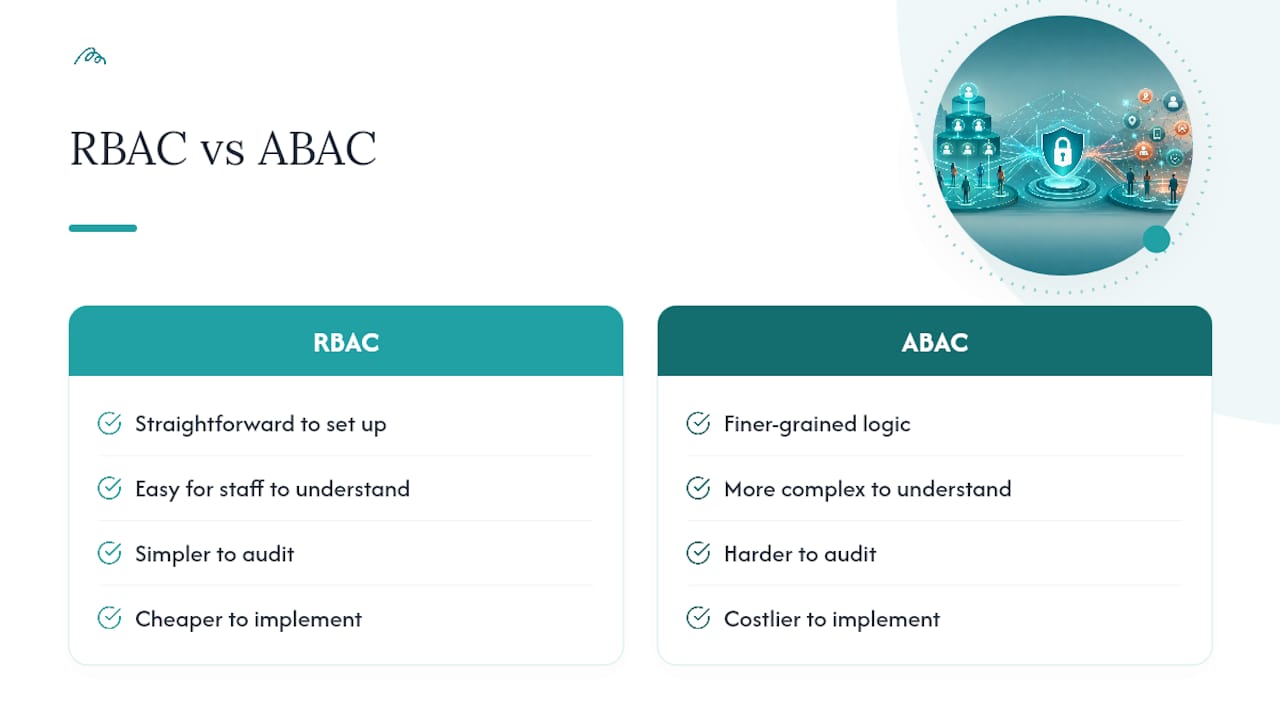
Role-based access control assigns permissions based on job function: a nurse role sees one set of records, an admin role sees another, a specialist role sees a third. It’s straightforward to set up and easy for staff to understand, which is exactly why most healthcare organisations start here.
Attribute-based access control adds finer-grained logic: permissions depend on multiple attributes at once, the user’s role, the patient’s care team assignment, the time of day, even the device being used. ABAC can enforce a rule like “allow access only if this clinician is on the patient’s active care team and accessing from an approved device during business hours,” something RBAC alone can’t express.
RBAC suits smaller practices with stable, well-defined job functions and a limited number of systems to manage. It’s simpler to audit and cheaper to implement. ABAC suits larger health services, multi-site organisations, or environments where care teams shift dynamically and a static role definition can’t keep pace with who actually needs access to what, and when.
Many organisations end up running a hybrid: RBAC as the baseline structure, with ABAC-style conditional rules layered on top for particularly sensitive record types, mental health notes or genetic testing results, for example, where a broader role-based permission would be too permissive. Whichever model you choose, the access rules should be documented clearly enough that an auditor can follow the logic without needing an explanation from IT.
Common mistakes and quick wins
The most common failure isn’t weak encryption. It’s practices accepting vendor claims at face value, treating encryption as a complete answer while ignoring access governance, and building workflows that staff quietly bypass because the “secure” option is slower than email.
Three moves fix most of that fast. In the next 30 days, run a proper security questionnaire against every vendor touching patient data. Within 60 days, enforce MFA across every system without exception. By 90 days, publish your privacy management plan and run a genuine test of your incident response process, not a tabletop discussion, an actual simulated trigger. None of this requires a new platform. It requires treating governance as seriously as the technology stack it’s supposed to control.
— Taylor
This article is general information, not a substitute for advice from a qualified doctor. Consult a qualified healthcare professional about your own circumstances before acting on anything here.
Sources
For primary requirements rather than summarised guidance, consult the OAIC’s health privacy guidance, the My Health Record security conformance profile, Digital Health interoperability standards, and the RACGP’s position on secure messaging.
- Key steps to embedding privacy in your health practice | OAIC
- My Health Record connecting systems security conformance profile v1.0
- My Health Record connecting systems security requirements (developer document)
FAQ
What is the most secure option when sharing documents?
The most secure option combines end-to-end or at-rest encryption (typically AES-256), multi-factor authentication, role-based access, and tamper-evident audit logging. No single control is sufficient on its own; it’s the combination that matters.
What is the most secure way to send medical records?
Secure clinical messaging or a dedicated secure portal with encryption, MFA, and audit logging is safer than email or fax. The RACGP identifies secure messaging as the safest, most efficient transfer method for exchanging patient information between practices.
How can I share documents securely?
Use a platform with encryption in transit and at rest, enforce MFA on every account, apply role-based permissions, and choose expiring links or a portal over unencrypted email for anything containing patient information.
Which file sharing service is the most secure?
There’s no single universally “most secure” service. The right choice depends on your workflow, ongoing collaboration favours a secure portal, one-off transfers suit expiring encrypted links, and the deciding factor should always be verifiable evidence: encryption specifications, certifications, and penetration test results, not marketing claims.
How long do practices have to respond to a patient’s request for their records?
Practices should generally provide access within 30 calendar days of a request, according to OAIC guidance.