SimplePractice alternatives for Australian allied health

TL;DR:
- Most Australian allied health practices should choose locally built platforms with native Medicare and DVA claiming for better workflow integration. Platforms like Meddle, Cliniko, Halaxy, Power Diary, Jane App, and Nookal offer tailored features, lower starting costs, and quicker onboarding compared to SimplePractice. Migrating typically takes two to four weeks, with the critical decision factor being native Medicare and DVA claim support.
For most Australian allied health practices, the best alternatives to SimplePractice are locally built platforms with native Medicare and DVA claiming, Xero or MYOB integration, and Australian Privacy Principles (APP) alignment. SimplePractice is a capable platform, but its core compliance and billing workflows are US-centric, which creates real friction for Australian therapists, dietitians, and multi-site clinics.
Your shortlist at a glance:
- Meddle — best for AI-powered patient matching, referral coordination, and fast rollout for Australian allied health clinics
- Cliniko — best for solo and small multi-practitioner practices wanting a clean, Australian-built PM suite
- Halaxy — best for cost-conscious solo practitioners; free core plan with Medicare/DVA claiming available
- Power Diary — best for group practices needing strong rostering, telehealth, and Xero integration
- Jane App — best for multi-disciplinary clinics wanting polished intake forms and a patient-facing portal
- Nookal — best for allied health clinics wanting an all-in-one platform with built-in AI tools and billing
TL;DR signals: Local platforms typically start from free to around AU$45/month per practitioner. Migration from SimplePractice generally takes 2–4 weeks, requiring a pilot phase and a scheduled transition. The single deciding factor: if your practice bills Medicare or DVA, choose a platform with native claiming built in from day one.
Table of Contents
- How do these SimplePractice alternatives compare for Australian practices?
- Which platform suits your Australian practice best?
- How do you choose and migrate to the right platform?
- Why does SimplePractice often misalign with Australian workflows?
- Do Australian platforms integrate with pathology and imaging services?
- What mobile app functionality do Australian clinicians actually need?
- How customisable are clinical templates and billing codes for Australian disciplines?
- Key takeaways
- The gap most practice managers miss
- Meddle fits where Australian PM suites stop
- FAQ
How do these SimplePractice alternatives compare for Australian practices?
SimplePractice’s standard pricing begins around US$49/month for core plans, which converts to roughly AU$75–80/month before you factor in the missing local integrations you’ll need.
| Platform | Starting price (AUD) | Best for | Medicare/DVA claiming | Telehealth | Xero/MYOB | Online bookings | Multi-site | Data migration |
|---|---|---|---|---|---|---|---|---|
| Meddle | from A$40/practitioner | Allied health clinics, referral coordination | Integration-ready | Built-in video | Yes | Yes, with patient portal | Yes | Guided onboarding |
| Cliniko | From ~$45/month | Solo to small group | Via integration | Built-in | Xero | Yes | Yes | CSV import |
| Halaxy | Free core plan | Solo practitioners | Native | Add-on | Xero/MYOB | Yes | Limited | CSV import |
| Power Diary | From ~$35/month | Group practices | Native | Built-in | Xero | Yes | Yes | CSV/guided |
| Jane App | — | Multi-disciplinary clinics | Via integration | Built-in | Limited | Yes, portal | Yes | CSV import |
| Nookal | Contact for pricing | Allied health clinics | Native | Built-in | Xero/MYOB | Yes | Yes | Guided |
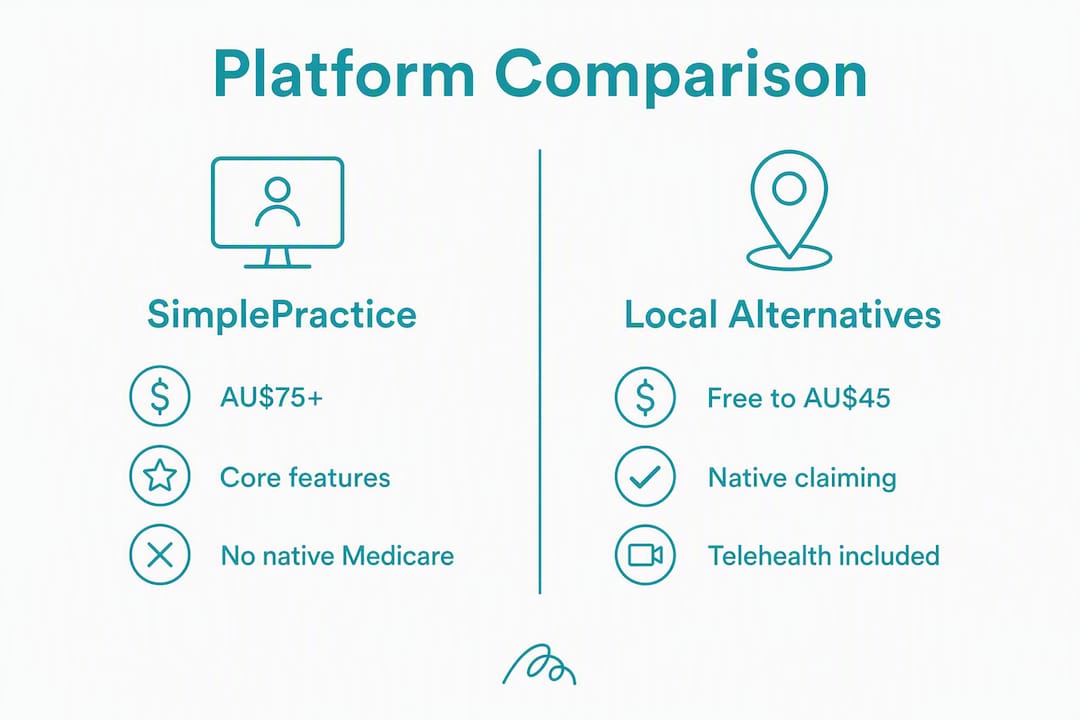
Pricing notes: Halaxy’s free plan covers core scheduling and records; Medicare/DVA claiming and some billing features are available on paid tiers. Power Diary and Cliniko both offer free trials. Nookal offers a demo on request. Meddle’s per-practitioner pricing begins at a competitive entry point, accessible for clinics of various sizes.
Onboarding time: Most local platforms quote 1–3 weeks for a standard migration from an existing PM system. Enterprise suites (Zedmed, MedicalDirector Pracsoft) typically require 4–8 weeks.
Pricing callout: SimplePractice starts at approximately US$49/month (roughly AU$75–80). Australian-built alternatives typically start lower and include local billing features that would otherwise require paid add-ons or third-party tools.
Which platform suits your Australian practice best?
Meddle
Best for: Allied health clinics wanting AI-powered patient matching, referral automation, and a fast, low-friction rollout.
Meddle is built for the Australian allied health market. Its algorithm matches patients to practitioners based on clinical needs, availability, and location, which reduces the admin burden of manual triage and referral coordination. The platform covers scheduling, secure digital health records, messaging, and a practice management dashboard, with integrations designed for Australian workflows.
- Native referral automation and patient-to-practitioner matching
- APP-aligned privacy controls and secure data handling
- Multi-site coordination and per-practitioner reporting
- Onboarding support with guided rollout from day one
- Practitioner benefits include reduced no-shows and faster patient intake
Limitation: Meddle’s strength is coordination and matching; practices needing deep clinical documentation templates for highly specialised disciplines may want to confirm template depth during a demo.
Onboarding: Guided rollout with dedicated support. Most clinics are live within 1–2 weeks.
Cliniko
Best for: Solo practitioners and small group practices wanting a clean, Australian-built PM suite with strong clinical notes.
Cliniko is one of the most widely adopted practice management platforms in Australian allied health. It handles appointments, clinical notes, invoicing, and online bookings, with Xero integration for accounting. Australian users report gaps around direct Xero/MYOB connectivity on US platforms, which is precisely where Cliniko delivers natively. Medicare/DVA claiming runs via integration rather than natively built in, so confirm your claiming workflow before committing.
- Strong clinical notes and customisable templates
- Xero integration; MYOB via third-party connector
- 14-day free trial available
- Limitation: Medicare/DVA claiming requires an additional integration step
Halaxy
Best for: Solo practitioners or small practices watching costs closely.

Halaxy’s free core plan is genuinely functional, covering scheduling, patient records, and basic invoicing. Native Medicare and DVA claiming is available on paid tiers, which keeps the entry cost low while preserving a clear upgrade path. Xero and MYOB integrations are both supported. The trade-off is that the interface can feel less polished than Cliniko or Power Diary, and multi-site rostering is limited on lower tiers.
Power Diary
Best for: Group practices needing rostering, telehealth, and consolidated billing across multiple providers.
Power Diary is purpose-built for multi-practitioner allied health. It includes native Medicare/DVA claiming, built-in telehealth, Xero integration, and per-provider reporting. Multi-site and multi-provider billing is the most common scaling pain point; Power Diary addresses this directly with consolidated invoicing and rostering tools. A 14-day free trial is available.
- Native Medicare/DVA claiming
- Built-in telehealth with Australian privacy compliance
- Strong rostering and group-practice reporting
- Limitation: Pricing scales with practitioner count, so larger teams should model costs carefully
Jane App
Best for: Multi-disciplinary clinics wanting polished patient intake and a strong patient-facing portal.

Jane App originated in Canada and has a growing Australian user base. Its intake forms, patient portal, and telehealth are genuinely well designed. Medicare/DVA claiming runs via integration rather than natively, and accounting integrations with Australian systems are more limited than local competitors. Worth evaluating if patient experience and intake customisation are your top priorities.
Pro Tip: Ask Jane App specifically about their Australian Medicare/DVA claiming integration partner and whether it adds per-transaction costs before you sign up.
Nookal
Best for: Allied health clinics wanting an all-in-one platform with built-in AI tools, billing, and strong Australian support.
Nookal is built specifically for allied health professionals in Australia. It covers scheduling, billing, patient records, and online bookings, with built-in AI tools designed to reduce admin time. Native Medicare/DVA claiming, Xero and MYOB integrations, and telehealth are all included. Nookal’s support team is locally based, which matters when you need help during Australian business hours.
Enterprise medical suites (Zedmed, MedicalDirector Pracsoft)
For larger multidisciplinary or general practices, enterprise suites offer deeper clinical workflows. Zedmed advertises multi-site support, e-scripts, integrated telehealth, and AI documentation aids, while MedicalDirector Pracsoft supports Medicare Online lodging, integrated EFTPOS, and extensive clinical reporting. Both suit practices that need deep clinical/administrative integration, but expect 4–8 weeks of onboarding and higher per-seat costs.
How do you choose and migrate to the right platform?
Evaluation checklist
Before you book a demo, confirm your practice’s non-negotiables:
- Medicare/DVA claiming: native or via a named integration partner (and at what cost per claim)?
- Accounting: direct Xero or MYOB integration, or manual export?
- Privacy: explicit APP alignment, Australian data residency, or equivalent assurances?
- Billing: automatic GST handling and local payment gateways such as Ezidebit for direct debit?
- Telehealth: built-in video with Australian privacy compliance, or a third-party add-on?
- Multi-site: per-provider reporting, consolidated invoicing, and rostering if you have more than one location?
- Data export: can you export client records, appointment history, invoices, and progress notes in CSV, HL7, or JSON?
Demo questions worth asking
- How do you handle Medicare and DVA claim submission — is it native or via a third-party integration, and what are the per-claim costs?
- Which accounting packages do you integrate with natively, and does the sync cover invoices, payments, and GST?
- What is your data export format, and do you offer a test import from a SimplePractice CSV export?
- Where is patient data stored, and how do you demonstrate APP compliance or equivalent data residency?
- What does onboarding look like — is there a dedicated migration specialist, and what is the typical go-live timeline?
Red flags in sales calls
- Vague answers about Medicare/DVA claiming (“we’re working on it” or “you can use a workaround”)
- No clear statement on Australian data residency or APP alignment
- Per-claim fees that are not disclosed upfront
- No free trial or pilot option before a 12-month commitment
Migration quick steps
- Export your SimplePractice data — client demographics, appointment history, invoices, and progress notes. Audit your export files first and confirm the target platform’s import formats (CSV/HL7/JSON) before you proceed.
- Map your fields — match SimplePractice field names to the new platform’s schema; flag any gaps.
- Pilot with one practitioner — run a 2-week parallel period where one clinician uses the new system while the rest stay on SimplePractice.
- Schedule a cutover weekend — migrate remaining data, verify claiming workflows, and confirm accounting sync before Monday morning.
Pro Tip: Use Meddle’s admin hours saved estimator to quantify the operational ROI of switching before you present the business case internally.
Why does SimplePractice often misalign with Australian workflows?
The core issue is structural, not cosmetic. SimplePractice is primarily designed for the US mental health market, with HIPAA compliance and US insurance billing at its centre. That architecture shapes every layer of the product, from its claiming workflows to its payment gateway options.
For Australian practitioners, the practical gaps are:
- No native Medicare or DVA claiming. Australian allied health practitioners typically choose local platforms specifically for built-in Medicare and DVA workflows, which reduce revenue cycle friction and eliminate the need for a separate claiming tool.
- No direct Xero or MYOB integration. Australian users report gaps around direct Xero/MYOB connectivity and local payment gateways, meaning bookkeeping requires manual exports or third-party connectors.
- HIPAA, not APP. Australian Privacy Principles differ from HIPAA in scope and operational requirements. Vendors should explicitly state APP alignment, Australian data residency, and any ISO certifications — not just HIPAA compliance.
- Payment gateway mismatches. Local platforms include automatic GST calculations and direct debit integrations such as Ezidebit that are not standard on US-first platforms.
When does it still make sense to stay with SimplePractice? If your practice operates primarily with private-pay clients, has no Medicare or DVA billing, and your practitioners are already trained on the platform, the switching cost may outweigh the benefit. That scenario is uncommon in Australian allied health, but it exists.
Do Australian platforms integrate with pathology and imaging services?
This is where enterprise and clinical suites pull ahead of scheduling-first platforms. MedicalDirector Pracsoft integrates with Medicare Online and clinical records, and enterprise suites like Zedmed support integrated pathology ordering as part of their clinical workflow. For allied health practices (physiotherapy, occupational therapy, dietetics, psychology), direct pathology ordering is less common, but referral network connectivity matters.
Meddle’s referral automation covers GP-to-allied-health referral pathways, which is the more common workflow for most allied health disciplines. Platforms like Nookal and Power Diary support referral letter generation and secure messaging, though deep pathology ordering integration is generally the domain of GP and specialist clinical suites. If your practice regularly orders pathology or imaging, confirm integration depth with any vendor before signing.
Modular platforms like MedNext allow clinics to phase in clinical modules over time, including pathology and theatre scheduling, which suits practices that anticipate growing into those workflows.
What mobile app functionality do Australian clinicians actually need?
Most leading Australian platforms offer iOS and Android apps for both clinicians and patients, but the depth varies. Clinicians typically need mobile access to their schedule, clinical notes, and secure messaging. Patients need appointment booking, reminders, and telehealth access from their phone.
Power Diary, Cliniko, and Nookal all offer clinician-facing mobile apps with schedule and notes access. Jane App’s patient portal is mobile-optimised and well regarded for intake and telehealth. Halaxy’s mobile experience covers scheduling and invoicing but is less feature-rich on the clinical notes side.
Meddle’s platform is designed for mobile-first access, covering patient matching, booking, and secure messaging for both practitioners and patients. For practices where referral coordination and patient intake happen on the go, that mobile-first design reduces the gap between desktop and field workflows.
One practical consideration: telehealth via mobile should be tested on both iOS and Android before go-live. Australian privacy compliance for video consults applies regardless of device, so confirm that the vendor’s telehealth solution meets APP requirements on mobile as well as desktop.
How customisable are clinical templates and billing codes for Australian disciplines?
Australian allied health covers a wide range of disciplines, each with specific Medicare item numbers, DVA billing codes, and clinical documentation requirements. A physiotherapist’s progress note looks nothing like a dietitian’s care plan, and a psychologist’s session notes carry different record retention obligations under AHPRA standards.
Cliniko and Power Diary both offer customisable clinical note templates, allowing practices to build discipline-specific forms. Nookal includes built-in templates for common allied health disciplines and supports custom template creation. Jane App is particularly strong on intake form customisation, which matters for practices with complex patient intake workflows.
For Medicare billing, the relevant item numbers differ by discipline and referral type (GP Management Plan, Team Care Arrangement, Enhanced Primary Care). Platforms with native claiming should support the full range of relevant item numbers for your discipline — not just the most common ones. Ask vendors specifically about your discipline’s item numbers during the demo.
Pro Tip: Before your demo, list the five Medicare item numbers your practice bills most frequently and ask the vendor to demonstrate claiming for each. This single test reveals more about billing depth than any feature checklist.
Halaxy’s free plan supports a broad range of item numbers and disciplines, which is why it remains popular with solo practitioners across physiotherapy, psychology, speech pathology, and dietetics. Power Diary’s billing customisation is strong for group practices managing multiple disciplines under one roof.
Key takeaways
For Australian allied health practices, locally built platforms with native Medicare/DVA claiming and Xero or MYOB integration deliver the strongest operational fit and avoid the fragmented admin that comes from adapting a US-centric platform.
| Point | Details |
|---|---|
| Choose local claiming first | Platforms with native Medicare/DVA claiming eliminate a separate tool and reduce revenue cycle friction from day one. |
| Xero/MYOB integration cuts bookkeeping overhead | Direct accounting sync is the single biggest admin ROI driver for most Australian clinics. |
| Migration typically takes 2–4 weeks. | Export SimplePractice data, pilot with one practitioner, then schedule a cutover weekend to minimise disruption. |
| Match platform scale to practice size | Solo practitioners can start on Halaxy’s free plan; group practices should evaluate Power Diary or Nookal for rostering and multi-site billing. |
| Meddle adds matching and coordination | Meddle’s AI-powered patient matching and referral automation address the coordination layer that standard PM suites do not cover. |
The gap most practice managers miss
Most comparisons of SimplePractice alternatives focus on feature checklists: does it have telehealth, does it have Xero, does it have Medicare claiming? Those are necessary questions, but they miss the more consequential one: how does the platform handle the moment a new patient enters your system?
The standard PM suite model assumes the patient already knows which practitioner they need and has already booked. In reality, a significant share of allied health referrals arrive through GPs, NDIS coordinators, or word of mouth, with no clear practitioner match. That coordination gap, between referral and confirmed appointment, is where admin time disappears and patients drop off.
Platforms that address only scheduling and billing leave that gap open. Meddle’s matching and referral automation is designed specifically for that moment, which is why it sits in a different category from a straight SimplePractice replacement. The right question is not just “which platform has the features SimplePractice lacks?” but “which platform reduces the total coordination burden on your team?”
For practices where referral volume is high and practitioner allocation is a recurring admin challenge, that distinction changes the vendor shortlist entirely.
Meddle fits where Australian PM suites stop
There are strong local alternatives to SimplePractice — Cliniko, Halaxy, Power Diary, Nookal, and Jane App each cover the core PM gaps. What they do not cover is the coordination layer: matching the right patient to the right practitioner, automating referral pathways, and reducing the manual triage that consumes front-desk time.
Meddle is built for exactly that layer, and it starts from A$40 per practitioner with guided onboarding that gets most clinics live within 1–2 weeks. APP-aligned privacy controls, multi-site coordination, and AI-powered patient matching are included from day one, not added as paid extras. If your practice is switching platforms and wants to solve the coordination problem at the same time, see how Meddle works and book a demo to confirm fit for your discipline and clinic size.
Useful sources and further reading
- SimplePractice review — Accelerware: Australian-market analysis of SimplePractice’s gaps around Medicare/DVA claiming, Xero/MYOB integration, and APP compliance.
- SimplePractice alternatives — Capterra Australia: Verified user ratings and feature comparisons for practice management platforms available in Australia.
- Nookal — allied health practice management: Product detail for Nookal’s scheduling, billing, AI tools, and Australian allied health features.
- Zedmed features: Enterprise medical suite capabilities including multi-site, e-scripts, telehealth, and AI documentation.
- MedicalDirector Pracsoft: Medicare Online integration and clinical workflow depth for GP and specialist practices.
- MedNext features: Modular cloud suite with phased rollout options for clinical, payments, and theatre scheduling.
- Meddle pricing and rollout: Per-practitioner pricing and plan features for Australian allied health clinics.
- Meddle practitioner benefits: Overview of how Meddle reduces admin, improves patient matching, and supports practice growth.
FAQ
What is better than SimplePractice for Australian therapists?
For Australian therapists, locally built platforms with native Medicare and DVA claiming — such as Halaxy, Power Diary, Cliniko, and Nookal — address the core gaps SimplePractice leaves open. Meddle adds AI-powered patient matching and referral coordination on top of standard practice management features.
What are the main complaints about SimplePractice from Australian users?
The most consistent complaints from Australian users centre on the absence of native Medicare and DVA claiming, no direct Xero or MYOB integration, and US-centric privacy compliance (HIPAA rather than Australian Privacy Principles), which creates extra admin and compliance uncertainty for local practices.
Is there a free version of SimplePractice?
SimplePractice does not offer a permanently free plan; it provides a free trial. For Australian practitioners wanting a free ongoing option, Halaxy offers a free core plan that covers scheduling and patient records, with Medicare/DVA claiming available on paid tiers.
How expensive is SimplePractice compared to Australian alternatives?
SimplePractice’s standard plan starts at approximately US$49/month (roughly AU$75–80/month). Australian alternatives typically start lower: Halaxy has a free core plan, Power Diary starts from around AU$35/month, and Meddle starts from AUA$40 per practitioner, with local billing features included rather than added as extras.
Does switching from SimplePractice to a local platform take long?
Most Australian practices complete a migration in 2–4 weeks. The key steps are exporting your SimplePractice data (client records, appointment history, invoices, and notes), confirming the new platform’s import format, running a pilot with one practitioner, and scheduling a cutover weekend before going fully live.