Cut Cancellations 8–16%: Appointment Lead Time for Clinic Managers

Appointment lead time is the gap between a patient requesting or being referred for care and the date of the actual appointment. The immediate step for any clinic manager is to measure your median and 90th-percentile lead time by appointment type, then set a booking-horizon target for each. Everything else, from triage models to SMS reminders, follows from that one baseline.
TL;DR:
- Reducing appointment lead times by setting target windows based on median and 90th percentile metrics can significantly cut no-shows and cancellations.
- Shortening booking horizons from 12 weeks to 4 weeks decreases weekly cancellation rates by up to 16% without extra costs.
- Implementing small, reversible interventions like booking-horizon limits and SMS reminders can deliver immediate operational benefits and easier clinician buy-in.
- Equitable scheduling requires careful exception policies to avoid disadvantaging patients with irregular schedules or transportation challenges.
- Structural solutions like STAT triage and NAA tools yield longer-term improvements but need clinician cooperation, so starting with configuration changes offers quick wins.
Table of Contents
- What is appointment lead time and how do you calculate it?
- Why does a long lead time hurt attendance and equity?
- What’s a reasonable appointment lead time by type?
- Which interventions actually reduce lead time?
- How do you roll this out without an IT overhaul?
- How scheduling software fits into this playbook
- What should leaders actually prioritise first?
- Get your clinic’s lead time under control with Meddle
- Sources
- FAQ
What is appointment lead time and how do you calculate it?
Appointment lead time is the number of calendar days between the trigger event, a referral, a patient request, or a booking call, and the scheduled appointment date. Most clinics track one of two variants: referral-to-appointment lead time (used for new patients and specialist referrals) and booking-to-appointment lead time (used for reviews and follow-ups booked directly by the patient).
The calculation itself is simple arithmetic. If a referral lands on March 3 and the appointment is scheduled for March 24, that record has a lead time of 21 days. The complexity comes from aggregating hundreds of these records into numbers you can actually act on.
Pro Tip: Don’t rely on the average alone. A mean lead time can look healthy while a fifth of your patients wait more than double that figure, because a handful of very short cancellation-fill bookings drag the average down.
Three numbers matter more than any single “average wait”:
- Median lead time: the midpoint of all bookings, less distorted by outliers than a mean.
- 90th percentile lead time: the wait experienced by your slowest 10% of bookings, often where dissatisfaction and no-shows concentrate.
- Booking-horizon compliance rate: the share of appointments booked within your target window (e.g. under 14 days for routine reviews).
Clinics that report only a mean lead time routinely underestimate the experience of their longest-waiting patients by a wide margin.
Pull this data from whatever system already timestamps bookings: your practice management export, online-booking platform logs, or referral inbox timestamps. Most practice management systems can export a raw booking list with request date and appointment date as two columns, which is enough to build a percentile distribution in a spreadsheet within an afternoon. Report the distribution monthly, not just the average, and break it down by appointment type. A psychology intake and a physiotherapy review have entirely different acceptable lead times, and blending them into one clinic-wide number hides the problem you’re actually trying to solve.
Why does a long lead time hurt attendance and equity?
Longer lead times measurably increase the odds a patient cancels or simply doesn’t show up. An observational study of booking-horizon reduction in pediatric outpatient care found that cutting the maximum advance-booking window from 12 weeks to 4 weeks reduced weekly last-minute cancellations and no-shows by 1.02 to 1.85 percentage points, a relative drop of 8 to 16%, and cut the week-to-week variance in those rates by 48%. That’s a substantial swing for a policy change that costs nothing to implement.
Patient tolerance for delay is already thin. ABS patient-experience data shows a significant share of people felt they waited longer than acceptable for a GP appointment in 2024–25, and more than a quarter said the same about specialist appointments. Almost half of people seeking urgent care waited 24 hours or more in 2023–24. Those aren’t abstract dissatisfaction scores; they’re the population your clinic is drawing from.
Long lead times don’t distribute their pain evenly, either:
- Rural and regional patients face compounding delays when a long lead time stacks on top of travel distance.
- Patients managing chronic conditions absorb the cost of delay differently, since a postponed review can mean a postponed medication adjustment.
- Lower-income patients are less able to absorb a last-minute reschedule, making them more likely to simply not attend a booking that no longer fits their week.
The operational cost runs both directions. A slot booked too far ahead is a slot at higher risk of a no-show, which leaves clinician time idle. That idle time then pushes the next patient further back, and the backlog compounds. Reducing appointment lead time isn’t only a satisfaction metric: it’s a capacity-protection mechanism.
What’s a reasonable appointment lead time by type?
There’s no single number that works across every clinic or appointment type, but the evidence gives you defensible starting ranges rather than guesses.
- New patient / initial assessment: target under about a month where clinically appropriate; the STAT trial demonstrated median waits can fall from 42 days to 24 days with protected triage capacity.
- Routine review: aim for a tighter, predictable window, often 1 to 2 weeks, since these patients are usually managing an ongoing condition where delay has clinical consequences.
- Urgent follow-up: same-day to 72 hours, protected separately from routine booking templates so it can’t be crowded out.
These ranges are starting points, not clinical guidelines. Your case mix, workforce, and referral volume will shift them.
Use median and 90th percentile to set targets, not the mean. The median tells you what a typical patient experiences; the 90th percentile tells you who’s being let down worst, and that’s usually where complaints and no-shows cluster. Align your targets with clinical prioritisation rather than a flat rule for every booking: a stable review patient and a newly referred patient with red-flag symptoms shouldn’t be competing for the same slot pool. Capacity planning has to reflect that difference, or your fastest-growing queue will always be the one nobody protected.
Which interventions actually reduce lead time?
Three approaches have trial or validation evidence behind them, and a fourth improves how patients experience whatever lead time remains.
STAT (Specific Timely Appointments for Triage) replaces a first-come, first-served referral queue with protected initial assessment slots combined with triage-led early management. The STAT trial ran as a stepped-wedge design across multiple community outpatient services and reduced median waiting time to first appointment by roughly a third, for example from about six weeks to about three and a half weeks, while also reducing variability between clinics.

Booking-horizon policy is the lowest-cost lever on this list. Shorter horizons also make overbooking strategies safer to run, because the booking pool is more predictable.
Next Available Appointment (NAA) tools simulate your waitlist using weekly queue modelling rather than complex machine learning, which is part of why clinics trust and adopt them. A validation study of an NAA tool tested against historical waitlists showed a simulated reduction in overdue appointments from over 40% to around one quarter in one practical scenario. Related template-planning tools deployed in outpatient systems extend this by modelling future capacity, not just current backlog.
An NAA tool doesn’t guess. It runs your actual waitlist forward through a simulated queue and tells you, with reasonable confidence, when the next slot will genuinely be free.
Patient-centred booking and reminders don’t shorten lead time directly, but they change how patients experience it. Patient preference research in Australia found the strongest preference was for automated SMS reminders sent under three days before the appointment, including basic visit details and the ability to cancel or reschedule interactively, with a reported scenario likelihood of 97%. Combine that with online self-booking and you cut a meaningful share of avoidable no-shows without touching your clinical roster at all.
How do you roll this out without an IT overhaul?
Start with measurement, not intervention. Every rollout below assumes you already have a baseline; skipping that step is the single most common reason a pilot fails to prove anything.
- Audit your data (week 1 to 2). Export 90 days of bookings with request date, appointment date, and appointment type. Calculate median and 90th-percentile lead time per type. Identify who owns this report going forward, ideally a practice manager or scheduling lead, not “whoever has time.”
- Choose one pilot (week 2 to 3). Pick a single intervention, a STAT-style triage pilot, a booking-horizon reduction, or an NAA probe on one clinician’s list, and run it against one appointment type for 6 to 12 weeks. Trying all three at once makes it impossible to tell which one worked.
- Adjust the operational settings. Protect a fixed number of slots per week for new-patient triage, reconfigure your booking template’s maximum advance window, and set SMS reminders to fire under three days out with a reply-to-cancel option.
- Brief staff before go-live. Reception and scheduling staff need a short script for explaining the new booking window to patients who are used to booking further ahead, since this is where clinician buy-in either forms or collapses.
- Monitor weekly, not monthly. Run a simple run chart of median and 90th-percentile lead time each week. Set a trigger point (for example, no-shows rising above baseline for two consecutive weeks) that pauses the pilot for review.
- Decide to scale, adjust, or stop at week 12. Compare against your pre-pilot baseline using the same percentile method, not a different metric that happens to look better.
Pro Tip: Run the pilot on one appointment type first, even if the rest of the clinic is impatient to change everything at once. A single clean before-and-after comparison is worth more than a clinic-wide change nobody can attribute to a single cause.
The main risk isn’t technical, it’s equity. Shortening a booking horizon can inadvertently disadvantage patients who plan appointments around irregular work shifts or carer schedules, so build in a documented exception process rather than a rigid cutoff.

How scheduling software fits into this playbook
Every intervention above depends on knowing, in real time, which slots are actually free and which patient should fill them next. That’s the operational gap AI-powered matching and real-time availability lookup are built to close: instead of a scheduler manually cross-referencing waitlists against a paper template, instant appointment booking surfaces the next genuinely available slot the moment a patient or referrer searches.
The matching algorithm applies the same logic behind NAA tools: it reduces the friction between “a patient needs care” and “a patient has a booked date.” Features that map directly onto the interventions covered above include:
- Interactive SMS reminders that let patients confirm, cancel, or reschedule without a phone call, matching the under-three-day, cancel-enabled format patients prefer.
- Group scheduling for clinics running batch appointment types, which protects capacity the way a STAT-style template does.
- Analytics dashboards that surface booking-horizon compliance and lead-time percentiles without a manual spreadsheet export.
For clinics testing this kind of platform for the first time, the CRM Integration add-on runs at $50 AUD per month per practice, letting existing scheduling data flow into the matching layer rather than requiring a system replacement.
What should leaders actually prioritise first?
Structural fixes like STAT and NAA tools deliver the biggest gains, but they take longer to build and need clinician cooperation to design triage criteria properly. Booking-horizon reduction is the opposite: it’s a configuration change you can make this week, and the pediatric outpatient data shows it moves the needle on cancellations almost immediately.
My honest read is that most clinics reach for the structural fix first because it sounds more serious, then stall for months waiting on stakeholder sign-off. Start with the horizon change and the reminder timing tweak. Both are reversible, both are cheap, and both give you real before-and-after data to bring to the harder conversation about triage redesign.
Buy-in comes from small, visible wins, not from a policy memo. Run one pilot, show the run chart, and let the clinicians see their own no-show rate move before asking them to change how they triage referrals. Equity has to be checked at every step, not bolted on afterwards; a shorter booking horizon that works beautifully for patients with flexible schedules can quietly punish those without one.
— Taylor
Get your clinic’s lead time under control with Meddle
Meddle is the alternative to running scheduling by spreadsheet and phone tag. Instead of a scheduler manually checking waitlists against a paper template, Meddle’s AI-powered matching finds the right practitioner and the next real available slot in one search, cutting the administrative hours clinics usually spend chasing bookings by hand.
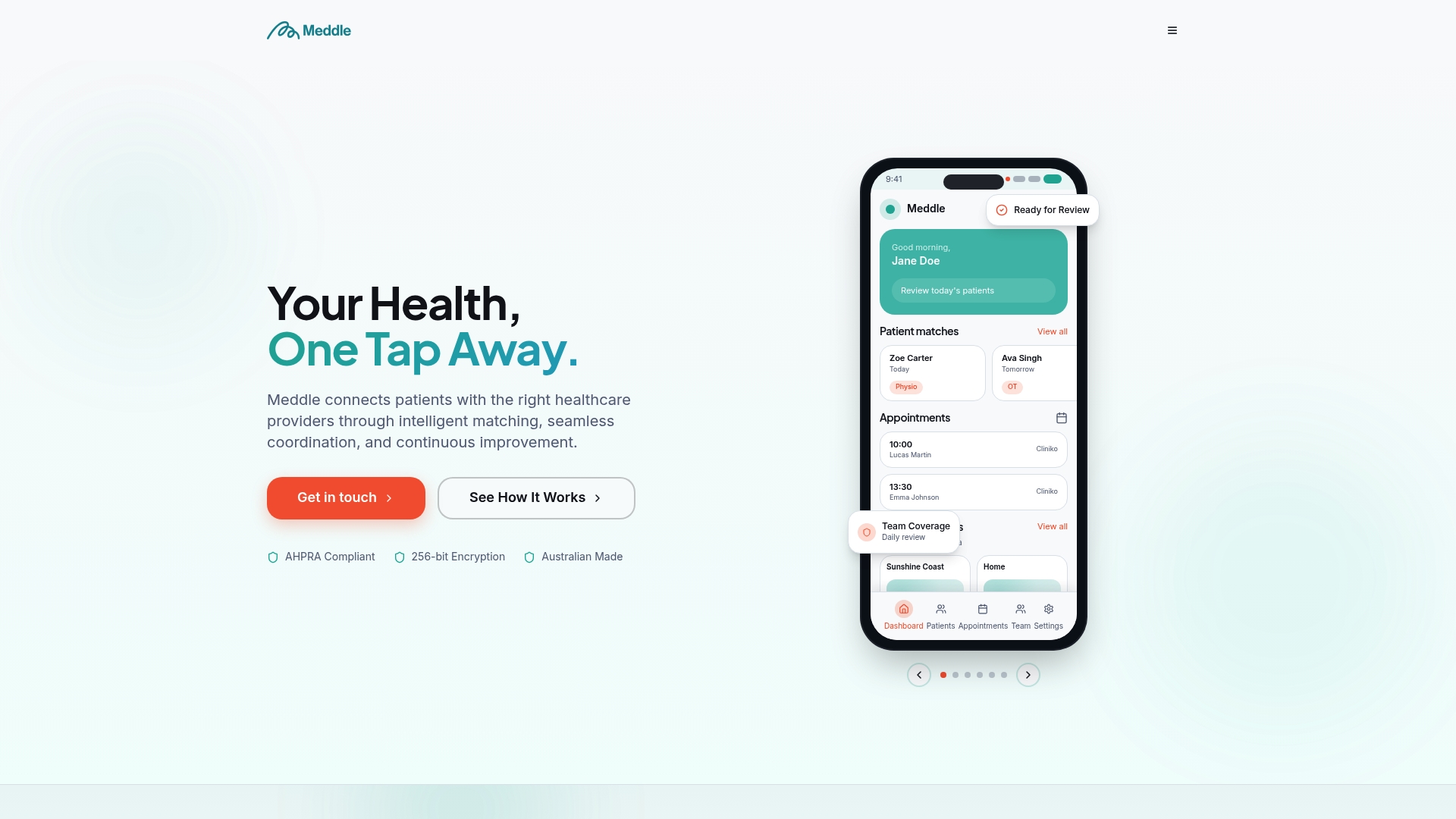
That’s the same logic behind every intervention covered in this article: protected capacity, faster triage, and reminders that actually get answered. Meddle’s platform brings instant appointment booking, interactive SMS reminders, and analytics dashboards into one practice management system, so your lead-time percentiles are a live number, not a monthly spreadsheet chore. Clinics can also add SMS Notifications to run the reminder cadence patients actually prefer.
If you’re ready to see how this fits your clinic’s booking templates, check the current pricing and rollout plans or browse how patients find care through the platform today.
Sources
- Australian Bureau of Statistics: Patient experiences (latest release)
- Effects of booking horizon reduction on cancellation rates: an experimental analysis in pediatric outpatient care
- Specific Timely Appointments for Triage (STAT) trial summary and outcomes
FAQ
What does lead time mean in scheduling?
Lead time in scheduling is the gap between a request or referral for an appointment and the date it’s actually booked for. In healthcare specifically, it’s usually measured from referral date or booking date through to the scheduled visit.
What does booking lead time mean?
Booking lead time describes the same interval, usually the term clinics use when it’s a patient-initiated booking rather than a referral. Both terms describe appointment lead time and are used interchangeably in scheduling reports.
How do I ask for an appointment time that suits me?
Most clinics using online self-booking, including those matched through Meddle, let patients filter available slots directly rather than negotiating by phone. If booking by phone, ask the scheduler for the next available slot within your preferred window rather than a specific date, since that widens your options considerably.
How long is it reasonable to wait for an appointment?
Reasonable ranges vary by appointment type and urgency, but ABS data shows a substantial share of patients already feel current waits are too long, 26% for GP appointments and 28.6% for specialists in 2024–25. Clinics following STAT triage evidence can bring new-patient median waits down to around 24 days, which is a reasonable benchmark for non-urgent initial assessments.