
Good appointment triage rules answer four questions for every request: is it complete, is it urgent, is it in scope, and who should see this person and when. Write those rules down once, apply them the same way at the front desk every time, and automate the repeatable parts. That is how a clinic stops losing leads in the inbox. Meddle turns referrals from GPs, email and web forms into structured intake, triage and practitioner matching, so your written rules run on every referral rather than on whoever is at the desk.
TL;DR
- Triage is a fast, structured way to decide how urgent a request is at the point of entry. Your rules should cover screening, urgency categories, red flags, missing information and documentation.
- Public health services give a tested template: screen within 7 days, then assign an urgency category based on clinical need alone.
- Red flags such as suicide risk or sudden neurological symptoms go to emergency care, not into your appointment queue.
- Incomplete referrals need a set response, a deadline and a record of every request.
- Meddle matches referrals to practitioners on specialty, travel radius and appointment type, with a free 30-day pilot.
Table of Contents
- What appointment triage means in an allied-health clinic
- A two-step model: screen, then prioritise
- Urgency categories you can adapt
- Red flags: when the answer is not an appointment
- Handling incomplete referrals
- Communicating and documenting the decision
- From category to the right practitioner
- Worked example: a mixed inbox on a Monday
- How we think about triage rules
- Try it with your own referrals
- FAQ
- Sources
What appointment triage means in an allied-health clinic
Primary Health Tasmania’s triage poster defines triage as a rapid, systematic process for working out a person’s level of urgency at the point of entry to a service. It adds that triage policies, decision tools, protocols and referral processes need input from the clinical team, plus staff training to recognise red flags and urgency levels.
That matters for allied health because the first person to see a request is often not a clinician. The same poster notes that non-clinical reception staff are usually the first port of call, so written systems and training, not individual judgement, keep front-desk triage safe.
Your triage rules should therefore cover:
- What counts as a complete referral.
- How urgency is categorised and who decides.
- Which presentations are redirected to emergency care.
- What happens when information is missing.
- How the decision is communicated and recorded.
- How the request is matched to a practitioner.
Public health systems are not your regulator, but their rules show what a defensible process looks like. You can mirror them at a scale that suits your clinic.
A two-step model: screen, then prioritise
NSW Health’s guideline GL2023_014 sets out a two-step process for outpatient referrals. Delegated staff first screen the referral within 7 days: they determine the referral type, identify the patient, check completeness and identify the service requested. Clinical prioritisation then assigns an urgency category based on clinical need alone, with any variation documented along with the clinical reasoning.
The split is useful for a private clinic. Your intake team does the administrative screening. A practitioner, or a rule set a clinician has approved, decides urgency. Keep the two jobs separate in your policy, so nobody at the desk is making a clinical call by default.
Screening checklist for intake staff
- Is the referral type clear (GP referral, self-referral, support coordinator, NDIS plan manager)?
- Is the patient identifiable, with contact details?
- Is the requested service one you provide?
- Are the required fields present?
- Are there any words or answers that trigger a red-flag rule?
We publish a referral triage checklist built for allied health admin teams, which you can use as the base for your own.
Urgency categories you can adapt
NSW Health GL2023_014 uses four categories:
| Category | Timeframe | Typical use |
|---|---|---|
| Rapid access | Booked to patient need, for example same day to one week | Patients diverted from emergency departments |
| Category 1, urgent | Within 30 days of receipt | Highest clinical need |
| Category 2, semi-urgent | Within 90 days | Moderate need |
| Category 3, non-urgent | Within 365 days | Lowest need |
These are hospital outpatient timeframes. A private allied-health clinic will usually compress them, but the structure carries over: a small number of named categories, each with a maximum wait and a clear definition.
A 2024 peer-reviewed study of physiotherapy hospital triage policies found allied-health tools ranging from 30 minutes for the highest priority to 365 days for the lowest. The range shows there is no single correct set of timeframes. What matters is that yours are explicit and applied consistently.
Discipline-specific criteria
Criteria work best when they describe clinical presentations. Queensland Health’s gross motor delay criteria place very severe delay, including significant developmental delay in infants under 12 months, in Category 1 (30 calendar days). They place severe delay, such as a child over 18 months not walking independently, in Category 2 (90 days), and moderate or mild delay in Category 3 (365 days). A clinical override applies where the referrer believes review is needed despite not meeting criteria.
SA Health does the same for adult conditions. Its carpal tunnel and ulnar nerve criteria put an acute neurologic deficit from trauma in Category 1 and symptomatic entrapment without muscle wastage or weakness in Category 3.
For a multidisciplinary clinic, that means one set of categories shared across the practice and a short criteria list per discipline: physiotherapy, occupational therapy, psychology, speech pathology, dietetics and podiatry. Ask each lead clinician to write theirs.
Red flags: when the answer is not an appointment
This is the part of your rules that must never depend on someone remembering. NSW Health’s referral criteria advise referrers to consider redirecting patients with emergency red flags to an emergency department or urgent care, or to seek medical advice, rather than referring them into the outpatient queue.
Queensland Health’s referral guidance lists situations that call for the emergency department (by ambulance if necessary) or emergent medical advice:
- Suicidal thoughts or immediate self-harm risk.
- Aggressive behaviour with an immediate threat to others.
- Acute deterioration in function, or loss of previously acquired skills suggesting neurological decline.
- Sudden neurological symptoms such as sudden weakness, slurred speech or seizures.
Its cognitive impairment and dementia criteria add imminent safety risk to self or others, suspected delirium that is unsafe to manage in the community, and very rapid onset of cognitive or neurological symptoms.
In your policy, write the red-flag list on one page, have your clinical lead approve it, and state the action in plain words: call 000 or direct the person to the emergency department, and tell the referrer. Staff should never be left to improvise this. Review the list with your clinical lead and train new reception staff on it at induction.
Handling incomplete referrals
Incomplete referrals are where leads quietly disappear. NSW Health GL2023_014 sets a clear pattern you can copy:
- Notify the referrer within 7 days that the referral is incomplete, with the reasons and the information needed.
- Ask for the complete referral within 14 days, or state that it may not be accepted.
- Prioritise urgent referrals and chase urgent gaps by telephone.
- Document every request for audit.
The Tasmanian Department of Health takes a stricter line: referrals missing required imaging, pathology, clinical history or demographic details are not accepted and are returned to the referrer. Its required content includes the patient’s full name, address, phone numbers and date of birth, past history and investigations, presenting symptoms and duration, current medications and allergies, and the referring practitioner’s details.
SA Health’s outpatient referral page also lists a need for interpreter services and alerts to infectious status or allergies. Those two items are easy to forget and change who can see the patient and how.
Choose your own line: return, or hold for a set period. Put it in writing so it is the same for every referrer. Our guides on referral acceptance rules and the GP referral process go deeper on what to require and why.
Communicating and documenting the decision
GL2023_014 requires patients and referrers to be notified in writing that the referral was received and of the triage outcome, and all communication with the referrer and GP to be documented. Your version needs four records for every request:
- Date and time received, and by which channel.
- The screening result and who did it.
- The urgency category, who assigned it and why, including any override.
- What was sent to the referrer and the patient, and when.
SA Health also notes that a change in circumstances, such as deterioration or pregnancy, may affect the urgency category and should be communicated as soon as possible. Build a rule for people already waiting: they can tell you their situation has changed, and someone must re-triage them.
A waitlist is a living queue. Our guide to waitlist prioritisation covers how to keep it ordered by need rather than by arrival date.
From category to the right practitioner
Urgency tells you when. You still have to decide who. Matching criteria usually include specialty, appointment type, location or travel radius, and availability. In a group practice, doing this by memory or from a shared spreadsheet is where delays creep in.

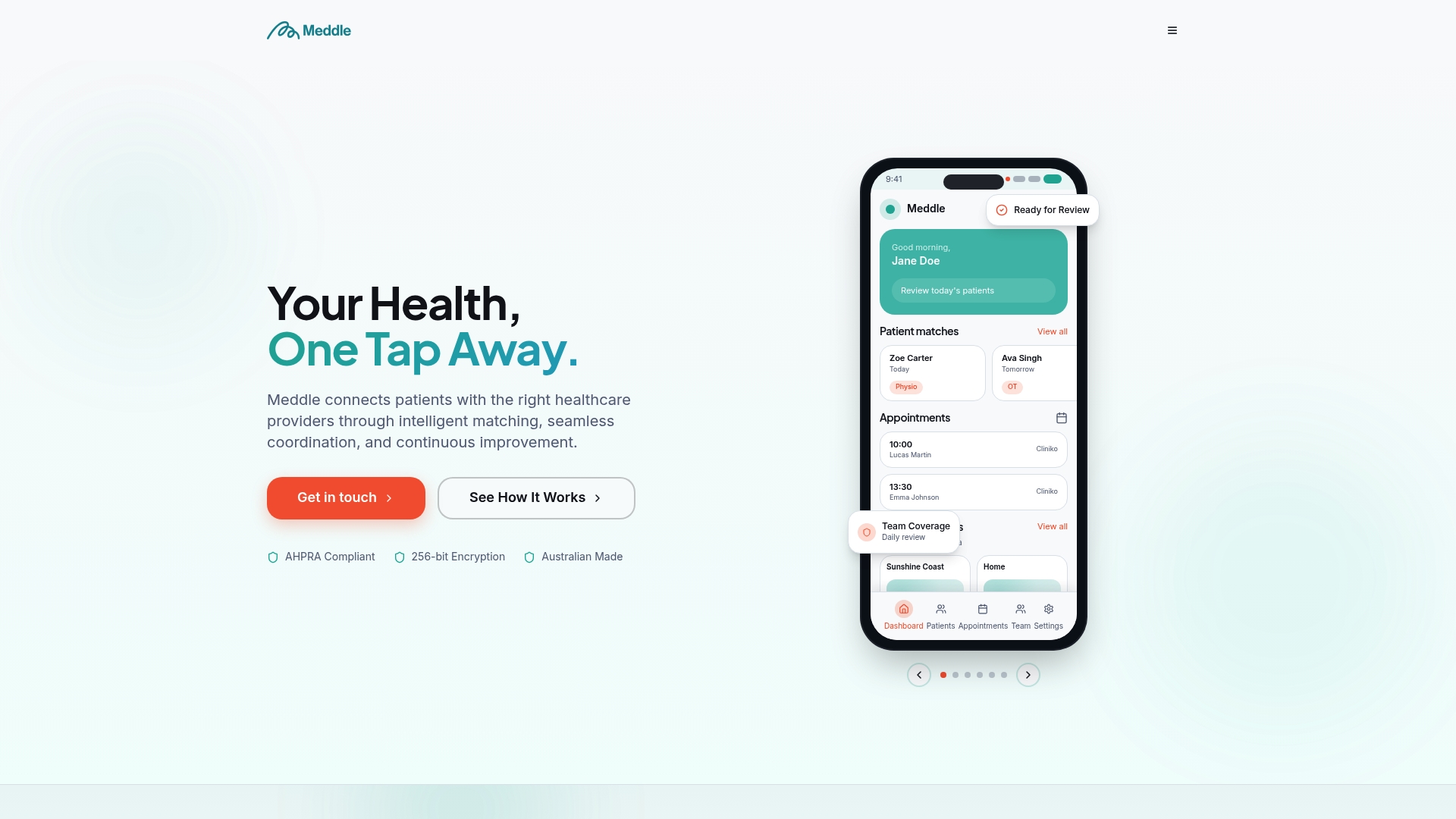
Meddle matches on specialty, travel radius and appointment type. See triage and practitioner matching for how it fits the rules above, and provider selection criteria for the factors worth writing into your policy. Our referral-to-booking workflow shows the full path.
Worked example: a mixed inbox on a Monday
Three requests arrive before 9 am at a multidisciplinary clinic.
- A GP referral for a child, missing the date of birth. Screening flags the gap. The intake team notifies the GP’s practice and sets the deadline from the clinic’s policy. The record notes the request.
- A web form from an adult describing sudden weakness on one side and slurred speech. A red-flag rule fires. Staff do not book. They direct the person to emergency care, then note the action.
- A complete podiatry referral with no urgent features. It passes screening, the podiatrist’s criteria place it in the routine category, and it is matched to a practitioner within the travel radius with the right appointment type.
Three requests, three different outcomes, all from the same written rules. That consistency is the point of having them.
How we think about triage rules
Most clinics we talk to already have triage rules. They live in a senior receptionist’s head, a folder nobody opens or a long email thread. When that person is on leave, the rules go with them.
Our view is that rules should be written once, approved by clinicians and applied the same way to every referral, whether it arrives from a GP, an email or a web form. Staff keep the judgement calls that need a person. The structured parts, such as completeness checks, category assignment and matching on specialty, travel radius and appointment type, should not need anyone to remember them.
That is what we built Meddle to do, so your team spends less time on admin and fewer leads are lost between the inbox and the first appointment.
Taylor
Try it with your own referrals
Meddle is priced at A$40 per user per month ex GST, or A$400 per user per year ex GST (2 months free). Every user pays the same, including admins and coordinators, and everything is included with no add-ons. There is a free 30-day pilot, so you can run your own triage rules on your real referral flow. See how Meddle works.
Dietetics practice? There is a version for you: referral software for dietetics practices.
FAQ
What should appointment triage rules include?
They should define a complete referral, urgency categories with timeframes, red-flag presentations that go to emergency care, the response to incomplete referrals, and what is recorded and sent to referrers and patients. Have your clinical lead approve them and train every staff member who handles intake.
Who is allowed to triage at a clinic?
Public health guidance splits the work. Delegated staff screen for completeness, and clinical prioritisation sets urgency. The Primary Health Tasmania poster stresses that reception staff need written systems and training. Your policy should say which decisions need a clinician.
How long should a clinic take to respond to a referral?
NSW Health’s outpatient guideline uses 7 days for screening and notifying the referrer of an incomplete referral, and 14 days for the missing information. A private clinic can set faster times. Choose them, write them down and apply them to every referrer.
Do the public-hospital categories apply to private allied-health clinics?
Not as a requirement. They are a tested template. Many clinics adopt a similar number of categories and shorten the timeframes, then add discipline-specific criteria written by their own clinicians.
To see your rules working on real referrals, book a 30-minute demo.
Sources
- Triage in general practice settings poster, Primary Health Tasmania
- Management of Outpatient (Non-Admitted) Services, GL2023_014, NSW Health
- State-wide referral criteria FAQ, NSW Health
- Gross Motor Delay referral criteria, Queensland Health
- Cognitive Impairment and Dementia, Queensland Health
- Referral standards and guidelines, Tasmanian Department of Health
- Outpatient referrals, SA Health
- Craniomaxillofacial paediatric CPC, SA Health
- Peripheral Nerve Entrapment CPC, SA Health
- Pagano et al. 2024, physiotherapy triage policies
Recommended
- Referral Acceptance Rules for Australian Allied Health Clinics
- Referral Triage Checklist
- Appointment Slot Optimisation for Allied-Health Clinics
- Waitlist Prioritisation in Allied Health: A Clinic Guide
This article is general information for healthcare businesses and isn’t legal, clinical or privacy advice. Check current requirements with the relevant regulator or a qualified adviser.