Appointment Slot Optimisation for Allied-Health Clinics

Appointment slot optimisation is the work of matching your clinicians’, rooms’ and equipment’s available time to the demand actually coming in. For an allied-health clinic that means redesigning templates, appointment lengths and booking rules, then reviewing the numbers on a regular cycle. The aim is not a fuller calendar for its own sake. It is shorter waits, fewer empty slots and fewer failures to attend, without burning out your team.
This guide walks through how to measure your current schedule, set slot lengths by appointment type, hold capacity for urgent and NDIS clients, close gaps from cancellations and run a review you can sustain.
TL;DR
- Measure first: slot utilisation, fill rate, next-available wait and no-show rate by clinician and day show where capacity is leaking.
- Build templates from appointment types and the time they really need, using short slot units that combine, rather than one fixed length for everyone.
- Pre-allocate a small block of urgent slots, and release unused ones to routine patients close to the day.
- Reminders, patient choice of time and a clear waitlist process close most cancellation gaps.
- Review monthly, and read utilisation alongside waits and staff workload: a full diary is not automatically a good one.
Table of Contents
- What slot optimisation means for an allied-health clinic
- Measure your current schedule first
- Build templates around appointment types
- Match slots to Medicare and telehealth rules
- Balance urgent referrals, routine bookings and NDIS clients
- Close the gaps from cancellations and no-shows
- Set up a monthly review
- Perspective: where slots are really won or lost
- How Meddle supports slot optimisation
- FAQ
- Sources
What slot optimisation means for an allied-health clinic
A slot is a block of bookable time. Optimising slots means deciding how long each block is, who can book it, which room or equipment it needs, and when it is released. A Monash Health rapid review of outpatient scheduling describes the intended outcomes as greater capacity and better flow, fewer overbookings and failures to attend, and improved access such as shorter waits.
Those three outcomes are a useful test for any change you make:
- Capacity and flow: are clinicians, rooms and equipment in use when the clinic is open?
- Reliability: do booked patients actually attend, and does the day run to time?
- Access: how long does a new patient wait for a first appointment, and how long does an urgent referral wait?
A multidisciplinary clinic has an extra layer. A physiotherapist, an occupational therapist and a psychologist all draw on shared rooms, shared admin time and the same intake team. Optimising one calendar in isolation often just moves the bottleneck.
Measure your current schedule first
You cannot tune what you have not counted. Pull three months of appointment data from your practice management system and calculate a handful of measures by clinician, by day of the week and by appointment type.
Fill rate and slot utilisation
A long-standing family medicine guide suggests reviewing scheduling data each month and calculating fill rate as slots filled or double-booked divided by slots available, then looking at unfilled and missed appointments by doctor and day. The same approach works for physios, psychologists and dietitians.
The University of Texas Medical Branch uses a slightly stricter definition on its 2023 dashboard: slot utilisation is the percentage of slots filled, including scheduled, completed and no-show appointments, compared with the original template, with future open slots reported separately. Counting no-shows as “filled” is important, because it exposes the gap between a booked diary and a treated diary.
Waiting-time measures
The same dashboard tracks median new-patient lag, which is the median days from booking to the appointment date, and third-next-available, the average days from a request to the third next open appointment. Third-next-available is a handy one for small clinics because it is less distorted by a single cancellation freeing up tomorrow morning.
A simple baseline sheet
| Measure | How to calculate it | What it tells you |
|---|---|---|
| Fill rate | Slots filled (including double-booked) ÷ slots available | Whether capacity is being used |
| Slot utilisation | Scheduled, completed and no-show slots ÷ template slots | Gap between template and reality |
| No-show and late-cancel rate | Missed or short-notice cancelled ÷ booked | How much capacity is lost on the day |
| Third-next-available | Days to the third open appointment, by discipline | Real access for new patients |
| Urgent wait | Days from urgent referral to first appointment | Whether urgent capacity is working |
Two cautions on interpretation. First, the research is from other settings. A 2018 neurology access study reported average slot utilisation of 80%, with some providers as low as 65%, largely because of no-shows and last-minute cancellations. Those figures are not allied-health benchmarks, so set your own baseline and compare yourself with yourself.
Second, a higher number is not always better. The AAFP article warns that fill rates above 95% may point to staff stress and access problems, while rates well below 90% may mean too few visits or too many missed appointments. Treat those as prompts to look closer, not targets to copy.
Build templates around appointment types
Most slot problems start in the template. A single 45-minute block for every client means a 30-minute review wastes 15 minutes, and a 60-minute initial assessment gets squeezed or runs over.
The Monash Health review draws on an Australian case where a service moved to multiples of 20-minute, later 10-minute, slot units instead of fixed appointment lengths, booked to the time needed, the treatment room and the clinician. The principle carries over directly to allied health.
A practical approach
- List your appointment types. For example: initial assessment, standard review, short review, group session, telehealth review, NDIS plan-related session, report-writing time.
- Set a realistic duration for each, based on what actually happens, using the last few months of start and finish times rather than the length printed in the template.
- Define slot units (10 or 15 minutes) so types can stack without leaving odd gaps.
- Tag resources. If a treatment needs a gym space, a podiatry chair or a sensory room, the slot should only be bookable when that resource is free.
- Set rules on who can book what. New-patient assessments go in your longer, more protected blocks; short reviews fill the edges.
We cover why templates should be fixed before you touch anything else in our guide to load balancing appointments, and how group formats change capacity in our piece on group appointment scheduling.
Book by need, not only by name
In a multidisciplinary practice, booking only by clinician name leaves some calendars jammed and others open. The Flinders case in the Monash review used flexible time units, booking to the next available appointment and pre-allocated emergency slots. For a clinic, that translates to offering a patient the next suitable slot across any clinician qualified for the appointment type, unless the patient or the clinical plan calls for a specific person. Continuity matters for many clients, particularly in psychology and paediatric therapy, so make “preferred practitioner” a deliberate choice rather than the default for everyone.
Match slots to Medicare and telehealth rules
Medicare-funded allied-health services come with constraints that shape your templates. Under MBS item 93000, an eligible allied-health video service must be at least 20 minutes, individually delivered, referred under specified chronic-condition plans, and limited to five applicable services in a calendar year. The related MBS note says the five-service annual limit applies across face-to-face, video and telephone modes, and that the practitioner must decide whether telehealth is appropriate. For eligible patients with type 2 diabetes, a separate note allows up to eight group allied-health services per calendar year when the plan conditions are met.
What this means for slots:
- Make the minimum duration a rule in the appointment type, so a funded telehealth session cannot be booked into a 15-minute gap.
- Keep the referral and remaining-services count visible to reception so patients are not booked into sessions they cannot claim.
- Treat group sessions as their own type with their own room and headcount rules.
Telehealth is a real part of the mix. The Australian Department of Health’s 2023 review reported that telehealth made up 14.5% of allied-health consultations in 2022, and found that for continuing management it generally had similar clinical effectiveness to face-to-face care, with added convenience and access, especially for rural patients and people who find travel hard. Dedicated telehealth blocks, perhaps on days when rooms are tightest, can free physical space. Our telehealth versus in-person advisor helps patients work out which fits them.
Balance urgent referrals, routine bookings and NDIS clients
If every slot is bookable weeks ahead, urgent referrals wait behind routine work. If too many are held back, they go empty. The usual answer is a small, deliberate reserve.
The Monash review recommends pre-allocating emergency slots and filling any unallocated urgent appointments with routine patients close to the clinic date. In practice:
- Hold a few slots per clinician each week for urgent referrals, such as post-surgical rehab, acute mental health or a time-limited hospital discharge.
- Release unused urgent slots to the waitlist 24 to 48 hours ahead.
- Record why a referral was classed as urgent, so reception applies the same rule every time.
- Review the reserve size monthly. If urgent slots are always used, the reserve is too small; if they are always released, it is too large.
For NDIS clients, plan reviews, report deadlines and funding periods create their own pressure points. Build in non-face-to-face time for reports and coordination, and avoid scheduling every available minute as client contact. Intake that captures funding type, goals and preferred times at the start lets you place the client in the right slot the first time. Our guide on restricting bookings by referral covers how to keep online booking from sending the wrong client into the wrong slot.
Close the gaps from cancellations and no-shows
Even a well-built template loses capacity on the day. The Monash review’s recommended toolkit is SMS, telephone or letter reminders, patient education, patient choice of time, patient-focused booking with finite booking periods, and minimal or no overbooking. It also advises booking from the waiting list by referral date.
Reminders and lead time
A reminder that lets the patient confirm, change or cancel in one reply turns a silent no-show into a freed slot you can refill. Booking too far ahead raises the odds that circumstances change, so shorter booking horizons for routine reviews help. We look at both in our no-show reduction guide and our piece on appointment lead time.
A reschedule-first policy
A 2025 study from a Central Coast Local Health District pain unit reported no-shows falling from 27.12% to 11.93% after introducing a booking process that gave patients a grace period to reschedule missed appointments, put those who did not reschedule at the bottom of the clinician’s list, and reappointed vulnerable patients. The same study reported billable clinical time rising from 39.3 to 52.4 minutes and booking-related admin contacts falling from 1.4 to 1.15, while the fall in waiting time (191.97 to 152.4 days) was a trend rather than statistically significant. It is one public-hospital setting, so treat it as a model to test, not a promise.

The vulnerable-patient exception matters. A policy that quietly penalises clients with unstable housing, disability or mental health crises will harm the people you most want to reach.
Cancellation fees under the NDIS
For NDIS participants, the 2025–26 Pricing Arrangements and Price Limits states that, subject to conditions and the service agreement, a provider may claim up to 100% of the agreed fee for a short-notice cancellation or no-show. Whether you can claim depends on the service agreement, the relevant support rules and whether you could find alternative billable work for that time, so a fast waitlist refill is both better for access and better for your claim position. Check the current NDIS price guide on the NDIS website before you set your policy, as it is reissued each year.
A waitlist that works
- Capture availability windows and travel limits at intake, not only “next available”.
- Offer a freed slot to the best-matched waitlisted patient first, based on referral date, urgency, discipline and location.
- Use a short confirm-by deadline so a slot is not held for hours.
Set up a monthly review
Optimisation is a cycle. The Monash review recommends reviewing through Plan-Do-Check-(Study)-Act cycles, and a monthly rhythm suits a clinic of almost any size.
- Plan: pick one change, such as converting two long blocks per week to flexible units.
- Do: run it for four to six weeks.
- Check: compare utilisation, no-shows, third-next-available and urgent wait with your baseline.
- Act: keep it, adjust it or revert it.
Results can be meaningful. At Flinders Medical Centre, average waiting time was cut from 15 days to 10, with fewer failures to attend. In the neurology pilot, targeted overbooking for physicians with utilisation under 85% raised pilot-site utilisation to 96% and increased referrals seen within 10 days from 25% to 43%. Overbooking is a poor fit where sessions are long, one-to-one and clinically intensive, so in allied health it is safer to start with templates, reminders and waitlist refills.
Alongside the numbers, ask your team. If utilisation climbs and clinicians report no time for notes, you have traded access for strain. The AAFP perspective is that utilisation has to be read alongside access and staff workload: a fuller calendar is not automatically a better schedule.
Perspective: where slots are really won or lost
Most clinics we speak to start by tweaking the calendar. The bigger loss usually happens earlier, at intake. A referral arrives by email, a web form or a GP letter, someone re-types it, and by the time the right clinician is identified, the slot that would have suited has gone.
We built Meddle around that gap. It turns referrals from GPs, email and web forms into structured intake, triage and practitioner matching on specialty, travel radius and appointment type. When the patient’s needs are clear up front, you can place them into the right appointment type, with the right clinician, on the first attempt.
Directories list who is out there. We focus on connecting the person to the care and carrying their story forward, so your team is not asking the same questions twice. Slot optimisation works best when intake, matching and booking share one set of information.
Taylor
How Meddle supports slot optimisation
Meddle is an Australian platform that matches patients to practitioners and supports instant booking, with real-time availability lookup, messaging, referral automation and a practice management dashboard. Patient data is hosted in Sydney. It is free for patients and referring doctors; clinics subscribe.
Pricing is AA$40 per practitioner per month ex GST, with a A$250 minimum, and a free 30-day pilot lets you test it on your own referrals first.
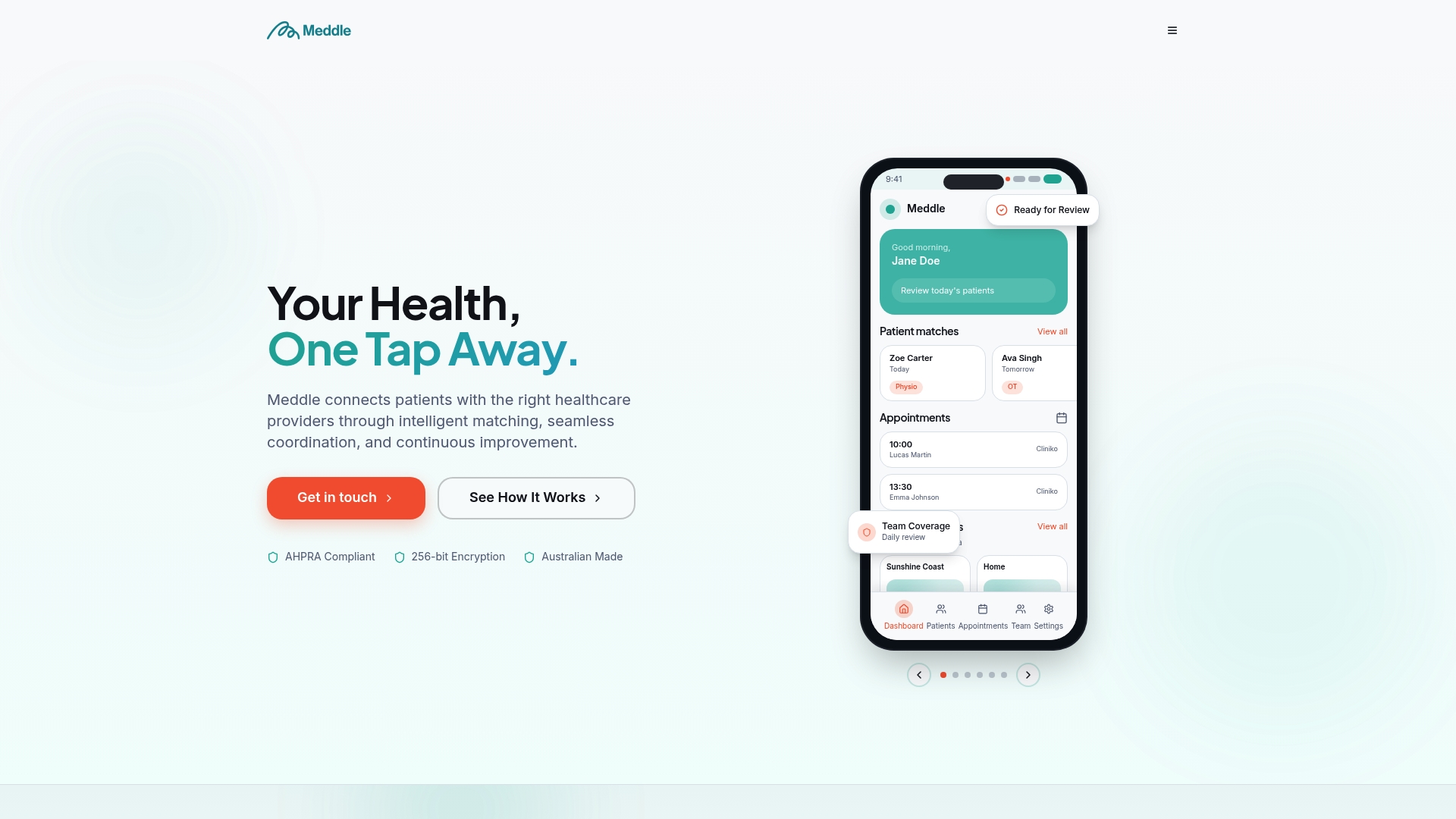
If you want to see how matching and booking fit your clinic, start with Meddle’s overview, or look at how patients find allied-health care. For referrers, there is a dedicated page for GPs and support coordinators. If online booking is part of your plan, our tips on increasing online bookings and booking page design are a good next step, and our instant booking workflow guide shows how the pieces connect. More on this theme sits under patient flow management.
FAQ
What is a good slot utilisation rate for a clinic?
There is no universal target. Published guidance suggests fill rates above 95% can signal staff stress and access problems, while rates well below 90% may indicate too few visits or too many missed appointments. Set your own baseline by clinician and appointment type, then watch the trend alongside waits and staff workload.
Should allied-health clinics overbook?
Start with other levers first. Reminders, patient choice of time, shorter booking horizons and fast waitlist refills recover capacity without putting clinicians behind. If you test overbooking, limit it to clinicians or days with consistently low utilisation and appointment types where running late has little clinical impact.
How many urgent slots should we hold?
Start small, a few per clinician each week, and adjust monthly based on use. If they are always taken, add more. If they are mostly released, cut the reserve and release unused ones to the waitlist 24 to 48 hours ahead.
How often should we review our templates?
Monthly is a good rhythm, using a Plan-Do-Check-Act cycle with one change at a time. Review sooner if a clinician joins or leaves, a service line changes or your wait times shift noticeably.
Sources
- Monash Health Centre for Clinical Effectiveness: Scheduling rapid review (2018)
- AAFP Family Practice Management: How to Use Scheduling Data to Improve Efficiency
- UTMB: Introducing DIMA dashboard (2023)
- Neurology: Using Data Analytics to Increase Neurology Access (2018)
- Medicare Benefits Schedule: Item 93000
- Medicare Benefits Schedule: Note MN.3.1
- Medicare Benefits Schedule: Note MN.9.2
- Australian Department of Health: Telehealth post-implementation review (2023)
- NDIS Pricing Arrangements and Price Limits 2025-26
- Central Coast Local Health District: Implementation of a New Booking System to Reduce No-Shows (2025)
Want to see how this works with your own referrals and calendars? Book a 30-minute demo and we will walk you through it.
Recommended
- 8–12 Patients in 90 Minutes: Group Appointment Scheduling for Clinics
- Clinics: Cut Missed Appointments up to 33.7% with SMS and Booking Fixes
- Waitlist Prioritisation in Allied Health: A Clinic Guide
- Best healthcare scheduling software for allied health clinics
This article is general information for healthcare businesses and isn’t legal, clinical or privacy advice. Check current requirements with the relevant regulator or a qualified adviser.