
Referral acceptance rules are the written criteria your clinic uses to decide whether to take a referral, send it back, redirect it or decline it. Under Medicare, acceptance is at the individual practitioner’s discretion, subject to anti-discrimination legislation. That means the rules are yours to write. This guide shows what to put in them: completeness checks, eligibility by funding pathway, triage, and how to record and communicate each decision.
TL;DR
- A referral is a request from a doctor or other health professional for expert help with diagnosis or treatment. Your rules decide which ones your clinic accepts.
- Check completeness first: referrer details, date, signature, reason for referral and relevant condition information. Medicare-funded services have specific requirements.
- Funding pathway changes the rules. Medicare, NDIS and private fee-for-service clients need different checks.
- Every decision, including a decline, should be recorded, and the referrer should be told when you can’t accommodate a request.
- Written rules applied consistently let reception and intake teams act without chasing a practitioner for each referral.
Table of Contents
- What counts as a referral
- Start with a completeness check
- Eligibility depends on the funding pathway
- Assess clinical suitability, urgency and capacity
- When a referral is incomplete, unsuitable or out of scope
- Record and communicate every decision
- Sample referral acceptance policy outline
- Where referral rules break down
- Our perspective
- Put your rules to work with Meddle
- FAQ
- Sources
What counts as a referral
Healthdirect describes a referral as a letter from a doctor or health professional to another health professional or service, to get expert help with diagnosis or treatment. For an allied health clinic, that covers a lot of ground in practice:
- A GP referral or a GP management plan, often sent as a letter, fax, email or through a secure messaging or eReferral system.
- A referral from a specialist, hospital discharge team or another allied health professional.
- A request from an NDIS support coordinator, plan manager or participant.
- A web form or phone enquiry from a patient who is referring themselves.
Not every pathway needs a formal referral. In Australia, patients can self-refer or pay privately for allied health services without a medical referral. NDIS participants also don’t generally need a formal referral for capacity-building supports, and they or their representatives can contact providers directly. Your rules should name each of these entry points, so that a self-referral and a GP letter are each assessed against the right checklist.
If you want a closer look at the GP side, our GP referral process guide walks through how these letters usually arrive and what clinics do with them.
Start with a completeness check
The first rule in any acceptance policy is also the simplest: is the referral complete enough to act on? For services covered by the Medicare Benefits Schedule, Note AN.15.6 says a referral must include the referring practitioner’s name, practice address or provider number, and the referral date. It must be written, signed and dated, and it must explain the reason for referral and relevant information about the condition.
Turn that into a front-desk checklist:
| Check | What to look for | If missing |
|---|---|---|
| Referrer identified | Name, practice address or provider number | Contact the referring practice |
| Date | Referral date present and legible | Request a corrected copy |
| Signed | Signature or valid electronic equivalent | Request a signed copy |
| Reason for referral | Clear request and relevant condition information | Ask the referrer for a clinical summary |
| Patient details | Name, date of birth, contact number | Contact the patient or referrer |
| Service type | Which profession the referral is for | Clarify before booking |
| Number of services | Where the pathway requires it | Ask the referrer to confirm |
The last row matters because Medicare requirements vary by service group. Some groups have additional referral requirements, and some referrals must state the number of services in the course of treatment. Check the current note for the services your clinic bills, and keep your checklist aligned with it.
One profession per referral
A common intake mistake is treating one referral as a pass to several disciplines. Medicare requires separate, specific referrals for each distinct allied health professional type, and one referral cannot be used to access multiple different professional services. A multidisciplinary practice should state this in its rules: a physiotherapy referral does not open an occupational therapy or dietetics booking.
Validity periods
For patients with chronic conditions under the M3, M10 and M11 items, a referral is valid for the stated period or, if none is stated, 18 months from the first service. Build an expiry check into your rules, so that rebooking staff see when a patient needs to return to their GP for a new referral.
Eligibility depends on the funding pathway
A referral can be complete and still not fit the pathway the patient hopes to use. Your rules should ask early which pathway applies, because the evidence you need differs.
Medicare and chronic disease management
A GP chronic condition management plan can give a person with a chronic health condition and complex care needs access to Medicare-rebated allied health visits. Your intake rule is to confirm that the referral names the right service type and that any required plan details are attached or referenced. Clinic staff should not make eligibility judgements. The GP and Medicare rules decide that.
NDIS
NDIS services depend on the participant’s plan and goals. The NDIA notes that information about functional impact is usually best provided through a functional assessment completed by an allied health professional. For your rules, that means asking for the plan details, the funding category and the plan manager or support coordinator contact before accepting. Your documentation habits matter too, and our guide to NDIS documentation compliance covers what to keep on file.

Private fee-for-service
Private clients don’t need a funding body or a referral, but they should check their private health policy cover and annual limits. A practical rule: tell private clients your fee, your cancellation terms and what they will need to claim from their fund before the first appointment. If you take bookings online from private clients, a clear page helps, much like this explainer on booking physiotherapy online shows how private bookings can be laid out for patients.
Assess clinical suitability, urgency and capacity
Once a referral is complete and the pathway is clear, the clinic decides whether it can help. Three questions sit behind most acceptance decisions.
- Is it within our scope? Does a practitioner here treat this condition, age group or complexity? Name the conditions and populations you do and don’t take.
- How urgent is it? Define your own categories, for example urgent, priority and routine, with the signs that place a referral in each and the target time to first contact.
- Can we actually see this person? Check practitioner availability, appointment type (clinic, home visit or telehealth) and travel radius.
Write each of these as a short list that a non-clinical team member can apply, with a clear point at which they escalate to a practitioner. Escalation triggers might include a mental health risk flag, a post-surgical timeframe, or a request outside your listed services.
Match on specialty, radius and appointment type
The best-run clinics treat acceptance and allocation as one step. A referral that is accepted but sits unallocated for days is a lost lead in practice. Your rules should say which practitioner types handle which referrals, how far they travel, and which appointment types they offer. Our guide to provider selection criteria sets out the factors referrers tend to weigh, which is a useful lens for writing your own.
Restricting bookings by referral
Some clinics only book certain services once a referral is on file. If that’s your model, say so on the booking page and in your rules. Our article on how to restrict bookings by referral covers the setup and the privacy principles involved.
When a referral is incomplete, unsuitable or out of scope
This is where most clinics have no written process, so staff improvise. Set a standard response for each of three cases.
Incomplete
Contact the referrer, not just the patient, and name exactly what is missing. Use a template email or message that lists the gaps from your checklist. Set a follow-up window, for example one reminder, then close the referral as incomplete and tell the patient. Western Health, for instance, states that referrals lacking sufficient detail for triage are returned with a request for more information, which is a reasonable model for a clinic of any size.
Unsuitable or out of scope
If the clinic can’t meet the need, say so quickly. Where appropriate, suggest the type of service that could help, such as another discipline or a service closer to the patient. Remember the patient can take the referral to any eligible professional of the same type. A fast, courteous decline protects the patient’s time and your relationship with the GP.
At capacity
Capacity is a legitimate reason to decline or to waitlist. Decide in advance which you do, how long the waitlist runs, and who tells the patient. Whatever you decide, apply it consistently, because acceptance is at the practitioner’s discretion but subject to anti-discrimination legislation. Write your criteria around clinical suitability, scope and capacity, and not around characteristics of the patient.
Record and communicate every decision
Under the MBS guidance, providers should keep adequate and contemporaneous records. If a referral isn’t accepted after being presented to the practice, the guidance says to inform the referring practitioner. Make both steps part of your rules.
For each referral, record:
- Date and channel received (letter, email, web form, eReferral, phone)
- Referrer and funding pathway
- Completeness outcome and anything requested
- Triage category and who assigned it
- Decision: accepted, waitlisted, redirected or declined, with the reason
- Date the referrer and patient were informed
- Practitioner allocated and first appointment date
This record does two jobs. It shows you met your obligations, and it shows you where referrals stall. If most delays occur at the “missing information” step, your referrer templates need work. Sharing a referral template for GPs and coordinators cuts incomplete submissions at the source.
Sample referral acceptance policy outline
Use this as a skeleton and adapt each line to your services.
- Purpose and scope: which services and locations the policy covers.
- Accepted sources: GP, specialist, hospital, other allied health, NDIS support coordinator, self-referral.
- Minimum information: the completeness checklist above.
- Pathway checks: Medicare, NDIS, DVA, private, with the extra document for each.
- Triage categories: definitions and response times.
- Scope and exclusions: conditions, ages and complexity you do not take.
- Capacity: how waitlists work and who approves exceptions.
- Incomplete or declined referrals: template messages, follow-up window, who sends them.
- Records and communication: what is logged, where, and who is told.
- Review: who reviews the policy and how often, for example every six months or when funding rules change.
Where referral rules break down
Three patterns come up again and again in clinics with referrals arriving from several channels.
- Referrals live in inboxes. When letters, emails and web forms land in different places, no one sees the full queue. One intake queue with consistent fields fixes most of this.
- Decisions depend on who is at the desk. Without written rules, the same referral gets different outcomes on different days.
- No loop back to the referrer. GPs who never hear back stop sending referrals. A short, prompt update builds trust, and our guide to GP and allied health coordination explains what referrers value. If you want to build these relationships deliberately, see our notes on referral networks for allied health clinics.
Our perspective
Most referral problems we see are not clinical. They are process problems: a referral arrives in the wrong place, a field is missing, nobody owns the next step, and a person who needed care waits.
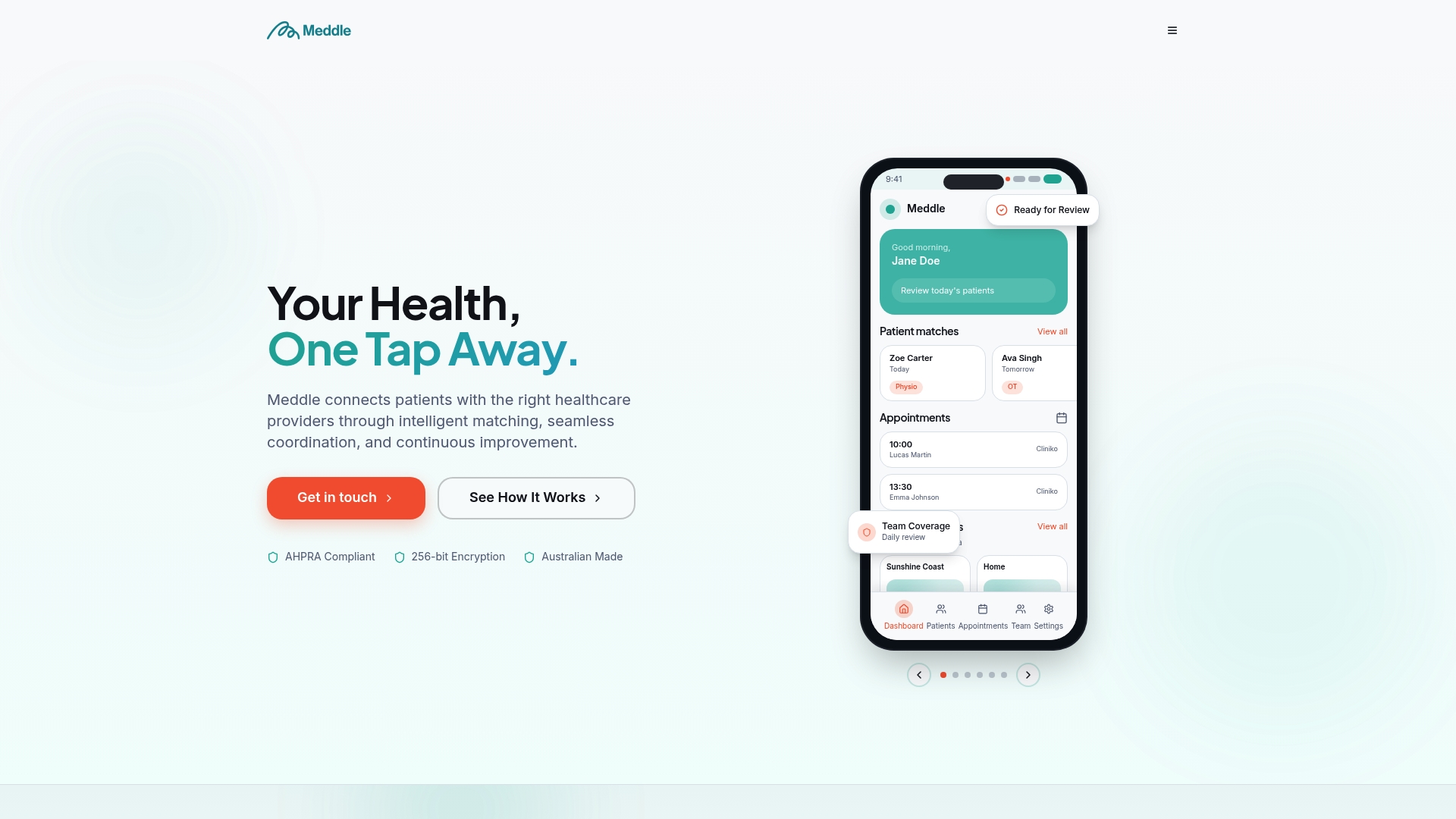
We built Meddle to turn referrals from GPs, email and web forms into structured intake, triage and practitioner matching on specialty, travel radius and appointment type. Your acceptance rules become the logic the intake follows, so reception teams apply them the same way every time, and practitioners see referrals that are ready to act on.
Directories list who is out there. We focus on the person, and on carrying their story forward so they don’t have to repeat it at every step. Good rules and a good intake flow make that possible, and they free your team for the work only people can do.
Taylor
Put your rules to work with Meddle
Meddle is software for allied health clinics that structures referral intake, triage and practitioner matching, and integrates with your practice management system and writes back to your CRM. Patient data is hosted in Sydney. There is no minimum spend and a free 30-day pilot, so you can see how your own acceptance rules run on real referrals.
If you want to see how it fits your clinic, explore how Meddle matches patients to care or look at how referrers use our referral page for GPs and support coordinators.
FAQ
What are the three types of referrals?
There is no single official list, but clinics usually sort referrals into three groups: GP or medical referrals (including management plans), referrals from other health professionals or hospitals, and self-referrals or NDIS participant requests. Each needs a slightly different completeness and eligibility check.
What should be included in a referral?
For Medicare-covered allied health services, the referral should be written, signed and dated, with the referrer’s name, practice address or provider number, the referral date, the reason for referral and relevant condition information. Some service groups also need the number of services stated. Check the current MBS note for your service group.
Does an allied health practitioner have to accept every referral?
No. Acceptance is at the individual practitioner’s discretion, subject to anti-discrimination legislation. If you can’t accommodate a referral that was presented to your practice, tell the referring practitioner.
Can one referral be used for several allied health professionals?
Not under Medicare. Each distinct allied health professional type needs its own referral, so a multidisciplinary clinic should request a separate referral for each discipline.
Sources
- What is a referral? (healthdirect)
- Access to allied health services (Allied Health Professions Australia)
- Note AN.15.6, Medicare Benefits Schedule
- Note MN.10.2, Medicare Benefits Schedule
- Accessing the NDIS: a guide for mental health professionals (NDIS)
- How to refer (Western Health)
Ready to see it on your own referrals? Book a 30-minute demo.
Recommended
- GP Referral Process in Australia: A Guide for Allied-Health Clinics
- Australian clinics: Restrict bookings by referral and meet three APPs
- Referral Networks for Allied Health Clinics | Australia
- Referral analytics for allied health: a practical playbook
This article is general information for healthcare businesses and isn’t legal, clinical or privacy advice. Check current requirements with the relevant regulator or a qualified adviser.