GP and Allied Health Coordination in Australia: A Practical Guide

Good coordination between a GP and an allied-health clinic comes down to four things: a complete referral, a fast acknowledgement, regular written reporting back, and clear roles for who owns what. Get those right and fewer referrals stall, patients repeat their story less often, and your front desk spends less time chasing missing details. This guide covers what Australian rules and official guidance expect, and how a multidisciplinary clinic can build a workflow around them.
TL;DR
- The GP is the primary care coordinator. Your clinic’s job is to receive, triage and report back in a way the GP can act on.
- A valid Medicare referral is written, signed, dated and states the reason for referral. Incomplete referrals are the most common cause of delay.
- For chronic condition referrals, send a written report to the GP after the first and last service, or sooner if clinically necessary.
- Share only the information the care team needs, and explain to patients who is in the team.
- A written intake and triage standard, plus secure messaging with delivery receipts, makes the loop trackable.
Table of Contents
- What GP and allied health coordination involves
- What a complete GP referral contains
- Medicare chronic condition referrals: rules your team should know
- Acknowledging, triaging and following up referrals
- Communicating progress, results and changes
- Consent and privacy when you share information
- NDIS referrals and support coordination
- Building a referral workflow for a multidisciplinary clinic
- Our perspective
- How Meddle supports GP referral coordination
- FAQ
- Sources
What GP and allied health coordination involves
The Department of Veterans’ Affairs treatment cycle guide puts the client at the centre and names the GP as the primary care coordinator. It also says GP and allied-health communication should happen at the start of treatment, when the condition changes or a new condition arises, and when further treatment is needed. That is a useful rhythm for any patient, not only veterans.
The RACGP’s shared care model, written for complex chronic conditions, describes what makes coordination work: jointly agreed responsibility among providers, the patient and their carers, clearly defined roles, structured management plans, prompt communication channels and better information exchange. The same document lists the barriers: poor communication, unclear roles, limited direct-referral pathways, inadequate information exchange and a lack of continuous coordination.
For a clinic, that translates into three practical questions:
- Who in our clinic receives and checks each referral?
- How quickly does the referrer hear that we have it, and what we decided?
- When and how do we report back?
If you cannot answer all three in one sentence each, that is where to start.
What a complete GP referral contains
The Medicare Benefits Schedule sets out what a referral must include. For covered referrals, the MBS referral note says to include the referring practitioner’s name, practice address or provider number, the referral date, and the reason for referral, including condition information the practitioner considers necessary. It must be in writing, signed (an electronic signature is acceptable) and dated.
Two details matter for allied-health intake:
- Chronic condition referrals need not name a specific provider or state the number of services.
- Better Access psychological therapy referrals should state the number of services and carry additional requirements.
For mental health, Services Australia lists what a Better Access referral should include: the patient’s name, date of birth and address, symptoms or diagnosis, current medications, the number of treatment services, and whether a Mental Health Treatment Plan or Psychiatrist Assessment and Management Plan has been prepared.
The National Allied Health Practice Engagement Toolkit recommends referral templates that hold the necessary clinical and demographic information, and points to secure messaging and e-referrals as ways to improve access and coordination across primary, acute and community care.
If you want referrers to send you what you need the first time, give them a template. We publish allied health referral templates for GPs and coordinators, and our guide to the GP referral process in Australia walks through the steps from the clinic’s side.
A quick intake check
When a referral lands, a receptionist or intake officer can check it against a short list:
- Patient name, date of birth, address and contact number
- Referrer name and provider number or practice address
- Referral date, signature and the reason for referral
- Funding pathway: Medicare chronic condition plan, Better Access, NDIS, DVA, private or other
- Number of services (where required), and any relevant medications or assessments
- Urgency and any access needs, such as an interpreter or home visit
Anything missing goes back to the referrer in one request, not several.
Medicare chronic condition referrals: rules your team should know
Since the GP Chronic Condition Management Plan (GPCCMP) replaced the earlier management plan and team care arrangement items, referrals to allied health are made by letter. The Australian Physiotherapy Association notes that patients can receive up to five Medicare-supported allied health services in a calendar year (ten for Aboriginal and Torres Strait Islander patients), and that patients can choose any allied health practitioner.
Services Australia’s guidance for GPCCMP referrals adds several points that affect your workflow:
- The GP or prescribed medical practitioner decides whether the patient’s condition would benefit from allied-health services. Allied-health providers must not pre-empt that decision or hand the GP a partly completed referral to sign.
- The referral may state a timeframe. If it does not, it is valid for 18 months from the date of the first service provided under it.
- You must send a written report to the referring GP after the first and last service, or more often when clinically necessary.
That last point is where many clinics lose the thread. Build report-back into the booking, not into somebody’s memory. When the first appointment is scheduled, schedule the report task with it.
Acknowledging, triaging and following up referrals
NSW Health’s outpatient services guideline is written for public services, but its standards are a good benchmark for any clinic. It expects referrals to be screened efficiently on receipt, patients and referrers to be told in writing that the referral was received and what the triage outcome was, alternative care options to be communicated when a referral is redirected or not accepted, and communication with the referrer to be documented throughout the episode of care.
A private allied-health clinic can adopt the same four habits:
- Acknowledge every referral the same day it arrives, to both patient and referrer.
- Triage against clear criteria: specialty, urgency, funding, location and appointment type.
- Decide and say so. If you cannot take the patient, say that promptly and suggest another route so the patient is not left waiting.
- Record every contact with the referrer against the patient file.
The matching step is where multidisciplinary clinics often slow down. A physio referral for a patient 40 kilometres away who needs a home visit is not the same as one for a patient around the corner who prefers telehealth. Matching on specialty, travel radius and appointment type, rather than on whoever has a free slot, protects your practitioners’ time and the patient’s patience.
Communicating progress, results and changes
The Department of Health and Aged Care’s 2023 research on allied-health information sharing found that clinicians prioritised information about treatment provided, treatment plans, progress, goals and assessments. It also found gaps in diagnostic results, instructions, referrals to complementary services and practical advice.
That gives you a sensible structure for a report to a GP:
- What we assessed and found
- What treatment we provided
- Progress against the patient’s goals
- Recommendations for future management
- What we need from you, if anything
For GPCCMP-referred services, Services Australia says the report should cover investigations, tests and assessments, treatment provided, and recommendations for future management. Keeping to one page makes it more likely to be read.
Secure channels and closed loops
The Australian Digital Health Agency explains that secure messaging encrypts clinical documents and routes them between registered messaging providers and clinical systems. It generates an alert when delivery succeeds. Commonly supported documents include referrals, reports, pathology, radiology, discharge summaries and allied-health consultation reports.
Delivery receipts matter because they turn a one-way message into a tracked one. You can see whether the GP’s practice received your report, and your intake team can see whether an acknowledgement went out. Our secure patient messaging checklist and our piece on messaging GPs securely cover how to set this up and test it. For the state and system gaps GPs face with electronic referrals, see our guide to eReferral systems in Australia.
The phone still carries a lot of referral traffic, too. If your front desk is stretched, a clear approach to managing incoming patient calls keeps urgent referrer queries from getting lost between appointments.
My Health Record is another channel. The Agency describes it as a secure online summary of key patient health information that healthcare providers can access and add to. See our overview of My Health Record compliance for what providers need to consider.

Consent and privacy when you share information
The OAIC’s guidance says health information may be used or disclosed for its primary purpose. Sharing within a treating team may be reasonably expected once you have explained who is in the team and what information will be shared. Disclose only the minimum necessary, and seek consent where a patient has expressed concern about sharing with a particular team member.
On consent itself, the OAIC says valid express consent must be informed, voluntary, current and specific, given by a person with capacity, and can be withdrawn at any time. Implied consent may be reasonable for communications about an established care plan, results, recalls and follow-up when the patient’s agreement is clear from the context.
In practice:
- Tell new patients at intake which providers may be involved and what will go to their GP.
- Record a patient’s concerns about sharing, and respect them.
- Send the minimum a GP needs to act, not the whole file.
- Keep access to records limited to those who need them.
The RACGP’s privacy guidance reminds general practices that they must protect patient health information and comply with the applicable Australian privacy framework. Allied-health clinics hold the same kind of information, so the same discipline applies. Our checklist on securing patient records and meeting APP 11 is a practical place to begin.
NDIS referrals and support coordination
NDIS work adds another layer. The NDIS guide for GPs says GPs and other health professionals can support an access request by documenting permanent or likely permanent disability and providing reports or assessments that describe diagnosis and functional impact. After access is granted, a Local Area Coordinator or support coordinator can help the participant select providers, develop service agreements and understand expenditure. Supports must be reasonable and necessary and related to the participant’s disability.
On the provider side, the NDIS says allied-health providers deliver therapeutic supports and supply evidence, assessments and reports that inform access and planning decisions. Its guidance covers NDIA-managed, plan-managed and self-managed participants.
For your intake team, that means asking early:
- Who is the participant’s support coordinator, and are they the referrer?
- How is the plan managed?
- What assessment or report is the referral for?
- Which practitioner has the right specialty and capacity, and can they travel or offer telehealth?
For families looking for therapy, our autism allied health pathways page shows how OT, speech and behaviour supports fit together. Support coordinators referring clients can start at our referrer page.
Building a referral workflow for a multidisciplinary clinic
The RACGP recommends formal shared-care protocols that specify responsibilities, monitoring and follow-up frequency. A clinic can apply that to GP referrals in five steps.
- Standardise what you ask for. Publish one referral template and link it from your website and email signature.
- Funnel every channel into one queue. Referrals arrive by GP letter, email, web form and phone. Capture each in the same structured format so nothing sits in a personal inbox.
- Triage with written criteria. Specialty, urgency, funding pathway, travel radius and appointment type. Decide who may accept, redirect or escalate.
- Set response times. Same-day acknowledgement, a defined target for the triage decision, and a named person responsible.
- Automate the report-back. Create the GP report task when the first appointment is booked, and another at discharge or the final service.
Then review monthly: how many referrals arrived, how many were incomplete, how long triage took, and how many converted to a first appointment. Those are your own figures, and they show where leads leak.
Building relationships matters as much as process. Our guides to referral networks for allied-health clinics and to building specialist networks with PHNs cover how to become the clinic a GP trusts with a complex patient.
Our perspective
Most referral problems we see are not clinical. They are handover problems: a form missing a field, an email nobody picked up, a patient who lives outside any practitioner’s travel radius, a report that never went back.
That is why we built Meddle around the person being referred, not the business listing. Directories list who is out there. We turn referrals from GPs, email and web forms into structured intake, triage and practitioner matching on specialty, travel radius and appointment type, so clinics lose fewer leads and spend less time on admin.
We believe a clinic that standardises intake and closes the loop with referrers earns more referrals, because GPs send patients where the handover is easy. Our platform is designed to make that the default, not an extra task for your busiest person.
Taylor
How Meddle supports GP referral coordination
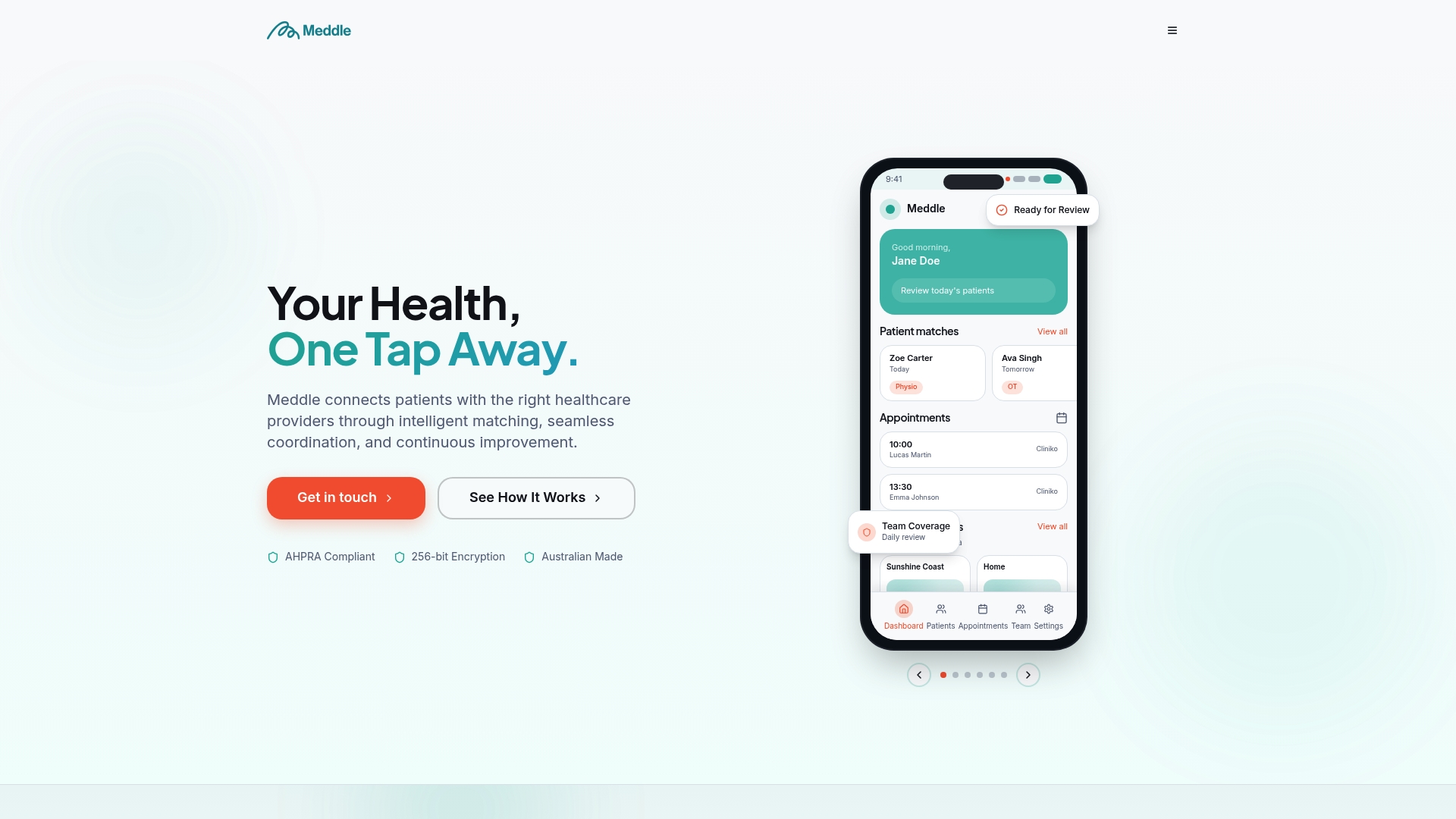
Meddle is Australian software for allied-health clinics. It brings referrals from GPs, email and web forms into one structured intake, then triages and matches patients to practitioners. It integrates with your practice management system and writes back to your CRM. Patient data is hosted in Sydney.
Pricing is A$40 per practitioner per month ex GST for Core. You can add Appointments (+A$20 a month, including a shared diary) and Telehealth (+A$10 a month). There is no minimum spend and a free 30-day pilot. Explore how patients and referrers find care through Meddle’s find care pages, or see how our practice management tools fit alongside intake. To see it working with your referral volume, book a 30-minute demo.
FAQ
Who is responsible for coordinating care between a GP and an allied-health provider?
The GP is generally the primary care coordinator, with the patient at the centre. The allied-health provider is responsible for acknowledging the referral, delivering treatment and reporting back. For complex cases, agree roles in writing at the start.
What should an allied-health clinic send back to the referring GP?
For GPCCMP-referred services, send a written report after the first and last service, or more often when clinically necessary. Cover tests and assessments, treatment provided, and recommendations for future management. Keep it short and specific so the GP can act on it.
Can a patient choose their own allied-health provider?
Yes. For chronic condition referrals the referral need not name a provider, and the patient can choose any allied-health practitioner. Your clinic can help by making its specialties, locations and appointment types easy to find.
How long is a GP chronic condition referral valid?
It may state a timeframe. If it does not, Services Australia says it is valid for 18 months from the first service under the referral. Confirm the current rules on the Services Australia page before booking a long course of treatment.
Sources
- Guide to the treatment cycle for GPs and allied health, DVA
- Shared Care Model between GP and non-GP specialists, RACGP
- Note AN.15.6, Medicare Benefits Schedule
- Allied health referrals for mental health treatment services, Services Australia
- National Allied Health Practice Engagement Toolkit
- Changes to Medicare chronic disease management, Australian Physiotherapy Association
- Allied health and other primary health care referrals for GP chronic condition management plans, Services Australia
- Management of Outpatient (Non-Admitted) Services, NSW Health
- Exploring Allied Health Information Sharing, Department of Health and Aged Care
- Secure messaging, Australian Digital Health Agency
- My Health Record for healthcare providers, Australian Digital Health Agency
- Using or disclosing health information, OAIC
- Communications with patients, OAIC
- Privacy and managing health information, RACGP
- A GP and Health Professional’s guide to the NDIS
- Allied health providers, NDIS
Recommended
- GP Referral Process in Australia: A Guide for Allied-Health Clinics
- Attracting & Retaining New Patients | Allied Health Australia
- Build Australian Allied Health Specialist Networks With PHNs
- Referral Networks for Allied Health Clinics | Australia
This article is general information for healthcare businesses and isn’t legal, clinical or privacy advice. Check current requirements with the relevant regulator or a qualified adviser.