Build Australian Allied Health Specialist Networks With PHNs

Start with a small cohort of complementary clinicians, and formalise how you work together through your local PHN and secure digital systems. Today, decide your clinical scope, contact your PHN, and draft a referral template with a consent line built in. That sequence gets a specialist network in Australia working faster than any broad recruitment drive.
TL;DR:
Use your PHN and association directories to shortlist three to five candidates per discipline, then test fit through case reviews and a few referrals.
Document patients’ expectations in notes, use secure messaging rather than email, and obtain formal consent if a patient objects to sharing with a practitioner.
Include clinical summaries, urgency, red flags, and relevant reports in referral forms; agree who acknowledges referrals, when clinicians report back, and how concerns escalate.
Track referral volume, response time, appointment uptake, missed appointments, and patient outcomes monthly using practice data and a simple spreadsheet.
Treat AI matching as a filter, keep practitioner profiles current, and have a coordinator confirm fit before booking or expanding beyond a pilot cohort.
Table of Contents
-
How do you serve different regions and communities equitably?
-
An editorial view: small, tested and consented beats big and loose
Who should you recruit first?
Recruit around the patients you already see, not the disciplines you wish you had. If most of your caseload is chronic conditions, post-operative rehab, paediatrics or aged care, pick the specialists those patients need next.
For most clinics, the strongest starting pool is:
-
Physiotherapists and exercise physiologists for movement, strength and rehab
-
Occupational therapists for function at home, work and school
-
Psychologists for the mental health side of chronic conditions
-
Speech pathologists and dietitians for communication, swallowing and nutrition
-
Podiatrists for foot health, especially with diabetes and aged care
Do not forget the non-clinical roles. A practice manager, referral coordinator or care coordinator keeps messages moving and chases outcomes, and without one a network quietly stalls.
The scale of the workforce helps you here. Government research on allied health information sharing counts over 200,000 allied health professionals in Australia, so you are choosing, not scrambling. Keep the first group small enough that everyone knows everyone.
Where do you find specialists in Australia?
The best channels are local and structured. Primary Health Networks (PHNs) sit at the centre of them. PHNs have released the National Allied Health Practice Engagement Toolkit, which helps practices connect with their local PHN, join Communities of Practice and move from ad-hoc networking to proper referral pathways. Optometry Australia’s summary notes it also points to local education and funding opportunities.
Peak bodies are your second channel. Associations such as the Australian Physiotherapy Association run national groups, events and searchable directories, and Indigenous Allied Health Australia lists professional associations that offer education and networking. Local CPD nights, hospital outreach sessions and regional clinical meetings let you meet people before you refer to them.
Here is an outreach sequence that works:
-
Shortlist three to five candidates per discipline from PHN contacts and association directories.
-
Send a tailored introduction email with your referral template attached.
-
Invite each person to a case-review session.
-
Agree a trial of a few referrals before anything is formalised.
What do privacy and digital systems require?
Privacy comes before volume. Health providers of nearly every size are covered by the Privacy Act 1988, and the OAIC explains what counts as a health service provider, including allied health professionals and online health services.
The OAIC’s guidance on using or disclosing health information separates primary purpose (delivering the care) from secondary purpose. A referral to another treating clinician is usually within what a patient reasonably expects, but you should document that expectation. If a patient objects to sharing with a particular practitioner, obtain formal consent first.
State and territory rules differ. The Digital Health guidance on referral systems links to jurisdictional referral and privacy requirements, so check yours during setup.
A short technical checklist:
-
Confirm your software can connect to My Health Record
-
Use secure messaging for every referral, never ordinary email
-
Record consent and patient expectations in the clinical notes
-
Keep a named register of each patient’s treating team
-
Review our secure patient messaging checklist before go-live
Pro Tip: Add one plain-language line to your intake form, such as “We may share your information with other clinicians involved in your care”, and have the patient initial it.
How do you set up governance and referral workflows?
Governance sounds heavy, but a one-page agreement does most of the work. Policy reviews such as the Scope of Practice Review point to stronger clinical governance in primary care and digital tools to support referrals, and a small network can adopt that thinking from day one.
Your referral template should capture:
-
Patient demographics and contact details
-
Reason for referral and a brief clinical summary
-
Urgency and any red flags
-
Relevant attachments, such as imaging or reports
Then agree the rules of the road:
-
Who receives referrals, and how quickly they acknowledge them
-
When the specialist reports back and how the referrer is updated
-
A data-sharing agreement, a meeting cadence and an escalation path
Our guide to referral partnerships for allied health clinics goes deeper on structuring these arrangements. Keep the document short enough that people actually read it.
How do you onboard members and keep them engaged?
Make onboarding concise and focused. Engagement is where networks usually fail, so build the rhythm early.
-
Send a welcome pack with your referral template, contacts and consent wording.
-
Hold an orientation meeting covering scope, workflow and response expectations.
-
Run a trial period of a handful of referrals each, then review what worked.
-
Hold regular case-review meetings, ideally monthly.
-
Close the loop with quick electronic feedback on every referral outcome.
Co-hosting a CPD session is one of the cheapest ways to keep people involved, because clinicians need the hours anyway. Lean on PHN and association events too: Communities of Practice give you a steady stream of new recruits and a reason to keep meeting. Our practical guide on building a referral network includes outreach templates you can adapt.
How do you measure results and fund growth?
Track a few numbers well rather than many badly. The core set is referral volume, response time, appointment uptake, no-show rate and patient-reported outcomes.
-
Export referral and appointment data from your practice management system each month
-
Keep a simple spreadsheet with one row per referral
-
Add lightweight analytics later, following our referral analytics playbook
-
Review the trends with the network at each case-review meeting
On funding, start with your PHN, which may know of local grants and engagement programs. The National Allied Health Digital Uplift Plan consultation outlines a phased national approach to lifting allied health digital capability, including My Health Record integration. The Department of Health also describes allied health workforce programs, including rural pathways and incentives, that can support network growth outside the cities.
How should you use AI-powered matching well?
AI matching works best as a first filter that a person then confirms. It can weigh a patient’s symptoms, preferences and location against practitioner availability far faster than a phone list, but a clinician or coordinator should still check the fit before a booking is confirmed.
A few practices make the difference:
-
Start with clean data. Matching is only as good as practitioner profiles, so keep scope, locations, languages and availability current.
-
Keep a human in the loop. Let coordinators override a suggested match, and log why. Those overrides show where the logic needs tuning.
-
Protect privacy by design. Any platform handling health information falls under the same OAIC obligations described above, so confirm how it stores data, records consent and limits access.
-
Pilot before you scale. Run matching on one cohort, such as post-surgical rehab, and compare uptake and no-show rates with your manual process.
-
Use it alongside your network, not instead of it. Matching should route patients to the specialists you already trust, which is why the governance work above comes first.
Experts at ANZCA have argued for moving beyond GP-centric referral models towards platforms that support direct referral pathways and reduce administrative burden. That aligns with how matching tools are best used: to shorten the path to the right specialist, while the network supplies the clinical judgement.
How do you serve different regions and communities equitably?
Australia is not one market, and a network built for a metropolitan suburb will not serve a remote community unchanged. Build equity into the design rather than adding it afterwards.
For regional and remote areas, recruit across modes of care. Telehealth, visiting clinicians and shared case reviews can stretch a thin local workforce, and the Department of Health’s allied health workforce programs include rural pathways and incentives that may help you attract practitioners. Your PHN will know which communities have gaps.
For cultural diversity, widen your recruitment. Include practitioners who speak community languages, and for First Nations communities, connect with bodies such as Indigenous Allied Health Australia to understand culturally safe practice and partnerships.
Practical steps:
-
Record language and cultural preferences in your referral template
-
Offer interpreter access and flexible appointment formats
-
Review uptake and no-show rates by region and community to spot who is missing out
-
Ask local services where patients struggle most, then recruit to fill those gaps
An editorial view: small, tested and consented beats big and loose
The networks that stall tend to share a pattern: they recruit widely, write a long agreement nobody reads, and measure nothing. The ones that work start small, test the template on a few referrals, track three numbers and adjust monthly.

A typical early win looks ordinary. A clinic standardises its referral template, and the back-and-forth of chasing missing details drops sharply, freeing a coordinator’s afternoon. Nothing about that is glamorous, and it is exactly what makes the network worth keeping.
Privacy and consent are the foundation, not the paperwork. A patient who trusts that their information goes only where it should is a patient who accepts referrals readily.
— Taylor
How Meddle helps you set up faster
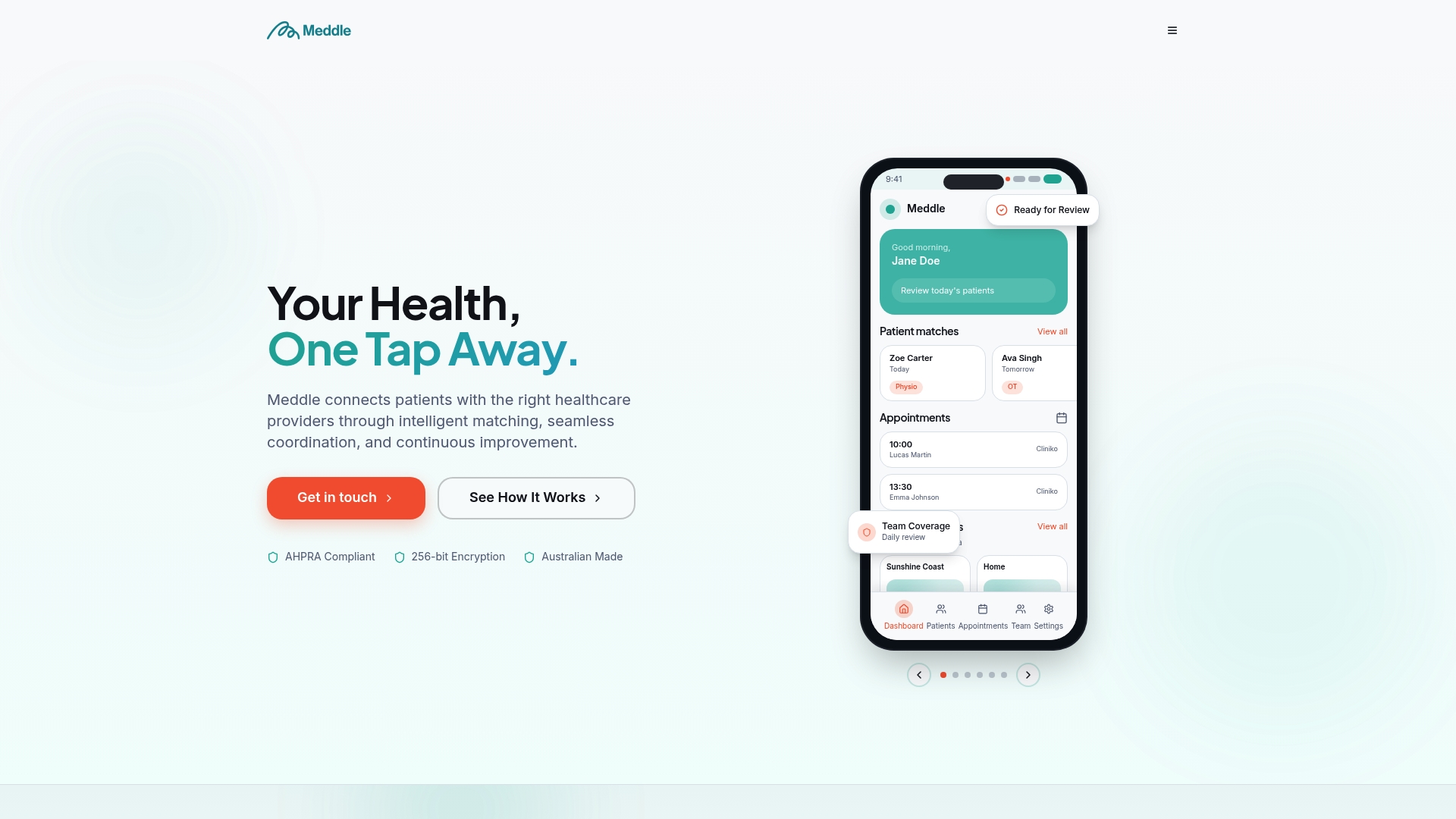
We built Meddle to take the matching and admin load off the network you are creating, using AI-assisted matching with privacy measures designed for Australian clinics. Our platform offers:
-
AI-powered matching of patients to practitioners
-
Referral routing based on the capacity each clinician has shared, with the clinic confirming the booking
-
Secure coordination between clinicians
-
SMS and email notifications included, from $40 per practitioner per month (ex GST, $250 monthly minimum), with CRM integration as a price-on-application add-on
See how Meddle works, explore the patient pathways on our find care page, then ask us about pilot access for your clinic.
This article is general information, not a substitute for advice from a qualified doctor. Consult a qualified healthcare professional about your own circumstances before acting on anything here.
FAQ
How many specialists should a new network start with?
A small group of complementary clinicians is a manageable starting size. A small group makes it easier to test your referral template, hold regular case reviews and see quick results before you expand.
Do I need patient consent to refer within a network?
Sharing information with the clinicians treating a patient is often within the patient’s reasonable expectations under OAIC guidance. Document that expectation, and obtain formal consent if a patient objects to disclosure to a particular practitioner.
Where is the best place to find specialists in my region?
Start with your local PHN and the National Allied Health Practice Engagement Toolkit, then check professional association directories. Local CPD events and regional clinical meetings let you meet candidates in person before you refer.
What should I measure first?
Track referral volume, response time, appointment uptake, no-show rate and patient-reported outcomes. A monthly export from your practice management system and a simple spreadsheet are enough to start.