
Real-time appointment availability means that the slots a patient, referrer or intake coordinator sees are the slots that are actually free right now, for the right practitioner, appointment type and location. It only works when availability is tied to the referral and intake process, not just to a diary. That is what Meddle is built for: it turns referrals from GPs, email and web forms into structured intake, triage and practitioner matching on specialty, travel radius and appointment type, so clinics lose fewer leads and spend less time on admin.
This guide explains what live availability involves in an Australian allied-health clinic, how to keep it accurate, how to handle waitlists and urgent referrals, what privacy rules apply, and how to measure whether it is working.
TL;DR
-
Real-time availability is a filtered view of free slots (by discipline, practitioner, appointment type and location), not a raw diary export.
-
It stays accurate only when bookings, changes and cancellations update one source of truth, and when waitlists are reviewed regularly.
-
It is most useful when it sits inside the referral flow: referral in, triage, match, offer a slot, book.
-
Health information, including appointment details, attracts extra protection under the Privacy Act 1988, so access control matters as much as speed.
-
Measure it: no-shows, administrative contacts per booking, time to first appointment and billable clinical time.
Table of Contents
What real-time availability means in an allied-health clinic
In a GP clinic, availability is usually simple: a doctor, a 15-minute slot, a clinic address. Allied health is more layered. A new referral for a child with feeding difficulties needs a speech pathologist or dietitian with paediatric experience, an initial assessment length rather than a standard review, and a location the family can reach. A slot only counts as available if it fits all of those.
So “real-time” has three parts:
-
Current. The slot has not been taken by another booking, a phone call or a cancellation made minutes ago.
-
Matched. The slot belongs to a practitioner whose specialty, caseload and funding pathway (NDIS, Medicare or private) suit the referral.
-
Bookable. The person looking at it can act on it: a patient can self-book, a referrer can request, or a coordinator can confirm in one step.
A clinic that shows a long list of open times without matching is still sending people back to the front desk. A clinic that matches without being current offers slots that vanish. You need both.
Why availability goes stale
Most clinics already have some form of online diary. The trouble starts when the diary is only one of several places where time gets committed:
-
Reception books a patient over the phone while the online view refreshes later.
-
A practitioner blocks time for admin, travel or a home visit in a separate calendar.
-
A cancellation arrives by text or email and nobody frees the slot.
-
A referral sits in an inbox with a verbal promise of an “early appointment”.
-
Group sessions or multi-appointment blocks are held but not shown as held.
Every gap produces one of two costs: a double-booking that someone must untangle, or an empty slot that was never offered. Our guides on appointment slot optimisation and multi-practitioner scheduling go deeper on how to lay out diaries so that live availability reflects reality.
How to keep displayed availability accurate
There is no trick here. Accuracy comes from a few disciplined habits and from software that enforces them.
One source of truth for time
Every booking, change, block and cancellation must write to the same schedule that the availability view reads from. Where the diary lives in your practice management system, the availability layer has to read from and update it. The Victorian Department of Health’s queue management and outpatient system integration principles describe appointment and queue tools as technologies that arrange appointments and manage queues, and note that they typically need to interface with, and automatically update, clinical, patient administration and billing systems. That is a public-hospital document, but the logic carries over to a private multidisciplinary clinic: if the scheduling tool cannot update the system of record, staff end up double-entering and the view drifts.
Meddle integrates with your practice management system and writes back to your CRM, so referral and lead activity is not left stranded in a separate tool.
Define what a slot is
Before going live, agree on slot rules and write them down:
-
Which appointment types can be booked online (initial assessment, review, telehealth) and which need coordinator approval.
-
How long each type runs, including buffer time for notes and travel.
-
Which practitioners accept which funding pathways.
-
How far ahead patients can book, and how late they can cancel.
Matching on appointment type is what stops a 60-minute assessment being offered in a 30-minute gap.
Free cancelled time quickly
A cancelled slot is only valuable while someone can still use it. Build a routine: the cancellation frees the slot, the waitlist is checked, and the first suitable person is offered it. Our guide to reducing patient no-shows covers the reminders and booking settings that make cancellations arrive earlier.

Review the waitlist on a schedule
Waitlists decay. People find care elsewhere, move, or change their mind, and a list full of stale names hides real demand. Monash Health states that where a clinic has very high demand and no appointments, patients are added to a wait list that is regularly reviewed to confirm patients still need an appointment, so openings can be offered to those still waiting. The Tasmanian Department of Health says it periodically contacts waiting patients by SMS with a link to an electronic form as routine waitlist auditing to keep details up to date.
A private clinic can adopt the same habit at small scale: a monthly pass over the waitlist, a short message asking “do you still need this appointment?”, and removal of anyone who no longer does.
Handling urgent referrals and waitlists
Live availability is not first come, first served. Some referrals should jump the queue, and the system has to let them.

Public outpatient services give a useful model for urgency tiers. Monash Health says it tries to provide an appointment within 30 days for urgent patients and within 365 days for non-urgent patients. Eastern Health states that patients needing an urgent consultation are offered an appointment within 30 calendar days, while routine patients are seen at the next available non-urgent appointment or placed on a waiting list. The Tasmanian Department of Health uses three categories: urgent referrals are accompanied by a phone call and it aims to see these patients within four weeks or sooner if clinically indicated; semi-urgent within 12 weeks; routine at the next available appointment (same Tasmanian page as above).
Your clinic’s timeframes will differ, and clinical urgency is for your practitioners to set. The workflow, though, is the same:
-
Capture the referral in a structured way, with the reason, the requested discipline, any stated urgency, funding pathway and location, so that urgency is visible rather than buried in free text.
-
Triage against a checklist. Our referral triage checklist is a starting point for the questions intake should settle before offering a slot.
-
Reserve capacity for priority cases, for example by holding a few early slots per week for urgent assessments.
-
Offer the first suitable slot, and set a time limit on how long it is held.
-
Record the outcome so that the next waitlist review is based on facts.
The practical point: a calendar alone cannot do step 1 or 2. Availability becomes useful when it is attached to a referral that already says what the person needs.
Connecting availability to referrals and intake
A clinic with a good diary and a messy referral inbox still loses people. Referrals arrive from GPs, by email, through web forms and sometimes by fax or phone. Someone reads each, decides who it suits, checks a diary, calls the family, and tries again if the first slot is declined. Every hand-off is a place where a lead goes cold.
HandinHand Mental Health & Disability describes a referral process that shows the sequence well: the referrer completes a short online form, the intake team acknowledges it, confirms the funding pathway (NDIS, Medicare or private), matches the client to a registered practitioner with the right scope and location, prepares service documents, confirms consent, books the first session and keeps the referrer informed with the client’s consent. Whatever your size, those are the steps real-time availability has to serve.
Here is where each part of the flow benefits from live availability:
| Stage | What intake needs | What live availability adds |
|---|---|---|
| Referral received | Structured details: discipline, urgency, funding, location | Shows at once whether any suitable capacity exists |
| Triage | Priority decision | Lets urgent cases be matched to held or earliest slots |
| Practitioner match | Specialty, travel radius, appointment type | Filters slots to practitioners who fit, not just who is free |
| Offer to patient | A realistic first appointment | Fewer “sorry, that’s gone” calls |
| Booking and confirmation | Consent, documents, reminders | Slot is locked and the diary updated |
| Feedback to referrer | Status update | Referrer sees progress without phoning |
Meddle matches on specialty, travel radius and appointment type, and it offers real-time availability lookup and instant appointment booking as part of one platform. The instant appointment booking workflow guide walks through how a booking moves from request to confirmed slot, and the patient self-scheduling guide covers what to let patients book themselves.
For referrers and support coordinators
GPs and support coordinators want two things: certainty that a referral has landed, and a rough idea of when the person will be seen. Live availability tied to intake lets a clinic answer both quickly. Practically, that means a referral that gets an acknowledgment, a named next step and an appointment offer, rather than a silence that prompts the referrer to try three other clinics.
For NDIS providers
NDIS clients add funding checks and service agreements to the booking. The slot is only useful once the funding pathway is confirmed and the practitioner can deliver the supports requested, so build those checks into intake before the slot is offered. Matching to the right practitioner first avoids rebooking a participant after discovering the first clinician was not the right fit.
Privacy and access control
Availability data looks harmless, but it is tied to people. The Office of the Australian Information Commissioner’s Australian Privacy Principles guidelines define health information to include appointment and billing details, and state that sensitive information, including health information, attracts additional protection compared with other personal information. A booking for a psychology appointment is health information, even before any clinical note exists.
What this means when you share availability:
-
Show slots, not stories. A public or referrer-facing view should show open times and practitioner type, never who holds the other slots.
-
Limit who sees what. Reception, practitioners, coordinators and admins need different views. Role-based access means a coordinator can see waitlist status without seeing clinical notes.
-
Keep an audit trail. Know who changed or cancelled a booking and when.
-
Know where data is hosted. Meddle hosts patient data in Sydney.
-
Check your software against the national standards. The Australian Digital Health Agency’s practice management software standards (updated May 2026) say such software must demonstrate adherence to the Privacy Act 1988 or relevant state or territory privacy legislation, and show it can meet mitigation strategies in line with the Essential 8 cyber security framework. Its enterprise scheduling standards add that scheduling software must respect a patient’s instruction not to upload scheduling information to My Health Record.
For the practical side of protecting records, our guide on securing patient records and meeting APP 11 sets out twelve steps, and the security questionnaire guide lists the questions to put to any software supplier. If you have a specific privacy question about your obligations, your legal adviser or the Office of the Australian Information Commissioner is the right place to confirm it.
Measuring whether it works
Live availability is a means, not a result. The results to watch are access, admin load and attendance. One Australian study gives a sense of what is measurable. Researchers at Central Coast Local Health District’s Gosford Hospital studied a new booking system with pre-emptive notification of a grace period in a public pain unit. In their November 2025 paper, no-shows fell from 27.12% to 11.93%, billable clinical time rose from 39.3 to 52.4 minutes, and mean administrative contacts fell from 1.4 to 1.15 for allied health appointments. That is one setting and one booking design, so treat the figures as an example of what to measure rather than a forecast for your clinic.
A simple scorecard for the first 90 days:
| Measure | How to capture it | Why it matters |
|---|---|---|
| Time from referral to first appointment | Referral date vs first booked date | Direct view of access |
| Referrals converted to booked appointments | Referrals received vs first sessions booked | Shows leads lost between inbox and diary |
| Administrative contacts per booking | Calls, emails and texts logged per appointment | Shows admin saved |
| No-show and late-cancellation rate | Diary status by appointment type | Shows attendance |
| Utilisation of released slots | Cancelled slots re-filled vs left empty | Shows whether live availability recovers time |
| Waitlist age | Days since each person joined, and share who still need care | Shows whether the list is healthy |
Take a baseline for four weeks before changing anything. Compare like with like: the same disciplines, the same weeks of the year, and the same appointment types. School holidays and end-of-financial-year periods move numbers on their own.
Perspective
We built Meddle around a simple observation: the person looking for care is not looking for a business, they are looking for the right person. A list of clinics with open times answers the wrong question.
Real-time availability matters most when it is the last step of a good match. The referral arrives, it is turned into structured intake and triage, the right practitioner is found on specialty, travel radius and appointment type, and only then is a slot offered. That order is what saves your team the phone calls.
It is also why we price it the way we do. Every user pays the same, including admins and coordinators, because the people who run intake are the people who make availability work. Everything is included, with no add-ons.
Taylor
What Meddle costs and how to try it
Meddle is A$40 per user per month ex GST, or A$400 per user per year ex GST, which is two months free. Every user pays the same, including admins and coordinators, and everything is included with no add-ons. You can start with a free 30-day pilot, so your team can see how referrals, matching and live slots work together with your own intake process. See the pricing page for the current plan details, or read how Meddle works for practitioners.
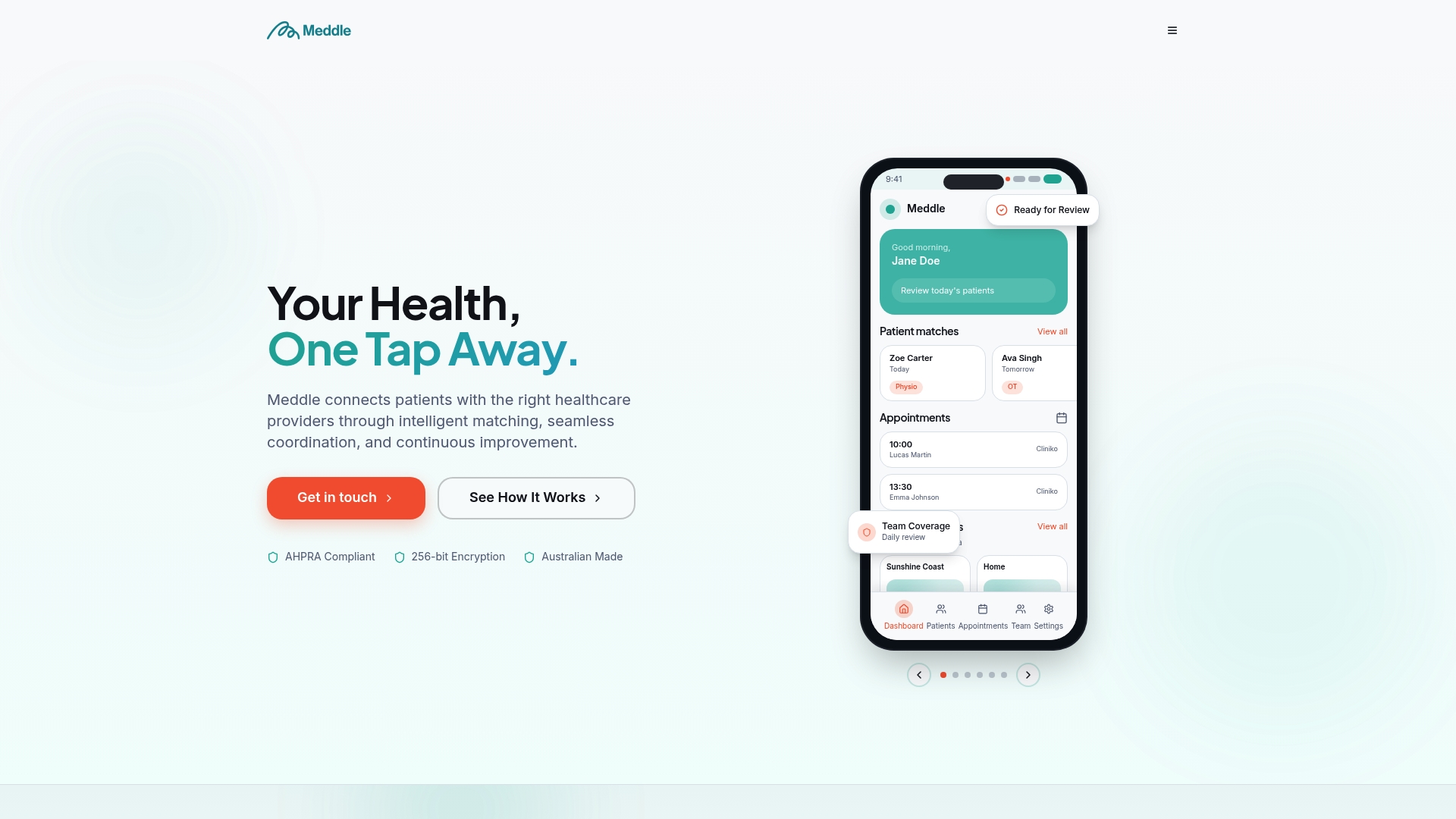
To see how Meddle coordinates referral intake, triage, matching and booking, see our page for clinics. For choosing between scheduling approaches more broadly, see the guide to the best healthcare scheduling software for allied health.
A rollout checklist for your clinic
Whether you start with a pilot or a manual process, work through these in order:
-
Map where time is committed today. List every place a booking can be made: front desk, phone, web, referral inbox, practitioner calendar.
-
Write slot rules. Appointment types, durations, funding pathways, booking windows and cancellation terms.
-
Structure intake. Decide the minimum fields every referral needs, including urgency, discipline, funding and location.
-
Set triage categories with your clinicians and the capacity you will hold for each.
-
Choose who sees what. Define roles for reception, practitioners, coordinators and admins.
-
Set a waitlist review rhythm. Monthly is a reasonable start for most small clinics.
-
Take a baseline of the measures above, then review at 30 and 90 days.
-
Handle multi-appointment and group needs. Block series and group sessions so they do not erode availability silently. The guides on multi-appointment booking and group appointment scheduling cover both.
If you are unsure which discipline a referral should go to, the allied health discipline matcher is a quick way to check, and the wider free tools cover other intake tasks.
FAQ
What is real-time practitioner availability?
It is a live view of which practitioners have free, bookable time that suits a given referral. It reflects the current diary, the practitioner’s specialty and the appointment type, and it updates as bookings and cancellations happen. The result is that staff and patients see slots that are genuinely open rather than a list that needs checking by phone.
Does real-time availability mean patients can book any slot?
Not necessarily. Most clinics allow online booking for straightforward types, such as reviews, and route complex or urgent referrals through intake first. Matching on specialty, travel radius and appointment type lets you show only the slots that suit the person, and keep the rest for coordinator decisions.
How do we handle urgent referrals if availability is live?
Treat urgency as a triage decision made before a slot is offered. Capture urgency in the referral, hold some capacity for priority cases, and offer the earliest suitable slot. Public services use tiered timeframes, such as 30 days for urgent patients at Monash Health, but your clinicians set the clinical urgency for your service.
Is appointment availability data covered by privacy law?
Yes. The OAIC’s Australian Privacy Principles guidelines treat appointment and billing details as health information, which receives additional protection under the Privacy Act 1988. Limit who can see what, keep an audit trail, and confirm your specific obligations with your legal adviser.
How long does it take to see whether it works?
Measure a four-week baseline, then compare at 30 and 90 days. Look at time to first appointment, referrals converted to bookings, administrative contacts per booking and no-show rates. Meddle’s free 30-day pilot gives you a window to test the workflow with your own team.
Sources
-
Queue management and outpatient system integration principles, Department of Health Victoria
-
Practice Management Software, Australian Digital Health Agency
Want to see live availability working inside your own referral flow? Book a 30-minute demo.
Recommended
This article is general information for healthcare businesses and isn’t legal, clinical or privacy advice. Check current requirements with the relevant regulator or a qualified adviser.