3 AU Core Aligned Integration Patterns for Australian Healthcare CRM

A correct healthcare CRM integration requires AU Core FHIR alignment, Healthcare Identifiers Service conformance, My Health Record FHIR Gateway compliance, and privacy-by-design under the Australian Privacy Principles, delivered through formal conformance testing rather than a simple connector. Treat this as project work with governance, negative testing and auditability built in from day one, not a plug-and-play feature.
TL;DR:
- Integration must support AU Core FHIR profiles, Healthcare Identifiers, and My Health Record gateway conformance with documented compliance evidence.
- Choose architectures like middleware or event-driven streaming for scalability and auditability, ensuring provenance and consent tracking are maintained in the integration layer.
- Data minimization, clear consent, role-based access, and strict control of shared health record data are essential to meet privacy obligations.
- Rigorous conformance testing, including negative scenarios, is critical before go-live to prevent silent data loss or duplicate records.
- In procurement, prioritize vendors that can produce detailed conformance statements and security evidence to avoid costly retroactive fixes.
Table of Contents
- Why integrate a CRM with clinical systems in the first place
- Standards and national services your integration must support
- Architectures that hold up under real clinical load
- Privacy, consent and data governance obligations that shape design
- Conformance, testing and what “ready to go live” actually means
- Implementation checklist: readiness, stakeholders and cost
- Common pitfalls and how to avoid them
- Meddle implementation snapshot: privacy-first integration in practice
- Patient data synchronisation and reconciliation strategies
- Interoperability challenges between disparate healthcare systems
- The impact of AI and machine learning on healthcare CRM integration
- Training and change management for staff using the integrated system
- Prioritising identity, conformance and privacy over feature checklists
- How Meddle helps with integration, booking and secure communication
- Sources
- FAQ
Why integrate a CRM with clinical systems in the first place
The business case for healthcare CRM integration rests on measurable operational gains, not novelty. Clinics adopt these systems to close the gap between patient intent and clinical action, and the return shows up in three areas.
Patient engagement improves when appointment reminders, intake forms and referral status updates flow automatically between the CRM and the practice’s clinical software. Referral automation reduces the manual re-entry that causes missed follow-ups, and better visibility into upcoming appointments helps front-desk staff intervene before a patient becomes a no-show.
Care coordination benefits too. A patient managing a chronic condition often sees several practitioners across a care pathway, and a CRM that reflects longitudinal record data lets each provider see recent visits, referrals and outstanding actions without phoning the previous clinic. This matters most in allied health, where handoffs between physiotherapists, psychologists and GPs are frequent and easy to lose track of.
Operational analytics round out the case. A properly integrated CRM gives administrators a live view of:
- Appointment fill rates and cancellation patterns across practitioners and locations.
- Referral source performance, so clinics know which pathways bring patients who complete their care plan.
- Revenue-cycle handoffs, where billing and claims data align with the clinical record instead of living in a separate spreadsheet.
- Population-level outreach opportunities, such as identifying patients overdue for a review.
None of this works if the integration treats the CRM as the source of truth for clinical data. The CRM should orchestrate scheduling, communication and administrative workflow; the clinical record stays authoritative in the EHR or national systems it was built to interact with. Getting that boundary right is the difference between a tool that speeds up admin and one that quietly introduces clinical risk.
Standards and national services your integration must support
Australian healthcare integrations sit on top of a specific stack of national services, and vague claims of “FHIR compatibility” from a vendor are not sufficient evidence that a system will actually connect.
Start with AU Core, the profile set built on FHIR R4 that defines how patient, practitioner and clinical resources should be structured for Australian systems. A vendor should be able to hand you an Implementation Conformance Statement listing exactly which AU Core profiles and resource interactions it supports, not a general assurance that it “uses FHIR”.
Next comes the My Health Record FHIR Gateway, which is the only sanctioned path for a CRM to exchange data with My Health Record. The gateway specification sits at version 5.0 and documents the R4 artefacts, permitted record types and conformance expectations a connecting system must meet. My Health Record is not a database a CRM can query freely: it is a tightly scoped exchange point, and treating it otherwise is a design error that surfaces during conformance testing.
The gateway’s conformance model exists precisely because unrestricted access to shared health records carries real risk, and the Digital Health Agency’s testing and conformance framework is what gives clinics and patients assurance that a connecting system behaves as specified.
Then there is the Healthcare Identifiers Service, which issues Individual Healthcare Identifiers, Healthcare Provider Identifiers for individuals (HPI-I) and for organisations (HPI-O). These identifiers underpin exchange with systems like My Health Record and electronic prescribing, and they are not interchangeable with a CRM’s internal contact ID or a practitioner’s Ahpra registration number. Identity matching logic that conflates these will eventually produce duplicate or mismatched records.
Finally, Provider Connect Australia handles provider and organisation directory data through its own FHIR-based publish and subscribe model. It is a separate use case from clinical record exchange and needs its own conformance assessment, so scope it independently rather than assuming gateway conformance covers it.
In practice, your planning document should list:
- The exact AU Core profiles and interactions the vendor supports, with an Implementation Conformance Statement as evidence.
- Which My Health Record record types the integration needs, and confirmation of gateway-only access.
- How IHI, HPI-I and HPI-O will be captured, stored and matched against CRM contact records.
- Whether Provider Connect Australia integration is in scope, and if so, its separate conformance pathway.
Architectures that hold up under real clinical load
Three integration patterns cover most healthcare CRM projects, and the right choice depends on data volume, latency needs and how much control you want over transformation logic.
- Direct embedded FHIR client: the CRM calls the EHR’s or gateway’s FHIR API directly. This suits smaller practices with straightforward workflows, but it puts transformation and error-handling logic inside the CRM itself, which becomes hard to maintain as more systems are added.
- Integration engine or adapter layer: a dedicated middleware layer sits between the CRM and clinical systems, handling profile mapping, identity resolution and consent checks in one place. This is the pattern most mid-sized and larger implementations should default to, because it keeps business logic and provenance metadata out of the CRM and in a layer built to be audited.
- Event-driven streaming: changes in the EHR publish events that downstream systems, including the CRM, subscribe to. This suits near-real-time needs, such as updating appointment status across systems the moment a patient checks in, but it adds operational complexity around message ordering and delivery guarantees.
Whichever pattern you choose, provenance metadata, who created a record, when, and under what consent, belongs in the integration layer or the clinical system, never only in the CRM. A CRM that silently becomes the sole record of who consented to what is a governance failure waiting to surface in an audit.
Authentication and connectivity deserve the same rigour as the data model, with modern solutions like voice AI for healthcare enhancing integration architecture and telephony capabilities. Plan for certificate-based authentication where the gateway or EHR requires it, realistic rate limits on API calls, and retry logic with back-off rather than aggressive polling that can trip conformance monitoring. Build monitoring that flags failed transactions immediately rather than relying on someone noticing a gap in the data days later.
Pro Tip: Log every failed or rejected transaction with its full error payload from day one; retrofitting this after go-live means months of unexplained data gaps you cannot reconstruct.
Privacy, consent and data governance obligations that shape design
Privacy is not a policy document you write after the integration is built, it is a design constraint that changes what the system is allowed to do.
The OAIC’s guide to collecting health information sets out that health information should generally be collected directly from the patient, by lawful and fair means, with clear notice of why it is being collected. For a CRM integration this translates into practical requirements:
- Purpose limitation built into the data model, so fields collected for scheduling are not silently reused for marketing.
- Consent capture that is documented and auditable, not a one-time checkbox with no record of what was agreed.
- Provenance tracking so you can show which system captured a piece of health information and when.
- Role-based access controls that limit who inside a clinic can see full clinical detail versus scheduling data alone.
A separate rule applies once data leaves My Health Record. The OAIC’s guidance on handling My Health Record information is explicit that once a record is downloaded into a local system, it becomes subject to the Privacy Act’s ordinary retention, access, correction and deletion rules rather than the protections that applied while it sat in My Health Record. A CRM that copies more data than it needs from the gateway is taking on obligations it may not be resourced to manage.
Overseas processing adds another layer. APP 8 makes an organisation accountable for how an overseas recipient handles personal information it discloses, so if any part of the CRM stack, hosting, backup or a support function, runs offshore, contracts need to bind the processor to Australian privacy standards, not just their own local rules.
Conformance, testing and what “ready to go live” actually means
Conformance is not a single certificate, it is a staged process, and skipping stages is how integrations fail quietly in production rather than loudly in testing.
- HI conformance assessment and Notice of Connection testing. Any software connecting directly to the Healthcare Identifiers Service needs a formal conformance assessment, and Services Australia’s NOC testing confirms the connection works in a vendor’s own environment before it goes live.
- My Health Record conformance and gateway testing. The Digital Health Agency’s conformance scheme covers developer self-testing through to formal assessment, and this must include negative scenarios: malformed messages, duplicate submissions and rejected transactions, not just the happy path.
- Operational acceptance criteria. Before sign-off, confirm the system correctly detects duplicate patient records, logs every rejected transaction with enough detail to diagnose it, maintains a complete audit trail, and has a defined incident response process for when something breaks after go-live.
Conformance testing that skips negative and error scenarios leaves the riskiest failure modes undiscovered until a real patient record is affected, which is exactly why the My Health Record conformance scheme treats error handling and monitoring as part of the assessment, not an optional extra.
Implementation checklist: readiness, stakeholders and cost
Scoping a healthcare CRM integration properly means involving the right people before a line of integration code is written, and budgeting for the parts of the project that do not show up in a sales demo.
Bring these stakeholders in early:
- A clinical lead who understands the actual workflow the integration changes, not just the theoretical one.
- A privacy officer who signs off on data flows before development starts, not after.
- An integration developer familiar with FHIR and the relevant national services.
- A test team resourced to cover negative scenarios, not just successful transactions.
- Procurement, holding the vendor to conformance evidence rather than marketing claims.
Procurement should request an Implementation Conformance Statement or equivalent scope summary, a completed security questionnaire, contractual clauses covering any offshore processing under APP 8, and a data-flow diagram showing exactly what moves between systems and why.
Timelines vary with scope, but conformance testing, security testing and integration middleware development are consistently the biggest cost and schedule drivers, more so than the CRM licence itself. Staff time for testing and change management is routinely underestimated in initial budgets.
Pro Tip: Ask every shortlisted vendor for their Implementation Conformance Statement before the first sales call ends; a vendor that cannot produce one quickly is telling you something about their integration maturity.
Common pitfalls and how to avoid them
Most integration failures trace back to the same handful of mistakes, and all of them are avoidable with the right procurement questions.
- Vague FHIR claims. “We support FHIR” is not a specification. Insist on the exact AU Core profiles and resource interactions the vendor supports, backed by an Implementation Conformance Statement.
- Over-copying My Health Record data. Pulling more than the workflow needs creates retention and access obligations under the Privacy Act that many clinics are not resourced to manage. Design for minimal, purpose-specific downloads.
- Weak identifier strategy. Matching patients on name and date of birth alone produces duplicate records at scale. Require HI Service conformance and robust matching logic that uses IHI where available.
- Treating conformance as a formality. Skipping negative-case testing to hit a launch date is how duplicate records and silent data loss make it into production.
Each of these is a design decision, not a technical accident, which means each one is preventable at the scoping stage rather than something you patch after go-live.
Meddle implementation snapshot: privacy-first integration in practice
Meddle’s approach to matching patients with practitioners illustrates how these principles translate into a working platform.
The high-level workflow follows the pattern described earlier in this article: identity resolution to correctly link a patient to their booking and clinical context, real-time availability and booking, secure messaging between patient and practitioner, and audit trails that record who accessed or changed what. None of this replaces a clinic’s own conformance obligations, but it shows how a CRM-adjacent platform can be built with identity and privacy as first-order design constraints rather than bolted on.
If you are evaluating a platform like this for your own clinic, ask for the same evidence you would ask any vendor for: conformance artefacts relevant to the systems you need to connect to, completed security questionnaire responses, and pilot metrics from a workflow similar to yours. A vendor confident in its integration maturity should have these ready.
Patient data synchronisation and reconciliation strategies
Keeping patient records consistent across a CRM and clinical systems is an ongoing operational task, not a one-time setup step. The core challenge is reconciling records that originate in different systems but describe the same patient, especially when identifiers, spelling or contact details differ slightly between sources.
A reliable reconciliation strategy uses the Healthcare Identifiers Service’s IHI as the primary matching key wherever it is available, falling back to a documented set of secondary matching rules, such as name, date of birth and address, only when an IHI is not present. Automated matching should flag low-confidence matches for human review rather than merging records silently.

Synchronisation frequency matters too. Near-real-time updates suit appointment status and availability, where stale data causes double-booking, while less time-sensitive data, such as historical referral outcomes, can sync on a scheduled batch without harming patient care. Building both speeds into the same architecture, rather than forcing everything through one sync interval, keeps the system responsive without overloading the integration layer.
Every reconciliation decision, whether a match was automatic or manually confirmed, should be logged with enough detail to reconstruct why two records were merged or kept separate. This audit trail becomes essential the first time a clinic needs to explain a data discrepancy to a patient or a regulator.
Interoperability challenges between disparate healthcare systems
The core interoperability problem in Australian healthcare is not a lack of standards, it is inconsistent implementation of the standards that already exist. Two systems can both claim FHIR support while implementing different profiles, different required fields or different error-handling behaviour, which means integration testing has to verify actual behaviour rather than trust a compatibility claim.
Legacy practice management systems compound this, since many were not built with FHIR in mind and rely on older interface formats or proprietary APIs. An integration engine or adapter layer, described earlier, is the practical answer here: it isolates the transformation logic needed to bridge an older system’s format into AU Core compliant resources, so that change lives in one maintainable place rather than scattered across every downstream consumer.
Terminology mismatches are a quieter but persistent problem. A condition or procedure coded differently in two systems will not match automatically, and resolving this requires consistent use of the coding systems AU Core specifies rather than each vendor inventing its own shorthand.
The practical solution across all of these issues is the same: demand an Implementation Conformance Statement from every system you are integrating with, test actual message exchange rather than reading documentation, and budget testing time proportional to how many systems are in the chain. Interoperability problems multiply with each additional system, not add.
The impact of AI and machine learning on healthcare CRM integration
Artificial intelligence is changing what healthcare CRM integrations are expected to do, particularly in matching patients to the right practitioner and predicting scheduling risk. Algorithmic matching, which analyses a patient’s stated needs and preferences to suggest a suitable practitioner, is one of the more mature applications, and it depends entirely on clean, well-structured data flowing correctly from the systems that feed it.
Predictive no-show modelling is another growing use case, where historical appointment data helps a CRM flag bookings at higher risk of cancellation so staff can intervene early. This only works if the underlying data pipeline, covered earlier in this article, is reliable, since a model trained on inconsistent or duplicated records will make unreliable predictions.
The privacy implications are significant. Any AI feature that processes health information inherits the same OAIC obligations as the rest of the system: purpose limitation, documented consent, and clear boundaries on what the model is trained on and how outputs are used. A machine learning feature is not exempt from APP obligations simply because it is automated.
For implementers, the practical takeaway is to treat AI features as an extension of the integration’s data governance, not a separate product decision. If the identity resolution and conformance foundations described earlier in this article are solid, AI-driven features built on top of them inherit that reliability. If they are not, AI amplifies the underlying data quality problem rather than fixing it.
Training and change management for staff using the integrated system
A technically sound integration can still fail in practice if staff do not trust or understand the new workflow. Change management deserves the same planning rigour as the technical build, not an afterthought squeezed into the week before go-live.
Start training before go-live, using the actual system with realistic patient scenarios rather than a generic demo environment. Front-desk staff, clinicians and practice managers each interact with the integrated system differently, so training should be role-specific rather than a single all-staff session covering everything at once.
Identify a small group of staff as early adopters or super-users who can troubleshoot everyday questions once the system is live, reducing the load on IT support and giving colleagues a familiar face to ask. Build a short feedback loop in the first weeks after go-live so workflow friction gets reported and fixed quickly, rather than staff quietly working around a broken step and losing trust in the system.
Document the new workflow clearly, including what happens when something goes wrong, such as a failed sync or a duplicate record flag, so staff know the correct escalation path rather than guessing. Clinics that treat the first month post-launch as an extension of the implementation project, with dedicated support time, see fewer workflow reversions than those that switch support off the day the system goes live.
Prioritising identity, conformance and privacy over feature checklists
If I had to compress this entire article into one instruction, it would be this: solve identity and conformance before you evaluate a single feature. A CRM with brilliant scheduling and communication tools is worthless if it cannot reliably tell two patients apart or pass Healthcare Identifiers Service conformance.
My practical priority order is identity and matching first, conformance and testing second, privacy-by-design and contracts third. Everything else, dashboards, automation rules, reporting, is genuinely useful but replaceable if the foundation is wrong.
For procurement, insist on test evidence, including negative-case results, before signing anything. A vendor that has only tested the happy path has not tested enough to trust with patient data.
Start narrow: pilot one workflow, measure it properly, then expand once you trust the foundation.
— Taylor
How Meddle helps with integration, booking and secure communication
Clinics juggling a CRM, a practice management system and separate messaging tools often end up with the same patient detail typed into three places, which is exactly the friction Meddle’s CRM Integration add-on is built to remove. It connects matching, scheduling and messaging workflows to the systems a clinic already runs, so staff are not duplicating patient data entry across platforms.
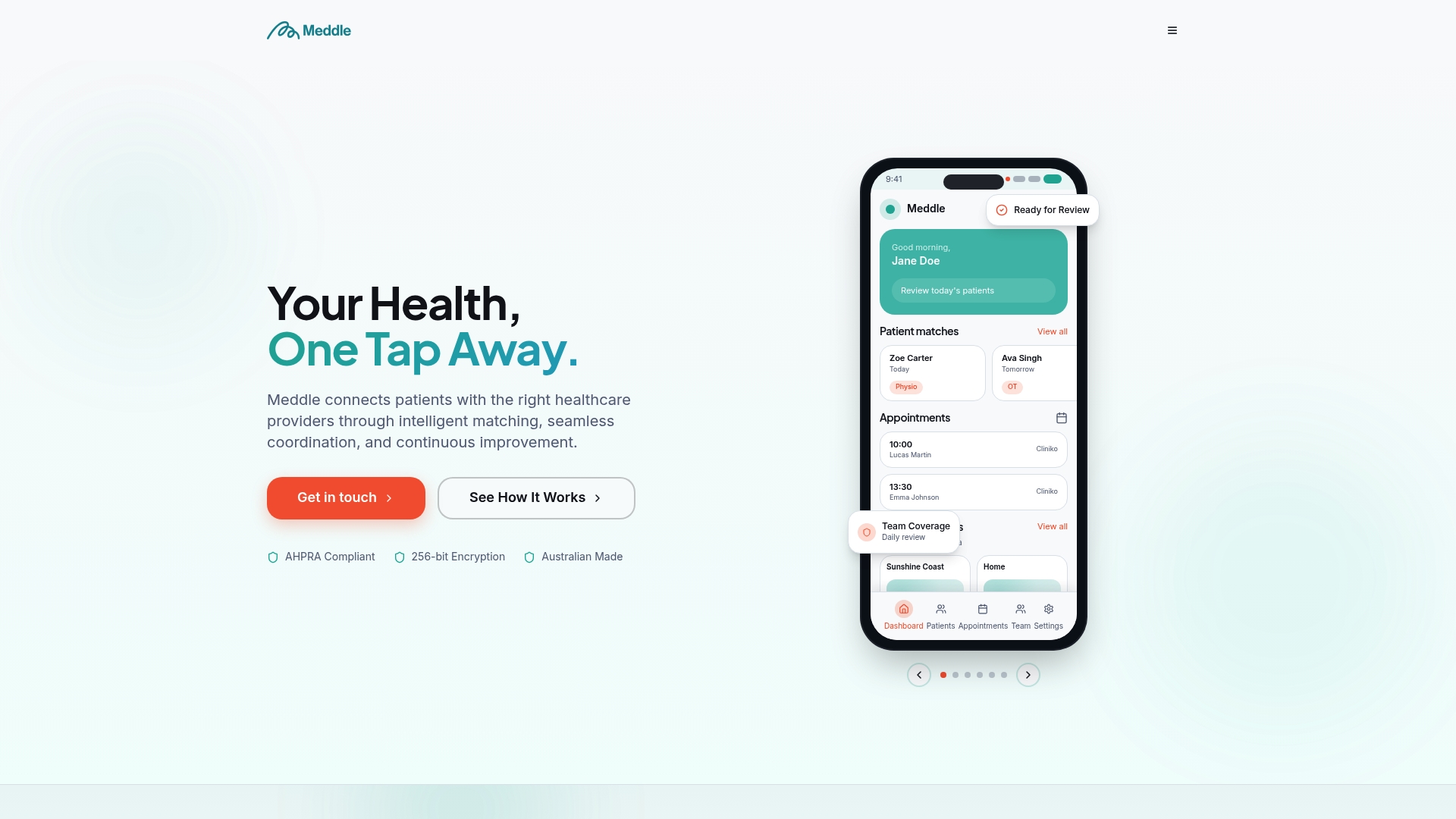
For clinics still weighing up build versus buy, Meddle is not a replacement for your EHR or a conformance-tested gateway connection, it is a layer that reduces the admin burden around matching, booking and referral communication that sits on top of those systems. If you are comparing this against a custom integration engine, the practical trade-off is effort: a fixed monthly cost against the developer time, conformance testing and ongoing maintenance a custom build requires.
What to bring to that conversation:
- Ask about conformance artefacts and security questionnaire responses relevant to your existing systems.
- Request a pilot plan scoped to one workflow, such as referral intake or appointment booking, before committing further.
- Check current plan details, including SMS Notifications and White Labelling, against your clinic’s actual needs.
See how Meddle works or check current pricing to start scoping a pilot.
Sources
Keep these close during procurement and technical scoping, since each answers a different part of the conformance and privacy picture.
- My Health Record FHIR Gateway v5.0
- Guide to health privacy — collecting health information (OAIC)
- About the Healthcare Identifiers service
Save these links directly in your procurement documentation. Vendors change their claims more often than these primary sources change their requirements, and having the original artefact on file makes evidence collection far faster when conformance questions come up later.
This article is general information, not a substitute for advice from a qualified doctor. Consult a qualified healthcare professional about your own circumstances before acting on anything here.
FAQ
How is CRM used in healthcare?
A healthcare CRM manages patient engagement tasks like appointment scheduling, reminders, referral tracking and secure communication, working alongside the clinical record rather than replacing it. It typically integrates with an EHR or national systems like My Health Record so administrative and clinical data stay aligned without duplicate entry.
What is the best CRM for healthcare?
There is no single best system, since the right choice depends on your clinic’s workflow, existing EHR and conformance needs. Prioritise vendors that can produce an Implementation Conformance Statement for AU Core profiles and Healthcare Identifiers Service conformance rather than choosing on features alone.
What is CRM integration?
CRM integration connects a customer relationship management system with other software, such as an electronic health record or scheduling platform, so data like patient details, appointments and referrals flows between them automatically. In healthcare, this must happen through standards-based channels like the My Health Record FHIR Gateway rather than direct, unregulated data access.
What is the most common CRM system used for healthcare?
There is no single dominant CRM used specifically for allied health or clinical practices; adoption varies by practice size, specialty and existing software. What matters more than brand is whether the system supports AU Core FHIR profiles and Healthcare Identifiers Service conformance for the integrations your clinic actually needs.
What should I check before signing a healthcare CRM integration contract?
Confirm the vendor can supply an Implementation Conformance Statement, completed security questionnaire responses and evidence of negative-case testing, not just a successful demo. Also confirm contractual terms around overseas data processing meet APP 8 accountability requirements if any part of the system is hosted offshore.