Cut Integration Costs With Interoperable Booking Systems in Australia
Interoperable booking systems let multiple scheduling platforms publish and discover appointment slots using open standards, rather than relying on custom, one-off connections. The most pragmatic approach for healthcare is standards-led slot publishing paired with aggregator clients that read that data. Done properly, this cuts integration cost, keeps providers in control of their own calendars, and gives patients a single place to find and book care. EMR integration and privacy controls aren’t optional extras here; they’re the difference between a pilot that stalls and one that scales.
TL;DR:
Interoperable booking systems use open standards like FHIR and SMART Scheduling Links to publish, discover, and book appointment slots across multiple platforms efficiently.
Using bulk publishing and aggregator or proxy models minimizes integration costs and scales better than point-to-point connections, especially for large networks.
Deep EMR integration, with features like calendar sync and intake automation, is essential for effective clinical workflow adoption of scheduling systems.
Security controls such as TLS, OAuth, data minimisation, and provider-controlled slot release are critical to protect patient health information in scheduling data exchanges.
A phased approach involving inventory mapping, architecture testing, and controlled pilot deployment helps organizations implement standards-based interoperable booking effectively.
Table of Contents
-
What are interoperable booking systems and why do they matter?
-
How do these systems integrate with EMRs and clinical workflows?
-
What security and privacy controls does medical scheduling need?
-
How does Meddle approach interoperable scheduling in practice?
-
Why standards-first interoperability is worth the slower start
What are interoperable booking systems and why do they matter?
An interoperable booking system is one that can publish its available appointment slots in a format another platform can read, verify, and act on, without a bespoke integration for every pair of systems involved. Instead of Clinic A building a custom feed for Aggregator B and a different one for Aggregator C, both sides speak the same structured language. That’s the entire point: fewer one-off builds, more reusable connections.
At the core, these systems perform four functions. First, availability publishing, where a scheduling platform exposes its open slots, usually as structured data tied to a provider, location, and service type. Second, slot discovery, where a searching application queries that published data to find matching availability across one or many providers. Third, booking URL retrieval, where the client system resolves a specific slot into an actual booking action, often a hosted link or an API call. Fourth, confirmation and reconciliation, where the completed booking gets written back to the originating calendar so nothing gets double-booked or lost between systems.
Three roles show up repeatedly in this architecture, and it’s worth knowing them because vendors use them loosely:
-
Slot publisher — the source system (a practice management platform or EMR) that exposes its own availability.
-
Aggregator — the intermediary that collects slots from multiple publishers and presents a combined view, often what a patient or referrer actually interacts with.
-
Client — the end application, which could be a booking widget, a referral tool, or a patient-facing app, that queries the aggregator or publisher directly and completes the booking.
The business case for getting this right is straightforward. Clinics juggling multiple systems, say a legacy practice management tool for billing and a newer scheduling front end for patients, waste hours reconciling calendars manually. Appointment booking software used across Australian clinics increasingly connects to the practice management systems clinics already use, specifically because clinics want fewer manual touchpoints, not more software to babysit.
In healthcare specifically, interoperable booking solves a problem that’s uniquely painful: patients often need to be booked across organisational boundaries. A GP referral to a physiotherapist, a specialist needing to check a patient’s existing appointment history, a hospital discharge planner trying to line up follow-up care within a tight window. None of that works if each system is an island. Interoperability isn’t a nice architectural principle in this context. It’s what makes multi-provider care coordination possible without a fax machine and three phone calls.
The practical benefits compound from there: reduced no-show rates through better visibility of true availability, less administrative time spent chasing bookings across incompatible calendars, and a real-time view of capacity that clinics can use for demand planning. This is also where the phrase “unified scheduling” earns its keep, because the goal isn’t a single monolithic booking product. It’s many booking systems behaving as one from the patient’s point of view.
What standards govern interoperable booking systems?
Three specifications matter most if you’re evaluating or building interoperable booking systems for healthcare: FHIR patient scheduling, SMART Scheduling Links, and the UK’s Booking and Referral Standard (BaRS). Each solves a slightly different part of the problem, and together they cover the technical vocabulary decision-makers should expect vendors to speak fluently.
FHIR patient scheduling is the foundational data model. Fast Healthcare Interoperability Resources (FHIR) defines structured resources for appointments, schedules, and slots that different systems can exchange without inventing their own formats each time. The FHIR patient scheduling workstream is actively advancing a bulk-publish approach, where a provider system exposes its entire block of upcoming availability as slot metadata in one go, rather than answering individual availability queries one at a time. That distinction matters operationally: bulk publishing is dramatically cheaper for the origin system to sustain at scale than fielding thousands of live lookup requests.
SMART Scheduling Links builds directly on that foundation, defining the practical mechanics of slot discovery and booking. It specifies how a client system finds available slots (rough-grain discovery, like “does this provider have anything this week”), narrows down to exact availability (fine-grain discovery, the actual bookable time), and then retrieves a working booking URL to complete the transaction. The SMART Scheduling patient scheduling documentation lays out end-to-end test scenarios covering exactly this flow, which is useful because it gives implementers a concrete checklist rather than an abstract spec to interpret.
BaRS, the Booking and Referral Standard, takes a different but complementary angle. Rather than focusing purely on the data format, BaRS defines a layered model covering transport, workflow, and payload separately. It also introduces a proxy and endpoint catalogue approach, where a central routing layer handles discovery and directs booking requests to the right destination system. This matters because it avoids the alternative: every organisation building direct, point-to-point connections to every other organisation it books with.
What good standards adoption reduces:
-
Custom integration builds per partner system, since everyone implements against the same specification instead of a vendor’s proprietary API.
-
Ongoing maintenance overhead when a partner changes their internal system, because the published interface stays stable even if the backend doesn’t.
-
Security review cycles, since auditors can assess a known standard’s authentication model once rather than re-litigating a bespoke protocol for every new connection.
-
Onboarding time for new provider organisations joining an existing network, since they implement one interface rather than negotiating separately with each aggregator.
Standards-based scheduling reduces per-connection engineering effort because implementers write against one specification instead of negotiating a bespoke API contract with every partner. The FHIR patient scheduling workstream’s move toward bulk publishing exists precisely because live, per-query slot lookups don’t scale once dozens or hundreds of provider systems are involved. Bulk publish shifts the load pattern from constant real-time polling to periodic data refreshes, which is far kinder to legacy systems that were never built to handle high query volumes.
None of this means standards adoption is free. FHIR resources have real complexity, and SMART Scheduling’s test scenarios assume a level of engineering maturity that smaller practice management vendors sometimes lack. But the alternative, custom point-to-point integrations for every pairing of systems, scales quadratically in cost as the network grows. Standards scale linearly. For any organisation planning to connect with more than two or three partner systems, that difference decides the project’s long-term maintainability.
Which architecture pattern should you choose?
Four architecture patterns dominate real-world interoperable booking deployments, and the right choice depends mostly on how many organisations you’re connecting and how much control you need over routing.
-
Bulk-publish slot publisher model. The source system periodically exports its full set of upcoming availability as structured slot data, rather than answering live queries. This is the pattern the FHIR patient scheduling workstream is pushing toward, and it works best when the origin system has predictable, cacheable availability, such as a specialist clinic with weekly recurring slots. It scales well because the publishing system isn’t hit with live traffic; it just refreshes a data feed on a schedule.
-
Aggregator or slot directory model. A central service collects published slots from multiple sources and presents a unified search surface. This is what most patients or referrers actually interact with. The limitation is real: an aggregator is only as current as its last sync with each publisher, so there’s an inherent lag between a slot being booked at the source and that booking reflecting in the aggregator’s directory. Good implementations minimise that window with frequent refresh cycles and webhook-style confirmation callbacks, but the lag never reaches zero.
-
Proxy or routing model. Rather than an aggregator holding a copy of slot data, a proxy layer routes booking requests directly to the correct destination system in real time, using a catalogue of registered endpoints. BaRS uses this proxy pattern at national scale specifically to avoid maintaining a duplicated slot directory, and to reduce point-to-point connections between hundreds of participating organisations. The trade-off is that the proxy layer needs to be highly available, since every booking request depends on it being up.
-
Adapter connectors for legacy systems. Many EMRs and practice management platforms predate any of these standards and expose only proprietary APIs, or none at all. An adapter translates between the legacy system’s native interface and the standard your broader architecture expects. These are the highest-maintenance component in any interoperable booking stack, because they break whenever the legacy vendor changes their API, often without much notice.
Pro Tip: Budget for adapter maintenance as an ongoing line item, not a one-time build cost. Legacy EMR vendors rarely publish changelogs for their APIs, so plan for a support contact and a testing cadence, not a “set and forget” connector.
Choosing between these isn’t really an either/or decision in most deployments. A typical Australian allied health network ends up running a hybrid: a bulk-publish feed from modern practice management systems, an aggregator layer that patients and referrers actually search, and one or two adapter connectors bridging older EMRs that can’t publish standards-compliant data natively. The proxy/routing pattern tends to only make sense once you’re coordinating dozens of organisations, which is why BaRS was built for a national health system rather than a single clinic network.
The mistake to avoid is defaulting straight to point-to-point integration because it feels faster to build. It is faster, for the first two connections. By the fifth or sixth partner system, the maintenance burden of separately-negotiated APIs outweighs whatever time you saved skipping the standards conversation.
How do these systems integrate with EMRs and clinical workflows?
Integration depth with the EMR, not just adoption of a new booking product, determines whether a scheduling system actually changes clinical practice. A well-cited study of family medicine clinics found that integrating medical appointment scheduling systems with EMRs was a strong predictor of extended use and better application of advanced access principles, with a statistically significant relationship (β=.52, P<.001) between integration depth and successful assimilation. Clinics that bolted a booking tool on top of their EMR without real data connections saw far weaker adoption than those where the two systems actually shared patient and calendar data.
Practically, integration touches several layers of clinical workflow; for example, apps like KinCarer exemplify interoperability-minded care coordination by supporting multi-party scheduling and shared care plans.
-
Calendar sync keeps the booking system’s view of provider availability matched to the EMR’s master schedule, so a slot booked externally doesn’t silently double-book a provider who was also booked directly.
-
Patient linking matches an incoming booking request to an existing patient record where one exists, avoiding duplicate patient files and letting practitioners see relevant history before the first appointment.
-
Intake automation can trigger pre-appointment forms or consent capture the moment a booking confirms, rather than leaving that to reception staff on the day.
-
Telehealth routing determines whether a booked slot generates a video consultation link automatically or flags for in-person check-in, based on service type metadata carried in the original slot data.
Operationally, this means someone on your team needs to map provider metadata (specialties, locations, service types, appointment durations) consistently across every connected system before go-live. Inconsistent metadata is the single most common cause of aggregator search results that look wrong to patients, showing a psychologist under “general practice,” for instance, because a code mapping was never reconciled.
Testing and fallback behaviour deserve explicit attention here too. What happens when the EMR is down for scheduled maintenance and a booking request comes in through the aggregator? A well-built integration either queues the request for retry or gracefully surfaces “temporarily unavailable” rather than silently failing and losing the booking. Test this scenario deliberately before launch, because it will happen in production eventually, usually during a software update nobody warned the scheduling team about.

For clinics evaluating scheduling software with these integration questions in mind, understanding how booking software connects with existing practice management platforms is a useful starting point before committing to a specific stack.
What security and privacy controls does medical scheduling need?
Medical booking data is health information, and the security bar has to reflect that even for something as apparently mundane as “which time slots are free.” The FHIR patient scheduling and SMART Scheduling workstreams both build security expectations directly into their implementation guidance, and any vendor conversation should start from the same baseline.
Minimum controls to require:
-
TLS or mutual TLS for every connection between publisher, aggregator, and client, so slot data in transit can’t be intercepted or tampered with.
-
OAuth 2.0 with SMART-aligned scopes, meaning each connected application requests only the specific access it needs, rather than a blanket credential that can read everything.
-
Data minimisation on published slots, so availability feeds expose only what’s needed to book (time, location, service type, provider identifier) and never leak diagnosis codes, referral reasons, or other clinical detail that has no business being in a scheduling feed.
-
Provider-controlled release policies, letting a practice decide which slots are published externally at all, and revoke that publication instantly if circumstances change.
-
Audit logging on every booking transaction, capturing who accessed what slot data and when, so any dispute or breach investigation has a clear trail.
A pilot’s security testing shouldn’t stop at “does it work.” SMART Scheduling’s documented pilot approach recommends testing both rough-grain availability discovery and fine-grain slot resolution separately, because a system that correctly hides sensitive slot detail during broad searches can still leak it once a client narrows down to a specific booking attempt. Test both paths independently before assuming either is secure.
Revocation deserves particular attention because it’s the control most often skipped under deployment pressure. If a practitioner needs to immediately pull a set of slots from public availability, perhaps due to an unexpected leave or a safety concern, the system needs to support that instantly, not on the next nightly sync. Ask any vendor to demonstrate this specific scenario live before signing anything.
Compliance-wise, Australian clinics handling patient data through interoperable booking systems need to align with the Australian Privacy Principles, and practical guidance on securing patient records to meet APP 11 is worth reviewing alongside any vendor’s technical security documentation. A vendor’s SOC 2 badge or ISO certification is a reasonable signal, but it doesn’t replace a direct conversation about how they handle Australian privacy obligations specifically, since many scheduling platforms are built primarily for US or UK compliance regimes first.
What’s the practical rollout timeline and checklist?
A realistic interoperable booking rollout runs in five phases, and skipping straight to vendor selection without the first two almost always causes rework later.
-
Inventory and use-case mapping. List every system currently holding scheduling data, every downstream consumer of that data (patients, referrers, internal staff), and the specific booking scenarios that matter most (new patient intake, existing patient rebooking, referral-driven bookings, telehealth versus in-person). This step usually takes one to two weeks and mostly involves talking to reception and clinical staff, not engineers.
-
Architecture selection and connector strategy. Decide which of the bulk-publish, aggregator, or proxy patterns fits your organisation’s scale, and identify which existing systems will need adapter connectors because they can’t natively speak a standard interface. Budget extra time here if any system in your stack is more than five years old; legacy connectors are almost always the long pole in the schedule.
-
Pilot design. Choose a limited scope, ideally one or two provider locations and a single booking scenario, define clear success criteria upfront (booking completion rate, sync lag, error rate), and select a handful of representative providers who’ll tolerate some early friction in exchange for shaping the final rollout.
-
Testing and phased rollout. Run through both rough-grain and fine-grain availability tests, confirm booking confirmations reconcile correctly back to the originating calendar, and test failure scenarios (system downtime, conflicting double-bookings, revoked slots) before expanding beyond the pilot group. Roll out in waves by location or service line rather than flipping the switch everywhere simultaneously.
-
Monitoring and SLAs. Once live, track sync lag between publisher and aggregator, booking failure rates, and time-to-resolution for any integration errors. Set internal service levels for how quickly a broken connector gets fixed, because a silent failure in a booking feed is invisible until a patient complains about a phantom appointment.
Pro Tip: Run your pilot with providers who already have decent digital literacy and tolerance for early bugs. Choosing your most tech-resistant location for the pilot “to prove it works for everyone” is a common mistake that turns a two-week test into a two-month one.
Timeboxes vary by organisation size, but a single-clinic pilot with one adapter connector typically runs six to ten weeks from kickoff to a stable pilot result. Multi-site rollouts with several legacy system connectors regularly stretch to four to six months, mostly due to the connector maintenance cycle rather than the core standards work itself.
Cost drivers worth flagging early to whoever holds the budget: legacy adapter development is almost always the single biggest line item, followed by ongoing connector maintenance (which doesn’t stop after launch), and then the aggregator or directory infrastructure itself, which is comparatively cheap if you’re building on an existing standards-compliant platform rather than from scratch. For teams looking at practical booking flow design alongside this technical work, a clinical workflow guide to instant appointment booking covers the patient-facing side of the equation.
How does Meddle approach interoperable scheduling in practice?
Meddle’s core workflow is a real example of the aggregator pattern described earlier, applied specifically to allied health referral matching in Australia. Rather than patients searching provider by provider, Meddle’s AI-powered matching takes individual needs, symptoms, preferences and practical constraints, matches them by discipline, location and the capacity each clinician has shared, then routes the referral. The clinic confirms the booking, without a round of phone tag first.
That’s the aggregator role in action: Meddle isn’t the source of truth for any single clinic’s calendar; it’s the layer that makes many providers’ shared capacity searchable from one place, with each clinic confirming its own bookings. That’s the pattern this guide has walked through. The matching workflow itself is paired with privacy measures designed around patient data protection, consistent with the data minimisation and provider-control principles covered earlier.
The platform is designed to bring practitioner matching and referral routing into a single coordination layer. A match is a referral routed to a practitioner suited to the patient’s needs, based on the capacity they have shared; the clinic confirms the booking.
A few implementation lessons fall out of building an aggregator like this at Australian scale. First, matching quality only matters if the capacity behind it is genuinely current. An accurate practitioner match that leads to a dead end because the clinician has no room erodes trust fast, which is why clinicians keep the capacity they share up to date and the clinic confirms each booking, rather than relying on a cached directory. Second, a matching layer has to work alongside clinic-side systems rather than replace them. Meddle’s practice dashboard and practitioner analytics exist partly to give clinics visibility into how matching and referral routing are performing, echoing the reconciliation point covered in the EMR integration section.
For any organisation planning a pilot along these lines, the practical takeaway is that aggregator success depends on the strength of the publisher-side connections feeding it, not just the intelligence of the matching layer sitting on top.
How should you evaluate booking system vendors?
A vendor evaluation for interoperable booking systems should weigh three categories: technical fit, operational readiness, and commercial terms. Skipping any one of these tends to surface as a painful surprise about six months into a live deployment.
Technical fit starts with standards support. Ask specifically whether a vendor supports FHIR-based scheduling resources and SMART Scheduling Links, or whether their “integration” is a proprietary API dressed up in standards language. Check EMR connector coverage against your actual stack, not a generic list of “50+ integrations” that turns out to be mostly unsupported or community-maintained. Confirm security controls match the baseline covered earlier: TLS, OAuth 2.0, audit logging, and provider-level slot revocation.
Operational readiness covers what happens after go-live, not just the demo. Does the vendor have real monitoring on sync lag between systems? What’s their retry behaviour when a downstream system is temporarily unreachable? How do they reconcile a booking that succeeded on their side but failed to write back to the source calendar? Ask for their actual SLA commitments in writing, not a verbal assurance that “it’s usually fine.”
Commercial considerations matter more than they get credit for in technical evaluations. Understand the pricing model, whether it’s per-provider, per-booking, or flat platform fee, and how that scales as you add locations. Ask directly about data portability: if you leave this vendor in two years, can you export your scheduling data and history in a usable format, or are you locked into their proprietary export?
| Evaluation area | What to check | Weight |
|---|---|---|
| Standards support | FHIR/SMART Scheduling compliance, not proprietary-only APIs | High |
| EMR connector coverage | Direct support for your actual practice management stack | High |
| Security controls | TLS/OAuth, audit logging, provider-level revocation | High |
| Operational monitoring | Documented SLAs, retry logic, reconciliation process | Medium |
| Commercial terms | Pricing model, onboarding time, data portability | Medium |
A simple scoring rubric works well for procurement: score each vendor 1 to 5 against each row, weight the high-priority rows double, and total the result. It won’t replace due diligence, but it forces a structured comparison instead of a gut-feel decision driven by whoever gave the slickest demo.
Why standards-first interoperability is worth the slower start
The temptation in any booking integration project is to build the fastest point-to-point connection that gets a demo working, then worry about standards later. That instinct is understandable and almost always wrong for anything beyond a two-system pilot.
Standards-based approaches cost more upfront in engineering discipline. They pay that back the moment you connect a third, fourth, or fifth system, because each new connection reuses the same interface instead of requiring bespoke negotiation. The research on EMR integration and assimilation backs this up directly: shallow, bolted-on integrations get abandoned; deep, standards-aligned ones get used.
My honest recommendation is to pilot before you commit to an architecture at scale. Prove that a bulk-publish or aggregator pattern actually assimilates into your clinical workflow with real providers and real patients before you build the operational playbooks around it. If it works in a six-week pilot, it’ll work at scale. If it doesn’t, you’ve saved yourself a six-month rebuild.
— Taylor
Get a working pilot up faster with Meddle
Building interoperable booking systems from scratch means solving matching, availability aggregation, EMR connectors, and privacy controls all at once, and most clinics don’t have a spare engineering team sitting around for that. Meddle already runs a matching layer like the one this guide describes: it matches patients by discipline, location and the capacity each clinician has shared, then routes the referral to the right practitioner. The clinic confirms the booking, so patients aren’t sent to a stale directory entry.
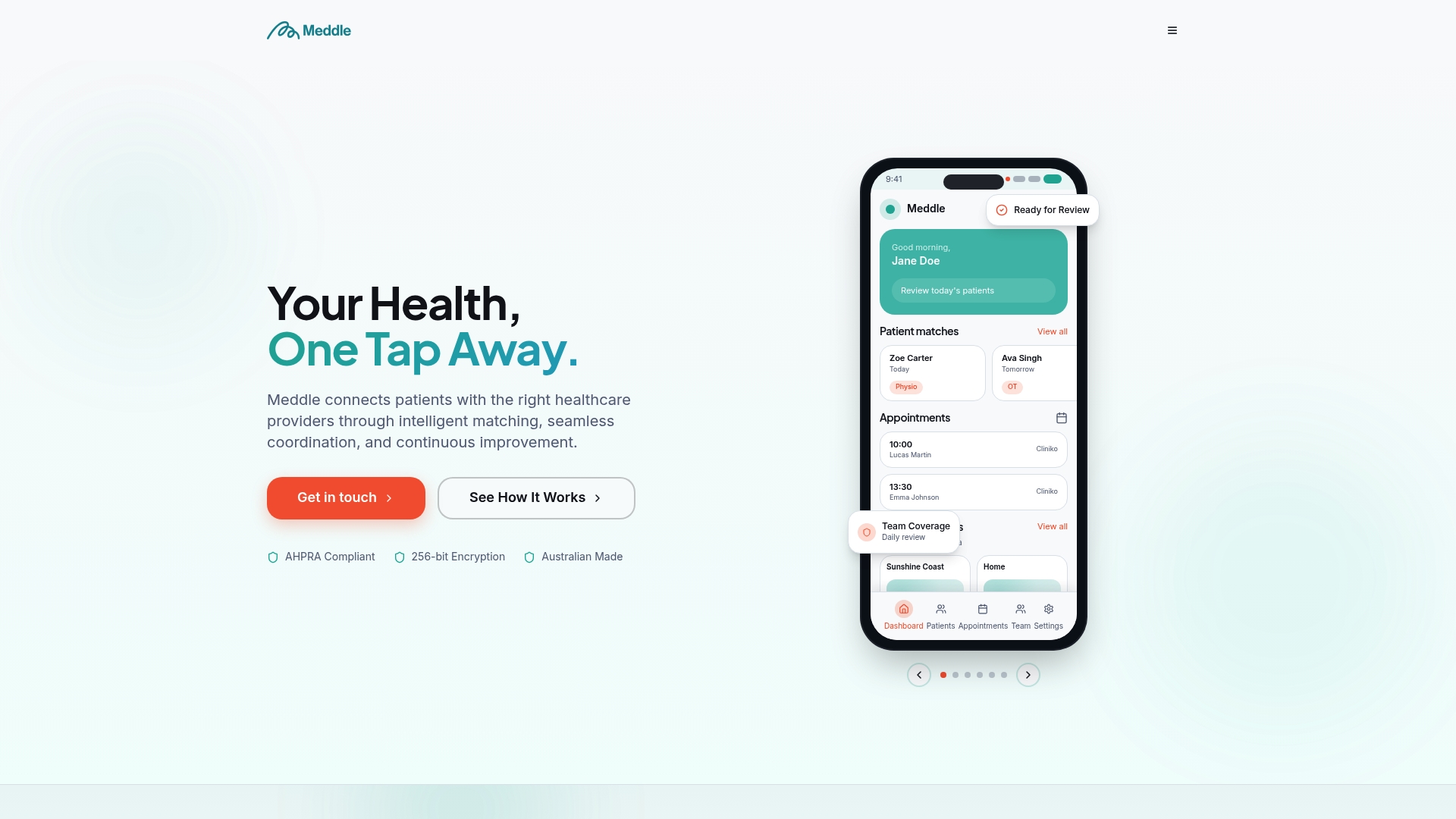
The platform’s privacy measures are built around the same data minimisation and provider-control principles covered throughout this guide, and its practice dashboard, with practitioner analytics, gives clinics visibility into how matching and referral routing are performing. For clinics evaluating whether to build custom integration internally or adopt a platform already solving this problem, Meddle’s discipline matcher tool is a practical way to see the matching logic in action before committing to anything.
If your clinic or practice group is weighing a pilot along the lines described in this guide, book a walkthrough of how Meddle works and bring your specific EMR and scheduling stack to the conversation. It’s the fastest way to find out whether a standards-aligned aggregator fits your workflow before you commit engineering time to building one yourselves.
Sources
For readers who want to go deeper on the technical specifications covered in this guide:
This article is general information, not a substitute for advice from a qualified doctor. Consult a qualified healthcare professional about your own circumstances before acting on anything here.
FAQ
What is the best online booking system for a clinic?
There’s no single “best” system for every clinic; the right choice depends on which EMR you already run, how many locations you manage, and whether you need multi-provider matching. Platforms like Meddle are built specifically for allied health matching and booking, which suits multi-practitioner networks better than a generic calendar tool.
What is the best booking system to use overall?
The best booking system is the one that integrates deeply with your existing practice management or EMR software rather than sitting alongside it as a disconnected add-on, since integration depth is what drives real adoption and better scheduling outcomes.
What is replacing Microsoft Bookings for clinics?
Clinics moving away from generic tools like Microsoft Bookings are typically shifting to healthcare-specific platforms with EMR connectors, standards-based slot publishing, and clinical workflow features such as intake automation and telehealth routing, none of which generic calendar tools support natively.
What are the different types of booking systems?
Booking systems generally fall into standalone calendar tools, EMR-embedded scheduling modules, and aggregator platforms that pull availability from multiple sources into one searchable interface, with the aggregator model being the closest fit to true interoperable booking systems.
How do interoperable booking systems protect patient privacy?
They rely on data minimisation in published slot feeds, encrypted transport through TLS, OAuth-based access control, and provider-controlled release policies that let a practice revoke published availability instantly if needed.