
Referral routing rules are the written decisions that tell your team where every incoming referral goes, who owns it, how fast it moves and what happens when it stalls. The strongest rule sets cover six things: what you capture at intake, how you triage, how you match to a practitioner, what you do with incomplete or out-of-scope referrals, who owns each handover, and how a referral is closed. Meddle automates the routing step by turning referrals from GPs, email and web forms into structured intake, triage and practitioner matching on specialty, travel radius and appointment type.
This guide gives you the rules themselves, with Australian examples from Primary Health Networks (PHNs) and NDIS providers that you can adapt to your clinic.
TL;DR
- A routing rule has a condition (for example, NDIS-funded paediatric OT), an action (route to a named practitioner group) and a fallback (what happens if nobody can take it).
- Capture the same fields on every referral, whatever the channel, so triage never starts with a phone call to chase details.
- Set time limits you can measure: accept or decline, first contact and first appointment.
- Give every referral one owner at all times, and record the handover and closure.
- We built Meddle to apply these rules for you, with a free 30-day pilot.
Table of Contents
- What a referral routing rule is
- Step 1: Standardise what you capture at intake
- Step 2: Triage by urgency and clinical need
- Step 3: Match to the right practitioner
- Step 4: Decide what happens to incomplete, urgent and unmatched referrals
- Step 5: Assign ownership, handovers and closure
- Privacy rules your routing must respect
- A worked example
- How Meddle applies your rules
- Our view: rules should live in the workflow, not in a folder
- FAQ
- Sources
What a referral routing rule is
A rule has three parts: a condition, an action and a fallback. The condition describes the referral (discipline, funding type, urgency, location). The action says where it goes (a practitioner, a team, a queue). The fallback says what happens when the action cannot be completed, for instance when nobody has a free slot.

Without the fallback, referrals sit. That is where most leads are lost: not at a refusal, but in an inbox nobody owns.
Public program guidelines show what a complete workflow covers. Murray PHN’s program guidelines require providers to have procedures for triage and allocation, timely response, confirmation of the first appointment, waitlist management and handling of people who miss early appointments. They also require a single consolidated system tracking each referral from referral date to discharge. Those are good headings for your own rulebook, even if your clinic is not funded by a PHN.
Step 1: Standardise what you capture at intake
Referrals arrive as GP letters, emails, web forms and phone calls. Routing only works if each one ends up as the same set of fields. If you want the GP side of this in detail, see our guide to the GP referral process in Australia.
A practical minimum:
- Patient identity and contact details, and preferred communication method and language
- Referrer details and the date received
- Discipline requested and reason for referral
- Funding pathway (private, Medicare-supported plan, NDIS, other)
- Location and travel limits
- Risks or concerns, including any risk to staff
- Consent to share information with the referrer
For NDIS work, St Vincent’s Health Melbourne’s allied health procedure lists what services may need on referral: communication preferences, NDIS goals, funding availability, plan manager contacts, any legal decision maker and any risks. Those questions help decide whether your service is the right one for that participant.
The rule: a referral is not routed until the mandatory fields are complete. Incomplete referrals go to a separate holding path with a clock on it (see Step 4). Our referral triage checklist lays out these fields for admin teams.
Step 2: Triage by urgency and clinical need
Triage rules should be simple enough for reception to apply and clear enough for a clinician to trust. Two levels (urgent and standard) are enough for most clinics. The SVHM procedure bases priority on clinical need and risk of deterioration, socio-economic factors and NDIS requirements.
Example rules to adapt:
| Condition | Action | Fallback |
|---|---|---|
| Mentions self-harm or suicide risk | Same-day clinician review and phone response | Escalate to clinical lead; direct to acute services if needed |
| Hospital discharge or deterioration risk | Urgent queue, first available slot | Offer next-best practitioner or reallocate |
| Standard referral, complete | Standard queue, triage within your set window | Waitlist with estimated wait time |
| Missing mandatory field | Holding queue, request from referrer | Close with notice after your set number of days |
Where you work with mental health referrals, the benchmark is strict. Murray PHN’s guidelines require providers to respond by phone within 24 hours and offer an appointment within seven days for people referred after a recent suicide attempt or at risk of one. If a person may be in immediate danger, your rule should say that staff call emergency services, not queue the referral.
Set a triage frequency too. SVHM triages referrals at least weekly, gives an estimated wait time after triage and updates waitlisted people monthly where possible. Pick a cadence your team can actually keep.
Step 3: Match to the right practitioner
This is where manual routing slows down. A coordinator checks diaries, remembers who treats what and guesses at travel. Write the matching criteria down in priority order:
- Specialty and skills: the discipline and any sub-specialty the referral needs.
- Appointment type: initial assessment, home visit, telehealth, group.
- Travel radius: whether the person lives inside the practitioner’s service area.
- Funding eligibility: NDIS registration or plan management arrangements.
- Availability: earliest suitable appointment.
- Patient preference: language, gender, continuity with a previous clinician.
Our triage and practitioner matching feature matches on specialty, travel radius and appointment type, so the first three criteria above are applied the same way every time instead of depending on who is at the desk. If you are unsure which discipline a referral calls for, the discipline matcher helps.
Travel is a legitimate rule. SVHM lists living outside the designated travel area among its decline criteria, along with not meeting clinical criteria, unmitigable risk to clinicians and lack of required expertise.
Step 4: Decide what happens to incomplete, urgent and unmatched referrals
The exceptions need rules more than the standard cases do.
Accept or decline within a fixed time. CESPHN’s psychological support guidance requires clinicians to accept or decline within 72 hours, accept before contacting the person and book the first appointment within four weeks of accepting. If no appointment time can be found, the clinician asks their provider to reallocate to a more appropriate clinician. That reallocation step is a good model for any fallback.
Decline with a destination. A decline should never be a dead end. Murray PHN expects providers to give service navigation support when a more appropriate service is indicated and to keep supporting the person until the alternative service is actively supporting them.
Waitlists. SVHM adds waitlisted participants in order of referral date and lets them ask to be removed without penalty. All About Kids’ handbook says participants may be placed on a waiting list and contacted when a position opens. Write down who contacts the person, how often and what they are told.
Missed first appointments. Murray PHN’s guidelines require a process for people who do not attend the first and following two initial appointments, including a risk assessment based on referral information. Decide in advance how many attempts you make and by which channel.
For more on acceptance criteria, see our guide to referral acceptance rules.

Step 5: Assign ownership, handovers and closure
Every referral needs one named owner at each stage: intake officer, triaging clinician, treating practitioner. A handover is a change of owner, and it should be logged with a date and a reason.
Record three communications:
- To the referrer at the start. Murray PHN requires written communication to the GP at the start of services covering receipt of the referral, that the person is receiving a service and the type of service, and again at case review outcomes and on conclusion or transfer, with informed consent.
- To the patient. Confirm the appointment, the wait time or the decline and the next step.
- To funders or coordinators where relevant. For NDIS participants using support coordination, the NDIS sends a request for service to the support coordinator in certain situations, such as first-time use or a change of provider, so check who your referrer is.
Close a referral only with a recorded outcome: booked and attended, declined with navigation, withdrawn by the patient or unable to contact. Our guide to NDIS documentation covers the records NDIS providers should keep, and our piece on GP and allied health coordination covers the loop back to the referrer.
If your team wants to keep the tone of handovers and patient messages consistent, a short communication-style exercise such as the communication wheel can help staff agree how they explain waitlists and escalations.
Privacy rules your routing must respect
Routing moves personal health information, so the rules must protect it.
- Channel. CESPHN states that its email is not encrypted end to end, so it does not accept referrals containing identifying information by email and requires its online referral form instead. A good rule is to steer referrers to a secure form.
- NDIS information. The NSW Ministry of Health’s Privacy Manual for Health Information notes that NDIS plans are protected agency information under the NDIS Act 2013 and that written consent is needed to release NDIS information to providers.
- Confidentiality. The NDIS Practice Standards require that participants are told about confidentiality policies in a language and mode they understand.
- Access controls. The MHCC’s Practice Standards guidebook calls for documented protocols so unauthorised people cannot access participant information.
Our guide to securing patient records under APP 11 covers the practical steps. Meddle hosts patient data in Sydney. For NDIS-specific intake, see NDIS referrals for allied health clinics.
A worked example
A multidisciplinary clinic receives a web form for a seven-year-old needing speech pathology, funded through an NDIS plan, living 35 km away.
- Intake: the form populates the mandatory fields. Plan manager details are missing, so the referral goes to the holding queue and the coordinator requests them.
- Triage: no urgency flags, so it enters the standard queue.
- Match: the rules filter to speech pathologists who see children, offer the right appointment type and cover that travel distance.
- Fallback: no one has capacity for six weeks, so the family is waitlisted, given an estimated wait and offered the next-best practitioner.
- Handover and closure: the first appointment is booked, the referrer is notified in writing and the referral closes as booked and attended.
Each step has an owner and a time limit. Nothing sits unowned.
How Meddle applies your rules
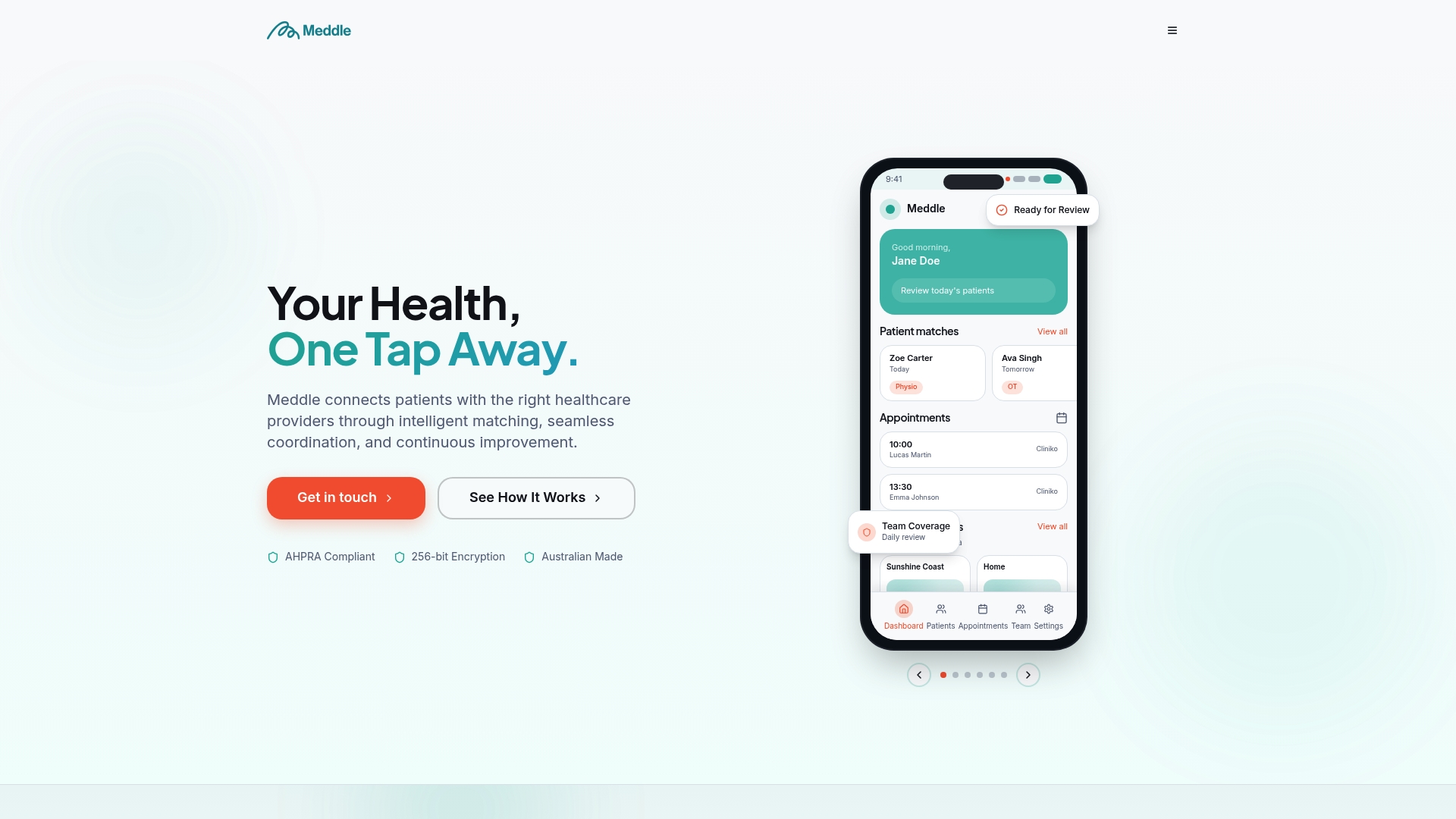
Writing rules is the easy part. Applying them every time, across email, GP letters and web forms, is where clinics lose leads and hours. Meddle turns referrals from those channels into structured intake, triage and practitioner matching, and integrates with your practice management system and writes back to your CRM.
Pricing is A$40 per user per month ex GST, or A$400 per user per year ex GST (two months free). Every user pays the same, including admins and coordinators, and everything is included with no add-ons. You can start with a free 30-day pilot. See Meddle pricing or the product overview.
Our view: rules should live in the workflow, not in a folder
Most clinics we talk about have a referral policy somewhere. The trouble is that a policy in a shared drive does not route anything. Staff fall back on memory, and memory varies between the front desk on Monday and the one on Friday.
We think the rules should be part of the intake itself: the same fields for every referral, the same triage questions, matching on specialty, travel radius and appointment type, and a visible owner at every stage. Directories list who is out there. We designed Meddle to connect the person to the right care and carry the story forward, so the practitioner starts with the referral context rather than a blank page.
Start small. Pick your five most common referral types, write one rule for each and run them through a pilot.
Taylor
FAQ
How many routing rules does a clinic need?
Start with five to ten covering your most common referral types, plus one urgent rule and one fallback for unmatched referrals. Add rules only when a real referral does not fit. Too many rules make the system harder for staff to follow.
What is the difference between triage and routing?
Triage decides how urgent a referral is and whether you can accept it. Routing decides where it goes: which practitioner, team or queue. In practice you apply them together, with triage setting the priority and routing setting the destination.
Can we accept referrals by email?
That is your clinic’s decision, but identifying health information should travel by a secure channel. Some funders refuse emailed referrals containing identifying details, as CESPHN’s guidance shows. A secure web form is a safer default for referrers.
How long should a clinic take to respond to a referral?
Set limits you can meet and measure. Public examples include a 72-hour accept-or-decline window and first appointment within four weeks at CESPHN, and a 24-hour phone response for suicide-risk referrals at Murray PHN. Match your limits to the funders and referrers you serve.
Can we try Meddle before committing?
Yes. There is a free 30-day pilot, and you can run a handful of your real referral types through it before deciding.
If you want to see your own rules running in a workflow, book a 30-minute demo.
Sources
- Murray PHN, Part A Program Guidelines
- SVHM, Allied Health NDIS Service Delivery Procedure
- CESPHN, Psychological Support Services Guidance
- All About Kids, Participant Handbook
- NDIS, connecting with participants as a support coordinator
- NSW Ministry of Health, Privacy Manual for Health Information
- NDIS Commission, Practice Standards and Quality Indicators
- MHCC, Embracing Change: NDIS Practice Standards Guidebook
Recommended
- Referral Acceptance Rules for Australian Allied Health Clinics
- From Referral to Booking: A Workflow for Allied Health Clinics
- Fair Referral Distribution in Allied Health Clinics
- GP Referral Process in Australia: A Guide for Allied-Health Clinics
This article is general information for healthcare businesses and isn’t legal, clinical or privacy advice. Check current requirements with the relevant regulator or a qualified adviser.