Hybrid care workflow for Australian allied health

A hybrid care workflow coordinates virtual and in-person care under one governance structure and one shared record, so a patient’s journey stays continuous no matter which channel they use. The single design priority is integration: clinical governance and recordkeeping have to work as one system, not two parallel ones. Teams building this should expect to work within the National Model for Clinical Governance, AHPRA’s telehealth guidance and the Privacy Act’s Australian Privacy Principles.
TL;DR:
- AHPRA requires telehealth consultations to meet in person standards, while questionnaire only models are generally unsuitable for prescribing or diagnosis in most circumstances.
- Map the current journey with clinicians, administrative staff, IT, and ideally a patient or carer; record modality rationale and use identical documentation fields across channels.
- Before launch, secure governance approval and complete a privacy impact assessment; confirm EMR integration, secure video, consistent consent templates, escalation paths, and written failure plans.
- Track modality mix, missed appointment rates, time to specialist, and medication errors at transitions; audit documentation, consent logs, and automated recommendations on a fixed schedule.
Table of Contents
- What a hybrid care workflow needs to cover
- Clinical governance and regulatory expectations
- Mapping your workflow before you touch any technology
- Implementation checklist from governance sign-off to go-live
- Technology and interoperability that prevent rework
- Roles, staff engagement and change management
- Measuring, auditing and improving the workflow
- Example: a coordination platform supporting a hybrid workflow
- What frontline adoption actually teaches you
- How Meddle supports hybrid care workflow implementation
- FAQ
- Sources
What a hybrid care workflow needs to cover
A working hybrid model needs six moving parts that all talk to each other: triage, the modality decision, scheduling, documentation, escalation and follow-up. Miss one and you get a patient who repeats their history three times or a referral that stalls between systems.
Picture a typical journey: a GP refers a patient for musculoskeletal pain, a virtual triage call confirms urgency and suitability for telehealth, a remote consult handles initial assessment and education, an in-person session covers hands-on treatment, and a shared care plan closes the loop with the referrer. Each handover needs the same record, the same consent status and the same clinical notes visible to the next clinician.
- Triage sets the modality and urgency before any appointment is booked.
- Scheduling reflects the chosen modality and any follow-up already flagged.
- Documentation travels with the patient across every touchpoint, virtual or in-person.
- Escalation pathways are predefined for when a virtual session reveals an in-person need.
Clinical governance and regulatory expectations
Digitally enabled care has to sit inside clinical governance from the outset, not bolt onto it afterwards. The Australian Commission on Safety and Quality in Health Care treats governance, virtual care quality and standardised data as one priority area, which means a hybrid workflow is a clinical governance decision as much as an operational one.
- AHPRA expects telehealth consultations to meet the same standard as an in-person visit, with real-time contact and full documentation.
- Asynchronous questionnaire-only models are flagged as unsuitable for prescribing or diagnosis in most circumstances.
- The 2024 Privacy Act amendments raise transparency requirements for any automated system processing personal health information.
Automated decision-making in patient matching or triage now carries a specific transparency obligation under the 2024 Privacy Act amendments. Any service using algorithmic triage or matching needs to be able to explain, in plain language, how that system reached its recommendation.
Mapping your workflow before you touch any technology
Workflow mapping works best as a facilitated session, not a document someone writes alone at a desk. Bring in a clinical lead, an admin representative, someone from IT and, where possible, a patient or carer who has lived through the current process.
- Map the current state first, including every handoff, so gaps are visible before new technology hides them.
- Build a swimlane diagram that separates clinician actions, admin actions and patient actions across virtual and in-person tracks.
- Write explicit modality-decision rules, so staff aren’t guessing whether a case belongs in a video consult or an in-person slot.
- Lock documentation standards so a virtual note and an in-person note capture the same fields, in the same place.
Our Agency for Clinical Innovation notes that mapping the patient journey and the administrative back-end at the same time is what prevents siloed records later. A telehealth versus in-person advisor tool can help formalise those modality rules so they’re consistent across a team rather than left to individual judgement.
Pro Tip: Record the clinical rationale for each modality choice directly in the patient file, it doubles as both a quality signal and an audit trail.

Implementation checklist from governance sign-off to go-live
Treat implementation as a sequence, not a single launch event. Skipping the governance and risk steps to get to a go-live date tends to create rework later.
- Secure governance sign-off and complete a privacy impact assessment before any patient-facing changes.
- Engage frontline clinicians and admin staff early, their process knowledge catches gaps a planning document misses.
- Confirm technology readiness, including EMR integration and secure video capability.
- Set scheduling rules that reflect modality-decision logic, not just calendar availability.
- Finalise consent and documentation templates so they’re identical in substance across channels.
- Train staff, run a pilot cohort and define escalation and tech-failure contingencies before scaling.
- Governance sign-off and a privacy impact assessment come first, not last.
- A pilot cohort with a clear monitoring schedule catches problems while they’re still small.
- Contingency plans for technology failure need to be written down, not assumed.
Our data governance guidance for healthcare sets out five procurement-stage pillars worth checking against before any contract is signed.
Technology and interoperability that prevent rework
The platform underneath a hybrid workflow has to move data without forcing anyone to re-enter it. That means secure video, single sign-on, an API connection into the existing EMR, audit trails and in-platform messaging as baseline requirements, not nice-to-haves.
- Confirm interoperability with My Health Record and FHIR/HL7 standards before signing anything, not after.
- Use store-and-forward only where it suits the clinical scenario, not as a default replacement for real-time contact.
- Check audit trail depth: who accessed a record, when, and what an automated system recommended and why.
- Review vendor support model and data flow diagrams as part of procurement, not as an afterthought.
Our guide to securing patient records under APP 11 covers the access-control side of this in more detail.
Roles, staff engagement and change management
Hybrid workflows fail more often from unclear ownership than from bad technology. A clinical lead, a virtual care lead, an IT lead and allied health coordinators each need a defined scope, with overlap deliberately minimised.
- Co-design the workflow with the staff who’ll run it daily, not just managers who’ll report on it.
- Use shadowing and short training sprints rather than one long onboarding session.
- Build a feedback loop so clinicians can flag friction points within weeks, not at the annual review.
Pro Tip: Protect clinician time by auditing for duplicate data entry early, that single fix often does more for adoption than any training session.
Measuring, auditing and improving the workflow
A hybrid workflow needs the same scrutiny as any clinical process: metrics, audits and a defined improvement cycle. Track modality mix, no-show rates, time-to-specialist and any medication errors linked to transitions between virtual and in-person care.
- Audit documentation completeness and consent logs on a fixed schedule, not only when something goes wrong; for example, ensuring patients have a valid ESA doctor’s note when required.
- Check that automated decision-making remains explainable, in line with the 2024 Privacy Act amendments.
- Run PDSA cycles and report findings back to clinical governance on a set cadence.
Embedding digitally enabled care inside clinical governance, rather than treating it as a separate IT initiative, is a stated priority of the Australian Commission on Safety and Quality in Health Care. That framing matters because it puts hybrid workflow performance on the same reporting line as every other clinical safety metric.
Example: a coordination platform supporting a hybrid workflow
Meddle pairs AI-powered matching with scheduling, messaging and practice management tools built for allied health settings, which lines up with several items on the implementation checklist above.
- AI-based matching routes a patient to the practitioner suited to their needs, which supports consistent triage.
- Referral automation cuts the manual re-entry that usually happens between a referrer and a receiving clinic.
- Built-in scheduling and reminders reduce the admin load of running two parallel booking systems for virtual and in-person slots.
- Privacy measures are built into the matching and messaging flow, supporting the documentation and consent consistency a hybrid model needs.
What frontline adoption actually teaches you
Clinicians adopt a hybrid workflow when it visibly saves them time within the first few weeks, not when a policy document says it should. We’ve found that involving frontline staff before a rollout, rather than after, surfaces the friction points that matter most. Start with one pilot, measure one or two outcomes well, and let that evidence carry the next phase of rollout.
— Taylor
How Meddle supports hybrid care workflow implementation
Setting up a hybrid workflow usually means juggling several disconnected tools for matching, scheduling and messaging, and that’s exactly where our platform removes a layer of admin. We built Meddle so clinics can run AI-powered patient matching, scheduling, secure messaging and referral handling from one connected system, rather than stitching several logins together.
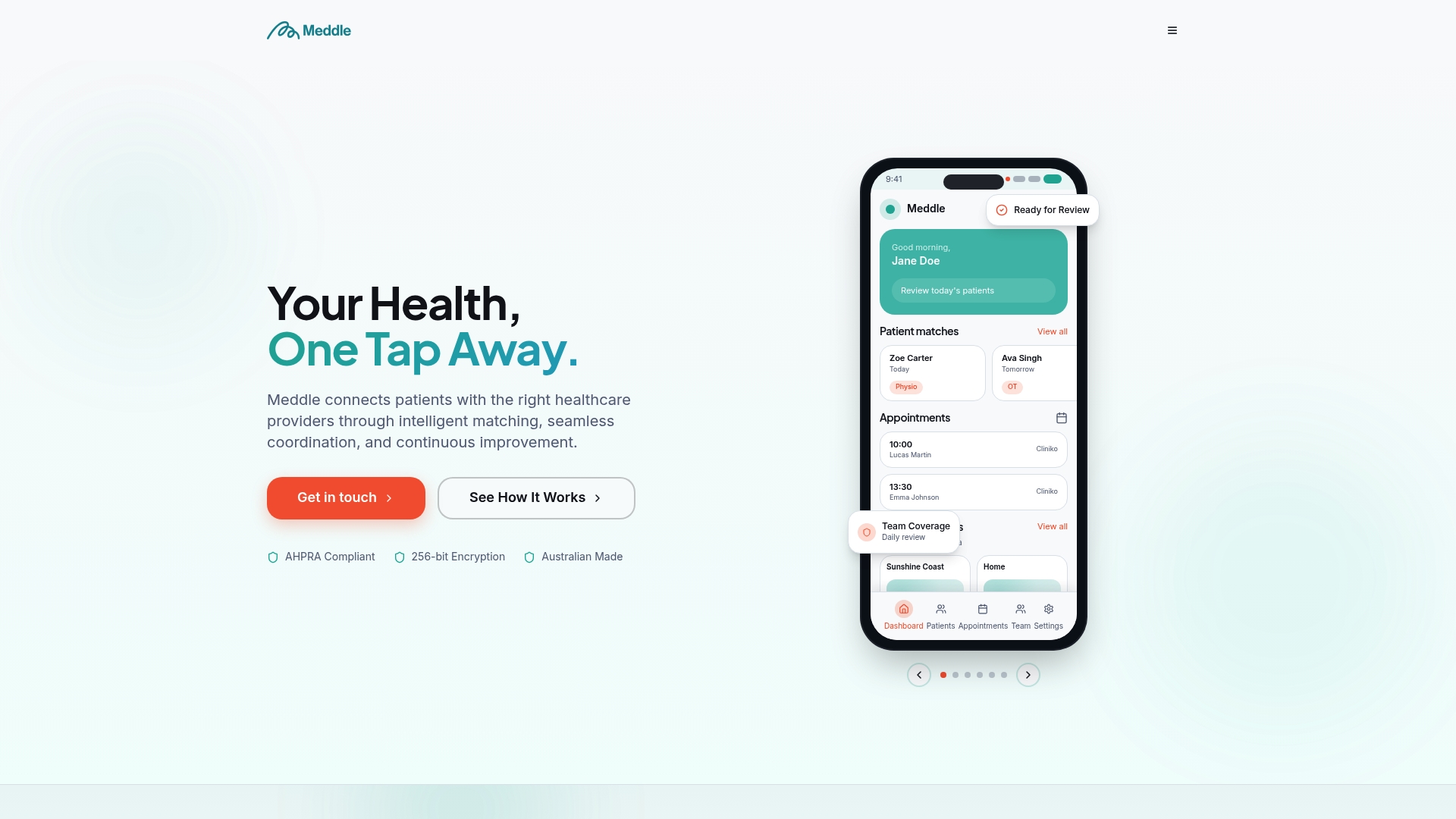
- Our patient matching and coordination tools support the triage and modality-routing steps covered above.
- Find care shows how patients experience the matching process from their side.
- Add-ons like SMS Notifications and CRM Integration, each $50 AUD per month per practice, extend the core platform where a clinic needs them.
If you’re mapping out a hybrid rollout for your own service, check our pricing page or request a walkthrough of how the platform fits your current workflow.
This article is general information, not a substitute for advice from a qualified doctor. Consult a qualified healthcare professional about your own circumstances before acting on anything here.
FAQ
Can you give an example of a hybrid workflow in healthcare?
A common example starts with a GP referral, moves to a virtual triage call to confirm urgency and suitability, continues with a remote consult for initial assessment, and finishes with an in-person session for hands-on treatment. Each step shares the same documentation and consent record, so no information is lost between virtual and in-person touchpoints.
What is hybrid healthcare?
Hybrid healthcare combines virtual and in-person care delivery under one shared governance structure and one patient record, rather than running them as separate systems. The goal is continuity: a patient can move between modalities without repeating information or losing clinical context.
What does a hybrid approach to therapy involve?
In therapy and allied health settings, a hybrid approach usually means some sessions happen by video and others in person, chosen based on clinical suitability rather than convenience alone. The Agency for Clinical Innovation recommends documenting the rationale for each modality choice as part of standard practice.
What is a hybrid medical record?
A hybrid medical record captures information from both virtual and in-person encounters in a single, consistently structured file, so no part of a patient’s history sits in an isolated system. This consistency is what allows audits, consent tracking and automated decision transparency, required under the 2024 Privacy Act amendments, to function properly.
How do clinics fund hybrid care arrangements?
Funding typically combines existing Medicare telehealth items, in-person consultation billing and, for clinics using a coordination platform, a subscription cost for the scheduling and matching software itself. Plans like Meddle’s Simple Rollout are priced on request, while add-ons such as SMS Notifications sit at $50 AUD per month per practice.
Sources
- Priorities for high-quality digitally enabled care | Australian Commission on Safety and Quality in Health Care
- Good virtual care practices | AHPRA and the National Boards
- Parliamentary bills and legislation (Privacy and Other Legislation Amendment Act 2024)