Provider Handoff Communication: Quick Steps, Checklists for Busy Teams

Provider handoff communication is the transfer of clinical responsibility and information between clinicians at points of care transition. The single best action any team can take now is to adopt a structured, standardised approach such as ISBAR, paired with clear documentation and a verification step. This combination consistently reduces communication errors and keeps clinical accountability visible at every handover.
TL;DR:
- Using a structured handoff method like ISBAR greatly reduces communication errors and improves accountability during all care transitions.
- Customized variations like iSoBAR are recommended for complex transfers, with a core set of information remaining consistent across settings.
- Keeping handovers brief, focused, and free of interruptions enhances accuracy, especially for high-risk deteriorating or perioperative patients.
- Incorporating visual aids, templates, and digital records helps ensure information completeness and quick access for incoming clinicians.
- Engaging staff gradually, with leadership support and regular audits, increases adoption and maintains high-quality handover standards.
Table of Contents
- Types of handoffs and when they happen
- Structured frameworks: ISBAR, iSoBAR and flexible standardisation
- Practical strategies and tools for time-poor teams
- Barriers to good handoff and how to drive change
- Patient involvement and safe discharge communication
- Practitioner tools that reduce handoff friction
- What realistic change actually looks like
- Where Meddle fits into a smoother handoff
- Resources for building your own handover toolkit
- Sources
- FAQ
Types of handoffs and when they happen
Handoffs occur constantly across a patient’s care, and each type carries its own risks. Recognising which scenario you are in shapes how much structure and time the handover needs.
- Shift-to-shift handover: the routine transfer of a full patient load between nursing or medical teams at change of shift.
- Bedside handover: information exchanged at the patient’s side, often combined with a visual check and patient involvement.
- Perioperative handover: transfer from ward to theatre, recovery and back, where medication and procedural details change rapidly.
- Inter-hospital transfer: movement of a patient between facilities, often across services with no shared record.
- Discharge handover: transfer of ongoing responsibility to primary care or community services.
Transitions are high-risk because information can be lost, assumed or misheard in the gap between one clinician’s shift and another’s. Complex or deteriorating patients benefit most from bedside involvement, while stable caseloads can often move through a centralised, structured handover.
Structured frameworks: ISBAR, iSoBAR and flexible standardisation
ISBAR, standing for Identify, Situation, Background, Assessment and Recommendation, gives clinicians a shared shape for what to say and in what order. Identify names the patient and the person handing over; situation states the immediate problem; background gives relevant history; assessment covers current findings; recommendation states what needs to happen next. The national patient safety strategy supports this kind of structured, standardised handover because it consistently reduces the risk of missed information.

For inter-hospital transfers, iSoBAR adds an identification and situational awareness step suited to handovers between teams that have never met the patient. Some services use local variants, such as Blue BARRWUE, to fit specific specialties, and that is expected: the Communicating for Safety standard asks health services to define their own minimum information content rather than force one script onto every context.
This is the principle of flexible standardisation: a mandatory core of fields (patient identifiers, current status, risks, actions required) stays fixed, while local teams adapt language and sequence to their setting. Pairing ISBAR with a documentation method, whether a printed template, an electronic handover tool or a shared whiteboard, closes the loop between what is said and what is recorded.
- Printed or electronic templates that mirror the ISBAR sequence.
- A single electronic record accessible to both outgoing and incoming clinicians.
- Visual aids such as whiteboards for at-a-glance status tracking on a ward.
Pro Tip: Keep a laminated ISBAR prompt card on every trolley or workstation. It costs almost nothing and removes the “what do I say first” hesitation that slows busy handovers.
Practical strategies and tools for time-poor teams
Good handover does not require a longer conversation, it requires a more disciplined one. A handful of habits, applied consistently, do most of the work.
- Open with identification and situation before background detail, so the receiving clinician immediately knows who and what they are dealing with.
- State the recommendation last and confirm the receiving clinician has understood it, using a brief read-back or check-back.
- Document once, in one place: avoid parallel handover books or sticky notes that duplicate what is already in the chart.
- Use a pocket ISBAR prompt or short electronic template rather than free text, since standardised templates measurably increase the completeness of information handed over compared with free-text notes.
- Match handover length to complexity: a stable patient needs thirty seconds, a deteriorating one needs the full structure plus a bedside check.
Minimising interruptions during handover matters as much as the content. A protected few minutes with no phone calls or drop-in questions does more for accuracy than any extra field on a form.
Pro Tip: For your highest-acuity patients, add a one-line “if this changes, call me” instruction at the end of the recommendation. It turns a passive handover into an active safety net.
Barriers to good handoff and how to drive change
Most handover failures are not knowledge gaps, they are workload and habit problems. Time pressure, inconsistent attendance at handover, legacy paper habits and competing clinical priorities all erode even a well-designed process.
- Identify a champion on each shift who models the structured format and gently corrects drift.
- Introduce change in small, incremental steps rather than replacing an entire handover process overnight.
- Pair any new template with brief training and simulation, not just a memo.
- Run short audit cycles on ISBAR element completeness and feed results back to the team quickly.
Success shows up in measurable ways: completeness of handover elements, incident rates linked to communication, and staff-reported comfort with the process. Leadership’s job is to set the policy, protect the time needed for handover, and make role responsibilities during handover unambiguous, since accountability during delegation sits with the delegating clinician under professional practice standards.
Patient involvement and safe discharge communication
Bedside handover works best for patients who can meaningfully participate or whose family and carers hold information the outgoing team may not know. It gives the patient a chance to correct errors in real time and gives the incoming clinician a visual check alongside the verbal one.
Discharge is its own handover, and the electronic discharge summary is the record that carries it. A safe eDS should include diagnosis, procedures performed, allergies, medication changes and follow-up actions, sent promptly to the patient’s usual GP or ongoing care team.
- Confirm medication changes are stated explicitly, not just listed among unchanged items.
- Name the person or service responsible for each follow-up action.
- Send the eDS to primary care as close to discharge as possible, since delay is itself a risk factor.
Practitioner tools that reduce handoff friction
Templates and shared systems do the quiet work of making structure stick. Referral templates that mirror ISBAR fields, a secure messaging checklist for check-back confirmations, and shared scheduling all cut down on the missing details that cause rework at handover.
- Pre-built referral templates that map to ISBAR fields save clinicians from reconstructing structure from scratch each time.
- A secure messaging checklist supports read-back and confirmation steps without extra phone tag.
- Shared scheduling and a single digital record reduce the risk of two versions of the truth existing at once, a point also covered in guidance on secure document sharing.
These are supports, not replacements for clinical judgement or the audits that keep any handover process honest.
What realistic change actually looks like
Staff acceptance, not knowledge, is the real barrier to better handover. Expect resistance even when the evidence is clear, and start with one pilot unit rather than a service-wide mandate. Prioritise your highest-risk handoffs first: deteriorating patients, perioperative transfers and discharges with complex medication changes. Visible auditing and a prompt built into the daily workflow do more than a policy document ever will.
— Taylor
Where Meddle fits into a smoother handoff
Meddle will not replace ISBAR or your team’s clinical judgement, and it is not meant to. What it offers is a practical layer underneath structured handover: ready-made referral templates, a secure messaging checklist for confirmations, and shared scheduling that keeps one version of the record visible to everyone involved.
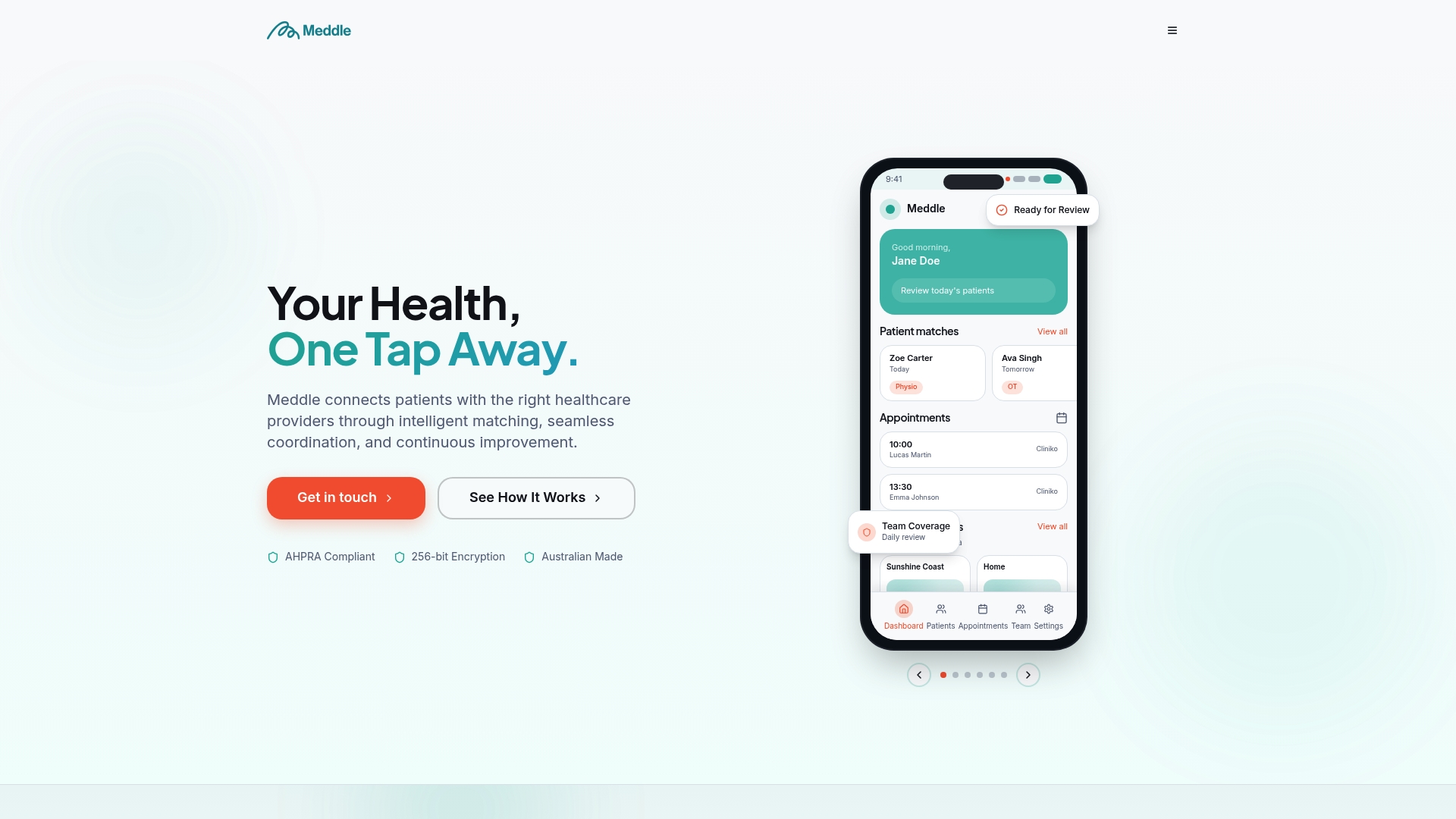
A clinic can pilot these features alongside an existing ISBAR rollout without changing how clinicians talk to each other, only how the supporting information is captured and shared. If your team wants to see how the platform fits alongside your current handover process, explore how Meddle works.
Resources for building your own handover toolkit
- The Communicating for Safety portal hosts the OSSIE guide and implementation toolkits.
- ISBAR posters and e-learning support inter-hospital transfer training.
This article is general information, not a substitute for advice from a qualified doctor. Consult a qualified healthcare professional about your own circumstances before acting on anything here.
Sources
- Going home from hospital — Healthdirect
- Improving emergency department medical clinical handover: Barriers at the bedside — PMC
- Communicating for Safety — Implementation resources
- Communicating for safety — NSQHS standards
FAQ
What does “handoff communication” mean?
Handoff communication is the transfer of professional responsibility and accountability for a patient’s care from one clinician or team to another. It typically includes identifying the patient, current status, relevant history and what action the receiving clinician needs to take, as defined under the NSQHS Communicating for Safety standard.
What are the 5 key principles of clinical handover?
Clinical handover should be accurate, unambiguous, timely and structured, with a clear transfer of both information and accountability. National guidance asks services to define the minimum information content expected for each type of handover rather than leaving it to individual habit, as outlined by the NSQHS standards.
What are the 5 C’s of communication in medical terms?
There is no single nationally endorsed “5 C’s” framework for clinical handover, and definitions vary between organisations and training programmes. The structured framework with the strongest backing in national guidance is ISBAR, covering identification, situation, background, assessment and recommendation.
What is handoff in communication?
In a clinical setting, handoff refers to the point where one clinician passes responsibility for a patient’s ongoing care to another, whether at shift change, transfer between facilities or discharge. Structured formats such as ISBAR are used at this point to make sure nothing critical is missed or misunderstood, an approach supported by national implementation resources.