Reduce Referral Leakage in Australian Clinics: Track, Fix 5 Gaps

The quickest way to reduce referral leakage is to pair standardised referral governance with closed-loop digital tracking. The national standards point the same way: the NSQHS Communicating for Safety standard and RACGP guidance both favour clear criteria, confirmed receipt and secure digital referrals. Below we cover measurement, process changes and tooling.
TL;DR:
- Clinics should track referral completion, time to appointment, stage drop off, source conversion, and no shows, segmented by referrer, service, and patient cohort.
- Before adopting software, clinics should publish acceptance criteria, standardize the form, assign each referral an owner through attendance, and set response deadlines and escalation steps.
- Digital tools should provide secure referrals, confirm receipt to both parties, show status updates, support booking, and limit shared health information to what is necessary.
- Clinics should explain the referral and arrange booking before patients leave, then send reminders and ask about cost, transport, or childcare barriers.
- Pilot one service or high volume source, establish baseline measures, train staff on escalation, and revise the form using referrer feedback before expanding.
Table of Contents
- Why does referral leakage matter for patients and your clinic?
- What causes referral leakage in the first place?
- Which metrics show where referrals are leaking?
- What operational changes close the loop fastest?
- Which digital tools actually close the loop?
- How can providers collaborate better across disciplines?
- How do you get patients to follow through on a referral?
- What training do staff need to reduce referral leakage?
- How does referral leakage affect compliance and regulatory standards?
- Roll out in small steps and fix the form first
- How we help you put the playbook into practice
- FAQ
- Sources
Why does referral leakage matter for patients and your clinic?
Leakage is not only a revenue problem. When a referral stalls, the patient waits, the referrer loses sight of the outcome and the care plan quietly breaks. The Communicating for Safety portal highlights that structured, two-way communication reduces the information failures that lead to poor outcomes, and practitioner research links communication failures to errors and post-discharge readmissions.
The harm shows up on both sides of the referral:
- Patient safety: delayed or lost referrals interrupt treatment and continuity of care.
- Clinical trust: referrers who never hear back stop referring to that service.
- Lost volume: appointments that never get booked are revenue that never arrives.
- Administrative waste: staff chase documents and statuses by phone instead of treating patients.
- Fragmented care: patients drift out of network without anyone noticing.
Documentation gaps carry a cost too. A partner article on outpatient documentation describes how missing detail turns into revenue leakage, which is the same pattern referral teams see when a form arrives incomplete.
What causes referral leakage in the first place?
Most leakage traces back to a handful of failure modes. Inspect these first, because fixing them removes the bulk of lost referrals.
- Paper and fax processes. Operational experience shows manual, paper-based referrals are a primary driver of leakage, with lost documents, incorrect patient details and no status notifications.
- No closed loop. The sender never receives confirmation of receipt, so neither the referrer nor the patient knows where the referral sits.
- Vague criteria and poor documentation. When referrers do not know what a service accepts, or send thin clinical detail, the receiving team has to chase or reject.
- Access and capacity barriers. Long waits, unclear availability and travel burdens push patients to whichever provider can see them first.
- Unclear ownership. If nobody is named as responsible for a referral, nobody follows it up.
None of these needs new technology to diagnose. Reviewing stalled referrals can help surface these failure modes.
Which metrics show where referrals are leaking?
You cannot fix what you cannot see. Start with five measures:
- Referral completion rate: the share of referrals that end in an attended appointment.
- Time to appointment: days from referral received to first visit.
- Step-wise drop-off: where referrals fall away between received, triaged, contacted, booked and attended.
- Source to conversion: which referrers and sources turn into attended appointments.
- Post-referral no-show rate: patients who book but do not attend.
Authoritative guidance asks organisations to define expected time frames, escalation steps when there is no response, and to support closed-loop communication (Communicating for Safety guidance). Those time frames become your measurement baseline: a referral that breaches its window is a leak you can count.
Segment every metric by referring clinician, service type and patient cohort. An overall completion rate hides the fact that one referral source or one service line may account for most of the loss. Analytics only earn their place when they trigger a response, so decide in advance what happens when a number moves: where drop-off is largest, that step gets fixed first.
A simple dashboard needs only a funnel view by stage, a list of referrals past their response window, and a table of completion rate by referrer. Our referral analytics playbook walks through these views in more detail.
What operational changes close the loop fastest?
Governance does the heavy lifting here. The Australian Commission on Safety and Quality in Health Care recommends referral processes that set clinical criteria, the method for making the referral, expected response time, follow-up and escalation, with standardised documentation. South Australian guidance adds that escalation paths and methods for expediting urgent cases protect continuity of care.
Roll the changes out in order of effort:
- Publish referral criteria. State who the service accepts, what it treats and what it cannot take, so referrers send suitable patients.
- Standardise the template. Capture a minimum clinical dataset on one form so receiving staff are not chasing basics.
- Set response-time SLAs. Agree how fast a referral is acknowledged, triaged and booked, and how urgent cases jump the queue.
- Name an owner for every referral. One person is accountable from receipt to attended appointment.
- Define the escalation path. Specify who is alerted when a referral breaches its window.
- Schedule proactive follow-up. Administrative staff contact patients who have not booked, and clinical staff review stalled complex cases.
- Move to secure e-referrals with status updates. This is the short-term step after the quick wins above.
- Integrate with clinical systems and analytics. The longer-term step, once the process underneath is stable.
Pro Tip: Fix the form before you automate it. A digital version of a poor template only delivers incomplete referrals faster.
For a step-by-step version, see our guide to closing the referral loop, and for routines that lift conversion, our clinic playbook.
Which digital tools actually close the loop?
Good referral technology does a few specific things well. Digital referral platforms can auto-populate patient data, attach imaging and documents, deliver secure referrals instantly and let clinicians and patients watch progress in real time, which cuts manual follow-up.
When you evaluate options, look for these capabilities:
- Secure electronic referrals with auto-population from clinical records
- Attachments for imaging, pathology and letters
- Real-time status tracking visible to referrer and receiver
- Two-way confirmations so receipt is acknowledged, not assumed
- Availability lookup tied to scheduling, so patients are booked at the point of referral
- SMS notifications for patients and referrers
- CRM integration so operational follow-up does not live in spreadsheets
Privacy deserves equal attention. OAIC guidance explains that health information may be used or disclosed for directly related purposes, that consent is needed for secondary purposes, and that disclosure should be limited to the minimum necessary. The guide to health privacy adds that sharing within the treating team is reasonable when explained to the patient.
Digital workflows also help with timing. RACGP guidance on referrals covers referral timeframes and the use of secure electronic systems that retain records. Submitting in real time avoids the backdated referrals that create compliance trouble.
How can providers collaborate better across disciplines?
Referral leakage is often a relationship problem wearing a process costume. When a GP, a physio and a psychologist each hold part of the picture, nobody sees where the patient dropped out.
Start with shared expectations. Agree, between referrers and receivers, what a good referral contains and how quickly each party will respond. Short, regular case huddles between a service and its top referrers surface problems faster than any dashboard, because people say what the data cannot.
Feedback closes the loop on the clinical side. A brief outcome note back to the referrer, even two lines, shows the referral mattered and keeps them sending patients your way. Give every referral a named point of contact on each side, so a query goes to a person rather than a generic inbox.
Finally, make the other team’s work visible. When referrers can see availability and referral status in one shared view, they stop guessing and stop redirecting patients elsewhere out of frustration.
How do you get patients to follow through on a referral?
A referral is only complete when the patient attends. Patients drop out for ordinary reasons: they are unsure why they were referred, find booking awkward, worry about cost or simply forget.
Make the next step easy while the patient is still in the consulting room. Explain why the referral matters, who they will see and what to expect. Where possible, book the appointment before they leave, or hand them a direct way to choose a time.
Reminders do steady work after that. SMS notifications and a prompt follow-up call for anyone who has not booked within a set window recover many patients who would otherwise slip away. Ask about barriers directly: transport, cost, childcare, confidence about the service. A patient who names a barrier can be helped over it.
Patient-facing tools help here too. Our Find care page lets patients see matched practitioners and book, which shortens the gap between being referred and being seen. Clinics can also restrict bookings by referral where that suits their governance.
What training do staff need to reduce referral leakage?
Process changes fail when staff do not understand why they exist. Training turns a new template and a set of response times into habit.
Cover three things. First, the purpose: show staff the journey of a lost referral from the patient’s side, so closed-loop communication feels like safety work rather than paperwork. Second, the mechanics: how to complete and triage the standard template, how to record status, and when and how to escalate. Third, the data: how to read the dashboard and what action each warning triggers.

Keep sessions short and practical. Run them with real, de-identified examples from your own stalled referrals, and repeat them when new staff join or a workflow changes. Refresher prompts matter because referral handling is routine work, and routine work drifts.
Frontline administrative staff deserve particular attention. They touch every referral, they see the problems first, and they are often the people who decide whether a stalled case gets chased or quietly closed. Give them clear authority to escalate without waiting for permission.
How does referral leakage affect compliance and regulatory standards?
Leakage can become a governance issue, not only an operational one. The Comprehensive Care Standard recommends systems that ensure timely referral to relevant services and identify the clinician with overall accountability for a patient’s care. A referral process with no owner and no tracking sits uneasily against that expectation.
Communication standards carry the same weight. The Communicating for Safety Standard describes when structured handover and communication of critical information are required, and recommends reviewing policies at transitions of care. Referrals are exactly that kind of transition.
Privacy is the third strand. The OAIC health privacy chapter expects referral disclosures to be proportionate, recorded and protected, with secure electronic communication where appropriate. Faxes and unsecured email sit poorly against that expectation.
Treat the audit trail as a benefit. A tracked, time-stamped referral gives you evidence that you met your timeframes and kept information protected, which is far easier to defend than a paper trail that has gone missing.

Roll out in small steps and fix the form first
Our view: most referral programs stall because teams reach for software before they agree who owns what. Start with one service or one high-volume referral source and measure it for a few weeks. A small pilot gives you real numbers, a working template and a story other clinicians will believe.
Win referrers over with time saved, not with a policy memo. Show them the short template, show them the status view, and publish a quick metric such as time to first appointment so progress stays visible. Ask for feedback and change the form when they tell you something is clumsy.
The common pitfalls are predictable. Automating a poor referral form speeds up bad data. Unclear ownership leaves every escalation path empty. Skipping the baseline measurement means you cannot show improvement later. Our pilot guide sets out a sequence that avoids these pitfalls. Legacy habits also resist change, and a partner knowledge-hub piece on legacy oversight is a useful read on how that plays out in digital projects.
— Taylor
How we help you put the playbook into practice
We built Meddle so clinics can run this playbook with less manual effort, and you can see how it fits your own workflow on our how it works page.
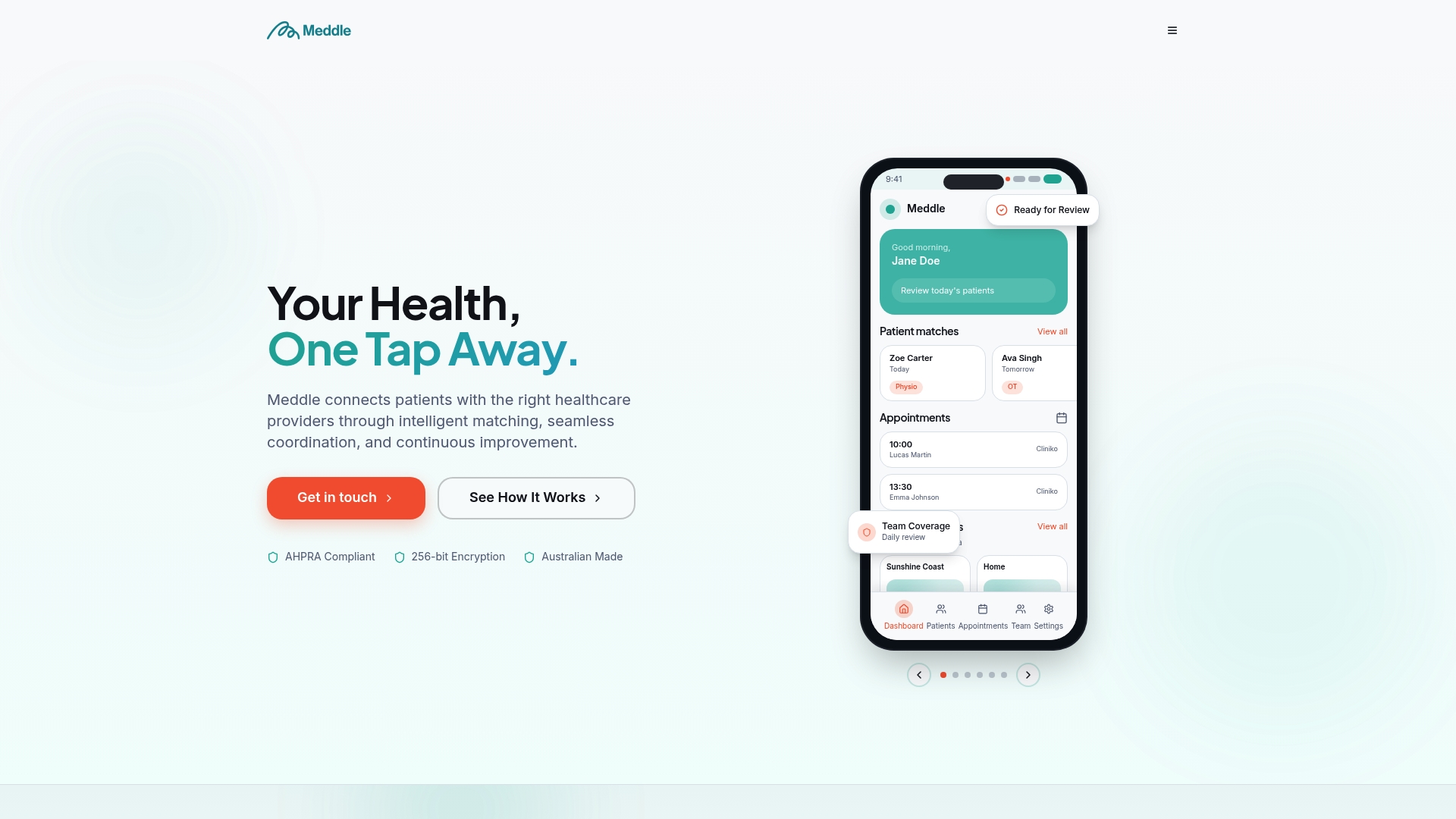
Here is how our capabilities map to the steps above:
- AI matching pairs each patient with a suitable practitioner.
- Referral automation helps reduce manual follow-up.
- SMS notifications are available for 50 AUD per month per practice.
- CRM integration moves operational follow-up out of spreadsheets, also 50 AUD per month per practice.
Both add-ons are listed on our pricing page, alongside Simple Rollout and White Labelling. Review how it works, check pricing, or ask us for a demo to see whether it fits your referral workflow.
This article is general information, not a substitute for advice from a qualified doctor. Consult a qualified healthcare professional about your own circumstances before acting on anything here.
FAQ
What does referral mean in medical terms?
A referral is a formal request from one clinician for another practitioner or service to assess or treat a patient. It usually carries relevant clinical information so the receiving team can act without starting from scratch.
What does leakage mean in medical terms?
In referral management, leakage describes referrals that never reach an appointment with the intended in-network service. Patients may go elsewhere, never book or simply be lost between steps.
What are the guidelines for referrals in Australia?
The Australian Commission on Safety and Quality in Health Care recommends referral processes with clinical criteria, expected response times, follow-up and escalation, plus standardised documentation. RACGP guidance covers referral timeframes and secure electronic referral use.
How do you market to physicians for referrals?
Make referring easy and show results. Offer a short template, quick acknowledgement and a brief outcome note back to the referrer, which builds the trust that keeps referrals coming.
How can a clinic stop referral leakage quickly?
Set clear referral criteria, name an owner for each referral and track status until the patient attends. Adding secure digital referrals with confirmations closes the loop that paper processes leave open.
Sources
Standards and examples to follow up when you implement these changes.