Close the referral loop in allied health practices

A closed-loop referral is one that is tracked from the moment it’s sent until you have a confirmed acknowledgement and a documented clinical action on file. That’s the whole definition: confirmation plus a recorded next step. If your practice does one thing this month, make tracking and acknowledgement the default for every referral you send, guided by the expectations set out in the Communicating for Safety Standard and the structured data fields in Service Referral v2.0.
TL;DR:
- Ensuring each referral moves through sent, acknowledged, triaged, actioned, and closed statuses with clear ownership reduces silent failures and enhances patient safety.
- Using standardized templates and defined response timeframes streamlines referral tracking and minimizes errors caused by manual data entry and system fragmentation.
- Implementing shared technical standards like Service Referral v2.0 and secure messaging improves interoperability and automates acknowledgment receipt and structured content exchange.
- Regularly auditing key metrics such as acknowledgment rates and report return times helps identify and address bottlenecks in closing referral loops.
- Starting with high-volume, problematic referral pathways for pilot projects allows for measurable improvements before scaling to wider clinical processes.
Table of Contents
- What a closed-loop referral looks like in practice
- Why closing the referral loop matters for patient safety and outcomes
- Common barriers that prevent referral loops closing
- Practical checklist: how to design or fix a closed-loop referral process
- Digital standards, interoperability and technologies that enable closed-loop referrals
- Measure, audit and improve: metrics and QI approaches to keep loops closed
- Practical example: how a coordinated referral platform can support closed loops
- Author perspective: frontline priorities when closing referral loops
- How the publisher can help: a concise, honest CTA for clinics wanting to pilot closed-loop referral tools
- Sources
- FAQ
What a closed-loop referral looks like in practice
A referral moves through five recognisable states: sent, acknowledged, triaged, actioned (appointment booked or report returned), and closed. Each state needs an owner and a place to be recorded, or it simply doesn’t exist for audit purposes.
Sent means the referral has left your system, whether by secure message, fax or portal upload, with a timestamp attached. Acknowledged means the receiving service has confirmed it arrived, ideally through an automated receipt rather than a phone call weeks later. Triaged means someone at the receiving end has reviewed the clinical content and assigned a priority or timeframe. Actioned means an appointment has been booked, or a specialist report has come back to the referrer. Closed means the referring clinician has seen that report or update and documented it in the patient’s record.

The minimum evidence of closure is a dated entry showing acknowledgement was received and that a clinical outcome, whether an appointment, a decline, or a completed report, was recorded against the original referral. Anything less, a referral sent into a fax machine with no return trail, is technically open even if the patient was eventually seen.
Ownership matters as much as the states themselves. The referring clinic should own tracking until acknowledgement; the receiving service owns triage and appointment scheduling; and the referring clinician owns final closure once the report lands back in the patient’s record, whether that’s an eMR, a referral management tool or a paper file with a clear audit trail. When responsibility for a state is unclear, that’s usually where the loop breaks.
Why closing the referral loop matters for patient safety and outcomes
Referrals fail silently more often than they fail loudly. A specialist report that never makes it back to the GP, a triage that never happens, a patient who assumes no news is good news: these are transition-of-care failures, and they’re exactly what the Communicating for Safety Standard was designed to reduce. The standard expects organisations to define referral criteria and implement formal processes that track whether critical information is recorded and acted on in a timely manner, not left to informal follow-up.
A peer-reviewed analysis of primary care referrals to specialists in a large health system found that closing the referral loop is critical to patient safety and is commonly incomplete without formal tracking in place, according to the PMC analysis of referral closure. That finding matters because incomplete closure isn’t a rare edge case: it’s what happens by default in systems that rely on manual follow-up rather than structured tracking.
When’s it my turn? project at Maitland Hospital’s paediatric ambulatory care service. That delay is the kind of gap that turns a routine referral into a missed diagnosis or a deteriorating condition nobody was watching.
Guidance from the Communicating Safety portal links these transition failures to medication errors and avoidable readmissions, and recommends structured communication as the fix rather than relying on individual vigilance. The safety case for closing the loop isn’t theoretical: it’s about catching the patient who falls through a gap nobody was tracking.

Common barriers that prevent referral loops closing
Most referral loops don’t stay open because of one dramatic failure. They stay open because of a handful of ordinary, fixable problems that compound across a busy clinic.
- One-way channels with no confirmation step: faxes and posted letters leave no reliable trail showing the referral was received, let alone actioned.
- Manual entry and inconsistent templates: referrals typed freehand into different formats are easy to misfile, misread or lose between systems.
- Cross-institution interoperability gaps: when a hospital, a GP clinic and an allied health provider run different systems with no shared referral standard, information has to be re-entered at every handover, and errors creep in.
- Inaccurate provider directories: a referral sent to an outdated address or a practitioner who’s moved on simply disappears.
- Workload and role ambiguity: when no one is explicitly responsible for chasing an unacknowledged referral, it sits untouched.
- Patients left to chase their own referrals: relying on the patient to follow up with a specialist shifts the safety burden onto the person least equipped to manage it.
The Triple R project found that inconsistent data entry across disparate platforms prevents a shared source of truth, and that moving to a single tracked referral record improves closing rates. That’s the pattern behind most of the barriers above: fragmented systems create fragmented accountability.
Practical checklist: how to design or fix a closed-loop referral process
Fixing a broken referral pathway doesn’t require a system overhaul on day one. It requires a short, ordered set of changes applied consistently.
- Agree referral criteria and standardise templates. Define what information a referral must contain before it’s considered complete, and use one structured template across your service rather than letting each clinician write their own.
- Set expected response times and an escalation pathway. The ACSQHC guidance on establishing referral processes recommends stating clinical criteria, the referral process itself, an expected response time and an escalation trigger up front.
- Adopt a tracking status model and decide where it lives. Pick one system of record, whether an eMR, a referral management tool or a shared spreadsheet as an interim step, and log every referral against the sent, acknowledged, triaged, actioned and closed states.
- Assign responsibility for each state explicitly. Name who owns follow-up on unacknowledged referrals; don’t leave that job to the patient, and build an escalation timeline so a stalled referral gets chased automatically rather than by chance.
- Pilot on one pathway before scaling. Choose a single high-volume referral type, measure your baseline, and adjust before rolling the process out more broadly.
Pro Tip: Start your pilot with the referral pathway that generates the most complaints or the longest delays. Fixing your worst pathway first makes the improvement visible fastest.
The When’s it my turn? project built its improvements around exactly this approach: design a pilot around one high-volume pathway, measure the core metrics, and feed findings into a local plan-do-study-act cycle before expanding. If you’re standardising referral content, our allied health referral templates show what a structured template with the required fields looks like in practice. For clinics still relying on paper or fax trails, a 90 day plan for secure document sharing is a reasonable place to start tightening the process without a full platform change.
Digital standards, interoperability and technologies that enable closed-loop referrals
Closing loops reliably at scale depends on shared technical standards, not just good intentions inside one clinic. A handful of specifications and product types do most of the heavy lifting.
- Service Referral v2.0 provides a standardised structured content model for exchanging referrals and supports conformance with interoperability requirements, according to the Digital Health Implementer Hub. Structured fields mean a receiving system can parse a referral automatically instead of a person retyping it.
- Secure messaging and SMD-compliant products replace one-way fax workflows with payloads that include acknowledgement receipts and structured fields, reducing the manual triage errors that come with free-text documents, per guidance from the Australian Digital Health Agency.
- Provider directories, specifically the National Health Services Directory and Provider Connect Australia, rely on accurate listings and unique identifiers to make sure a referral reaches the right practitioner rather than a stale address, as outlined in the national healthcare interoperability plan.
- Integration priorities for most clinics should be eMR connectivity, booking system links and My Health Record visibility, in that order, since these carry the most referral volume and the most safety-critical handovers.
Procurement teams should treat conformance with Service Referral v2.0 and SMD standards as a baseline requirement, not a nice-to-have, when evaluating any referral or messaging product. Our secure patient messaging checklist walks through what to check before signing a contract.
Measure, audit and improve: metrics and QI approaches to keep loops closed
You can’t close loops consistently without measuring whether they’re closing. A small set of metrics, audited regularly, tells you where the pathway breaks.
| Metric | What it tracks | Why it matters |
|---|---|---|
| Percentage acknowledged | Referrals with a confirmed receipt within a set window | Flags channels or services with no confirmation step |
| Time to triage | Days between acknowledgement and priority assignment | Highlights bottlenecks at the receiving end |
| Percentage reports returned | Referrals with a specialist report back at the referrer | Direct measure of loop closure |
Audit high-risk pathways, such as urgent specialist referrals or paediatric cases, more frequently than routine ones, and sample a manageable number each quarter rather than attempting a full audit of every referral. The ACSQHC clinical governance guidance recommends plan-do-study-act cycles paired with monitoring of adverse events tied to communication failures, feeding findings back into governance rather than treating audits as a one-off exercise.
Practical example: how a coordinated referral platform can support closed loops
Features that materially improve closure rates share a common thread: they remove reliance on memory and manual follow-up. Status tracking, automated SMS confirmations, structured templates and pathway guidance tools all shift the burden from individual staff to the system itself.
Meddle builds referral automation, status tracking and structured templates around this same logic, with more detail on how the platform supports referrals. If you’re piloting a similar approach, start with one referral pathway, track the same acknowledgement, triage and closure metrics outlined above, and refine before expanding, as our 90 day referral automation pilot guide sets out.
Author perspective: frontline priorities when closing referral loops
Patient safety comes first, then feasibility. The best referral process is the one clinicians will actually use, so involve them before you finalise a template or an escalation rule, not after. Keep the burden off patients wherever you can. Pick one pathway, fix it properly, then move to the next.
— Taylor
How the publisher can help: a concise, honest CTA for clinics wanting to pilot closed-loop referral tools
If your team is ready to move past spreadsheets and phone-tag follow-ups, Meddle gives clinics a structured way to track referrals from send to close, without building that infrastructure from scratch.
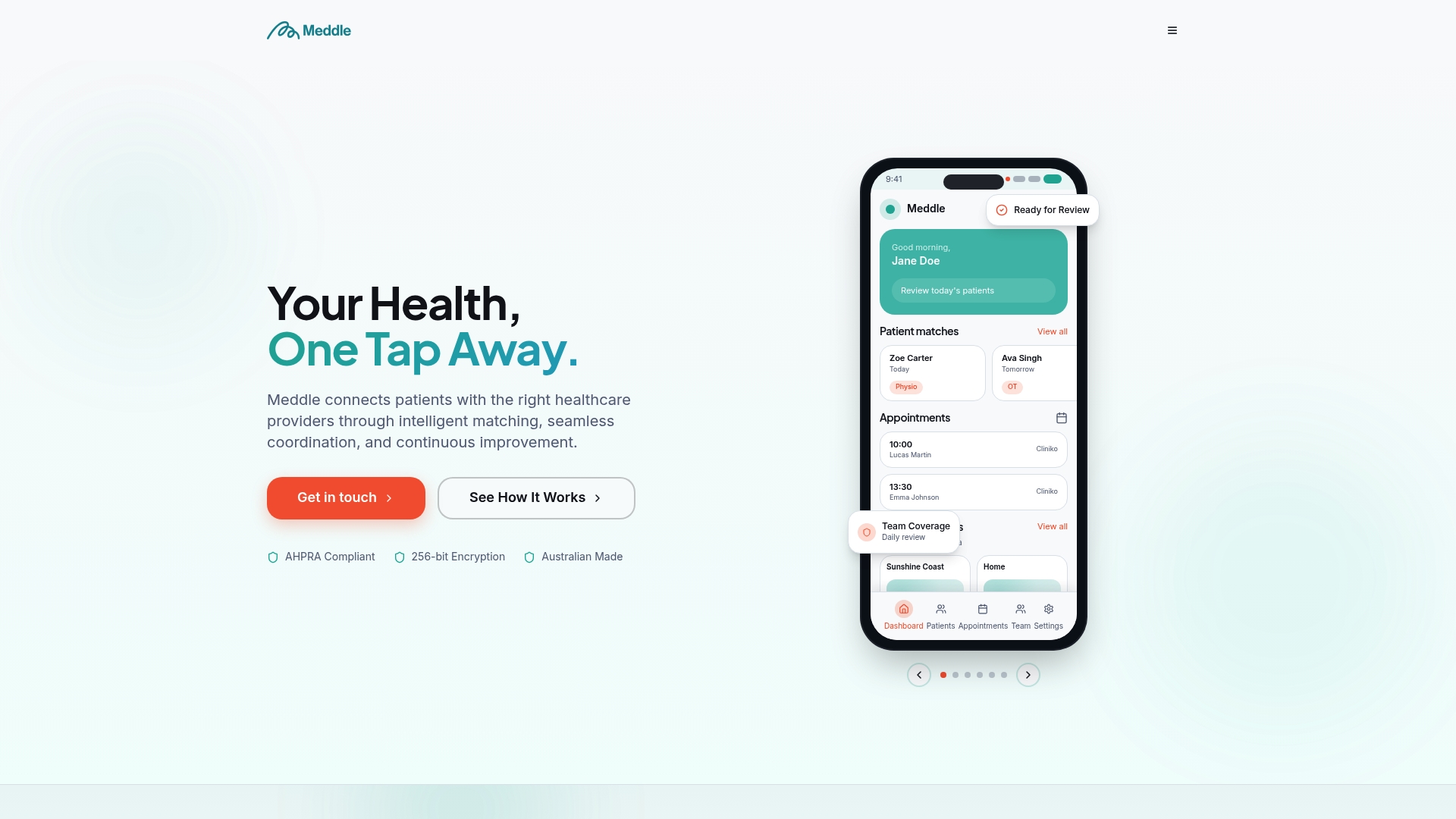
- Referral automation replaces manual re-entry with structured, trackable referral records.
- SMS notifications confirm receipt and appointment status automatically, an add-on available for purchase on the Meddle pricing page.
- Find care connects patients to practitioners through algorithmic matching, useful where a clinic wants visibility over where a referral lands.
For automated appointment confirmations specifically, some clinics also pair this with dedicated communication tools such as Odontia’s reminder and communications module. If you’d rather see the full plan list first, view Meddle’s pricing or explore how the platform works before committing to a pilot.
This article is general information, not a substitute for advice from a qualified doctor. Consult a qualified healthcare professional about your own circumstances before acting on anything here.
Sources
- Communicating for Safety Standard | Australian Commission on Safety and Quality in Health Care
- Service Referral v2.0 | Digital Health Implementer Hub
- When’s it my turn? The Maitland Hospital Paediatric Ambulatory Care Service
- Closing the Referral Loop: an Analysis of Primary Care Referrals to Specialists in a Large Health System
FAQ
What does “closed loop referral” mean?
A closed loop referral is one where the referring clinician has confirmed receipt by the specialist and received a documented outcome, such as an appointment or a report, back in the patient’s record. Without that confirmed return trip, the referral is considered open regardless of whether the patient was seen.
What does it mean when a referral is closed?
A referral is closed once the outcome, whether a completed appointment, a specialist report or a formal decline, has been recorded against the original referral in the patient’s file. Closure is a documentation event, not just a clinical one: the information has to make it back to where the next clinician will look for it.
How do I say no to a referral request?
Declining a referral should follow the same escalation and documentation pathway as accepting one: notify the referrer promptly, state the reason, and suggest an alternative pathway where possible. The ACSQHC guidance on establishing referral processes recommends building this kind of response into your standard referral criteria from the outset.
What is closed loop communication in healthcare?
Closed loop communication is a broader safety principle where information sent by one party is confirmed received and understood by the other, with an acknowledgement returned. In referrals, this means the same acknowledgement and documentation cycle applied to any critical clinical handover under the Communicating for Safety Standard.