
A care pathway is the agreed route a patient takes through your clinic, from the moment a referral arrives to the review that decides what happens next. Good design means every referral is handled the same way, the right practitioner is matched early, and nothing is lost between the GP, your front desk and the treating clinician. The part of the pathway that most often breaks is the front end: referral capture, intake, triage and matching. That is the part Meddle is built to structure, turning referrals from GPs, email and web forms into structured intake, triage and practitioner matching on specialty, travel radius and appointment type.
This guide is for clinic owners, practice managers, intake teams, NDIS providers and the GPs and support coordinators who refer to them. It walks through what a pathway is, how to build one stage by stage, and how to keep it working.
TL;DR
- A pathway is a local, step-by-step operating tool that turns guidelines into consistent workflow for a defined patient group. It is not the guideline itself and not an individual care plan.
- Design it in six stages: referral, intake, triage, matching, treatment and handover, then review.
- Most leakage happens before the first appointment, so write down rules for acceptance, routing and matching first.
- Define who owns each handover and what triggers an escalation, in writing.
- Meddle structures referral intake, triage and practitioner matching for A$40 per user per month ex GST, with a free 30-day pilot.
Table of Contents
- What a care pathway is, and what it is not
- Start with the patient groups, not the flowchart
- The six stages of an allied-health pathway
- A worked example: post-surgical knee referral
- Pathways for NDIS participants
- Privacy and governance in the pathway
- Implementing and measuring the pathway
- Where Meddle fits
- Our perspective
- FAQ
- Sources
What a care pathway is, and what it is not
People use “pathway”, “guideline” and “care plan” as if they were the same. They are different tools, and mixing them up is how clinics end up with a 40-page document nobody opens.
A peer-reviewed review of pathway definitions describes a clinical pathway as a structured, multidisciplinary plan that turns evidence or guidelines into local steps, with sequencing, timeframes or criteria-based progression for a defined patient group. A clinical pathways primer draws the line neatly: guidelines set out best-practice expectations from evidence and expert analysis, while pathways are local, interdisciplinary operational tools for carrying those practices out.
So, in a clinic:
- Guideline: what good care looks like for a condition. Written by professional bodies.
- Pathway: who does what, in what order, by when, in your clinic, for a defined group of patients, such as post-surgical knee referrals or NDIS speech pathology referrals.
- Care plan: the individual plan for one client, built around their goals.
The Department of Veterans’ Affairs treatment cycle shows how the last of these works in practice. Under the DVA treatment cycle guide, the allied-health practitioner assesses the client and develops a Patient Care Plan with the client’s goals. Your pathway is what makes sure that assessment happens on time, with the right person, every time.
Start with the patient groups, not the flowchart
The most common design mistake is drawing one flowchart for the whole clinic. Pathways work because they are specific to a defined group. Begin by listing your three to five highest-volume referral types. For a multidisciplinary practice that might look like:
- Musculoskeletal and post-surgical physiotherapy referrals
- NDIS occupational therapy and speech pathology referrals
- Chronic condition referrals under a GP management plan, such as dietetics and podiatry
- Psychology referrals for adults and children
For each group, write one sentence defining who is in it and one sentence defining the outcome you want. Everything else hangs off those two sentences. If you cannot say who a pathway is for, staff will not know when to use it.
The six stages of an allied-health pathway
The stages below follow a patient from referral to review. Each one lists what to decide and where it typically goes wrong.

1. Referral: capture it once, completely
Referrals arrive by fax-to-email, direct email, web form, phone and, increasingly, from support coordinators and plan managers. The design question is simple: what is the minimum information you need before a referral counts as received?
DVA guidance makes a useful point here. The referral should identify the condition to be treated or the reason for referral, not merely name a service such as rehabilitation. Use that as your standard. A referral that says “OT please” cannot be triaged or matched properly.
Write a short required-fields list for each pathway: reason for referral, relevant history, urgency, funding type, contact details and consent to share information. Our guide to the GP referral process in Australia covers what referrers typically send and how to ask for what is missing.
Where it goes wrong: referrals sit in a shared inbox, get re-keyed by hand, and incomplete ones wait for someone to notice. Meddle takes referrals from GPs, email and web forms into structured intake, so the information lands in the same format regardless of how it arrived.

2. Intake: collect what the clinician will need
Intake is where you gather the details that make the first appointment productive. Keep it proportionate. Ask only what the matched clinician will use, and ask it once.
The Austin Health ReCOVery long-COVID model, described in the Medical Journal of Australia, collected clinically relevant intake information, assessed symptom severity, and used goal setting and standardised outcome measures to streamline referrals to the appropriate disciplines. You do not need a hospital programme to borrow the logic: capture severity, goals and a baseline outcome measure at intake so the review stage has something to compare against.
Where it goes wrong: long forms that patients abandon, or forms that differ by practitioner so nobody can compare results later.
3. Triage: decide urgency and level of care
Triage answers two questions. How quickly does this person need to be seen, and what level of care do they need?
ReCOVery used a stepped approach: a multidisciplinary team for people with more severe symptoms and a self-management pathway for those with less severe symptoms, according to the same MJA case. Your clinic’s version of this is a short set of criteria that sorts referrals into urgent, standard and single-discipline versus multi-discipline.
Time standards are a good model for writing urgency rules. The Australian Rheumatology Association’s 2025 juvenile idiopathic arthritis standards say children with strong clinical suspicion should see a paediatric rheumatology specialist within 30 days of initial referral. That is a specialist standard, not a rule for your clinic, but it shows the form a good triage rule takes: a defined group, a defined clock.
We have put together a referral triage checklist for front-desk teams, and a guide to referral acceptance rules for deciding what you will and will not take on.
Where it goes wrong: triage lives in one senior clinician’s head, so it stops when they are on leave.
4. Matching: the right practitioner, not the next free slot
Matching is the step where a pathway stops being a diagram and starts affecting your waitlist. A good match considers the practitioner’s specialty, how far they will travel, the appointment type (clinic, home, telehealth) and capacity.
Poor matching has a quiet cost. A patient booked with the wrong clinician is re-referred internally, waits again, and may give up. Write your matching rules down: which conditions go to which skill sets, how you break ties, and how you share new referrals fairly across the team. Our guides to referral routing rules, fair referral distribution and provider selection criteria go through the options in detail.
Meddle matches on specialty, travel radius and appointment type, which are the same three criteria most clinics try to apply by hand. Triage and practitioner matching is a core part of the product, so the rules you write in this stage are the rules the system applies.
5. Treatment and handover: name the owner of every transition
Multidisciplinary care fails at the handoffs. A 2021 systematic narrative review of 24 studies on communication between hospital allied health and primary care found several enablers of effective communication: multidisciplinary care plans, patient and caregiver involvement, health information technology and a designated follow-up or care-management person.
Turn those four enablers into pathway rules:
- One named coordinator per patient. Someone owns the next step, even when several clinicians are involved.
- A shared plan. All disciplines work from the same goals.
- Defined escalation points. For example, no improvement in outcome measure by session four triggers a case review; a safety concern triggers a same-day call to the referrer.
- A communication standard for referrers. What the GP hears, when and in what format.
Scope matters too. Exercise & Sports Science Australia’s scope of practice document for accredited exercise physiologists says practitioners should practise collaboratively within scope and refer to other health professionals or services when appropriate. Build “refer on” decision points into the pathway so that stepping outside scope is a planned move, not an improvisation.
If you want a benchmark for communication timing, the ARA’s JIA standards call for a written care plan to go to the family, referring doctor, GP and other involved professionals within two weeks of diagnosis. Pick your own clock for each pathway and write it in.
6. Review: close the loop on goals and outcomes
A pathway without a review stage is just a queue. The DVA’s allied health treatment cycle has the provider prepare an end-of-cycle report based on outcomes and recommend whether another cycle is needed, with the GP reviewing the report with the client. That structure works well beyond DVA clients: goals drive the plan, outcome measures track progress, and a report informs the next decision.
For your own pathway, set a review point for each patient group, decide which outcome measures every clinician will use, and decide who sends the summary back to the referrer. Reviewing the goal-based plan and deciding on further treatment is where clear data handling and patient privacy matter most, because summaries travel between providers.
A worked example: post-surgical knee referral
Here is how the six stages might look for one pathway, written the way you would put it on a single page. This is an illustration, not a clinical standard.
| Stage | Rule | Owner | Clock |
|---|---|---|---|
| Referral | Must state procedure, surgeon’s protocol, date of surgery, weight-bearing status | Intake team | Completeness check same day |
| Intake | Goals, baseline outcome measure, preferred location | Intake team | Before first appointment |
| Triage | Urgent if within the surgeon’s early-rehab window; standard otherwise | Senior physio or intake rule | Same business day |
| Matching | Musculoskeletal physio within the patient’s travel radius, clinic or home visit as needed | Intake team | Within one business day of triage |
| Treatment | Progress against agreed protocol; escalation to surgeon if outcome measure stalls | Treating physio | Review at set session |
| Review | End-of-episode summary to GP and surgeon | Treating physio | Within a set number of days of discharge |
Notice what makes this usable: each row has an owner and a clock. Our pages on post-surgery rehabilitation and stroke rehabilitation at home show how these referral types look from the patient and referrer side.
Pathways for NDIS participants
NDIS pathways have the same six stages with two additions: funding checks at intake and stronger documentation obligations. The NDIS Practice Standards Guidebook explains that participants should understand what information is collected and why, and that procedures should obtain consent for collecting it. It also explains that participant information should be identifiable, accurate, current and confidential, with access limited to relevant workers.
Translate that into pathway rules:
- Record consent at intake, in the same place every time.
- Limit record access by role, so coordinators see what they need and no more.
- Keep participant details current, with a named person responsible for updating them.
- Explain to the participant, in plain language, what you collect and why.
With NDIS referrals, goals are central. Capture them in the participant’s own words at intake so reports to plan managers and support coordinators can trace back to them.
Privacy and governance in the pathway
Governance is not a separate document. It is a set of decisions inside each stage: who can see referral content, where intake data is stored, what is sent to whom, and how long you keep it. For each stage, write one line stating the data collected, the person who can access it and the consent that covers it.
When you assess software for the pathway, ask where patient data is hosted. Meddle hosts patient data in Sydney. Make sure your team can describe, in plain words, what happens to a referral from the moment it arrives.
Implementing and measuring the pathway
A pathway is only real when people use it. A sensible rollout:
- Pick one patient group. Build and trial a single pathway first.
- Write one page. Stages, owners, clocks and escalation points. If it needs two pages, split the group.
- Run it for a defined period with the full team, then hold a short review.
- Fix the leaks. Look at where referrals stalled or patients dropped out.
- Add the next group.
Measure what the pathway controls:
- Time from referral received to referral accepted
- Time from acceptance to first appointment
- Proportion of referrals that were incomplete on arrival
- Proportion of patients rebooked with a different practitioner
- Proportion of episodes with a baseline and follow-up outcome measure
- Referrer feedback sent on time
Our guide to practice analytics for Australian allied-health clinics explains how to turn these into a regular report. Set the baseline before you change anything, so you can see whether the pathway improved the numbers.
Where Meddle fits
The six stages above involve a lot of repeated admin: reading referrals, chasing missing fields, deciding who should take a patient, and keeping a record of it all. Meddle automates the front end. It turns referrals from GPs, email and web forms into structured intake, triage and practitioner matching, integrates with your practice management system and writes back to your CRM, so clinics lose fewer leads and spend less time on admin.
Pricing is A$40 per user per month ex GST, or A$400 per year ex GST, which is two months free. Every user pays the same, including admins and coordinators. Everything is included, with no add-ons, and there is a free 30-day pilot, which is enough time to run one patient group through your new pathway and see how it behaves. See the Meddle product for the path from referral to booked appointment.
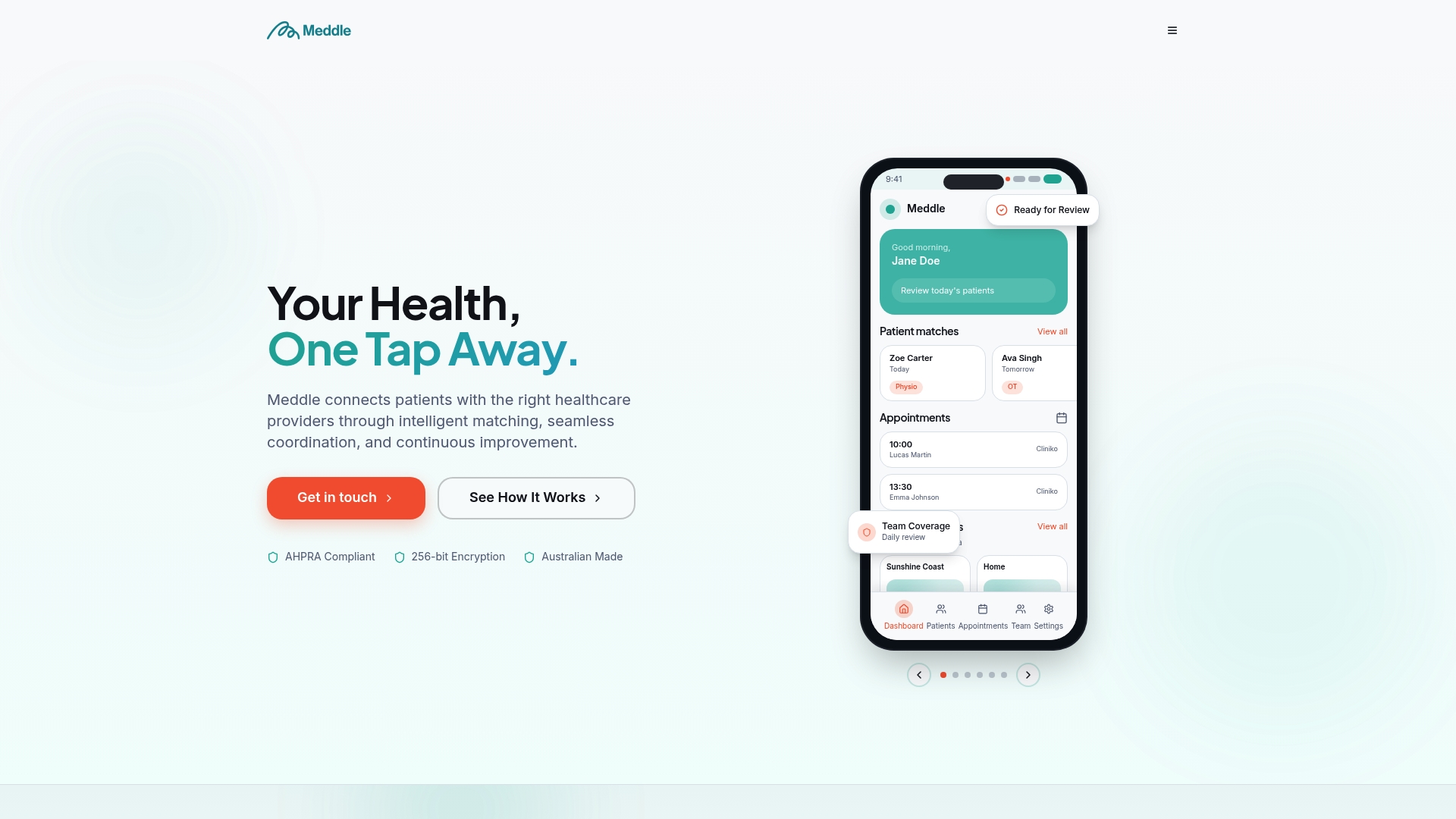
GPs and support coordinators who refer can see how referrals are received on our referrer page.
Our perspective
We think a care pathway should be judged by what happens in the first week, not by how good the diagram looks. Most of the delay and drop-out a clinic experiences sits between a referral arriving and a patient sitting in front of the right practitioner.
That is why we build around the person, not the business. Directories list who is out there. Meddle connects the person to the care and carries the story forward, so the reason for referral, the goals and the context travel with the patient from the GP to the clinician.
We also believe pathway tools should be priced so the whole team can use them. Every user pays the same, admins and coordinators included, because intake is a team job and the people who handle referrals every day should be in the system.
Start small. Choose one patient group, write the rules, and let structured intake, triage and matching apply them consistently. Then widen.
Taylor
FAQ
What is a clinical care pathway?
It is a structured, multidisciplinary plan that turns evidence and guidelines into local steps for a defined patient group, with sequencing and timeframes. It sits between a guideline, which sets the standard of care, and an individual care plan, which applies to one client.
How long should a care pathway document be?
One page per patient group is a good target. List the stages, the owner of each, the time expectation and the escalation points. If it runs longer, the group is probably too broad and should be split into two pathways.
Who should be involved in designing a pathway?
Include a senior clinician from each discipline that touches the group, the practice manager and the intake team who handle referrals daily. Invite a regular referrer, such as a GP or support coordinator, to comment on what they need to receive back.
How is an NDIS pathway different?
The stages are the same, but you add a funding check at intake and give more weight to consent, record accuracy and limited access, as set out in the NDIS Practice Standards Guidebook. Capture participant goals in their own words so reports can trace back to them.
Can we trial software before committing?
Yes. Meddle offers a free 30-day pilot, and you can book a 30-minute demo to see how intake, triage and matching would work for your referral types.
If you would like to see your own pathway running on structured intake and matching, you can book a 30-minute demo.
Sources
- What is a clinical pathway? Development of a definition
- A Primer on Clinical Pathways
- Guide to the treatment cycle for GPs and allied health providers, DVA
- Allied health treatment cycle, DVA
- An allied health model of care for long-COVID rehabilitation, MJA
- Methods and Effectiveness of Communication Between Hospital Allied Health and Primary Care
- AEP Scope of Practice, ESSA
- Standards of Care for children and young people with JIA, Australian Rheumatology Association
- Embracing Change: NDIS Practice Standards Guidebook
- Australian clinic data security and patient privacy
Recommended
- Referral Pathway Advisor
- SaH Associated Providers & Allied Health Routing
- Appointment Triage Rules for Allied Health Clinics
- Referral Networks for Allied Health Clinics | Australia
This article is general information for healthcare businesses and isn’t legal, clinical or privacy advice. Check current requirements with the relevant regulator or a qualified adviser.