

Practice analytics is the habit of turning the data your clinic already holds (referrals, bookings, cancellations, billing and outcomes) into decisions about staffing, capacity and patient experience. For an Australian allied-health clinic, the work comes down to four things: pick a small set of measures, define them consistently, compare them fairly, and review them on a regular rhythm with your team. This guide shows how, with measures you can start tracking this month.
TL;DR
-
Practice analytics means analysing clinical, operational and financial data to spot trends, gaps and opportunities. Start with five to eight measures, not thirty.
-
Track the whole path: referral received, triage, first appointment, attendance, rebooking and outcome. Most lost revenue hides at the handover points.
-
Compare against your own earlier periods first. External benchmarks only help when definitions and service mix match.
-
Health information is sensitive under the Privacy Act 1988. Use de-identified data for analysis where possible and keep access role-based.
-
Set KPIs tied to clinic goals, review monthly or quarterly, and involve the team.
Table of Contents
What practice analytics means for an allied-health clinic
Avant describes practice data as a way to measure and improve business performance, covering daily processes, patient satisfaction and outcomes. In practice, it helps you understand three things: how efficiently the clinic runs, how profitable it is, and the quality of care it delivers.
There are two levels worth keeping apart.
-
Practice-level analytics answers questions about the clinic as a whole. Are practitioners’ diaries full? Are cancellations rising? Which referrer sends the most work?
-
Patient-level analytics identifies individuals who need action. The Australian College of Rural and Remote Medicine describes a workflow for practice analytics: set an objective, filter your data, generate a population result, then identify the individual patients requiring action.
For a multidisciplinary clinic, that second level might be a list of clients who cancelled and never rebooked, or referrals that sat without a first appointment. The aggregate number tells you there is a problem. The list tells reception who to call on Monday.
Operational reporting (utilisation, billing, wait times) is a different job from clinical analytics. Keep the two separate, and write down what each measure means so that every practitioner and manager reads the same number the same way.
The measures worth tracking
Most clinics fail at analytics by tracking too much. A long dashboard nobody reads is worse than five numbers reviewed every month. Choose measures that map to a decision someone can make.
The table below groups practical measures by the question they answer. They draw on Australian guidance and allied-health reporting practice.
| Area | Measure | The question it answers |
|---|---|---|
| Referrals | Referral-to-triage time | How quickly does a new referral get looked at? |
| Referrals | Referral-to-first-appointment time | How long does a new client wait? |
| Referrals | Conversion from referral to booked client | How many referrals become clients? |
| Capacity | Available appointments by discipline | Where is there room, and where is the queue? |
| Capacity | Practitioner utilisation | Is the diary full of billable, attended sessions? |
| Attendance | Cancellations and did-not-attend rate | Which days, services or referrers lose the most sessions? |
| Attendance | Rebooking rate | Do clients continue after the first visit? |
| Finance | Revenue per clinician, average client spend | Is each practitioner’s time producing the revenue you planned? |
| Outcomes | Standardised outcome and goal-setting measures | Are clients progressing toward their goals? |
A paper from the Australian Institute of Health and Care on a data-driven outpatient service shows analytics tracking referral-to-triage time, time to first appointment, available discipline appointments, cancellations, did-not-attend rates, incomplete appointments, quality-of-life and goal-setting measures, and discharge feedback. It is written for a health service rather than a private clinic, but the logic transfers: follow the client from referral to discharge.
For finances, Australian clinic-management advisers commonly point to total revenue, profit margin, revenue per clinician and average client spend as the core set, alongside new client bookings, rebooking rates and billable hours per clinician for capacity.
Start with the referral pipeline
If you can only fix one area first, make it referrals. A referral that arrives by fax, email or web form and waits two days for someone to read it is a lead already cooling. Measure how many referrals arrive by channel, how long each waits for triage, and how many reach a first appointment. We cover this in more depth in our referral analytics playbook.
Then look at booking conversion. Our guide to the booking conversion rate explains how allied-health clinics track and lift it.
Then utilisation and attendance
Utilisation tells you whether capacity is being used. Cancellations and did-not-attends tell you why it is not. Read them together: a practitioner with low utilisation and a high cancellation rate has a different problem from one with low utilisation and a thin referral flow. The first needs reminders and booking fixes. The second needs more matched referrals. See how to measure and lift appointment utilisation and how to cut missed appointments with SMS and booking fixes.
How to turn data into decisions
Avant’s guidance is simple and works for a three-practitioner clinic as well as a large group: choose measures meaningful to operations, service quality and business performance, link KPIs to practice goals, use them to track progress and guide action, and involve the team in reviewing the numbers and suggesting improvements.
Here is a workable sequence.
-
Write down two or three clinic goals. For example, shorten the wait for a first appointment, fill late-week capacity, or improve rebooking after the initial assessment.
-
Pick one to three measures per goal. If the goal is a shorter wait, the measures are referral-to-triage time and referral-to-first-appointment time.
-
Define each measure in a sentence. What counts as a referral? Does a cancelled-with-notice session count as a did-not-attend? Settle it once and record it.
-
Pull a baseline. Use the last three to six months from your practice management system.
-
Review on a fixed rhythm. Avant suggests reviewing progress monthly or quarterly. Monthly suits operational numbers. Quarterly suits finances and outcomes.
-
Assign an owner and one action per finding. A finding without a named person and a date tends to stay a finding.
-
Check whether the change worked at the next review by looking at the same measure, defined the same way.
Share the numbers with the team
The Australian Institute of Health and Care paper notes that leaders can use recurring reports to align staffing with demand, identify disciplines with capacity for interdisciplinary assessments, address discharge barriers, and communicate findings through huddles, meetings, newsletters and supervision. A five-minute huddle with one chart on the wall does more than a quarterly spreadsheet nobody opens.
Treat odd results as questions
When a number looks wrong, investigate before reacting. A sudden drop in utilisation might reflect a gap in data extraction, a change in capacity, a shift in the mix of services, or a change in process, not poor performance. Ask what changed, then act.
Comparing performance fairly
A comparison is only useful if both sides measure the same thing. Three rules keep it honest.
-
Compare to yourself first. This quarter against the same quarter last year removes most of the noise from case mix and location.
-
Account for context. Fee changes, funding changes (for example NDIS price changes), practitioner leave and a shift toward longer or shorter appointment types all move your numbers without any change in how well the clinic runs.
-
Use consistent definitions. If one practitioner records a late cancellation one way and a colleague another, your cancellation rate is two different numbers added together.
External benchmarks can show where a clinic sits against similar practices, but treat them as a prompt to ask questions. Where you find a gap, build a short plan that names a specific improvement: a reminder change, a diary template change, a referrer conversation. Do not just note that you are below an average.
Primary health networks are a good place to look for locally relevant data support. Western Victoria Primary Health Network notes that data-extraction tools support service planning, reporting and quality improvement, and can identify patient groups with specific care needs and gaps in care. Your own PHN may offer something similar.
Privacy and data quality when you analyse health information
Health information is among the most sensitive information a clinic holds, and analysis counts as a use of it. The Office of the Australian Information Commissioner’s guide to health privacy sets out what the Privacy Act 1988 expects: proactive management of health information through privacy plans, policies and staff training.
For analytics specifically, the OAIC’s guidance on data analytics and the Australian Privacy Principles says organisations should be transparent about how they handle data and collect only personal information that is reasonably necessary for their functions. In practical terms:
-
Use de-identified data for practice-level reporting wherever you can. Owners rarely need names to see a trend.
-
Reserve patient-level lists for the people who act on them, such as the intake team chasing unbooked referrals.
-
Consider a Privacy Impact Assessment before introducing a new tool that handles identifiable data.
-
Train staff on what they may and may not export or share.
Our guides on the Australian Privacy Principles in healthcare, securing patient records under APP 11 and data retention in Australia go through the detail. If a privacy question touches a specific legal obligation, speak to your professional indemnity insurer or a lawyer who works in health privacy.
Data quality matters as much as privacy. Reports built on inconsistent data entry mislead. Agree on how referral sources, appointment types and cancellation reasons are recorded, and audit a sample every quarter.
Choosing analytics tools and reports
Most clinics start with the reports inside their practice management system, then add a dashboard when those run out. When you evaluate anything that handles client data, Allied Health Professions Australia’s selection guidance for clinical information systems is a useful checklist. It points to support for clinical and administrative needs, quality improvement tracking, role-based access, audit logs, and data protection and cyber security requirements.
Add these practical questions:
-
Does it show the referral stage, not just the appointment? Many reports start at the first booking and miss everything before it.
-
Can different roles see different views? Owners usually want aggregated trends, while intake and clinical leads want worklists of individual clients needing action.
-
Can you export or connect the data? Reports you cannot reconcile with your billing system will not survive a finance review.
-
Where is the data hosted, and who can see it? Ask for specifics, and read the answer against your obligations under the Privacy Act.
-
How much of the setup is manual? If someone must rekey referrals to get a report, the report will always be late.
For a closer look at what a clinic dashboard can show, see our practice management dashboard guide.
A month-one plan for a small clinic
You do not need a data team. Here is a realistic first month for a clinic of five practitioners.
Week 1. Choose the goal. Most clinics pick the wait for a first appointment or the cancellation rate. Write the definition of each measure on one page.
Week 2. Pull the last three months for those measures, split by practitioner and by discipline. Note anything unusual and ask what changed before drawing conclusions.
Week 3. Share the chart at a team huddle. Ask staff what they think is behind it. Reception and intake teams usually know the cause before the data does.

Week 4. Agree one change per measure, name an owner and set the next review date. Then leave the process alone long enough to see whether it works.
Repeat the cycle each month and add measures only when the current set is stable and understood.
Our view: analytics should start at the referral
Most practice analytics begins when the first appointment is booked. We think that is too late. By then, the clinic has already lost the referrals that arrived in a shared inbox, sat unread, or went to a practitioner who could not take the client.
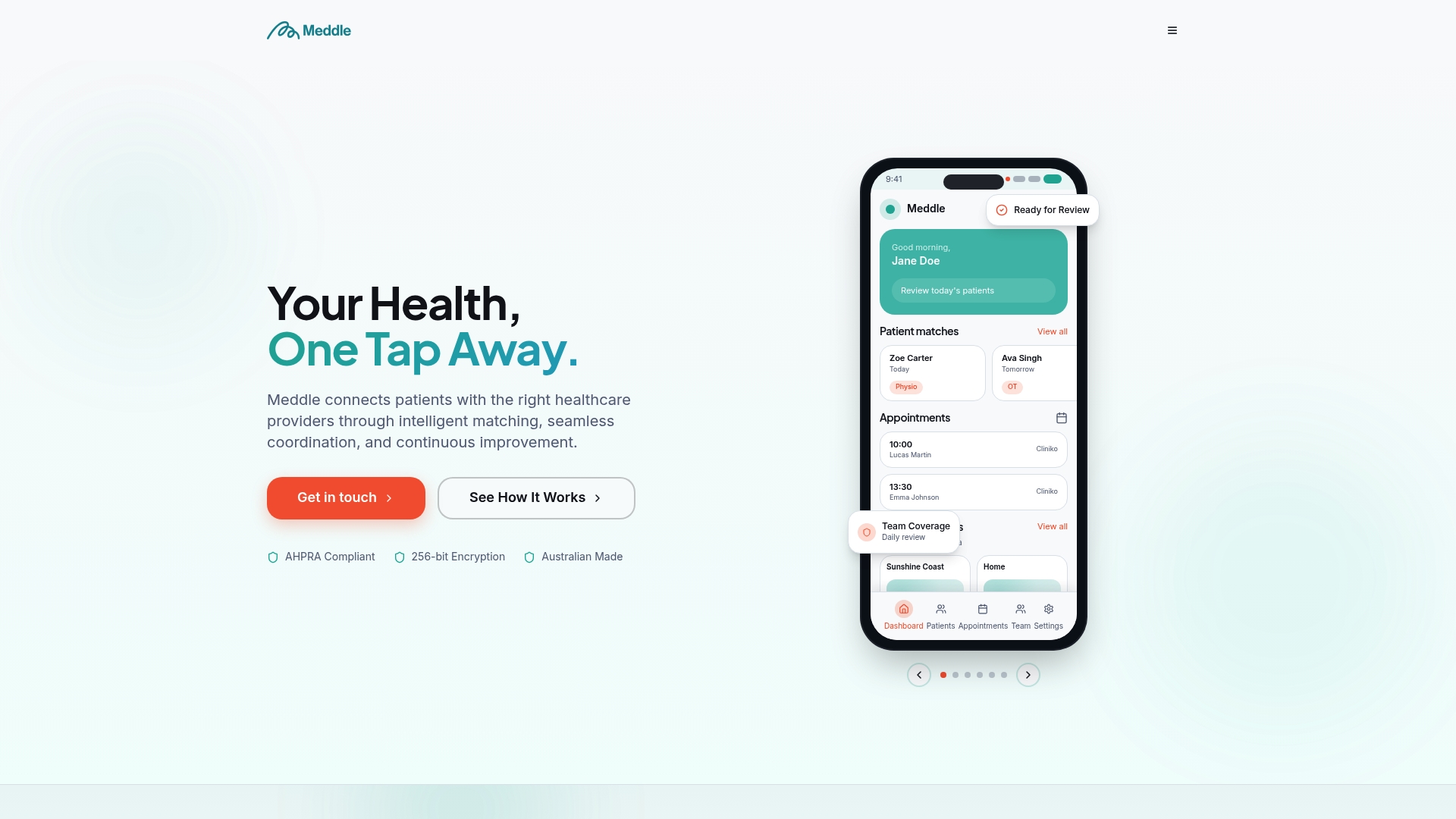
We built Meddle around that gap. It turns referrals from GPs, email and web forms into structured intake, triage and practitioner matching on specialty, travel radius and appointment type. When every referral enters the clinic in the same structured form, the numbers that matter become easy to see: how many arrived, how fast they were triaged, who they matched to, and which became booked clients.
Directories list who is out there. We focus on connecting the person to the right care and carrying the story forward, so the client does not repeat themselves at every handover. That also gives you cleaner data to review, because intake is captured once rather than retyped.
Our advice for owners and practice managers: pick a few measures, start at the referral, and review them with your team on a fixed rhythm. The clinics that improve are the ones that look at the same numbers every month and do something about them.
Taylor
See your referral data in one place
Meddle structures referral intake, triage and practitioner matching, integrates with your practice management system and writes back to your CRM, so the data you analyse starts clean. Plans are priced at A$40 per user per month ex GST, or A$400 per user per year ex GST (2 months free), with Appointments, Telehealth, CRM write-back, PMS integration and SMS and email reminders all included and no add-ons, no minimum spend and a free 30-day pilot. You can see how it works on the Meddle home page.
If you refer clients rather than receive them, our Find care page is a place to start. To see what clients see, browse allied health by discipline and location. When you are ready, book a 30-minute demo at meddle.com.au/book-a-demo.
FAQ
What is practice analytics?
It is the analysis of clinical, operational and financial data to find trends, gaps and opportunities for improvement. In an allied-health clinic that usually means referrals, appointments, capacity, revenue and client outcomes, reviewed on a regular schedule.
Which measures should a small allied-health clinic start with?
Start with referral-to-first-appointment time, cancellation and did-not-attend rate, practitioner utilisation and rebooking rate. Add revenue per clinician once those are stable. Keep the list short enough that you can discuss every number at one team meeting.
How often should we review our numbers?
Monthly works for operational measures such as wait times and cancellations. Quarterly suits finance and outcome measures. Avant recommends reviewing KPI progress monthly or quarterly and involving the team.
Do privacy laws limit how we analyse patient data?
Yes. The Privacy Act 1988 applies to health information, and the OAIC advises collecting only what is reasonably necessary and being transparent about use. Use de-identified data where possible for practice-level reporting.
Can we benchmark against other clinics?
Yes, but only when definitions and service mix are comparable. Compare against your own earlier periods first, then use external figures to prompt questions and build a specific improvement plan.
Sources
-
Better Rural Health Outcomes using Practice Analytics (ACRRM)
-
Data-Driven Outpatient Service (Australian Institute of Health and Care)
-
Numbers that matter: essential metrics for a thriving clinic (The Practice Lab)
-
Guide to data analytics and the Australian Privacy Principles (OAIC)
Recommended
This article is general information for healthcare businesses and isn’t legal, clinical or privacy advice. Check current requirements with the relevant regulator or a qualified adviser.