Appointment utilisation: how allied-health clinics measure and lift it

Appointment utilisation is the share of a practitioner’s available appointment time that is actually booked and attended. Divide the time spent with patients by the time the practitioner was rostered to be available, then multiply by 100. A clinic that measures it per practitioner, every week, can see whether an empty diary is a demand problem or a scheduling problem. Those two problems need opposite fixes.
This guide covers the definition, the calculation (with worked examples), what to track, how to read the result, and the changes that lift utilisation without hurting patient access or your team.
TL;DR
- Utilisation = appointment time delivered ÷ available practitioner time × 100. Decide up front whether DNAs (did not attends) and late cancellations count, and keep that rule fixed.
- Track it per practitioner, per week, next to new-patient wait times. A clinic-wide average hides outliers.
- Low utilisation with a waitlist is a scheduling and availability problem. Low utilisation with no waitlist is a demand problem.
- The biggest levers are fewer missed appointments, tighter templates, faster referral intake and sensible waitlist use, not squeezing more patients into each hour.
- Aim for a target you set from your own data. Treat 100% as a warning sign, not a goal.
Table of Contents
- What appointment utilisation means in an allied-health clinic
- How to calculate appointment utilisation
- What to track, and how often
- Reading the number: what is a good utilisation rate?
- Designing templates around demand and capacity
- Reducing no-shows and late cancellations
- Lifting utilisation without hurting care
- Our perspective
- How Meddle supports a fuller, fairer diary
- A simple 30-day utilisation plan
- FAQ
- Book a demo
- Sources
What appointment utilisation means in an allied-health clinic
Utilisation is a capacity ratio. The numerator is time used for patient appointments. The denominator is the time a practitioner was genuinely available to see patients. It answers one question: of the hours we could have offered, how many did we deliver?
It is easy to confuse with three nearby measures:
- Attendance is the outcome of an individual appointment (attended, cancelled, DNA). It is not a ratio of capacity. Attendance feeds utilisation, but a clinic with perfect attendance can still have a half-empty diary.
- Occupancy describes how much a room, gym or treatment space is in use. A physio can be 90% utilised while the gym is 40% occupied, or the reverse in a clinic that shares rooms.
- Clinical-care ratio compares direct patient care with administration, supervision and other non-billable work. A practitioner with a full diary can still have a poor ratio if admin keeps growing.
Keeping these separate matters because each one points to a different fix. Attendance problems call for reminders and booking policy. Occupancy problems call for room allocation. Utilisation problems call for template and demand work.
How to calculate appointment utilisation
The formula is simple. The hard part is agreeing what goes into each side.
Utilisation % = booked appointment hours ÷ available hours × 100
A worked example: a physiotherapist is rostered for 6 hours of patient time on a Tuesday. Four one-hour appointments are booked and attended. Utilisation is 4 ÷ 6 = 66.7%.
Decide what counts as available time
Available time should be the hours a practitioner could realistically see patients. In practice that means:
- Include time open for patient booking, including online booking and waitlist fills.
- Exclude lunch, meetings, leave, public holidays, closures and any block that is not bookable.
- Exclude admin or supervision blocks, or track them separately so they do not drag the ratio down.
If you pad the denominator with time nobody could book, the number looks worse than reality. If you strip out too much, it looks better than reality. Write the rule down and apply it to every practitioner.
Decide what counts as an appointment
The numerator needs the same discipline. Settle these questions once:
- Cancellations. A cancelled appointment that was not refilled is not used time. Most clinics exclude it.
- DNAs. A no-show consumed a slot but delivered no care. Some clinics count it as booked time to see demand, others exclude it to see delivered time. Either is defensible, but pick one and report the other as a separate line.
- Appointment types. Decide whether group sessions, telehealth, case conferences, report writing and travel count.
- Overlaps. Do not double-count overlapping bookings. If two bookings sit on the same hour, the hour still counts once.
Scheduled versus true utilisation
A useful habit is to report two numbers. Scheduled utilisation counts everything that was booked. True utilisation removes cancellations and DNAs. The gap between them is your leakage, and it tells you how much capacity is lost to missed appointments rather than to a lack of demand.
A second worked example. A psychologist has 25 available hours in a week. 22 hours are booked, so scheduled utilisation is 88%. Of those, 3 hours were DNAs or late cancellations that were not refilled, so 19 hours were delivered. True utilisation is 19 ÷ 25 = 76%. The practice does not have a demand problem. It has a 12-point leak.
Booked availability is not the same as free hours
Remaining free time and bookable slots are different things. A practitioner with 90 free minutes scattered in three 30-minute gaps cannot offer a 60-minute initial assessment. If your appointment types vary in length, count how many whole appointments of each length still fit into the free windows. That is the capacity a patient can actually book.
What to track, and how often
A single clinic-wide percentage is a starting point, not a dashboard. Averages hide the practitioner who is at 95% and close to burnout, and the one at 50% who has a half-empty diary.
Track these weekly:
- Utilisation by practitioner, against genuinely available time.
- Utilisation by service type, such as initial assessments, follow-ups, telehealth and group sessions.
- Scheduled versus true utilisation, so you can see DNA and cancellation leakage.
- New-patient wait time, the number of days to the first available initial appointment.
- Waitlist size and age, to separate demand problems from scheduling problems.
- Rebooking rate, the share of patients leaving with their next appointment already booked.
The Australian Psychological Society suggests clinicians know their current availability and waitlist status, book the next appointment deliberately with the patient during the session where possible, and measure total appointments using a six-week rolling average. A rolling average smooths out school holidays and flu weeks, so one quiet fortnight does not trigger the wrong response.
| Metric | Frequency | What it tells you |
|---|---|---|
| Utilisation by practitioner | Weekly | Who has spare capacity and who is stretched |
| Scheduled vs true utilisation | Weekly | How much capacity leaks through DNAs and cancellations |
| New-patient wait time | Weekly | Whether patients can get in when they need to |
| Waitlist size | Weekly | Whether spare capacity meets unmet demand |
| Rebooking rate | Monthly | How well follow-up booking is working |
| Service-type mix | Monthly | Whether the template matches what patients need |
Reading the number: what is a good utilisation rate?
There is no official Australian benchmark for allied-health appointment utilisation. Software providers publish their own targets, and they vary by profession and by how each one defines available time. Treat any figure you see as a prompt to check your own definitions, not as a pass mark.
It also helps to know the demand context. The AIHW reports that in 2024–25 about four in ten Australians had at least one Medicare-subsidised allied-health service. The same report notes that these statistics do not cover all allied-health care, because services funded through private insurance, DVA, workers compensation, state or territory programs, or paid out of pocket sit outside them. So the national picture is useful for context, but it will not tell you what your local catchment needs.
A more practical approach to targets:
- Set a target range per practitioner, not one figure for the clinic. A new graduate building a caseload, a senior clinician with complex NDIS clients and a part-time practitioner will not share the same sensible number.
- Leave headroom. A practitioner running at 100% has no room for urgent referrals, late changes or catching up on notes. When a diary is always full, wait times lengthen and quality suffers.
- Read utilisation alongside wait times and clinical-care ratio. High utilisation with long waits means you are short of capacity. High utilisation with growing admin means the team is overloaded.
Same number, opposite problems
Two clinics can both sit at 60% utilisation and need opposite responses.
- Empty diary, no waitlist. Patients are not arriving. This is a demand and referral problem: referrer relationships, visibility, intake speed and how quickly enquiries turn into bookings.
- Empty diary, waitlist present. Patients want care but cannot be matched to the open slots. This is a scheduling problem: templates that do not suit patient availability, the wrong practitioner mix, the wrong appointment lengths, or slow waitlist fills.
Working out which one you have before you act saves months of effort in the wrong direction.
Designing templates around demand and capacity
Most utilisation problems start in the template, the pattern of appointment types and lengths that each practitioner’s week is built from. Monash Health’s Centre for Clinical Effectiveness rapid review of outpatient scheduling recommends modelling patient flow against demand and capacity, then redesigning schedules with a systems-thinking, data-driven approach. It is hospital-focused, but the principles carry across to a multidisciplinary private practice.
The practical steps for an allied-health clinic:
- Pull 8 to 12 weeks of data. Look at referrals received, appointment types booked, lengths used and when patients actually want to come in.
- Match slot lengths to real need. The review recommends flexible slot units and booking for the time and treatment room needed. If most follow-ups run 30 minutes, a template of 45-minute blocks wastes time.
- Reserve urgent slots inside the template. Allocate a small number of urgent appointments and, as the clinic date approaches, release unused urgent slots to the general list so they do not go empty.
- Match times to patient preference. Paediatric OT and speech pathology demand clusters after school. Workers’ compensation physio clients often want early mornings. A template that ignores this leaves slots unbooked while a waitlist grows.
- Plan rooms and equipment alongside people. In a multidisciplinary clinic, a practitioner’s free hour is only usable if a suitable room or gym space is also free.
- Review quarterly. Demand shifts with school terms, NDIS plan cycles and seasons.
If you take on group sessions, the numbers change substantially: see our guide to group appointment scheduling for clinics. To avoid wasting capacity on clashes, read about how to prevent double bookings.
Reducing no-shows and late cancellations
Missed appointments are the largest avoidable drain on utilisation, and they are measurable. A 2026 Monash Health conference poster reported 71,000 missed appointments in 2024, or 11.3% of all scheduled appointments, and flagged repeated non-attendance and inconsistent DNA management as capacity and access problems.
The Monash rapid review points to a short list of approaches: SMS or telephone reminders, patient education, patient choice in booking, finite booking periods, a clear policy for patients who fail to attend, and minimal or no overbooking.
A study from Central Coast Local Health District in NSW shows what a structured pathway can do. Its allied-health teams tested a booking pathway that gave patients a grace period to reschedule after a missed appointment. Vulnerable patients were reappointed, and other patients who did not respond moved to the bottom of the clinician’s list. The published results reported no-shows falling from 27.12% to 11.93%, billable clinical time rising from 39.3 to 52.4 minutes, and booking-related administrative contacts falling from 1.4 to 1.15. This was a public-health service, and your results will differ, but the design is worth copying: a defined window, a defined follow-up and a fair rule for who gets priority.

For researchers and managers wanting a wider view of the cost side, a QUT PhD by publication examines digital solutions for outpatient non-attendance, including the processes and costs of responding to missed appointments.
Practical steps for your clinic:
- Send reminders by SMS with a one-tap confirm or reschedule option.
- Book the next appointment before the patient leaves, and agree it with them rather than for them.
- Shorten lead times for follow-ups where the clinical picture allows. Our piece on appointment lead time covers why long gaps raise cancellations.
- Keep a live waitlist so a cancellation at 8am can be filled by 9am.
- Write a short, plain-language attendance policy and apply it consistently, with exceptions for vulnerable patients.
More detail is in our guides on reducing patient no-shows and reducing clinic wait times.
Lifting utilisation without hurting care
The quickest way to raise a utilisation number is to overbook and to shorten sessions. It is also the quickest way to harm continuity of care and wear down practitioners. The Monash review recommends minimal or no overbooking and treating patients in turn where possible. Keep these guardrails:
- Protect session length for clinical need. Do not shorten an initial assessment to fit another patient in.
- Keep continuity. Where a patient benefits from seeing the same practitioner, a fuller diary elsewhere should not override that.
- Watch workload. Check utilisation against the clinical-care ratio. If admin is eating a practitioner’s day, adding patients adds strain, not capacity.
- Cap the target. A target of 100% guarantees long waits and no slack for urgent referrals.
The levers that raise utilisation safely are mostly upstream of the diary:
- Faster intake. Referrals that sit in an inbox for two days are patients who book elsewhere. Structured intake that captures the right details the first time cuts the back-and-forth.
- Better matching. A patient booked with a practitioner who suits their need, location and appointment type is more likely to attend and continue.
- Self-scheduling where it fits. Letting patients pick a suitable time reduces phone tag and fills gaps. See our practical guide to patient self scheduling and booking page design.
- Visible queues. Knowing who is waiting and for what lets the front desk fill gaps quickly. Our queue management guide explains the basics.
The patient-flow tag collects more of these articles in one place.
Our perspective
We talk to allied-health clinics about their diaries, and the same pattern keeps showing up: owners ask how to fill the diary, when the first question should be where patients are being lost on the way to it.
A referral arrives by fax-turned-PDF, an email, a web form or a phone call. Someone re-keys it. Someone else checks which practitioner treats that condition, whether they are close enough and whether they have a suitable slot. By the time the patient hears back, the moment has passed, or they have booked with the next clinic on the list. None of that shows up as a low utilisation figure until much later.
That is why we built Meddle around the person rather than the business. Directories list who is out there. We turn referrals from GPs, email and web forms into structured intake, triage and practitioner matching on specialty, travel radius and appointment type, and we carry the patient’s story forward so they do not have to repeat it. Fewer leads are lost, and the front desk spends less time on admin.
Our advice on utilisation is plain. Measure it per practitioner. Separate scheduled from true utilisation. Find out whether you have a demand problem or a scheduling problem. Then fix intake and matching before you consider squeezing the template.
— Taylor
How Meddle supports a fuller, fairer diary
Meddle is an Australian platform that connects patients with allied-health practitioners and helps clinics turn enquiries into booked appointments. For a clinic owner or practice manager, that means structured intake from referrals and web forms, matching on specialty, travel radius and appointment type, and real-time availability and instant booking. Patient data is hosted in Sydney.
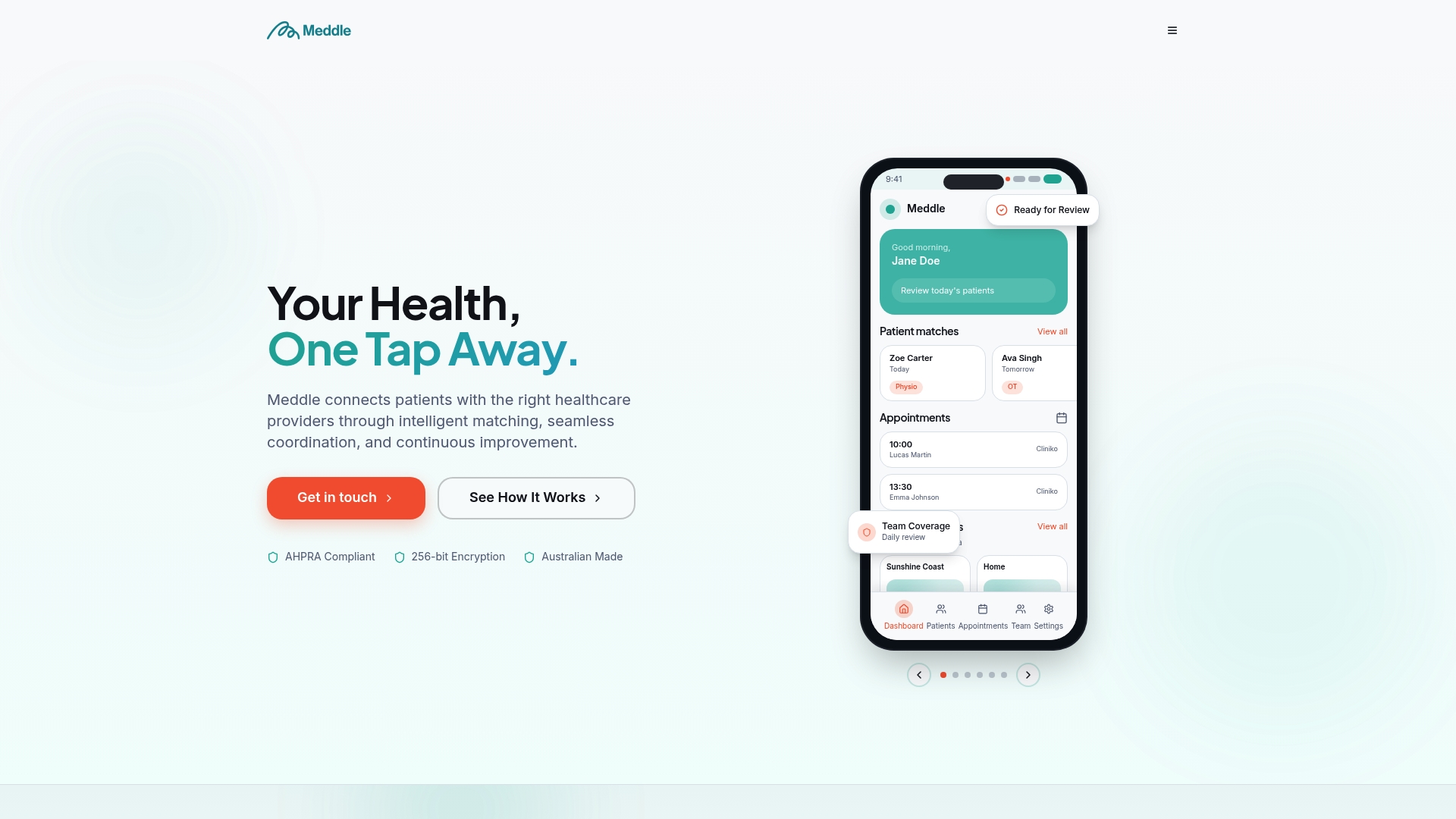
Pricing is AA$40 per practitioner per month ex GST, with a A$250 minimum, and there is a free 30-day pilot so you can see how it fits your clinic before committing. Patients use Meddle free of charge, and you can see how they find care on our find care page. If you are a multi-practitioner clinic, a pilot is a good way to test whether faster intake and better matching change your waitlist and your true utilisation.
A simple 30-day utilisation plan
If you want to start without new software, this sequence works in most clinics.
Week 1: Define. Write down what counts as available time and what counts as a used appointment. Decide how DNAs are treated. Share the definitions with every practitioner.
Week 2: Baseline. Pull the last 8 to 12 weeks by practitioner and service type. Calculate scheduled and true utilisation. Note new-patient wait times and waitlist size.
Week 3: Diagnose. For each practitioner, sort into one of three groups: full with a waitlist (capacity problem), partly empty with a waitlist (scheduling problem), partly empty without a waitlist (demand problem).
Week 4: Act. Pick one change per group. Examples: add an extra clinic session where waits are long, change slot lengths where the template does not fit appointment types, tighten referral follow-up where demand is thin, and switch on reminders and a waitlist fill process everywhere.
Then repeat the same calculation monthly. Changes you cannot measure are changes you cannot keep.
FAQ
What is the difference between appointment utilisation and occupancy?
Utilisation measures how much of a practitioner’s available time is filled with patient appointments. Occupancy measures how much a physical space, such as a room or gym, is in use. In a shared-room clinic the two can move in opposite directions, so track both.
Should DNAs count as utilised time?
There is no single right answer, but be consistent. Counting DNAs shows how much of the diary was booked and signals demand. Excluding them shows how much care was delivered. Many clinics report both as scheduled and true utilisation, so the gap between them shows how much capacity missed appointments cost.
What is a good utilisation rate for allied health?
There is no official Australian benchmark, and published targets depend on how each source defines available time. Set a range per practitioner using your own baseline, leave room for urgent referrals and notes, and read the figure next to wait times and the clinical-care ratio.
How often should we review utilisation?
Review it weekly per practitioner, using a rolling average of about six weeks so a single quiet week does not mislead you. Review templates quarterly, or sooner when school terms, funding cycles or staffing change.
Can utilisation be too high?
Yes. A diary that is always full means long waits for new patients, no room for urgent cases and little recovery time for practitioners. Persistent utilisation near 100% usually signals a need for more capacity, not a success.
Book a demo
If you would like to see how structured intake and practitioner matching could work in your clinic, we would be glad to show you. Book a 30-minute demo and we will walk through it with your own referral flow in mind.
Sources
- Monash Health Centre for Clinical Effectiveness: outpatient scheduling rapid review (2018)
- Monash Health: standardised DNA-hold pathway poster (2026)
- Central Coast Local Health District: new booking system to reduce no-shows (2025)
- AIHW: Medicare-subsidised GP, allied health and specialist health care across local areas
- Australian Psychological Society: The highly efficient psychologist (2022)
- QUT: Digital health solutions for improving ambulatory care (2025)
Recommended
- Booking conversion rate: how allied‑health clinics track and lift it
- Patient self scheduling: a practical guide for Australian clinics
- Waitlist Prioritisation in Allied Health: A Clinic Guide
- Clinic Cancellation Policy: 48/24/Same Day Templates & Metrics
This article is general information for healthcare businesses and isn’t legal, clinical or privacy advice. Check current requirements with the relevant regulator or a qualified adviser.