Case Conference Scheduling for Allied Health Clinics

Scheduling a case conference comes down to four things: confirm who has to be in the room, get the patient’s consent, find a time every required participant can attend for the whole conference, and record the outcome so it can be shared. Get those four right and the rest is administration. This guide shows Australian allied health clinics how to do it, including where Medicare (MBS) and NDIS rules change the steps.
TL;DR
- Under the MBS, the conference must be initiated and organised by a medical practitioner. Allied health providers are invited participants, so your clinic’s job is to make attendance easy and the record complete.
- Minimum team sizes depend on the item. A consultant-organised community case conference needs at least four formal care providers from different disciplines, and the patient and carer do not count toward that number.
- Record patient agreement before the conference, then record date, times, attendees, issues, goals, strategies and outcomes afterwards.
- NDIS therapists may bill case conference time only when it is linked to the participant’s goals and agreed in the service agreement.
- A fixed intake and scheduling routine beats ad hoc emails. Build it once and reuse it for every conference.
Table of Contents
- What a case conference is in allied health
- Who organises it, and who has to attend
- Step-by-step: scheduling a case conference
- Consent and privacy before you share anything
- During and after: recording decisions and following up
- NDIS case conferences: what you can bill
- Where scheduling breaks down, and how to fix it
- Our perspective
- How Meddle supports clinics that coordinate care
- FAQ
- Sources
What a case conference is in allied health
A case conference is a structured meeting where the people involved in a patient’s care agree on goals, split responsibilities and set a plan. The group usually includes a GP or other medical practitioner, two or more allied health professionals and, where appropriate, the patient and their carer. It can run face to face, by phone or by video.
The Department of Health describes multidisciplinary case conferences as a way to improve patient outcomes and reduce hospitalisation, with care focused on the patient’s goals and on teamwork. For regional and remote patients, the format also lets professionals who are not physically in the community contribute to a care plan.
For a clinic, the clinical value is clear. The practical problem is that you are coordinating four or five diaries that you do not control. That is why scheduling deserves its own process.
Who organises it, and who has to attend
The first rule catches many practice managers out. To be eligible for MBS-subsidised multidisciplinary case conference items, the conference must be initiated and organised by a medical practitioner. Your physio, psychologist or dietitian is typically invited, not the organiser.
The attendance minimums vary by item:
| Scenario | Minimum team | Source |
|---|---|---|
| Mental health case conference | A medical practitioner plus at least two other providers from different disciplines, or from the same profession with different clinically relevant specialisations | MBS Note AN.15.1 |
| Community case conference organised by a consultant physician | At least four formal care providers from different disciplines; the patient and informal carer do not count | MBS Item 820 |
The consequence for scheduling is simple. If one required provider drops out, the conference may no longer meet the minimum. For Item 820, the minimum number must be present throughout, so a late arrival or early departure is a scheduling risk, not just an inconvenience.
A pre-existing relationship with the patient is not required for an allied health professional to take part. The patient must, however, consent to that professional’s participation and to the use of Medicare funding. That matters when a referrer invites a clinician the patient has never met.
MBS items and eligibility change, so check the current schedule on the MBS website before you tell a referrer you can take part in a particular item.
Step-by-step: scheduling a case conference
A repeatable sequence stops conferences from stalling in email threads. Here is the one we recommend clinics build into their intake routine.
1. Confirm the trigger and the organiser
Start with the question: who is organising, and under which funding pathway? If it is an MBS conference, the medical practitioner is the organiser and your clinic responds to their invitation. If it is an NDIS conference, your clinic or the support coordinator may be driving it. Write the pathway at the top of the request so nobody has to guess later.
2. Get the patient’s agreement on record
For consultant-organised community case conferences, the MBS expects the conference to be explained to the patient or their agent, their agreement sought and that agreement recorded. Do this before you send invitations, not after. A conference scheduled around five diaries and then cancelled because the patient never agreed wastes everyone’s time.
See the privacy section below for what consent should cover.
3. List required and optional participants
Split your attendee list into two groups:
- Required: the people needed to meet the minimum team size for the item.
- Optional: additional clinicians, a support coordinator, a carer or family member, an interpreter.
Schedule around the required group first. Optional attendees can join if they are free. This single habit prevents most last-minute failures.
4. Offer a short window of times, not an open question
The MBS wants the conference arranged in advance, within a timeframe that allows all participants to attend. In practice, send two or three specific time options with a reply-by date, rather than asking “when suits everyone?”. Lunchtime and the end of the clinical day tend to be easier for clinicians, but check each person’s roster.

Participating providers must be invited by the organising practitioner. If your clinic is handling the logistics, make sure the invitation clearly comes from, or on behalf of, that practitioner.
5. Choose the format
Participants can communicate face to face, by telephone or by video, or a combination. Offering video or phone widens the pool of times and removes travel for clinicians in other suburbs or towns. Send the dial-in or video link with the invitation, along with a named person to contact if the link fails.
6. Send the pre-read
Give each participant what they need to prepare. A one-page brief is enough:
- The patient’s main goals in their own words
- The reason for the conference and the questions to resolve
- Current interventions from each discipline, with dates
- Relevant results or reports (only what the patient has consented to share)
- The agenda and the expected length
7. Confirm 24 to 48 hours ahead
Send a short reminder with the time, link and attendee list. Ask each required participant to reply yes or no. If a required person cannot attend, you have time to reschedule instead of discovering it on the call.
Consent and privacy before you share anything
A case conference means sharing health information between providers, and health information is sensitive information under the Privacy Act. The OAIC’s guidance says an APP entity should generally seek express consent before handling sensitive information, given its greater privacy impact.
Two practical points follow:
- Be specific. Tell the patient who will attend, what will be discussed and what will be recorded. Note it in their file.
- Respect withdrawal. Patients can withdraw consent at any time, and practitioners should explain the implications, such as possible effects on access to certain services. Build a step into your process for what happens if consent is withdrawn between scheduling and the conference.
Where you store the pre-read and the notes matters too. Use a secure platform rather than personal email, and keep the documents in the patient’s record. If you are reviewing how your clinic handles referrals and information handoffs, our guide on restricting bookings by referral and meeting three APPs covers the intake side.
During and after: recording decisions and following up
The conference is only worth the scheduling effort if the outcome reaches the people who act on it. For Item 820 the MBS expects a record in the patient’s medical record of the date, start and finish times, names of all participants, problems discussed, goals, strategies and an outcome summary. The notes and summary go to every participant and to the patient’s usual GP, and the outcomes are discussed with the patient.
A simple template keeps this consistent:
| Field | What to capture |
|---|---|
| Date, start and finish | Exact times, including any late arrivals or early exits |
| Participants | Name, discipline, attendance mode (in person, phone, video) |
| Issues discussed | The problems the team addressed |
| Goals | Patient-defined where possible |
| Actions | One owner and one due date for each task |
| Follow-up | Date of review, who books it |
Then close the loop inside 48 hours. Send the summary, book any follow-up appointments the plan calls for, and diarise the review. Most conference value is lost between the call and the first action, so this step is where good clinics separate themselves.
If handoffs between in-person and telehealth care are part of your conference plans, see our piece on fixing handoffs in hybrid care workflows. For the wider picture, governance first for care coordination explains how to set responsibilities so actions do not fall through.
NDIS case conferences: what you can bill
NDIS providers face a different set of rules. Under the NDIS Pricing Arrangements and Price Limits for 2025–26, therapists may bill for time in case conferences when the conference is specifically linked to the participant’s needs and goals and agreed in the service agreement.
The same document expects providers to explain to the participant why the conference is the best use of their funds, and to make sure it is not a general administrative activity, which is covered by overheads. So before you schedule:
- Check the service agreement allows case conference time.
- Write down the link between the conference and the participant’s goals.
- Explain the cost and purpose to the participant, and record that you did.
- Keep attendance and time records that match what you bill.
Price limits are updated regularly, so check the current NDIS Pricing Arrangements and Price Limits for the rates that apply when you schedule.
Where scheduling breaks down, and how to fix it
The same few problems show up in most clinics.
- Referral details arrive in different places. A GP’s request lands in email, a form comes through the website and a phone message sits in a notebook. Fix: one structured intake route for every referral.
- Diary clashes surface late. Fix: offer a short list of times and confirm the required group first.
- Nobody owns the follow-up. Fix: one named owner per action, in the notes.
- Consent is assumed. Fix: make consent a gate before invitations go out.
Group scheduling and self-scheduling tools can reduce the admin load around these steps. Our guides on group appointment scheduling and patient self scheduling show how clinics free up reception time for work like conference coordination. If you want to build referral relationships with specialists first, read about building specialist networks with PHNs.
Our perspective
Case conferences fail for ordinary reasons: the referral sat in an inbox, the patient was never asked, or the right clinician was booked solid for two weeks. None of those is a clinical problem. They are intake and scheduling problems.
We built Meddle around the idea that coordination starts at the first referral. When GP referrals, emails and web forms become structured intake, triage and practitioner matching on specialty, travel radius and appointment type, a clinic has the information it needs to say yes to a conference quickly and to know who should be in it. Real-time availability means you are not guessing which practitioner has a gap.
Directories list who is out there. We focus on connecting the person to the care and carrying their story forward, so the details a conference needs are already in one place and not rebuilt for every meeting. Patient data is hosted in Sydney, and the platform is designed with privacy in mind.
Our view is that clinics should spend their time on the conversation and the plan, not on chasing diaries.
Taylor
How Meddle supports clinics that coordinate care
Meddle is an Australian platform that helps allied health clinics turn referrals from GPs, email and web forms into structured intake, triage and practitioner matching, with appointment booking, messaging, referral automation and a practice management dashboard. That gives your team the groundwork for conference scheduling: a clean record of who the patient is, what they need and which of your practitioners fit.
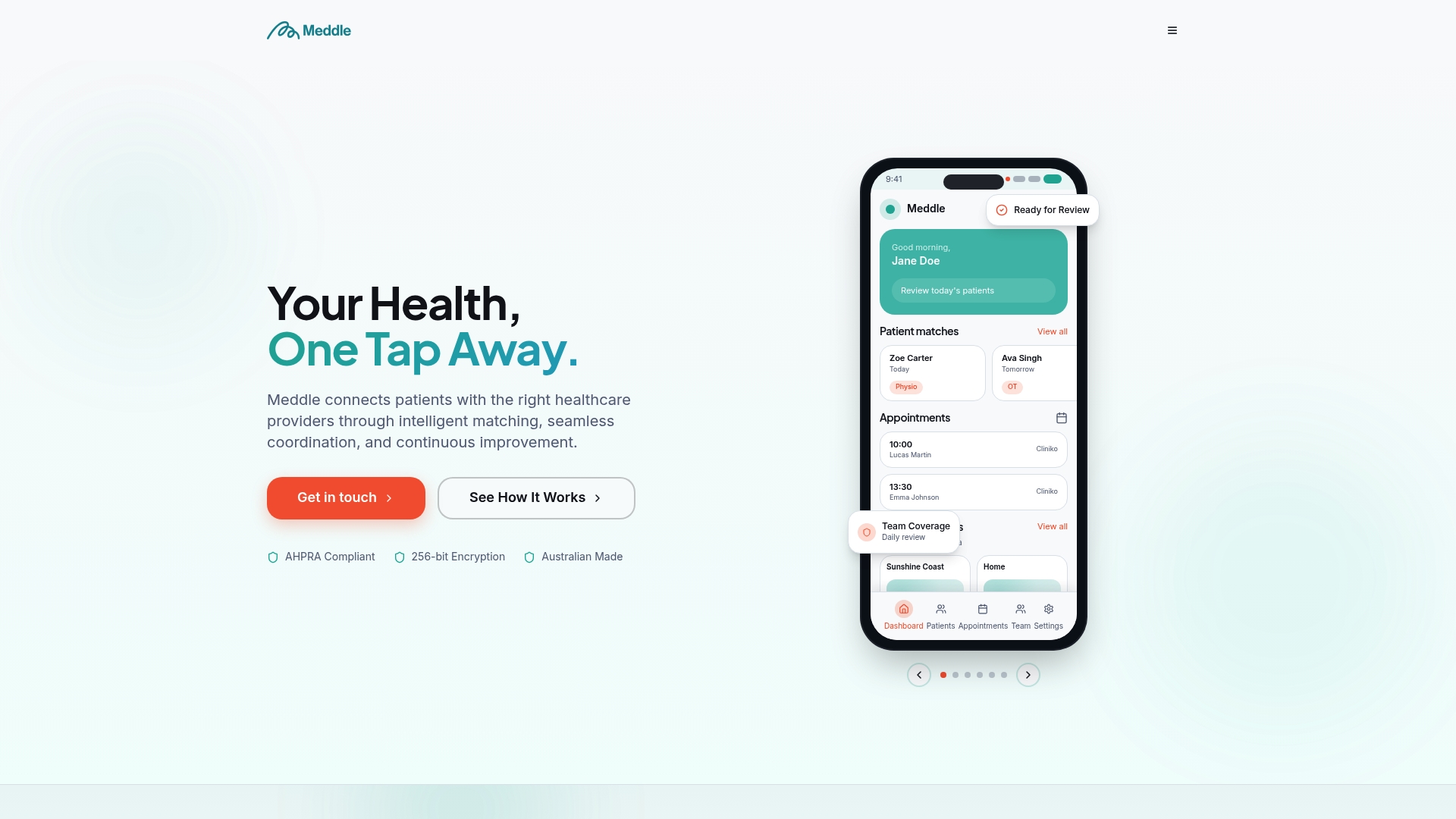
Pricing is AA$40 per practitioner per month ex GST, with a A$250 minimum, and there is a free 30-day pilot so you can test it in your own clinic. You can see how patients find care across physiotherapy, psychology, occupational therapy and other disciplines on our find care page.
FAQ
Who is responsible for scheduling an MBS case conference?
For MBS-subsidised items, the conference must be initiated and organised by a medical practitioner, and participating providers are invited by that practitioner. Allied health clinics usually take part by responding to the invitation and helping with logistics. Confirm the specific item’s requirements on the MBS website.
How many people need to attend?
It depends on the item. A mental health case conference needs a medical practitioner plus at least two other providers, while a consultant-organised community case conference under Item 820 needs at least four formal care providers from different disciplines. The patient and informal carer do not count toward that four.
Can we hold the conference by phone or video?
Yes. Participants can communicate face to face, by telephone or by video, or a combination of these. Offering video or phone usually makes it easier to find a time that suits every required participant.
Does the patient have to agree?
Yes. The patient must consent to the professional’s participation and to the use of Medicare funding, and for community case conferences their agreement should be recorded. Patients can withdraw consent at any time, so confirm it again if the conference is rescheduled.
How can we make this easier at our clinic?
Start with one structured intake route for referrals, a standard consent step and a conference template. If you would like to see how Meddle handles intake, matching and booking for allied health, book a 30-minute demo and we will walk you through it.
Sources
- Allied Health Multidisciplinary Case Conference, Australian Government Department of Health
- Multidisciplinary Case Conferencing, Mullumbimby Comprehensive Health Centre
- Note AN.15.1, Medicare Benefits Schedule
- Item 820, Medicare Benefits Schedule
- Note MN.3.2, Medicare Benefits Schedule
- Chapter B: Key concepts, Office of the Australian Information Commissioner
- NDIS Pricing Arrangements and Price Limits 2025-26, National Disability Insurance Agency
Recommended
- 8–12 Patients in 90 Minutes: Group Appointment Scheduling for Clinics
- Best healthcare scheduling software for allied health clinics
- AI Telehealth Scheduling for Allied Health Clinics 2026
- 5 Day TNAA Playbook: Advanced Access Scheduling for Clinics
This article is general information for healthcare businesses and isn’t legal, clinical or privacy advice. Check current requirements with the relevant regulator or a qualified adviser.