Clinic Booking Policy: What to Include and How to Write It

A good clinic booking policy answers six questions before a patient has to ask them: how to book, how much notice is needed to change a booking, what happens if they are late, what a missed appointment costs, how Medicare and NDIS funding affect that cost, and how their information is handled. Put those answers in plain language, show them at the point of booking, and apply them the same way every time.
This guide is for allied-health clinic owners and practice managers in Australia. It uses real policies from physiotherapy, psychology, speech pathology and occupational therapy practices, plus the NDIS rules that shape cancellation fees, so you can write a policy that is clear to patients and workable for your team.
TL;DR
- State the notice period in business hours or clear business days, and say how patients can give notice (phone, SMS, email).
- Set the fee as a percentage or dollar amount, and say who pays it. Medicare does not cover it, and NDIS fees must follow the pricing arrangements.
- Cover late arrivals, rescheduling, clinic-initiated changes, waitlists and intake in the same document.
- Show the policy at registration, in reminders and at booking, not only on a page nobody reads.
- Keep telehealth, privacy and consent wording in line with the Australian Privacy Principles.
Table of Contents
- What a booking policy needs to cover
- Setting the notice period
- Cancellation and non-attendance fees
- Late arrivals
- Funding rules: Medicare and NDIS
- Waitlists, intake and rescheduling
- Telehealth, privacy and booking information
- Making sure patients see it
- A starter template
- Our view: the policy is a workflow, not a document
- Put your policy into daily practice with Meddle
- FAQ
- Ready to see it in action?
- Sources
What a booking policy needs to cover
Read enough clinic policies and a pattern appears. The strongest ones are short, specific and complete. A booking policy for an allied-health clinic should include:
- How to book. Phone, online form, referral, or waitlist. Say which is the only way in if that is the case.
- Notice period. The point after which a change counts as short notice.
- How to give notice. Which channels are accepted and when notice is treated as received.
- Fees. What is charged for short-notice cancellation and non-attendance, and who pays.
- Late arrivals. Whether the session is shortened, rescheduled or treated as a cancellation.
- Rescheduling and clinic-initiated changes. What happens if the practitioner is unavailable.
- Exceptions. Who can waive a fee, and for what reasons.
- Funding rules. Medicare referrals, NDIS service bookings, and third-party funders.
- Telehealth and privacy. How remote appointments work and how booking information is used.
- Complaints. A dispute path the patient can follow.
A legal guide on NDIS service agreement cancellation policies lists much the same elements: the notice period, how to give notice, the definition of short notice, the fee, rebooking and provider unavailability, exceptions, and a dispute process. Use that list as a final check before you publish.
Setting the notice period
The two most common notice periods in allied-health policies are 24 hours and two business days (48 hours). Both are in use across the sector.
| Policy type | Notice required | Fee for short notice |
|---|---|---|
| Speech pathology clinic with a waitlist | 2 business days | 50% within 48 hours, 100% within 24 hours |
| Multidisciplinary specialist centre | 48 hours | Fail-to-attend fee equal to the consultation fee, without Medicare rebate |
| Sydney psychology practice | 24 hours | Up to $100 for non-attendance or late cancellation |
| Allied-health group practice | 2 business days (48 hours) | $120 within 48 hours, full session fee within 24 hours or for non-attendance |
| Specialist services provider | 2 business days | 50% for private and Medicare clients, 100% for NDIS and third-party funded clients |
There is no single correct answer. What matters is that the period suits your diary. A clinic with a long waitlist can refill a slot with 48 hours’ notice. A clinic that rarely has a waitlist may find 24 hours is as much notice as it can use.
Define what “business day” means
Vague wording creates disputes. One speech pathology clinic spells out that working days run Monday to Friday, 9am to 3pm, and that a 9am appointment must be cancelled before 3pm the previous day. That is the kind of detail that stops an argument at the front desk. If you use “business days”, say which hours count and how a Monday appointment is treated.
Say how notice can be given
List the accepted channels and say when notice is treated as received. A message left on a Sunday night may not be seen until Monday morning. One specialist services provider notes that messages sent outside business hours are received the next business day. Decide your rule, then write it down.
Cancellation and non-attendance fees
Fees are the part of a booking policy that patients read most closely, and the part most likely to cause friction. Three principles keep it fair.
Tell patients before the first appointment. The fee has to be disclosed before it can be charged. One psychology practice explains that fees are noted in the appointment email under “Important Information” and repeated in consent forms when a client starts with a therapist.
Explain why the fee exists. A Sydney psychology practice describes a late cancellation as a loss to three people: the client who delays their progress, the person on the waitlist who could have had the slot, and the practitioner who prepared. A speech pathology clinic makes the same point, noting that its policy lets cancelled appointments be filled by waitlisted clients. Patients accept a fee more readily when they understand it.
Be clear that Medicare does not cover it. Medicare rebates do not apply to cancellations or non-attendance, as one psychology practice’s FAQ states. Say so in your policy so a patient does not expect a rebate on a missed session.

Offer an alternative before charging
Some clinics give patients a way to avoid the fee. One speech pathology provider first offers to convert a short-notice appointment to telehealth where clinically appropriate, and charges the fee only if telehealth is unsuitable or declined. Another clinic waives the fee when the patient calls ahead in some circumstances. Options like these reduce disputes and keep the patient in treatment.
Keep fees reasonable
Fees should be proportionate to the loss. A high fee with a long notice period is the pattern most likely to be challenged. Consumer law guidance on NDIS provider contracts points to high cancellation fees and long notice periods as potentially unfair terms in standard form contracts. If you are unsure whether your terms are reasonable, have a lawyer review them.
We cover templates and the numbers worth tracking in our clinic cancellation policy guide.
Late arrivals
Late arrival is where policies differ most. Three approaches appear in practice:
- The session ends on time. One specialist provider states that sessions end at the scheduled time even if you arrive late, and a significantly late arrival may be treated as non-attendance.
- A cut-off. A speech pathology clinic deems clients arriving more than 15 minutes late for an individual appointment to have cancelled.
- Full charge regardless. A group practice runs 50-minute sessions charged in full regardless of arrival time, with a shortened consultation or reschedule if the patient is late.
Pick one, write the exact number of minutes, and tell reception to apply it consistently. A rule that changes with who is on the desk is worse than a strict rule applied evenly.
Funding rules: Medicare and NDIS
Your policy should not treat all patients the same where the funding rules differ. Keep a short section for each funding type.
Medicare referrals
For Medicare benefits to be payable, the patient must be referred by their GP, and the patient presents the referral form at the first consultation unless the GP has already sent it to the practitioner. That document dates from 2014, so check the current Medicare Benefits Schedule for the latest wording before you rely on it.
For psychology, the number of rebated sessions is also set by the referral. Under Better Access, eligible patients with a Mental Health Treatment Plan can claim for up to 10 individual and 10 group sessions per calendar year, and a GP typically refers for an initial block of six. A booking policy can note that the patient should bring the plan to the first session, and that you will tell them when a review with their GP is due.
If you want to control who can book based on referral status, our guide to restricting bookings by referral covers the privacy side.
NDIS participants
The NDIS adds its own rules. Under the NDIS Pricing Arrangements 2025-26, a provider can claim up to 100% of the agreed fee for a short-notice cancellation, defined as less than 2 clear business days’ notice for most supports, provided the provider could not find other billable work and the terms are in the service agreement. Pricing arrangements are updated each financial year, so confirm the current version.
Two more points belong in your policy:
- A service booking must be created before a participant receives supports, and without one you cannot submit payment requests for NDIA-managed participants.
- A service agreement should set out the supports, cost, cancellation and no-show terms, responsibilities of both parties, review and complaint mechanisms, and conditions for ending the agreement, and be explained in the participant’s preferred communication format.
Some clinics also state that patients pay the cancellation fee personally even when treatment is otherwise funded by a third party, as one osteopathy clinic’s terms do. If you take that approach, check that it is consistent with each funder’s rules.
Waitlists, intake and rescheduling
Many allied-health clinics now run a waitlist, so the booking policy has to explain how someone gets on it and what happens next.
Three real examples show the range:
- One speech pathology clinic requires every new client to complete an intake form in full to join the waitlist, then triages referrals on clinical needs and complexity, age, service type, clinician skill set and availability, location and funding type.
- Another states that it cannot give wait time estimates for its waitlist.
- A group practice asks for a short enquiry form, then organises an initial clinical call generally within two weeks.
For your own policy, say what the patient must submit, what you do with it, roughly when they will hear back, and what you cannot promise. Honesty about wait times builds more trust than an optimistic estimate you miss.
Also cover what happens when the clinic changes the booking. If a practitioner is unavailable, say how you will notify the patient, what rebooking options they get, and that no fee applies. Patients accept a firm cancellation policy more readily when the clinic holds itself to a standard too.
For slot planning and refilling gaps, see our guides on appointment slot optimisation and filling last-minute cancellations.
Telehealth, privacy and booking information
Telehealth
The simplest approach is to apply the same rules to telehealth as to in-person care. One specialist provider states that telehealth follows the same scheduling, attendance and cancellation rules, must be paid before the session begins, and that clients are responsible for a private, confidential space and a stable connection. Add one line on what the patient should do if the connection drops, and who will call whom.
Privacy and consent
A booking form collects personal and often health information, so your policy should link to your privacy policy. Under the Australian Privacy Principles, at or before collection you must tell the individual who you are and how to contact you, why you collect the information, the main consequences if you do not, and that your privacy policy explains how to complain.

The same guide stresses that consent should result in the client actually understanding what they agree to, and that a conversation helps more than reading a script. That matters for front-desk staff: train them to explain the policy, not recite it.
Our guides on consent management, the Australian Privacy Principles and securing patient records go deeper. If you send reminders by SMS, read the SMS consent checks and SMS opt-out requirements first.
Making sure patients see it
A policy only works if patients have seen it before they need it. A practice management consultancy recommends placing the cancellation policy at the foot of the registration form with a tick box, in reminder messages, on waiting-room notice boards, and repeated by admin staff to new patients. Add your booking confirmation to that list.
A practical rollout looks like this:
- Write the policy in plain language, at one page or less.
- Put a short summary in the booking confirmation and a link to the full version.
- Add a tick box at registration.
- Send a reminder 48 hours before each appointment with a simple way to cancel or reschedule. One speech pathology clinic sends SMS and email 48 hours prior so clients can say they cannot attend.
- Give reception a single script and a list of the exceptions they can approve.
- Review the policy once a year, and after any funding rule change.
A starter template
Adapt this wording to your clinic and have it checked against your funding arrangements and the law. The notice period and fee percentages below are placeholders, not recommendations.
Booking and cancellation. To change or cancel an appointment, please give us at least [2 business days] notice by [phone, SMS or email]. Business days are Monday to Friday, [hours]. If you give less notice, or do not attend, we may charge [fee]. Medicare rebates cannot be claimed for cancelled or missed appointments. NDIS participants are charged in line with the NDIS Pricing Arrangements and the service agreement.
Late arrival. Sessions finish at the scheduled time. If you are more than [15] minutes late, we may treat the appointment as cancelled.
If we need to change your appointment. We will contact you as soon as possible and offer a new time. No fee applies.
Exceptions. We may waive a fee for genuine emergencies. Please contact us and we will review your situation.
Questions or concerns. Contact [name, role, details]. Our privacy policy explains how we handle your information and how to make a complaint.
Our view: the policy is a workflow, not a document
We see the same problem in clinics of every size. The policy is written well, then lives on a web page while the real booking process runs through phone calls, emails and a shared inbox. Referrals arrive from GPs, by email and through web forms, and someone has to read each one, work out what the patient needs, and find a practitioner with the right specialty, location and appointment type.
That is where booking rules get applied inconsistently. A policy is easier to keep when intake is structured from the first contact: the referral is captured once, the patient sees the terms at booking, and the right practitioner is matched without a chain of forwarded messages.
That is what we built Meddle to do. It turns referrals from GPs, email and web forms into structured intake, triage and practitioner matching on specialty, travel radius and appointment type, so clinics lose fewer leads and spend less time on admin. Directories list who is out there. We connect the person to the care and carry the story forward.
Write the policy first. Then make it easy for your team to follow it every day.
Taylor
Put your policy into daily practice with Meddle
Meddle is Australian software for allied-health clinics. It brings referrals from GPs, email and web forms into one structured intake and matches each patient to the right practitioner. Optional Appointments (including a shared diary) and Telehealth add-ons are available, there is no minimum spend, and you can start with a free 30-day pilot. Patient data is hosted in Sydney.
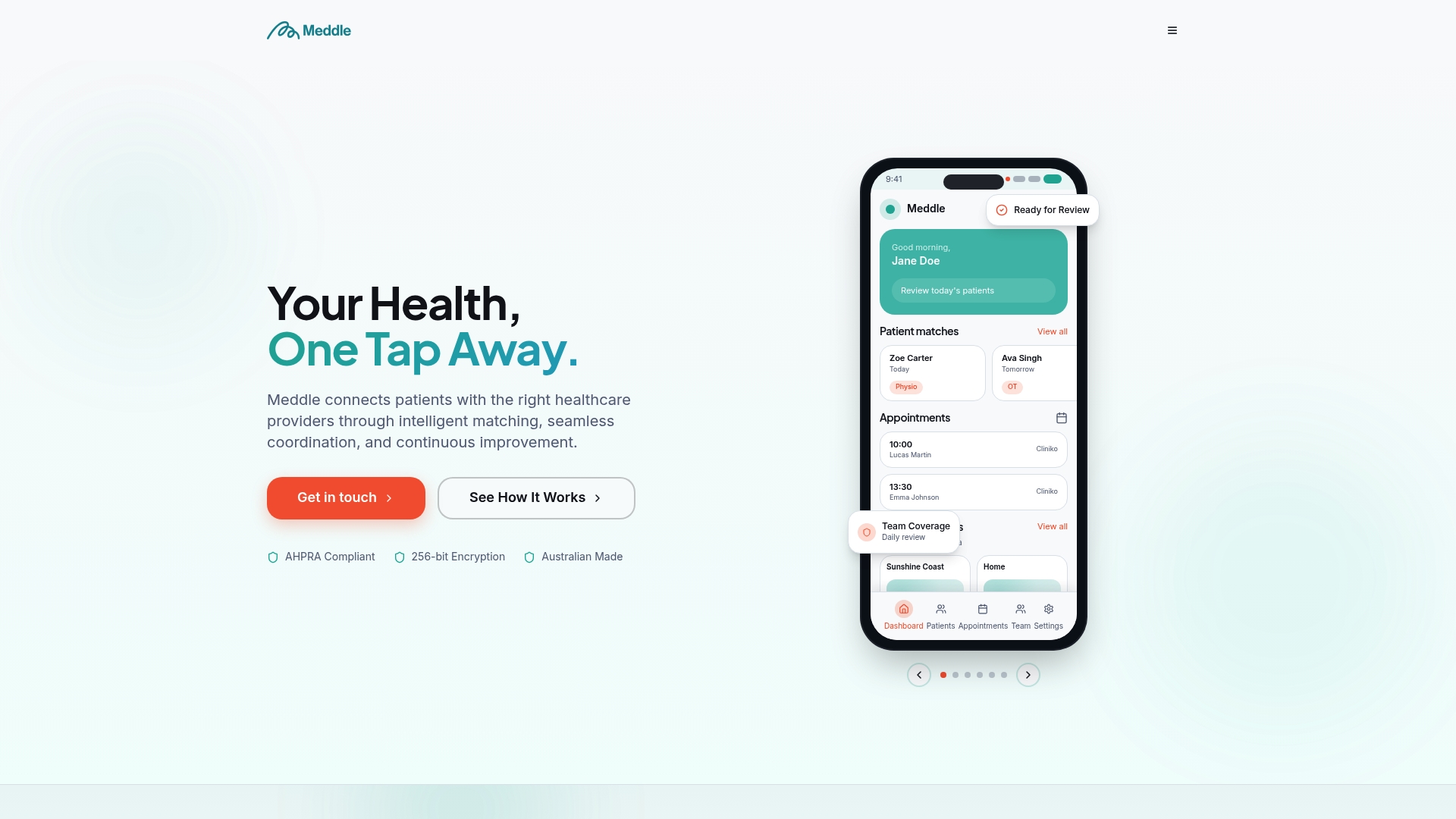
See how clinics can connect patients with the right care, or book a 30-minute demo below.
FAQ
How much notice should a clinic require to cancel an appointment?
Most allied-health policies use either 24 hours or two business days. For NDIS-funded supports, the short-notice definition in the pricing arrangements is less than 2 clear business days for most supports. Choose a period that gives you enough time to refill the slot, and state it in clear terms.
Can I charge a cancellation fee for a Medicare patient?
Yes, if you have told the patient about the fee beforehand. The Medicare rebate does not apply to the fee, so the patient pays it themselves, as clinics’ policies commonly state. Make sure the fee is reasonable and disclosed at booking.
What should I do when a patient arrives late?
Decide on one rule and apply it consistently. Common options are ending the session at the scheduled time, shortening it, rescheduling, or treating arrivals beyond a set number of minutes (such as 15) as a cancellation. Write the number of minutes in the policy.
Do I need a separate policy for NDIS participants?
You need NDIS-specific terms in the service agreement. Cancellation terms must be documented there, and a service booking must exist before supports are delivered. Many clinics keep one general policy and add an NDIS section.
Where should I publish the booking policy?
In several places: on your website, at registration with a tick box, in the booking confirmation, in reminders and in the waiting room. Repeating it is what makes it enforceable in practice, because patients have seen it before they need it.
Ready to see it in action?
If you want booking, intake and referrals handled in one place, book a 30-minute demo and we will walk you through how it works for your clinic.
Sources
- NDIS Pricing Arrangements and Price Limits 2025-26
- Managing service bookings, NDIS
- Medicare Benefits Schedule Allied Health Services
- Private Practice Privacy Guide, PACFA/AHPA
- Scheduling and Attendance Policy, EDUCARE Specialist Services
- Clinic Cancellation Policy, TSH
- For Clients, Allied Health Studio Collective
- Policies and Procedures, Beyond Speech
- Appointments, LaLaSpeech
- FAQ, Wellbe Counselling and Psychology
- Book an appointment, Western Specialist Centre
- Terms and Conditions, Osteopathy One
- Medicare rebates for psychology, Unbound Minds
- NDIS Service Agreement Cancellation Policy, Sprintlaw
- NDIS Service Delivery and Access Policy Template, ClinicComply
- The How and Why of a Cancellation Policy, Augmentum Consulting
- ACCC crackdown on NDIS providers, Mondaq
Recommended
- Clinic Cancellation Policy: 48/24/Same Day Templates & Metrics
- Clinics: Cut Missed Appointments up to 33.7% with SMS and Booking Fixes
- Booking page design that gets patients seen, not just clicked
- Booking conversion rate: how allied‑health clinics track and lift it
This article is general information for healthcare businesses and isn’t legal, clinical or privacy advice. Check current requirements with the relevant regulator or a qualified adviser.