How to Reduce Admin in Your Allied Health Clinic

You reduce clinic admin by finding the handful of repeat tasks that eat the most staff time, then removing the manual steps from them. In most allied health practices those tasks are referral intake, booking changes, reminders and chasing missing information. Fix those first, keep records secure as you go, and measure the result after a few weeks.
This guide is written for clinic owners and practice managers in Australia. It covers how to audit your admin, how to tighten intake and booking, what to check for privacy, and how to roll changes out so they stick.
TL;DR
- Start with an audit: list every admin task, who does it, how often, and how many times it gets redone.
- Intake, referrals, booking changes and reminders are the usual time sinks. Structured online intake and automated reminders remove much of the phone and email handling.
- Keep privacy in view while you automate: limit access, back up records and know which government registrations your billing needs.
- Change one workflow at a time, train the team, and review after a set period.
- Meddle is built to turn referrals and web enquiries into structured intake and practitioner matching. You can book a 30-minute demo to see it.
Table of Contents
- What counts as admin burden in a clinic
- Find out where the time actually goes
- Fix intake and referrals first
- Simplify booking, reminders and no-shows
- Keep privacy and compliance intact while you automate
- Our perspective
- How Meddle fits
- Roll out changes and measure the result
- FAQ
- Next step
- Sources
What counts as admin burden in a clinic
Admin burden is any non-clinical work that has to happen around a consultation but does not need a clinician’s judgement. The Department of Health describes administrative record keeping as covering the records that support practice operations, patient information, reporting, compliance and Medicare claims. That is a wide net, and it is why admin quietly grows as a clinic does.
For allied health, the common sources look like this:
- Referral handling. Referrals arrive by email, fax, web form, phone and GP software. Someone has to read each one, check what is missing, and decide which practitioner should see the person.
- Intake forms. Paper or PDF forms that are retyped into the client record.
- Scheduling. Phone calls to book, move and cancel, plus filling gaps left by late cancellations.
- Reminders and follow-up. Manual calls and texts, and chasing people who do not turn up.
- Claims and funding paperwork. Medicare, private health, NDIS and other funders each have their own steps.
- Compliance. Keeping records secure, limiting who can see them and keeping backups.
The pressure is well documented in general practice, which sits next to allied health in most referral pathways. The RACGP reported in September 2024 that 70% of GPs were concerned about their administrative workload, up from 60% the year before, pointing to complex Medicare rules and forms that do not connect with practice software. In October 2025 the RACGP also noted that 44% of GPs find authority script approvals waste consult time. Those figures are about GPs, not allied health, but they show the same pattern: paperwork that does not flow between systems costs clinical time.
There is a people cost too. A 2021 study across 10 countries, including Australia, found that 58% of Australian nurses and doctors reported feeling burned out, with nearly half naming clinical documentation as a significant factor. When your front desk and your clinicians carry that load, it shows up in turnover, errors and slower response to new patients.
Find out where the time actually goes
Do not start by buying software. Start by measuring. The Department of Health guidelines suggest clinics review their record-keeping processes with a checklist, seek staff feedback and use internal audits to find improvements. You can apply the same approach to the whole admin workload.
A simple one-week admin audit
- List the tasks. Ask reception, intake and each practitioner to write down every admin task they touch in a normal week.
- Record frequency and duration. For one week, note how often each task happens and roughly how long it takes.
- Mark the repeat work. Flag anything done twice: a referral retyped, a patient called three times to confirm details, a form returned incomplete.
- Ask the team. The people doing the work usually know which steps are pointless. Ask what they would remove first.
- Rank by hours. Sort the list by total weekly time. The top three items are your starting point.
A table keeps it honest:
| Task | Who does it | Times per week | Minutes each | Repeat work? |
|---|---|---|---|---|
| Read and triage new referrals | Intake | Your count | Your count | Missing details |
| Retype intake forms | Reception | Your count | Your count | Double entry |
| Book, move and cancel appointments | Reception | Your count | Your count | Phone tag |
| Call or text reminders | Reception | Your count | Your count | Manual follow-up |
Fill it with your own numbers. Industry averages are less useful than what is happening at your front desk.
Fix intake and referrals first
Intake is where admin starts and where delays hurt most. A referral that sits in an inbox for two days, or arrives without the funding type or contact details, creates a chain of follow-up calls before a single appointment is booked.
What tends to work:
- One front door per channel, one structure behind it. Whether a referral comes from a GP, an email or your website, capture the same fields: reason for referral, preferred location or travel radius, appointment type, funding source and contact details. Required fields on a web form stop incomplete submissions at the source.
- Triage rules written down. Decide in advance which referrals go to which practitioner, based on specialty, availability and location. When the rule is written, anyone on the team can apply it, and you rely less on one person’s memory.
- Acknowledge quickly. An automatic confirmation that a referral has arrived cuts the “did you get my referral?” calls.
- Close the loop with referrers. GPs and support coordinators want to know the referral was received and acted on. A clear status update saves them chasing you. If you take many referrals, our guide to eReferral systems in Australia explains where the gaps tend to sit.
This is the part of the workflow Meddle was built around. It turns referrals from GPs, email and web forms into structured intake, triage and practitioner matching on specialty, travel radius and appointment type, so fewer leads fall through and less time goes on sorting. If you are a referrer rather than a clinic, the referral page for GPs and support coordinators shows how the process looks from your side.
Simplify booking, reminders and no-shows
Phone-based booking is one of the most visible drains on a front desk. The RACGP’s guidance on digital tools says online booking lets patients book, reschedule or cancel outside business hours, and that SMS or email confirmations and reminders can help minimise non-attendance. It also notes that online booking reduces the time staff spend on phone calls.

That guidance is written for general practice, but the logic carries over to physiotherapy, psychology, occupational therapy and other allied health services, where the same calls and cancellations happen.
Practical steps
- Offer online booking for the appointment types that are simple to book. Keep complex or funding-dependent first visits for a short intake step, so the booking is right the first time.
- Make rescheduling as easy as booking. A link in the confirmation message means a patient can move a time without ringing you.
- Send reminders automatically. Use SMS or email, and include how to cancel or change the appointment.
- Plan for gaps. When someone cancels, a way to offer that slot quickly to people waiting recovers capacity that would otherwise go unused.
We have written more detail on each of these in our guides to SMS appointment reminders for Australian practices, reducing patient no-shows, instant appointment booking workflows and quick wins to increase online bookings.
Keep privacy and compliance intact while you automate
Less admin should never mean looser controls. The Department of Health guidelines say practices should keep records secure, limit access to appropriate staff and back up electronic records so they are protected from loss. Put those three on your checklist for any tool you consider.
Questions worth asking of any system that holds patient information:
- Who can see what? Can you set access by role, so reception sees scheduling details and clinicians see clinical notes?
- Is data encrypted, and where is it hosted? Ask the vendor to state this plainly. Meddle hosts patient data in Sydney.
- Can you back up and export records?
- What happens when a staff member leaves? You need a quick way to remove their access.
If you take part in My Health Record, the OAIC has assessed that registered healthcare provider organisations must have, communicate and enforce a written security and access policy. Our guides on My Health Record compliance, securing patient records under APP 11 and the Australian Privacy Principles in healthcare walk through the practical steps. If you share documents with referrers, the 90 day plan for secure document sharing is a useful structure.
Know your funding registrations
Some admin is not optional, and it helps to know exactly what it involves:
- Medicare. Practices must make sure their practice management software is approved by Services Australia to support Medicare Online claiming. Health professionals also need a PRODA account and must complete the Online Claiming Provider Agreement (HW027) through the same process.
- NDIS. Providers and their employees verify their identity with myID and link the business to the NDIS portal through the Relationship Authorisation Manager to access and manage participant data.
Set these up once, document who holds which access, and keep that record current. It prevents the scramble that follows a staff change.
Our perspective
Most clinics we speak with do not have an admin problem so much as a handover problem. A referral arrives in one place, the details live in another, and the person booking the appointment has to rebuild the story from scratch. Every handover is a chance for something to be lost or retyped.
That is why we built Meddle around the person, not the business listing. Directories show who is out there. We aim to connect the person to the care, and carry their story forward, so the details captured at intake follow them to the practitioner.
Our view is that intake, matching and booking belong in one workflow. When a referral is structured from the start, with specialty, travel radius and appointment type captured up front, a clinic can match it to the right practitioner without a chain of emails. That is how we think clinics lose fewer leads and spend less time on admin.
Start small. Pick the one workflow that costs you the most hours, fix it, and then move to the next. You do not need to change everything at once.
Taylor
How Meddle fits
Meddle is an Australian platform for allied health clinics that brings together structured intake, practitioner matching, instant appointment booking, messaging and a practice management dashboard. It is free for patients and referring doctors. Clinics subscribe, and pricing is AA$40 per practitioner per month ex GST, with a A$250 minimum and a free 30-day pilot, so you can test it against your own referral flow.
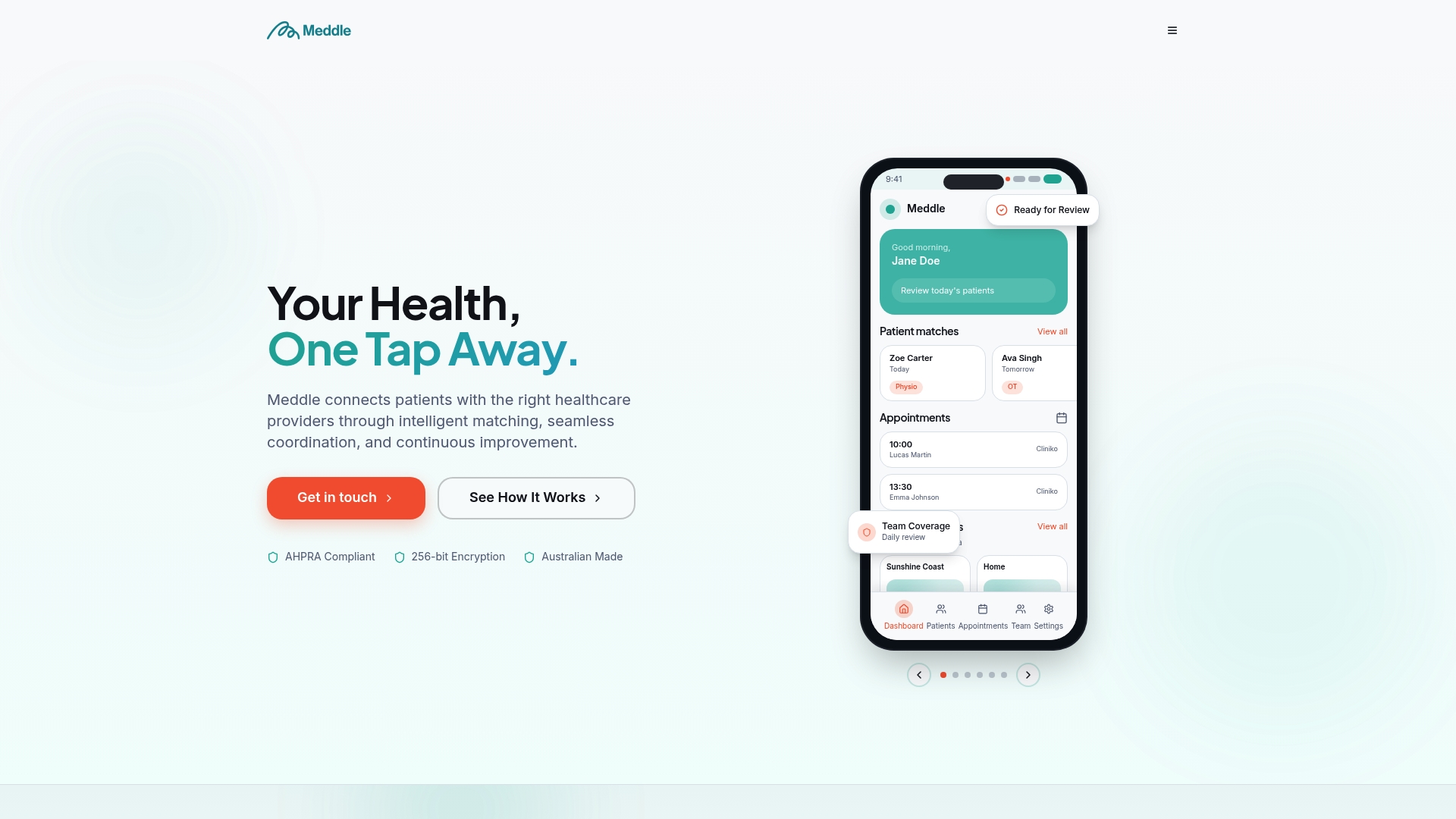
It suits multidisciplinary practices covering physiotherapy, occupational therapy, psychology, speech pathology, dietetics, exercise physiology and podiatry, as well as NDIS allied health providers. You can see how patients search and are matched on the Meddle find care page, or look at the practice management view to see what your team would work in.
Roll out changes and measure the result
A good plan is simple and has an owner. The Department of Health’s guidance is to plan processes, allocate resources, train staff, seek feedback and regularly review the process and audit findings. In practice:
- Pick one workflow. Usually intake or booking, whichever topped your audit.
- Name an owner. One person is responsible for the change, usually the practice manager.
- Set a baseline. Use your audit numbers: hours per week, time from referral to first appointment, number of incomplete referrals, number of no-shows.
- Train and document. A one-page process that says what happens at each step. Walk the team through it.
- Run it for a fixed period. Four to six weeks is enough to see whether the change holds.
- Review with the team. Re-measure against the baseline and ask what still feels clumsy.
- Move to the next workflow.
The RACGP’s Dr Rob Hosking has argued for ongoing collaboration with software vendors and government bodies so manual data entry is streamlined and new forms work with existing practice software. The same advice applies at clinic level: talk to your vendors about what connects to what before you commit, and ask for specifics rather than general assurances.
Measures worth tracking
- Admin hours per practitioner per week
- Time from referral received to first appointment offered
- Share of referrals needing follow-up for missing information
- Non-attendance and late cancellation counts
- Staff feedback on which tasks still feel repetitive
Track these before and after, using your own data. That is the only evidence that matters for your clinic.
FAQ
What is the quickest way to reduce admin in a small clinic?
Start with whichever task your audit shows is repeated most often, which is usually referral intake or phone booking. Moving booking online and sending automatic reminders removes a lot of calls without changing how clinicians work. Fix one workflow, measure it, then continue.
Which admin tasks suit automation, and which should stay human?
Tasks with fixed rules suit automation: confirmations, reminders, form capture and routing referrals by specialty and location. Anything needing judgement, such as clinical triage decisions, sensitive conversations or complex funding questions, should stay with your team. Automation should give them more time for those.
How do we keep patient information safe when we digitise intake?
Limit access by role, keep records secure, back up electronic records and ask every vendor where data is hosted and how access is controlled. These are the points in the Department of Health’s record-keeping guidelines. Our guide to APP 11 and patient records covers the steps in more detail.
How long does it take to see a difference?
You can often tell within four to six weeks whether a single workflow change is working, provided you recorded a baseline first. Compare admin hours, time to first appointment and non-attendance before and after. Larger changes across several workflows take longer, so stage them.
Can I try Meddle before committing?
Yes. Meddle offers a free 30-day pilot, and pricing is AA$40 per practitioner per month ex GST with a A$250 minimum. Book a demo and we will walk through how it handles your referrals and bookings.
Next step
If you want to see structured intake, matching and booking working together, book a 30-minute demo and bring your current referral process with you.
Sources
- Administrative record keeping guidelines for health professionals, Department of Health
- RACGP: GPs concerns about out of control admin workload
- RACGP: Unlocking GP productivity could transform patient care
- RACGP newsGP: Hundreds of forms every day
- RACGP: Digital tools in your practice
- OAIC: My Health Records security and access policy assessment
- Services Australia: Register for Medicare Online
- NDIS: my NDIS provider portal and resources
Recommended
- How to Reduce Inbound Calls at Your Allied Health Clinic
- Cut Cancellations 8–16%: Appointment Lead Time for Clinic Managers
- How to reduce clinic wait times: strategies that actually work
- Waitlist Prioritisation in Allied Health: A Clinic Guide
This article is general information for healthcare businesses and isn’t legal, clinical or privacy advice. Check current requirements with the relevant regulator or a qualified adviser.