

The clinic KPIs worth tracking are the few that tie directly to your goals: where new patients come from, how fast referrals become booked appointments, how full practitioner diaries are, and what clients say about their care. Most of that data starts at intake, which is why a clinic that structures its referrals can measure almost everything else with less effort. Meddle turns referrals from GPs, email and web forms into structured intake, triage and practitioner matching, so the numbers behind these KPIs are captured as the work happens.
TL;DR
- Pick a handful of indicators linked to your clinic’s strategy. Tracking everything leads to analysis paralysis.
- Combine non-financial measures (bookings, re-bookings, satisfaction, referral mix) with financial ones (revenue per room, gross margin, budget variance).
- Intake is where leads are lost, so referral-to-booking measures deserve a place on every dashboard.
- Set a baseline first, compare practitioners, then set targets with your accountant and local peers.
- Write the system before you measure it: a KPI only reflects how well the process behind it works.
Table of Contents
- What a clinic KPI is, and how to choose yours
- Two kinds of indicator: real-time and slower
- Referral and intake KPIs
- Access and capacity KPIs
- Client-experience and quality KPIs
- Financial KPIs
- Adjusting by discipline, size and funding
- Setting targets without losing care quality
- A simple monthly KPI review
- Where Meddle fits
- Try it in your clinic
- FAQ
- Sources
What a clinic KPI is, and how to choose yours
A key performance indicator (KPI) is a measurable number that shows whether the clinic is moving toward a goal. The Australian Physiotherapy Association (APA) advises that KPIs should link to the practice’s strategy and that you should avoid measuring indicators that have no impact on decisions.
A practical test for each candidate: if this number moved 10%, would we do something different? If not, drop it.
A peer-reviewed audiology tutorial adds that goals should be specific, measurable, actionable, realistic and time-bound, and notes that most practice KPIs centre on two variables: patient satisfaction and revenue. For a multidisciplinary clinic, that is a useful starting frame, then extended to access and referrals.

Two kinds of indicator: real-time and slower
Melissa Mitchell of the APA argues that non-financial indicators give the best real-time health-check, because they come straight from the software that tracks bookings. Financial indicators such as profit and budget variance are critical but arrive more slowly. The strongest owners combine both, plus benchmarking data.
| Type | Examples | How often you see it |
|---|---|---|
| Non-financial | Patient visit average, re-booked patients, satisfaction score, calls answered or diverted | Weekly |
| Financial | Profit, revenue per consulting room, budget variance, gross margin | Monthly or quarterly |
These examples come from the APA’s practice-of-business guide.
Referral and intake KPIs
For most allied-health clinics, referrals are the front door. If a referral sits in an inbox for two days, the patient may book elsewhere, and no financial report will show you that loss. These are the measures to put first:
- Referral-source mix. The APA’s Know your numbers guide suggests a target for new patients of 40% from referral partners, 40% from word of mouth and 20% from external marketing. Treat it as a starting point and adjust it to your own strategy.
- Referral-to-booking conversion. Of the referrals received, how many become a booked first appointment? We cover the method in our guide to booking conversion rate and the routines that lift it in the referral conversion playbook.
- Time from referral to first contact. Record the timestamp when a referral arrives and when the clinic first responds.
- Referral leakage. Referrals that arrive but never reach a booked appointment. Our piece on reducing referral leakage shows where these gaps usually sit.
- Reports per new patient. The percentage of new patients for whom a report goes back to the referring health professional, listed in the same APA guide.
- Visits to referrers and referrals sent onward. Both signal how active your referral network is. See our referral networks guide.
If you want to see how these measures can be built from intake data, our referral analytics playbook walks through it.
Access and capacity KPIs
Access measures show whether people can actually get care from you. The Audiology Australia professional practice guide sets access indicators at practice level: accurate written information on services and opening hours, appointment schedules that allow enough time for assessment and intervention, a policy for prioritising appointments, and information about other services when timely care cannot be offered. Those translate neatly into trackable numbers:
- Wait time to first appointment, by discipline and by appointment type.
- Triage turnaround, the time from referral received to priority assigned.
- Practitioner utilisation, booked hours against available hours.
- Cancellation and no-show rate, and how quickly the slot is refilled.
- Matching fit, the share of referrals placed with a practitioner whose specialty, location and appointment type suit the request.
Timeliness has more than one meaning. Grimmer and colleagues (2014) note it can refer to referral pathways, waiting time or the opportunity cost to the patient, so define yours before you measure it. Our triage and practitioner matching page shows how specialty, travel radius and appointment type drive the match, and the referral triage checklist helps your intake team standardise priority decisions.
Client-experience and quality KPIs
The same Grimmer framework, published in a peer-reviewed journal, proposes quality measures for allied-health therapy that include satisfaction with care delivery, timeliness, equity, value for money and engagement in care decisions. It treats quality as an episode-of-care matter, so measures should span what the service does, what happens to patients, how care is delivered and what happens next.
For a clinic, that means:
- Patient-reported experience measures (PREMs). The NSW Agency for Clinical Innovation’s rehabilitation audit tool expects routine PREM collection and a documented follow-up process for client and carer feedback.
- Willingness to refer others and perceived benefit from treatment, both named in the audiology KPI tutorial.
- Re-booking rate, a behavioural signal that sits beside the satisfaction score.
- Staff survey results. The same ACI tool suggests staff surveys ideally every one to two years.
More on retention routines is in our patient experience and retention guide.
Financial KPIs
The APA lists profit, revenue per consulting room, budget variance and gross margin among the financial indicators for a practice. They matter, but they lag. Read them alongside the weekly non-financial numbers, so a dip in referral conversion is spotted weeks before it shows up in margin.
Adjusting by discipline, size and funding
A solo podiatrist and a ten-practitioner multidisciplinary clinic need different dashboards. A few guides:
- Small clinics: three to five indicators, reviewed in a weekly team huddle.
- Multidisciplinary clinics: the same core set, split by discipline, so you can compare practitioners and services fairly.
- NDIS providers: keep the access and referral measures (response time, time to first appointment) and add the reporting your funding arrangements require. Check the requirements with the NDIS Quality and Safeguards Commission or your plan manager contact.
- Discipline-specific intake: referral patterns differ between physiotherapy, exercise physiology and speech pathology. See how intake is set up for physiotherapy, exercise physiology and speech pathology practices.
Setting targets without losing care quality
The APA’s advice is simple: track the indicator first to set a baseline, compare figures between practitioners, then set targets with an accountant’s help on expenses and wages, and by talking to local colleagues. Some safeguards for care quality:
- Pair every speed measure with a quality measure. Shorter triage times should not come at the cost of satisfaction or appropriate matching.
- Review trends over several weeks, not single days.
- Discuss results with practitioners as information about the system, not as a ranking of people.
Daniel Gibbs frames each metric as a reflection of how effective your systems are. The first job is therefore writing and implementing the system, whether a tracking sheet, a software report or a checklist, and only then measuring it. He also warns against trying to track every indicator at once. A good way to begin is choosing one measure and tracking it consistently, then adding the next once the first is routine.
A simple monthly KPI review
- Pull referrals received by source for the month.
- Calculate referral-to-booking conversion and median time to first contact.
- Check utilisation and wait time by discipline.
- Read the month’s PREM and satisfaction results.
- Compare with last month and with the baseline.
- Choose one action, assign an owner and a date.
One action a month, followed through, beats a dashboard no one acts on. Our practice analytics guide goes deeper on reporting.
Where Meddle fits
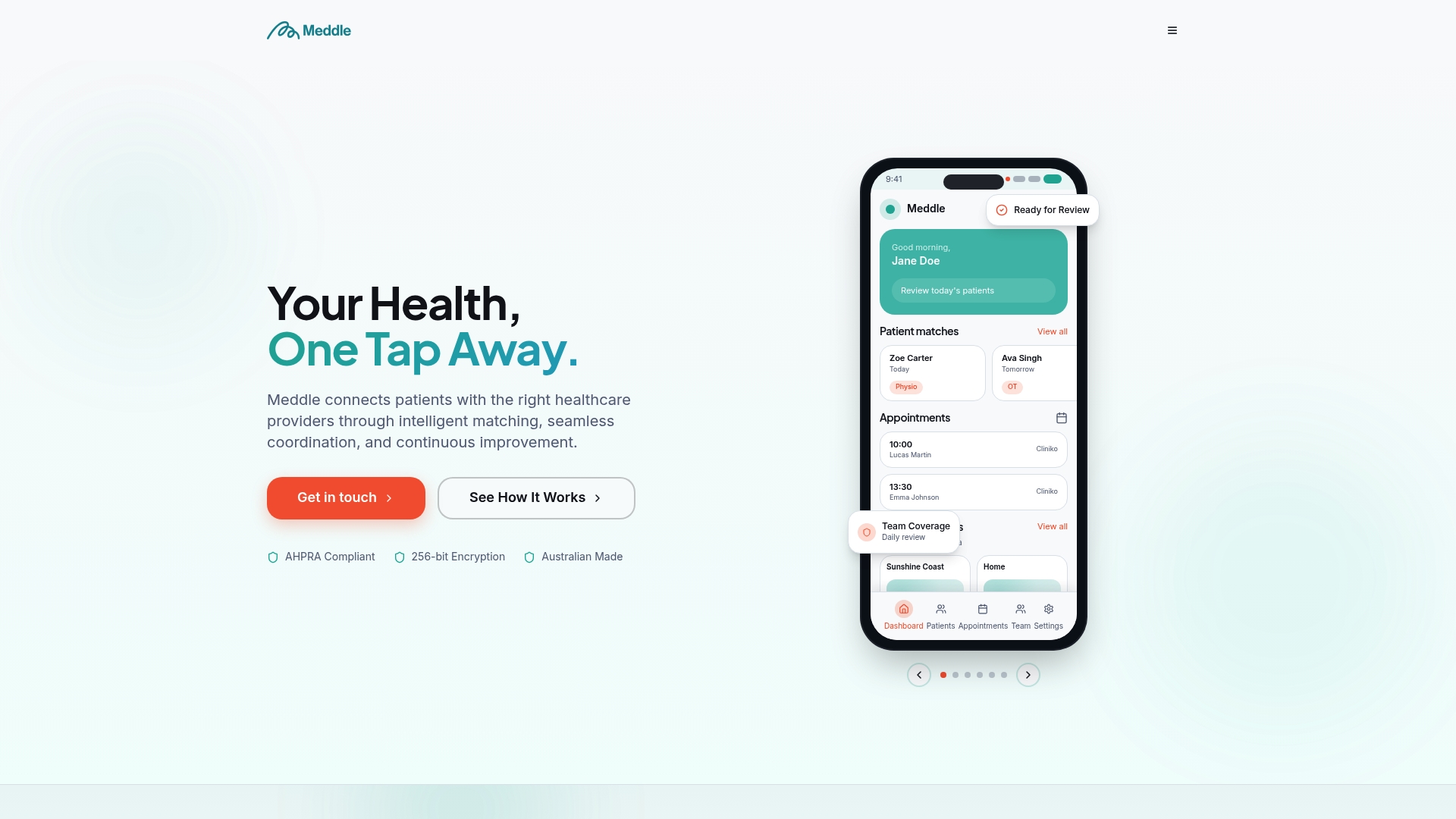
We built Meddle around a simple observation: most clinic KPIs begin with a referral. When referrals from GPs, email and web forms land in one structured intake, triage and matching flow, the numbers that matter (response time, conversion, fit between patient and practitioner) are recorded as the work is done, not rebuilt from inboxes at month end.
Directories list who is out there. Meddle connects the person to the care and carries the story forward, so clinics lose fewer leads and spend less time on admin. Pricing is simple: every user pays the same, including admins and coordinators, and everything is included.
Taylor
Try it in your clinic
Meddle is A$40 per user per month ex GST, or A$400 per user per year ex GST (2 months free). Every user pays the same, everything is included with no add-ons, and there is a free 30-day pilot. Patient data is hosted in Sydney. See the product overview for how a referral becomes a booked appointment.
Want to see your own intake and referral measures on one screen? Book a 30-minute demo at meddle.com.au/book-a-demo.
FAQ
How many KPIs should a clinic track?
Fewer than you think. The APA advises choosing a few clinic excellence indicators rather than tracking everything. Three to five that link to your strategy is a sound start for most clinics.
What is the most useful KPI for a new allied-health clinic?
Referral-to-booking conversion and referral-source mix are strong starting points, because they show whether demand is turning into appointments and where it comes from. Add a satisfaction score once those are stable.
How often should we review KPIs?
Review non-financial measures such as bookings and response times weekly or monthly, and financial measures monthly or quarterly. The ACI audit tool suggests staff surveys ideally every one to two years and service review at least every three to five years.
Do KPIs differ for NDIS providers?
The core access, referral and experience measures still apply. NDIS providers should add whatever reporting their funding arrangements require, and confirm those requirements with the relevant NDIS body.
Sources
- APA: The practice of business, how do you measure up?
- APA: Know your numbers
- Grimmer et al. (2014): An evidence-based framework to measure quality of allied health care
- NSW ACI: Rehabilitation service delivery audit tool
- Audiology Australia: Professional practice guide 2022
- Taylor: Using Key Performance Indicators to Do More with Less
- Start with one measure: client progress tracking for therapists
Recommended
- Practice analytics in Australia: a guide for allied-health clinics
- Appointment utilisation: how allied-health clinics measure and lift it
- Booking conversion rate: how allied-health clinics track and lift it
- Referral analytics for allied health: a practical playbook
This article is general information for healthcare businesses and isn’t legal, clinical or privacy advice. Check current requirements with the relevant regulator or a qualified adviser.